Tag Archives: Australian meat processing

Weipa

Other Names

Current Operation

  • Is currently operating as at 2012.1

Location   


Hema Maps – Australia Truckies atlas.

Owner

Operation   

History

Year

Sources

    1. ‘Northern Australian beef Industry – Assessment of risks and opportunities’ ABARE. 2012.

Charleville. #101. QLD

A goat processing facility that is currently operating located in central QLD. This facility exports all its production. Charleville had past problems of securing visa workers to ensure ability to continue production. Floods have affected operations and government costs. Currently goat values are very good with a significant increase in various export markets

Other Names

  • Western export abattoirs
  • Western Meat Exporters

Current Operation

  • Currently operating.
  • Aus-Meat accreditation #01014
  • 100% export3
  • Processing capacity of up to 15,000 animals per week.26
    • 3,000 head a day26

Location   

  • Charleville

Hema Maps – Australia Truckies atlas.

Owner

  • Western Exporters2
    • totally Australian owned3
    • Managing Director – Neil Duncan6

Operation   

  • Processes mainly Goats,1
    • is licencsed to process sheep but not currently doing so3
  • Minimum dressed weight 10kg, ferals dress out about 42% with skin off.1
  • Producers use goats to supplement income with beef and sheep1
  • The largest goat processor in Australia3
  • Established with the main purpose to produce Halal goat and sheep meat products for all export markets3
    • United states3
    • European union3
    • Asia3
    • Middle east3

History

1997

  • Before the Charleville abattoir was built the government were spending $16M a year to control goats27.
    • Goats were regarded as feral27
  • August. Facility rebuilt after devastating fire3
    • Facility had only been  six months old27
  • Major flooding occurs in the Charleville area20

1999

  • October. Charleville abattoir refuse to pay $12,929 accreditation fee for 1999/2000 to QLD Livestock and Meat Authority (QLDMLA)2
    • QLDMLA served notice it would suspend licence if not paid2
    • Cause closure of abattoir currently employing 94 people2
    • Fee is due for any abattoir operating in the state of QLD2
    • Fee structure had been lowered from $15,000 to $12,9292
  • Abattoir and QLDMLA long running dispute concerning payment of fees2.
    • Had paid QLDMLA last 3 years yet a representative had never been on premises or conducted an audit2
    • QLDMLA is not the regulating body for export2
    • Abattoir do not sell meat domestically2
    • QLDMLA say fee is to maintain integrity of States meat processing system2
      • set by legislation and payable by all red meat processors2
      • Equivalent entry level fees NSW $2,000, Victoria $1,6002
  • Abattoir already paid fees for AQIS Export accreditation $30,000 pa2
    • Also paid $1,200 per month Ausmeat inspection fees2
    • Further $1,200 per month for AQIS audits2

2004

  • Major flooding occurs in the Charleville area20

2005

  • Western Exports win by bidding tender for Broken Hill Exports company5
    • Broken Hill abattoir at Broken hill shut down by  AQIS in November 2005, failed to meet guidelines5
  • May. 22 employees at the Charleville abattoir are on 457 temporary visa program38

2006

  • April. AQIS close facility as notice issued in November 2005 wasn’t complied with to improve yards to meet animal welfare standards of export abattoirs6.
    • 140 laid off for 2 weeks while improvments are made6
    • Director, Neil Duncan claimed could have been negotiated and stoppage not occur6
  • May. Abattoir employs 15 Vietnamese skilled workers and wants to employ another 50 immediately7
    • Visa applications are not being processed and is a problem being faced by meat abattoirs around the nation7

“This is Australia-wide…the Government has put a hold on all applications for the meat industry and, you know, I see on TV the unions up and down saying they’re going to lose Australian jobs…. well where are they?” Neil Duncan, managing director7

“Send them out to Charleville….there’s work here for them straight away” Neil Duncan. Managing Director7

  • Immigration department say there is no hold on visa applications7
    • allegations some employers are abusing the program and the department is in discussion with the industry over the concerns7
    • department understands Australia is experiencing a significant skill shortage7
  • July. Charleville abattoir begins a $2M expansion8
    • Enable production up to 3,000 head in an 8 hour shift of skin-on goats8
    • create another 50 jobs and boost export income by $15M8
    • US consumes 70-80% of the product produced8
    • Taiwan is big for 6 months for their winter season8
  • August. Charleville abattoir wants to employ 20 employees from Vietnam with visas9.
    • Federal government blocks application as meatworkers do not qualify as skilled workers9
    • Charleville had struggled 15 years ago because of decline in wool, now the abattoir was an important employer9
    • Senator Ron Boswell says he will help the abattoir overcome the visa restrictions by meeting ministers of immigration and workplace relations to push to have visas approved.9

2007

Source RIRDC.New.Animal.Abattoirs.in.Australia.2007


  • October. Australian dollar currently at 90 cents US, Is not good for exports10

“Overseas in the US they are actually paying the highest rate they have ever paid for a kilo of goat meat, but when you revert it back through our exchange rate we’re actually receiving the lowest we’ve received in 12 months” Neil Duncan. Managing director10

  • November. Neil Duncan travelled to Vietnam on a recruitment drive for workers11
    • Once worker shortage is filled in Charleville, work can resume at the Broken hill meatworks11


2008

  • Major flooding occurs in the Charleville area20
  • March. Charleville closes down temporarily due to critical staff shortages12
    • 100 workers laid off for an indefintie period with full entitlements12
      • Authors note. Another article cites. 90 workers laid off25
      • Included 15 Vietnamese workers who entered Australia on 457 visas25.
    • Need at least 50 more staff12
      • Need at least another 60 staff to remain viable25
    • $2M worth of product is being thrown out a year that should be boxed and exported12
    • Applications for visa workers are being held up by Federal government12
      • Immigration department was rejected repeated applications for more meatworkers from Vietnam25
        • Abattoir failed to meat 457 rules requiring Australians to be trained for jobs held by the foreign workers during the 4 year span of their visas15
      • Charleville facility has been trying to get immigrant workers for over 2 and a half years25
    • People are going to the mines, city for better conditions, bigger money and better lifestyle13
    • There is a chronic shortage of both skilled and unskilled workers25
  • Current Proprietor of Western Exporters – Neil Duncan25
  • Minimum wage at the present time is $803.00 a week25
    • AMIEU believe closure is a tactic by Charleville abattoir to pressure Canberra to allow the abattoir to employ migrants on lower than minimum wage awards25
  • April. Federal government will not allow employees from overseas unless the abattoir signs an agreement to employ the same number of local workers14
  • Agforce  says will be a significant drop in income for goat producers if the abattoir remains closed15
  • November. Overseas workers been allowed under the 457 visa program16
    • Employment from 90 to over 150 people now16
    • 24,000 goats processed in the last 2 weeks16
    • Setting new records for its production16
    • Should have been doing these sort of numbers years ago to keep up with the goat industry16

2009

  • February. Abattoir faces charges under the Land Act and the Integrated Planning Act, Department of Natural resources alleged it was land clearing without a permit17
    • Issued compliance notice to restore 240 ha native vegetation17
    • Millions of goats had been held on the land while they awaited processing, Mulga trees had died due to grazing pressure and drought17
    • All the company did was remove dead timber17
    • Before the Charleville magistrates court17
    • If company has to revegetate will have to lay off 40 workers and cut production of number of goats being processed17
  • December. New production record set18

“We hit our record of 2,780 skin-on goats for an eight hour period but we should have been at these levels probably five years ago but we’ve struggled with labour” Neil Duncan Managing director18

2010

  • March. Major flooding occurs in Charleville area20
  • Abattoir closed due to flooding19
    • Roads leading in and out of Charleville all flooded21
      • Unable to export or import product21
    • 180 workers stood down21
    • no time frame in place for re-opening21
  • Abattoir is too expensive to keep operating19
    • Needs government assistance to reopen19
    • Pay AQIS whether working or not $8,000 or $10,000 per week19
    • $60,000 in electricity a month19
    • Running costs are basically $400,000 a week19
  • re-opening of abattoir crucial to regions economy22
    • Government, Prime Minister assured abattoir nothing get in the way of reopening and workers on visa’s don’t leave region and stay for the plant to re-open22
    • Regional economy is losing $1M a week while abattoir is closed22
    • throughput in the community is in the order of $5M a month from abattoir operations22
  • April. Abattoir re-opens23
    • Getting access to goats has been a problem but abattoir is in full operation23

2013

  • At this point in time Charleville abattoir is the largest goat meat processor in the world26
  • May. Charleville participates in a sponsored Meat and Livestock Australia food expo in Shanghai with 14 other mostly beef and lamb producers26
  • July. Since the Shanghai food expo Charleville have signed $3M worth of orders with more to come26
  • US and Taiwan were traditionally the biggest goat meat importers26
    • Flat US economy and loosening of import regulations to China has made China more attractive export proposition26
  • Currently processing 15,000 animals per week26
    • 3,000 head a day26
  • Largest line, skin on product, Europeans call ‘Smokie’26
  • Western Meat exporters is the only processor in Australia that doesn’t have a boning room26
    • bone is left in with the meat frozen and cut into cubes26.
      • Packed into 1kg bags26
    • Customers traditionally use their hands to eat – they want warm product and to hold the bone” Trade and Investment QLD spokesman Morgan Gronold26
  • Operational costs of Charleville abattoir are getting too expensive26.
    • would be willing to move his operations offshore26
    • We just can’t compete, and electricity prices are making things pretty tough” Neil Duncan Western Meat Exports managing director26.
  • Charleville abattoir has operating capacity of 200 employees but at the moment only has 17526.
    • employees are too difficult to source26
  • Western QLD suppliers are urged not to move to far to pure Boer goat genetics26
    • Boer goats tend to put too much fat cover26
      • Most goat is slow cooked where high fat content isn’t desired26


2014

  • Number of new chillers had been added to facility extension27
  • July. Currently operating at full capacity.24
  • 80% of the feral goat herd is coming from the Surat Basin area.24
  • Roma #2 – Proposed (QLD) not looking to compete against Charleville.24

Source. Goatmeat-Fast-Facts-2014_EMAIL

Source Goatmeat-Fast-Facts-2014_EMAIL

  • October. Two 40-foot containers back up to the 1300 carcase capacity fridges for a daily trip to Brisbane port27
    • Output is set to grow27
  • Charleville abattoir has a 100% export focus27
    • Current director at this time – Campbell McPhee27.
    • Since free trade talks with Korea, exports to that country had increase 140-fold27
  • New techniques to reduce hair contamination and modern equipment keep pace with the stringent health requirements demanded by overseas markets27
    • Sprays and vacuums are in use to achieve zero tolerance hair control27
    • Workers have colour coded hair nets to show what jobs and areas of the abattoir they are allowed27
      • separate eating rooms to prevent possible contamination between different parts of the plant27
  • Current livestock purchases of 16,000 goats per week27
    • 75% of supply comes from NSW27
    • Processing 3,000 head per day27
      • the kill line moving 6.5 goats every minute27
  • Currently employing 185 people and another 15 in the trucking company27
    • Western meat exporters use their own trucks to collect goats from properties and depots26

2015

  • January. Goat is worth $3.70 (12.1 to 16kg carcass weight)39.
  • There are approximately 6 million wild goats in Australia29.
    • Generally regarded as a pest, increasingly becoming regarded as a good alternative income29.
  • Australian exports of goat meat have doubled to 35,800t in 2014 since 200429.
    • Most is sold to the USA for Hispanic population29.
  • Live exports of goat have jumped from 50,500 head to 88,500 from 2004 to 201429.
  • Wild goats are purchased for $1.70/kg live weight29.
  • Live export goat price is $4.20/kg live weight29.
    • Average goat sells for $55 per head29.
  • August. Charleville (Game meat) abattoir that had closed in 2009 due to the collapse of the Russian kangaroo market proposes an upgrade to the facility to process 350 head a day of cattle35.
    • Employ 140 people35
    • Chinese investor $45M, who has become a partner in the business35
    • Expected to be in operation within a year35
  • October. Bourke Shire backs a proposal to build the abattoir29.
    • Expected to cost $61M. Bourke. Currently under construction. NSW
      • Aims to process 6,000 goats a day40
      • Employ 200 people 40
      • Abattoir should be up and running by mid 201740.
      • Developer Capra Pty Ltd40.
        • Capra is made up of partners with experience in both export and market processing operations and supply37
  • Another proposal to build a facility at Blayney NSW
    • Developer – Metziya40.
    • Would process 4,500 animals per day40
      • but it had received public opposition.
  • Bourke goat abattoir is expected to cost $60M to build30
    • Create 200 jobs30
    • World’s largest goat processing abattoir30
  • Currently 90% of the states (NSW) goats are transported interstate to be sold30
    • 95% of those transported are killed and processed in QLD, Victoria and South Australia30

Source. mla_goat-fast-facts-2015

Source. mla_goat-fast-facts-2015

  • Rangelands goats are currently the star performers of Australian red meat sector in 201531.
    • Farm-gate prices for goats have almost doubled in past 12 months to over $5 per kg31.
    • There has been a fundamental increase in demand relative to supply31.
      • In the past Australia has largely relied on one market the USA to take its product31.
      • Had been no other high volume markets to force price upwards pressures31.
    • Now there are new and emerging markets61.
      • Competing against the USA for goat meat product31.
      • Increasing markets to Taiwan, Vietnam, Indonesia, Korea, and China31.
    • Demand is likely to grow as trade tariff barriers are reduced with recently secured Free Trade Agreements31.
  • A number of southern Sheep processing plants are now processing goats in response to positive demand outlook31.
  • Supply pressure of goats has not been as constant this year due to increased demand31.
  • Goat populations  in the past have mostly been sourced by opportunistic harvesting of wild herds31.
    • MLA estimates there are around 4M head of goats in Australia at present31.
      • Only 500,000 are in managed herds31.
    • Challenge for industry is whether it can build a supply base to fulfil and sustain new levels of demand31.
  • Prices for goats have traditionally fluctuated31
    • To encourage sustainable development of the industry a five year strategy has been released31.
    • Goatmeat and Livestock Industry Strategic Plan 2020
  • Goats have a low cost of production that has some advantages over raising other stock31.
  • December. Bourke abattoir gets Federal government funding $10M32.
    • Grant will assist the facility to overcome challenges of isolation and lack of infrastructure at the remote site32.

2016.

  • January. Goat meat is worth $5 /kg (12.1 to 16kg carcass weight)39.
  • Charleville #101. QLD. Says its future will be jeopardised if the Bourke plant goes ahead33.
    • Goat supply in QLD, NSW and Victoria is too low to accommodate a new abattoir33.
    • Charleville #101 QLD processed 70% of the goats sourced from producers across the border in 201533.
      • Charleville processed 620,000 animals last year for export33.
    • If the Bourke plant is successful in being built it would threaten processing jobs at Charleville facility33.
    • Charleville never received a similar grant from the government and feel it is an unfair advantage to the Bourke site33.
  • Currently in NSW there are seven different abattoir processing goats33.
  • Authors note. The above reference was by the speaker of the article, it may include domestic facilities that are not on this blog.(03/12/2017)

Source Australian Abattoirs Locations – Australian goat processing abattoirs as per Aus-meat as at 02/10/2017

Above diagram. Bourke is indicated by the green pointer slightly above centre of picture. Charleville is located directly above Bourke to the far north. Abattoirs are marked as red for Export or blue for Domestic accreditations. No abattoirs specialise only in goat processing. Most are combinations of beef, sheep and goat. There are facilities in WA and one in Tasmania not shown on this diagram

  • Murweh Shire council Mayor, Dennis Cook speaks and writes to Federal government explaining his shire don’t want to see ‘a big lot of government money coming in and propping them up, because our business here is a wonderfully run business…”, Charleville #101 QLD Shire council explains is a privately run business34.
    • Charleville shire don’t want to interfere in what happens in NSW but they are concerned the Bourke facility will negatively impact on the employees at Charleville34.
  • February. Bourke Site Plans are developed and submitted for approval36
  • March. NSW Planning and Environment release a media statement for community views on the Bourke abattoir36.
    • Bourke abattoir will have capacity to process 6,000 goats, sheep or lambs per day for export36.
    • Submissions close 26/04/201636
  • Stock Supply. Bourke abattoir make an agreement with a goat depot located in Bourke to supply the facility (Pg 2)43.
    • Depot currently sends 200,000 outside of Bourke for sale or process(Pg 2)43
  • August. Proposal to revamp existing closed Kangaroo abattoir at Charleville Game meat. QLD 35
    • Facility will be refurbished to suit killing cattle35
    • Chinese Investor $45M35
  • December. Development consent for the Bourke abattoir has been approved37.
      • Now in the construction certificate phase37.
        • Project spokesperson JPA Business Managing Director – James Price37.
        • Slaughter level of 6,000 head per day will take some time to reach at an operational level37
          • When fully operational the facility will have the potential to almost double the value of goat exports from Australia37.
  • Bourke abattoir will be a useful outlet for producers who rely on meat exporters slaughtering in other states37.
    • Major priority  is to capture the goat meat demand in the international market37.

2017

  • January. Goat meat is worth $6/kg (12.1 to 16kg Carcass weight)39.
  • May. Currently employ 165 staff28
    • 52 of the 165 are undertaking the 457 temporary visa program38
    • Federal government had announced they would abolish the 457 program but have rectified the decision to not impact the meat industry38

Source ‘Vietnamese farmer moved to Charleville to  give his children a better education’ QLD Country Life 12/05/2017

  • June. Construction of the cement foundations begins39.
    • Plant is expected to be operational early 201839.
  • When in operation it is expected to boost Bourke regional economy by 30%39.
    • approximately $50M is expected to be injected into the Bourke local economy per year39.
  • Estimates of 5.8M goats in Western NSW39.
    • 50-60% of all of Australia’s feral goats located in NSW44.
    • Others dispute these figures39.
      • Bourke. Local producers ‘economics’ would play a major role to determine if they sent their stock to the facility39.
  • DPI is about to start a new goat count across NSW39
  • This week goat carcasses hit $7.50/kg, averaging $6.50/kg14.
    • January 2015, the monthly average was $3.70 (12.1 to 16kg carcass weight)14.
    • January 2016 $5/kg14.
    • January 2017 $6/kg14.
  • Australian Goat industry is currently in a rebuilding phase39.
    • Market potential in Europe39.
    • Goat meat was being included in new Brexit trade talks39..
  • it was a big challenge to get more western graziers to produce goats39
  • August. A new goat abattoir is proposed for the Goulburn Valley, Gillieston (Proposed) Vic.41.
    • Capacity of 3,000 head per day41.
    • Plant could be operational in about 18 months if approvals go through41.
  • November. 2,197 solar panels are installed on the roofs of the facility42
    • rising energy costs are a major threat to the profitability of the meat processing sector
    • Cost $1.4M42.
      • 756KW system, equivalent to power requirements of 252 homes42.
      • Panels are designed to operate independently in case one is covered by shadow or dust42.
      • Initiative was wholly privately funded42.
        • Australian Renewable Energy agency didn’t provide assistance as they were more interested in new and emerging technology42.
      • Costs of the installation expected to be re-couped within 5 years42..
      • cost of panels was actually less than the plants annual electricity bill42
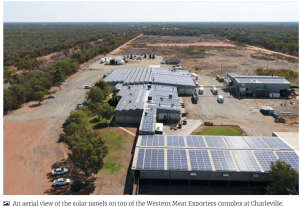
Source ‘Charleville’s solar innovator’ QLD Country Life 23.11.2017

  • December. NSW Department of primary Industries conduct a rangeland population survey of goats46.
    • Show goat herd has declined from 5.7M in 2016 to 3.4M in 201746
    • Aerial survey was conducted of central and western NSW46
    • Lower numbers could be due to 46
      • Dry seasonal conditions46
        • Poor reproductive rates of livestock and goats46
      • Efficient goat harvesting operations in the area46

Sources

  1. ‘Goats prove Winton winners’ QLD Country life 13.06.2013
  2. ‘Closure looms for Charleville abattoir’ QLD Country life 13.10.1999
  3. http://www.westernexporters.com.au – Accessed 07.03.2014
  4. aus meat accreditation as at 01.01.2014
  5. ‘QLD company set to become leading goat exporter’ ABC News 16.12.2005
  6. ‘Goat abattoir lays of 140 in quarantine dispute’ ABC news. 04.04.2006
  7. ‘Immigration delay hampers goat meat abattoir expansion’ ABC news. 29.05.2006
  8. ‘Expansion of Aust largest goat abattoir gets under way’ ABC News. 31.07.2006
  9. ‘Boswell vows to help meatworks secure visas’ ABC news 14.08.2006
  10. ‘Strong dollar hurting goat meat exports’ ABC News 16.10.2007
  11. ‘Meatworks owner hopes new government frees up foreign worker recruitment’ ABC news 27.11.2007
  12. ‘Goat meat exporter to shut Charleville abattoir’ ABC News 20.03.2008
  13. ‘Goat abattoir closes outback QLD plant’ ABC News 26.03.2008
  14. ‘Govet unmoved on abattoir worker conditions’ ABC News 03.04.2008
  15. ‘Abattoir closure ‘will hurt goat producers’ ABC News 03.04.2008
  16. ‘Goat abattoir breaks production records’ ABC News 04.11.2008
  17. ‘Goat abattoir owners face land clearing charges’ ABC News 10.02.2009
  18. ‘Goat production hits high’ ABC News 10.12.2009
  19. ‘Goat abattoir too expensive to run’ ABC News 09.03.2010
  20. ‘Flood-drunk Charleville’ http://www.ben-global.com
  21. ‘Floods close abattoir’ The Chronicle 10.03.2010
  22. ‘Meatworks re-opening crucial’ ABC News 17.03.2010
  23. ‘Goat abattoir re-opens after flood woes’ ABC News 09.04.2010
  24. ‘Roma ramps up abattoir study’ QLD Country Life 31.07.2014
  25. ‘Lack of migrant staff forces Charleville abattoir to shut’ The Australian 22/03/2008
  26. ‘Charleville’s China forey’ QLD Country Life 01/07/2013
  27. ‘Charleville goats full bore’ QLD Country Life 21/10/2014
  28. ‘Developers say $38M Blayney goat abattoir will provide …..’ Central Western Daily 07/05/2015
  29. ‘Growth in goat farming in Bourke for halal butchers and restaurants’ www.smh.com.au 08/06/2015
  30. ‘Bourke goat abattoir could be a “game-changer”, says MP’ ABC News 22/10/2015
  31. ‘What is behind the rise and rise of goat prices? Beef Central 29/10/2015
  32. ‘Bourke goat abattoir gets Federal government funding’ ABC rural 08/12/2015
  33. ‘QLD goat processor says jobs will go if government-backed Bourke abattoir is built’ ABC news 05/01/2016
  34. ‘Cross border goat abattoir competition’ Charleville Plus More. 14/01/2016
  35. ‘Charleville set to get abattoir in 2017’ Sunshine daily 02/08/2016
  36. Proposed Small Stock Abattoir. Capra Developments Feb 2016
  37. ‘Bourke abattoir gets OK’ The Land 07/12/2016
  38. ‘Vietnamese farmer moved to Charleville to  give his children a better education’ QLD Country Life 12/05/2017
  39. ‘Bourke abattoir on way’ The Land 08/06/2017
  40. ‘Two new goat abattoirs planned in Bourke and Blayney’ The Land 09/07/2016
  41. ‘Abattoir in the works’ Country News 09/08/2017
  42. ‘Charleville’s solar Innovator’ QLD Country Life 23/11/2017
  43. Bourke. Small stock abattoir. Environmental Impact Statement March 2016
  44. http://www.markcoulton.com.au. media release 27/07/2017
  45. RIRDC.New.Animal.Abattoirs.in.Australia.2007
  46. ‘Latest goat industry data’ NSW DPI 13/12/2017

Victorian Meat processing facilities

Listings of abattoirs as at 02/03/2014
Aus-meat Accreditation List – Latest Version www.ausmeat.com.au

AUS-MEAT list 28.02.14.

Lists Victoria as having 9 Boning Rooms, 18 Export licensed abattoirs and 6 Domestic abattoirs

Prime Safe Facilities – Latest Version www.primesafe.vic.gov.au

PrimeSafe_Licence_02.03.2014

39 Primesafe licenced facilities.

In 1988 report  Meat_88_01 facilities listed in Victoria in 1987.

Chart - facilities _edited-1Chart – Victorian meat processing facilities in 1987 compared to 2014.

Mt Bundey

Other Names

  • Deepwater meatworks (Pg 143)1
  • Mt Bundey Deepwater (Pg 189)

Current Operation

Location   


Hema Maps – Australia Truckies atlas.

Owner

  • Mt Bundey & Darwin meat supply 75% – Alben Perrett ( Father -in -law of Bill Ross)1
    • Jim McGhie,1
    • Jim Richards ( brother in law of Bill Ross)1
    • Bill Ross1

Operation   

History

1960

  • Decision made to build an abattoir at Mt Bundey(Pg 141)1
    • Roy Angrove – Darwin meat supply1
    • Bill Ross – Mt Bundey1
    • Design was for 20 head per day1
    • Ammonia pipe and refrigeration equipment used from Bullocky Point (NT)
    • rail line from various rail yards1
    • Ore loader bins from the Adelaide River Uranium mine1

1961

  • Plant in opertion, processes 20 head per day.(Pg 141)1
    • lots of operational problems1
    • Jim McGhie – controlled shooting and catching of Buffalo/Bulls1
    • Johnny Richards drove refrigeration truck1
    • Roy Angrove managed abattoir and did the marketing1
    • Bill Ross managed Mt Bundey and cattle1
    • Kevin Larkin – operated butcher shop in Darwin to sell goods1

1962

  • Abattoir up to export standard(Pg 142)1
    • Was thought the export rating would be very beneficial but meat exporters objected to Buffalo meat being exported on the same terms as Beef1
    • Was a large demand for Buffalo1
    • Loss of markets for Buffalo meat, mainly Japan as Buffalo had to be sold under different paperwork requirements.1
    • Mt Bundey had to pay 400 pounds to have a trial shipment in Japan already there destroyed of Buffalo meat.1
    • Hong Kong were a strong market for Buffalo1
    • Other countries were interested but shipping and trans shipping made export unprofitable
  • Buffalo had originally been shot before transport to abattoir for slaughter, attempted to use tranquiliser guns but Buffalo drowned in their own fluids as they were usually full of water and went into their lungs.(Pg 142)1
  • Used drugs Nicotines, Scholine and Anectine in tranquiliser to lower losses but didn’t improve greatly (Pg 142)1

1965

  • Temporarily closed due to personal moving to other areas and1
  • Mt Bundey abattoir was unable to keep up supply to the shop, Sid Parker was able to source other goods for it to sell (Pg 143)1
  • Reopening abattoir was difficult due to poor communications – using telegrams1
    • Team assembled butchers, boners, mechanics, engine drivers1
    • two teams of catching contractors1
    • Commonwealth meat inspector resided at abattoir – was of great assistance in getting abattoir operating again1
    • Processing meat that was shot and live caught – processing 50 head a day1
  • Buffalo and scrub bulls processed, meat packed seperately and beef mainly went to SA(Pg 144)1
    • Had permit to remove Buffalo from Kakadu national park (pg 144)1
  • Interest was shown in people wishing to buy property or butchers shop but not together (pg 144)1
  • Darwin meat Supply (butcher shop) and Mt Bundey was 25% owned by McGhie, Richards and Ross families, Perrett family owned rest.
    • others brought out Perrett family.1
    • Enterprises were to be sold at first opportunity1

1967

  • American Company showed in purchasing Mt Bundey and shop as going concern (Pg 144)1
  • February . American company paid 5% non-returnable deposit, 3 month option to purchase.1
  • April. Amercian company paid out another 5%  with 3 month option to purchase.(Pg 144)1
  • July. Mt Bundey and Darwin meat supply sold to Americans (Pg 145)1
    • Bill Ross stayed on as manager until the end of the year1
    • consultants then would take over running and operation of property.(Pg 145)1

1968

  • Laurie Howard starting catching buffalo for abattoir (Pg 189)


Sources

  1. ‘The Privileged few’ Jeff Hill. 2008

Cygnet

Other Names

  • Cradoc Hill
  • Cradoc Blue Hill abattoir

Current Operation

  • Currently operating at time of writing 03.01.2014

Location   

  • Cradoc Hill is located approximately 10km north west of Cygnet. Cygnet is located approximately 70km by road south west of Hobart in southern Tasmania

Australia. Cygnet

CygnetHema Maps – Australia Truckies atlas.

Owner

  • Dave, Rita Stephens and Michael Munnings8
  • James Lord (2011)1

Operation   

  • Cygnet is only major abattoir south of Cressy abattoir (Tas) in the northern Midlands.4
  • A small service kill abattoir for the use of local producers who may only have one or low number of animals to process.3
  • Some product is now commercially being sold to retailers under brand names7
  • Producers may retain ownership of product and use for their own purposes or value add and further sell to retail.7
  • Process large animals cattle7
  • Process small animals calves, sheep, lambs, deer, rabbits, poultry and pigs.2

History

2009

  • Cygnet is featured in the ‘Gourmet Farmer’ SBS series with local producer Mathew Evans3
  • In reference to Cygnet abattoir and  taking two of his pigs to be slaughtered there3

” ..is run by people who want to help smallholders. Who understand you may only have one sheep, one pig to kill at at time. They make it easier for people who want to rear their own meat, to get it killed legally and affordably. If there’s one thing I’m happy about with the death of my pigs, it’s that the abattoir at Cradoc hill will do the right thing by them” Mathew Evans3

2011

  • June. Dave and Rita Stephens had operated the abattoir for a number of years and wished to retire.1
    • Possible a consortium of interested parties may pool resources to buy the freehold and operate the business1
  • Loss of this abattoir to the community would have been a severe blow to the local producers small and large.2
    • Important to know the animals are free-range and killed humanely with many producers following their animal through process of delivery to final product of meat cuts.2
    • some producers larger animals sheep and cattle while others have pigs, goats, rabbits.2
    • Some are niche market meats and by-products2
    • Economies of the dairy and fleece buisinesses would be marginal or impossible without access to an abattoir, local market for vealers and wethers2
    • Producers would be forced to send stock to northern processing works – some over 4 hours drive from Cygnet3
    • Products also sourced for bone, pig ears for pets, blood and bone for gardens, organs for university and forensic research2
  • July. Abattoir closes for two weeks when new buyer moves in.2
  • James Lord purchases Cygnet facility2

2013

  • Development of two meat brand logos7
    • Blue Logos – Cradoc Hill meat – targets premium interstate markets7

logo _edited-1Source – Cradoc Hill website – Logo used to promote products to Interstate markets.

meat selections _edited-1Source – Cradoc Hill website – Example of meat cuts offered in a box sale being offered direct to door of customers through website sales.

meat selections _edited-2Source – Cradoc Hill website – Example of meat cuts offered in a box sale

    • Green Logo- Huon Valley meats – targets the Hobart market and surrounds.7

Huon valley logo _edited-1Source – Huon Valley Meats website – Logo used to promote products local markets.

“We source our produce from farmers we know and trust, We are particular in who we work with, seeking out growers who genuinely enjoy raising their stock and who take pride in growing the highest quality produce” James Lord

  • Cygnet now processing 20-30 cattle, 100 lambs and 20-30 pigs a week.7
    • employs 8 people, 4 permanent and 4 casual7

Sources

  1. http://www.theviewfrommyporch.blogspot.com.au
  2. ‘Save Cradoc Hill Abattoir’ Tasmanian Times 14.06.2011
  3. ‘Killing the pigs’ Gourmet Farmer. SBS. 18.12.2009
  4. ‘James meats his destiny’ The Mercury. 29.07.2011
  5. Huon Valley Meats website
  6. Cradoc Hill website
  7. ‘Huon meat goes for fine dining’ The Mercury. 20.12.2013
  8. http://www.buffaloaustralia.org

Cooee

Cooee was a very small service kill abattoir located Tasmania, fire caused its closure in 2012 affecting many small producers who would follow the complete process of their animals treatment through to packing.

Other Names

  • Cooee Point

Current Operation

  • Closed – fire burnt processing and packing facility in 20121

Location   

  • Cooee is on the western end of the north coast of Tasmania.1

Australia. Cooee

CooeeHema Maps – Australia Truckies atlas.

Owner

  • Wendy Gee1

Operation   

  • A small service kill and processing, packing facility for local producers1
  • Processed pigs, lambs and cattle1
  • Employed 6 people1

History

1992

  • facility had been in operation before this time1

2012

  • January. Extensive fire damage to facility occured.1
  • 90% of the commercial cattle in the area were processed at Devonport abattoir (Tas) but Cooee had a solid local following1
    • facility is used by smaller producers to kill, butcher and pack their meat.2
    • Producers were able to watch the animal processed right throughout2
  • Fire thought to be suspicious1
  • June. Wendy Gee will offer services at a butchery in Terrylands, Animals are killed at Devonport abattoir (Tas) approximately 50km away, then transferred to Terrylands for processing.3

Sources

  1. ‘Fire razes North-west abattoir’ The Examiner 22.01.2012
  2. ‘Cooee abattoir fire forces producers to assess their options’ ABC Country Hour. 23.01.2012
  3. ‘Abattoir owner back in business’ The Advocate. 17.06.2012

Devonport

Devonport abattoir, located in Tasmania and owned by JBS, a multi species abattoir with a checkered past.

Other Names

  • North West Rendering8
  • Devonport City abattoir.

Current Operation

  • Aus Meat Accreditation registration dated 29/12/2015 #13T – JBS Australia Pty Ltd (Devonport).18
    • registered as a Beef, Sheep and Pig, Domestic facility.16
  • Direct employment enquiries to www.jbssa.com.au

Location   

  • Devonport is located approximately midway on the Northern coast of Tasmania

Australia. Devonport

DevonportHema Maps – Australia Truckies atlas.

Owner

Operation 

  • Multi species abattoir located ajacent to Devonport saleyards1

    • Processes beef, sheep and pork1
    • Capacity 150 beef daily and 1,200 Smallstock daily (Lamb, mutton, Veal and Pork)1
  • Employs 150 people1

History

1977

  • Devonport rendering plant had been in operation6
    • Note – some conflict of when abattoir operations began, not sure if 1977 was a previous owner prior to Devonport City abattoir acquisition.

1980

  • Meatworks operation began9

1995

  • August. Employee Ian Sutton sacked by abattoir for mistreatment of sheep, Industrial relations hearing of Ian Sutton was supported by AMIEU for unfair dismissal – court dismissed and sacking held.10

1997

  • Expanded rendering works.5

2000

  • October. Quoiba Progress Association Ltd v North West Rendering Pty Ltd. – Resource Management and Planning appeal tribunal found that the rendering works had caused material harm in breach of section 52 of the Environmental Management and Pollution Control Act.5
    • Facility was to cease operating unless after 12 months it could reduce emissions of odour by 2 odour units.5
    • NWR given 18 months to fix odour problems7

2001

  • Rendering works was the only facility in Tasmania taking external meat waste from around the state to5

2002

  • March. Contested hearing conducted – regarding Rendering works – to consider if had complied with tribunal orders5
    • residents still experiencing odour problems7
    • Works operators and Director of Environmental management submitted to hearing that rendering works had “substantially complied”5
    • Quoiba Progress association disputed claim.5
    • Tribunal found rendering works hadn’t complied – effectively ruling that after 27 April 2002 operation of the rendering works at the current premises in Quoiba was unlawful5
    • Given 12 months to relocate7
    • NWR commenced supreme court action challenging original decision5
      • Judge ruled testing regime for acceptable odour emissions as set out in original orders was too unclear7
      • Matter set back to original tribunal panel to decide if any fresh orders should be made.7
  • June. Smithton abattoir (Tas) retrenches 21 workers.11
    • Blue Ribbon (owners of Smithton) insolvent and collapse.12
  • Devonport says it is doing well but calls for inquiry into the state meat industry11
  • September. Agreement reached for new site for rendering plant8
    • Previous negotiations had considered operating hours and ungrades.8
      • Planning & Appeals tribunal decreed odour still unacceptable.8
    • NRW have agreed with Websters to purchase 65ac near Parramatta creek.8
    • Cost of $3M8

2003

  • August. Installed $125,000 bio-oxygen odour control generator at the rendering plant6
    • Local residents had complained of smells since 19776
  • Abattoir had considered relocated but was unable to find suitable land in the last 12 months6
  • Would have to sack 200 people if business was closed6
  • September. Resource Management and Planning Tribunal would rule on decision to allow plant to operate or close it down6

2004

  • Devonport City abattoir had owned Wignalls – sold to Tasma smallgoods in Hobart.
    • focus on contract killings at Devonport (Quoiba) site

2005

  • July.Tasman Group purchase Devonport facilities.9
  • Resource Management and Planning tribunal hearing7
    • North West Rendering Pty Ltd (NWR) confirmed that the rendering plant and land had been sold and the company was no longer involved with the operation of the plant – to Tasman Group Services (JBS)7
    • NWR changed name to Brown and Grey No2 Pty Ltd.5
    • Quoiba progress Association to work with new owners to address odour problems.7
    • Tribunal was unable to make any orders in relation to ongoing plant operations7

2006

  • Tasman Group Chairman – Giuseppe Catalfamo brided Cole’s head of supermarket merchadising Peter Scott (Coles fired Scott in 2007).13
    • Scott had acquired million dollar bayside apartment from Catalfamo13
    • Considered a breach of retailers code of conduct – Tasman group main supplier of beef in Victoria and Tasmania13
    • Catalfamo been caught bribing and meat substitution in past – horse-meat substitution scandel that threatened Australia’s export industry 20 years ago, fined and banned from exporting to the USA for 10 years.13
  • Devonport abattoir provides Woolworths with fresh sausages for 29 Tasmanian stores13
  • Tasman Group – report ending 200513
    • sales had increased 30% but profit halved to $6.3M13
    • Company borrowings total nearly $62M13
      • Main creditors – National Australia Bank, ANZ and Japanese meat company Hannan Corporation13

2008

  • JBS purchased as part of Tasman group when entered Australia with acquitsition of AMH3
  • Tasman Group consists of abattoirs in Tasmania – Longford, Devonport and King Island14
    • Tasman group 3 abattoirs in Tasmania including King Island and 3 in Victoria.14
    • JBS paid $US150M14
  • JBS also purchased Smithfield Group $US565M14
    • Has four abattoirs14
  • JB also purchase National Beef $US560M14
    • Has three abattoirs14
    • 2 meat processing facilities14

2011

  • JBS elect to combine it’s US and Australian beef processing results into a common finanical report presented at ‘US beef’.22
  • Impossible to distinguish Australia’s performance and contribution to the overall result.22

2012

  • JBS Australia split into two operating entities to make Northern and Southern regions in relation to abattoirs and feedlots within those areas15.
    • South – Victoria, South Australia and Tasmania15
    • North – NSW and QLD.15

2013

  • Closure of King Island abattoir (Tas) assisted the supply of cattle to Longford.
  • JBS “Company is still pleased with its decision to close (King Island)” John Berry. JBS director2
    • Islands King Island and Flinders supply 200-450 head cattle a week, higher in spring run.3
    • Longford process 450 cattle a day – 4 day week roster.3
  • King Island cattle supply receives freight subsidy – sliding scale – $26 into Stanley in proximity to Smithton abattoir (Tas), $30 into Devonport4.Where cattle can be sent to Devonport or Longford abattoir (Tas)
    • Scale acts as disincentive to increase freight efficency.4
  • September. JBS launch brand launch.20

Beef central 27.09.2013 logo

Great Southern Logo. Source Beef Central 27.09.2013

  • Great Southern grassfed beef and lamb.20
    • Products first of their type in Australia.20
    • third party audited program JAS/ANZ ISO.20
    • 65 accredited farm quality assurance programs backing the brand.20
    • huge demand in domestic and global customers for traceable fresh grassfed meat.20
      • supplied by best practice producers with better livestock genetics.20
      • MSA graded for eating quality.20
      • Farmers would receive premium prices.20
        • 10c/kg premium applied to grid for UK.20
        • 650 farmers through NSW, Vic & Tasmania accredited to supply the program.20
        • Audit costs (for farmers) are paid by JBS.20
          • Audits conducted by AsureQuality.20
        • Animals are consigned driect to JBS.20
        • forward pricing.20
        • Animals consigned through saleyards would not be eligible.20
  • “Today the margins are so tight that if you want a point of difference and that premium or no discount, you have got to be involved with quality assurance” Jeremy Upton, Producer.20
  • November. JBS Swift Australia install closed-circuit television camera’s (CCTV) in it’s Australian meatworks.21
    • For the purpose of animal welfare and meatworker safety issues.21
    • CCTV for internal use by only JBS, with no plans to allow outsiders to view the footage.21
  • JBS’s US beef division (which includes Australia) delivered drop in net sales and earnings in it’s third quarter financial results.22
    • Australia’s division performance and overall contribution to the overall result is impossible to distinguish due to inclusion with US and Canadian beef processing results.22
    • Earnings before tax $134M,.22
      • Down by 22.5% on previous quarter.22
      • Down by 28.4% on third quarter last year.22
    • result reflection of domestic North American markets.22
      • Improved performance had occured in Australian.22
        • Demand had increased in Chinese markets.22

2014

  • April. Devonport currently employ 150 people.19
  • July. JBS Australia across all facilities in operation kills daily.15
    • 8,500 cattle,15
    • 24,000 smalls – which includes lambs15
    • Employs more than 8,000 people15
  • December.
    • JBS currently operate 12 meat processing plants across 5 Australian states16
      • Wages & local procurement $730M (Excluding livestock purchases)16
      • Employs 8,500 people at the facilities16
        • Employs 12,000 people in Australia16
      • Total revenue of $6.5B16

    JBS plants 2014_edited-1

    JBS processing plants in Australia

    Source JBS submission #50 Market Consolidation.

    • JBS estimates its current share of four eastern states beef kill – 20% (excludes service kill)16
      • JBS share of Australian beef production 16%16
      • Market share of national small (lamb, mutton & goat) 16%
    • JBS spent $2.4M on halal certification costs of approved religious certifiers in 201416

    2015

    • June. Cost of processing in Australia 1.5-3 times the cost of processing animals in another country16
    • cost of processing grain-fed cattle in Australia is twice of the USA16
      • lower levels of productivity in Australia in regards to kg per unit of labour16
      • 2 major differences between Australia and the USA8
        1. Government regulation
          • $10 a head more in Australia16
          • Dept. of Australian Agriculture fully recover costs of meat export inspection and certification16
            • Australia wide DAFF costs $80M16
            • JBS contribute $14.5M16
          • Export plants don’t use DAFF but use approved employees, which plants fully cover costs16
            • JBS estimate an additional $30M at Export level16
          • USA & Brazil governments provide services at no or minimal costs to processors16
        2. Energy Costs
          • $15 a head more in Australia16
      • Technical barriers to trade (TBT’s)- Total value in Australia estimated at $1.25B as identified costs16
        • 261 TBT’s in 40 key markets16
          • 136 have significant trade distortion impacts16
  • December. ATO publishes tax data for agribusiness corporates.17
    • Data interpretation – Companies do not pay company tax on revenue (total income) they pay on profits after paying all expenses, including wages, capital replacement, supplier costs and other operating expenses.17
    • Income tax information is for 2013/14.17
    • JBS Holdco Australia Pty Ltd produced Total Income $4,040,948,610.17
      • Taxable Income $419,882,525.17
        • Tax Payable $44,809,334.17


Sources Devonport Tas. JBS

  1. http://www.jbsswift.com.au
  2. ‘Abattoir closure continues to bite’ ABC News 14.09.13.
  3. ‘Expansion plans ahead for JBS Longford – One of Australia’s most versatile meat plants’ Beef Central 18.10.13.
  4. ‘King Island freight subsidy fight’ ABC rural. 17.09.2013
  5. Environmental Defenders Office (Tas) inc. Bulletin Dec 2002.
  6. ‘Hope for NW abattoir jobs as stink fades’ Examiner 04.09.2003.
  7. Journal – ‘Impact’ – #79 Sept 2005.
  8. ‘NW rendering plant to Move’ ABC rural 04.09.2002
  9. ‘Devonport abattoir sold’ ABC rural 15.07.2005
  10. AMIEU v Devonport City Abattoir T5776 of 1995
  11. ‘Devonport City abattoir doing well’ ABC rural. 26.06.2002
  12. ‘Australia: Smithton abattoir to reopen tomorrow’ Just foods. 04.03.2002
  13. ‘Woolies sticks by kickback butcher’ SMH. 15.01.2007
  14. ‘Big Beef producer cuts deal with Tasman Group’ The Age. 06.03.2008
  15. ‘The next Swift Shift’ The Weekly Times. 30.07.2014
  16. sub50_JBS Inquiry into the effect of market consolidation on the red meat processing sector
  17. ‘ATO publishes tax data for agribusiness corporates’ Beef Central 18.12.2015
  18. AUS-MEAT Accreditation Listing 29.12.2015
  19. ‘JBS expands its books’ Stock & Land 24.04.2014
  20. ‘JBS unveils new QA driven southern grassfed brand program’ Beef Central 27.09.2013
  21. ‘Swift CCTV camera action’ Weekly Times 13.11.2013
  22. ‘JBS delivers lower third quarter beef sales, revenue’ Beef Central 14.11.2013

Cressy. #19. Tas.

Cressy abattoir is better known as TQM. Located in Tasmania and processing sheep and lambs for export markets.

Other Names

  • Tasmanian Quality Meats

Current Operation

  • Currently operating at time of writing December 2013.

Location   

  • Cressy is located on the Mainland of Tasmania approximately 50km south of Launceston

Australia. Cressy

CressyHema Maps – Australia Truckies atlas.

Owner

  • Tasmanian Quality Meats (TQM)1
    • Co-Owners – Brian Oliver & John Talbot4
    • Managing director – Brian Oliver1

Operation

  • Processes and send lambs to export3

ABC rural sheep photo_edited-1Source ABC Rural ‘ Stopping Sheep disease..” 16.09.2013

  • Skins salted and sold3

School Salted skins_edited-1Source – Agricultural studies school visit abattoir. – Salted skins being packed.

  • non-meat body parts processed into fertiliser3
  • Employs 70 people3

Other abattoirs in Australia

Go to this link to view Location of Australian Abattoirs

abattoirs_edited-1   

History of Cressy #19.

1997

  • Established business2
    • Plant previously used to process small numbers of wallbies and venison4
  • Cressy processed 100-120 smallstock a day6
    • 12 staff6
    • battled with this processing level for 3 years as stabilised business6
    • Selling into the domestic market

2001

  • Blue Ribbon Smithton abattoir (Tas) – Tasmania’s largest processor went into receivership6
  • Coles asked Cressy to process and distribute beef, sheep and pork to its Tasmanian stores6
  • Cressy leased and operated Smithton site processing 500 units a day and 52 staff.6
    • as production increased so did costs6
  • Cressy developed new beef processing floor, beef chiller and larger smallstock chiller6

2003

  • Built meat processing floor providing a service kill for veal and lamb for butchers and wholesalers throughout Tasmania and mainland Australia

2004

  • Expansion of facilities at Cressy should be finished by April – allow for processor to explore new export market opportunities.1

2010

  • Tasmania  required a small stock export plant
  • Cressy start work on a new state-of-the-art processing floor

2011

  • January. Processing 4,000 units per week6
  • August. Cressy abattoir achieved export certification5
  • September.Processing floor developed in 2010 commissioned – achieving Tier 1 Export registration

2012

  • January. Processing 5,500 units per week6
  • Since export accreditation sent 86,000 lambs to Middle east and killed 75,000 for domestic market.5
    • Once Halal slaughter introduced stopped production of pigs immediately on religious grounds6
  • May. Ceased beef kill operations – only killing 50 head a week and return was unviable6
  • Further expansion of slaughter line occured6
  • October. Cressy announce significant expansion at their meatworks2
    • grant $250,000- Tasmanian Government Innovation and Investment Fund2
      • total cost is $538,000 TQM invest $288,0002
      • One of five companies to receive grant5
    • Convert old beef floor into 500 unit lamb/mutton chiller2
    • Need for greater chiller space due to market availabilty fluctuations of supply5
    • Lift processing to 10,000 lambs a week5
    • Focus is to build export markets for local product2
    • Since establishment has undergone 4 major upgrades2
    • currently employing 17 FTE, 41 casuals.2
    • 12-15 new full time and part time jobs will be created with expansion2
    • allow TQM to ship direct to markets on Australian mainland and key overseas export markets2
      • switch to exports incurred additional costs due to shipping.4
      • Shipping to Melbourne can be as costly as sending produce on from Melbourne to Southeast Asia4
  • Productivity increase – by 25% to 2000 units a day2
    • decreasing fixed costs and improving efficencies2

2013

  • January. Processing 9,000 units per week6
    • processing all of Tasmania’s bobby calf production6
    • 1,000 lambs processed and shipped to Brisbane under Royal Reserve brand6

    ABC rural photo carcases_edited-1Source – ABC Rural ‘Stopping sheep…’ 16.09.2013

  • Tasmania had good competition and processing for beef but large portion of sheep and lamb was being shipped live to Victoria for processing6
  • Tier 1 Export Licenced audited by AQIS6
    • restricted export opportunities to 22 countires6
    • 2nd Tier requires outsourcing to Victorian abattoir to meet freezing, packing and cutting requirements of markets6
      • double handling and extra costs
      • When sent then has Victorian stamp  when its actually Tasmanian product6
      • Plans to build blast freezer  with extra boning  and cutting room renovations to aim for Tier 2 application.6
  • Pre stuns sheep prior to slaughter4
  • Cressy is Halal accredited – Customers Dubai, Jordan, Bahrain, Kuwait and Vietnam4
    • also sending to Qatar5
  • Currently processing 2,000 animals a day4
  • Local market is shrinking due to undercutting by giant supermarkets4
    • Cressy weren’t competitive, their domestic market small and export opportunities limited4
    • Changed focus direction, invested and innovated around the problems of high Australian dollar – now supplying halal meats in a growing number of international markets.4
    • Cressy is tapping into growing markets and air-freighting product4
    • preferable to exporting of live animals according to owners of abattoir4
      • Lamb killed at TQM Monday can be at Customer Middle East Wednesday.4
      • Tasmania is only state prohibiting use of HGP’s4
  • Employing 80 people4
  • Cressy recently named regional exporter of the year.4
  • September. Have an open door policy to suppliers to observe, learn and improve7
    • Quality assurance manager – Chris Cocker – selected as a finalist for biosecurity Farmer of the year.7
    • Animal health workshops to assist farmers to identify, educate, knowledge and combat diseases.7
    • More than 120 producers have taken opportunity to see their own stock processed7
      • liver fluke, cheesy gland, sheep measles and Ovine Johnes disease7
      • Sarcocysts comes from cats and is a problem due to feral cats7
      • Producers wear cost of disease due to downgrades in carcase7
      • Cressy supply a feedback sheet to producers – giving percentagaes of diseases or what processor has found.7
      • Carcase costs $8-$10 per animal to process if it is condemned to meat meal, producer receives nothing.7
  • November. Tasmania Quality Meats  – Announced as winner of Regional Exporter of the year category at 51st Australian Export Awards.8
    • “The company’s change in direction to becoming a direct exporter is a major milestone, and is to be congratulated” Award Judges.8
    • No direct export sales in 2011 financial year to $12M in export sales 20138
    • Last few years from 20 staff have now employed 75.8
    • Produce certified Hala and HGP free chilled and frozen whole -carcase veal as well as 6-way boxed veal.8
    • Products including frozen veal, mutton, lamb and offal processed in accordance with Halal requirements and sol as Halel in  markets such as Bahrain, Jordan, Qatar and the United Arab Emirates.8

Logo_edited-1Source:‘National Exporter award to Tasmania Quality Meats’ Beef Central 27.11.2013
Tasmania Quality meats Logo.

2017

  • This year has been very difficult due to10;
    • high stock prices10
    • Shortage of workers10
      • Had gained some workers from other abattoirs that have closed Flinders Is and Longford #195. Tas.10
  • Currently processing 1,700 livestock a day10
    • Using 65-70 workers10.
  • Flinders Island facility moved some of its service kill process to Cressy10
  • Current Manager – Ralph Jak10
  • Cressy is currently operating service kill and own branded products10
    • Diversification allows better adaptability to current market conditions10
      • Trade lamb products10
      • Mutton  in 3 or 6 way cuts to the Middle East10


Sources

  1. ‘Cressy abattoir upgrade’ The Examiner 08.03.2004
  2. ‘Further investment in Tasmanian Livestock Industry’ 11.10.2012
  3. Agricultural studies visit Tasmanian Quality Meats
  4. Reuters Market Analyst – Clyde Russell 18.12.2013
  5. ‘Middle east demand spurs Tasmanian lamb abattoir upgrade’ ABC rural. 15.10.2012
  6. ‘What’s in store: Big steps in small stock’ Stock and Land. 22.04.2013
  7. ‘Stopping the spread of sheep diseases a winner’ ABC rural. 16.09.2013
  8. ‘National Exporter award to Tasmania Quality Meats’ Beef Central 27.11.2013
  9. ‘Tas Quality meats back on track after a tough year’ ABC rural. 18/12/2017. Audio

Cowra

Cowra abattoir is located about 250km west of Sydney, it is currently operating but not export registered. It was export registered in 1997 as a pig processing facility only.

Other Names

Current Operation

  • Is currently operating at time of writing 27.12.2013.

Location   

  • Cowra is located approximately 250km west of Sydney

Australia. Cowra

CowraSource – Hema Maps – Australia Truckies atlas.

Owner

  • David Mulligan – Up to late 20063
    • sole director
  • Chris Cummins ( 2007)

Operation   

History

1928

  • Discussion in town to establish abattoir

1966

  • Public meeting was held to discuss abattoir establishment. 250 people attended.
    • Decision to form company
    • 50% capital raised locally rest from Sydney company

1970

  • Abattoir commenced operation

2006

  • April. Workchoices legislation came into effect March 27th – Abattoir wanted to shed 29 workers, on the promise of taking back 20 under the federal award1
    • 16 beef and 13 pig slaughtermen told to finish up May 51
      • Managers Letter to workers1
        “We deeply regret this situation: however, given the current economic conditions we must take this action to ensure the ongoing viability of the abattoir” Ray Petterson Cowra abattoir manager.1
      • Abattoir wanted to amalgamate it’s pig and cow processing teams – reason gave for sackings.8
    • One slaughterman quoted his wages prior were $880 per week Federal award would be $580.1
    • had been prior enterprise agreements in place – it was being removed 12 months ahead of schedule.1
    • 22 workers offered jobs – would be paid less than before dispute but more than initially offered by abattoir, remaining workers offered redundancies.8
  • July. Federal Government workplace watchdog found – “Employers can sack workers and rehire them on lower pay and conditions in order to secure their company’s financial viability” Nicholas Wilson – Office of Workplace services director2
  • Abattoir backed down and took back the workers on the same original pay3
  • August Business was shut down and administrator appointed3
    • 200 workers told there was no money to pay their entitlements3
      • workers owed $2.8M – annual leave, long service leave4
    • Collapse of sale negotiations worth $8M3
  • September – Investigation into transfer of $2M moved between companies uncovered by administrator4
    • David Mulligan transferred $1.7M to another of his companies PD Mulligan Holdings4
    • last transaction nearly $1M transferred only weeks before closure4
    • Company had entered into uncommerical transaction aware that PD Mulligan my not have been able to repay4
    • Company may have also traded while insolvent4
    • Creditor – National Australia bank – owed $1M4
      • Liquidator – Frasers Insolvency said PD Mulligan a guarantor of the NAB loan, had discharged the abattoirs debt to NAB and now held the mortgage over the abattoir7
      • Instead of NAB being 1st mortgagee, now PD Mulligan was,7
      • Bank was charging 18% interest, PD Mulligan was charging 8%7
      • The bank charge was enforcable but before employee entitlements7
        • AMIEU advising members to vote against proposal of Frasers to take over administration of PD Mulliagan as there would be a conflict of interest – firm acting as liquidator of abattoir and administrator of priority creditor7
  • December – Liquidators announced they entered into agreement for facility to be sold $2M and reopen early 20073
  • Local businessmen behind purchase – Stock buyer Chris Cummins and local businessman George Kollas.
  • Possibly able to offer 120 jobs if re-open in February 20075
  • Plan to slaughter sheep, lambs, cattle and pigs at the plant and supply meat locally and to Sydney, Canberra, Southern Highlands, South Coast and Newcastle markets5
  • Other buyers had been considered but primarily interested in selling off abattoirs assets5

2012

  • June. upgraded facilities to improve animal welfare6
  • Installed surveillance cameras – $15,0006
  • Installed a head restraint to assist when stunning cattle with bolt stunner.  cost $150,0006
  • Pigs are gassed using carbon monoxide6
  • Operator of the facility at this time – Chris Cummins6
  • Chris Cummins wants animal welfare rules in Australia to go further to make it harder for the meat works with low standards (to operate)6
  • Cowra abattoir supplies 300 restaurants and butchers making it the largest domestic meat wholesaler in the state.6
  • July – Carbon tax starts – will make kill fees 5-6% greater9
    • Independent pricing and regulatory Tribunal (IPART) says electricity prices could rise by 18%, hald of rise attributable to the carbon tax.9

    Chris Cummins comments 25.12.13._edited-1Source NSW Business Chamber Comments by Chris Cummins

2015

  • February. National Sheep health monitoring project is begun
    • Provide information on diseases and conditions detected on the slaughter floor of abattoirs
    • Provide sheep producers with feedback
      • Provide information on conditions such as grass seeds, pleurisy, arthritis and sheep measles
      • Conditions requiring trimming at the abattoir include sarcocystis, rib fractures, cheesy gland and vaccine lesions

Sources Cowra. #3173

  1. ‘A lot of beef about for abattoir workers’ SMH 04.04.2006
  2. ‘Watchdog clears Cowra abattoir over sackings’ The Age 08.07.2006
  3. ‘Cowra abattoir set to re-open’ http://www.news.com.
  4. ‘Cowra abattoir owner faces investigation’ ABC Online 11.09.2006
  5. ‘Locals to save Cowra abattoir’ The Land 28.12.2006
  6. ‘inside the kill room at the Cowra meat works’ http://www.abc.net.au. 11.06.2012.
  7. ‘Abattoir boss in dash for cash’ The Telegraph 04.10.2006
  8. ‘Jobs on lower pay for Cowra workers’ The Advertiser 15.06.2006
  9. ‘Chris Cummins on Cowra abattoir on the carbon tax debarcle’ Meat trade News daily. 07.07.2012
  10. ‘Politics in Place- Social power relations in an Australian country town’ Ian Gray. Pg 38
  11. http://www.theland.com.au/story/3381290/thinking-outside-the-slaughter-box/?cs=4963#!. 10.11.2014. See Cootamundra
  12. http://www.farmonline.com.au/story/3380028/abattoir-surveillance-lifts-sheep-health-profits/. 24.02.2015
  13. http://www.farmonline.com.au/story/3376282/bush-towns-welcome-syrian-refugees/. 24.09.2015
  14. http://www.theland.com.au/story/4924111/passing-of-meat-industry-identity/. 15.11.2016
  15. http://www.theland.com.au/story/4924111/passing-of-meat-industry-identity/. 15.09.2017

Guyra

Other Names

Current Operation

Location   

  • Guyra is located 35km North of Armidale in NSW. Armidale is approximately 460 km North of Sydney

Australia. Guyra

GuyraHema Maps – Australia Truckies atlas.

Owner

  • DR Johnston Group Pty Limitied1
    • Other articles say DA Johnston Pty Limited4
  • Australian Meat Holdings4

Operation   

History

1960

  • NSW government closed all government owned small slaughterhouse facilities that didn’t meet hygiene and inspections standards.3

1965

  • NSW Government built Guyra abattoir as a central facility for the areas meat processing needs3
    • Operated as New England Abattoir Council4
    • Finance was entirely from loan funds $1.83M3
    • abattoir didn’t trade in meat on its own behalf but service kill – cattle, sheep, pigs3

1971

  • Estimated cost of processing one head of cattle is equivalent to 8.3 sheep or lambs or 6.9 pigs.3

1977 – 1981

  • Meat and Live-stock Corporation estimate that between 1977-19813
    • Cattle capacity utlisation declined from 84% to 60% nationally3
    • Declined cattle capacity utilisation in NSW alone 92% to 58%3
    • Sheep capacity declined from 83% to 66% nationally3
    • Declined sheep capacity utilisation in NSW alone 86% to 77%3
    • Between 1977 – mid 1981 22 abattoirs ceased operations.3

1981

  • Following several months unprofitable operations the abattoir was ‘mothballed’3
    • mothballed is term used to keep maintenance and requirements on repairs on facility up to date but not actually processing any animals.
  • Ceased trading in February due to drought4
  • 150 people lost jobs caused Guyra unemployment to go from 0% to 13.3% by July4

1983

  • Guyra unemployment by March 27.4% – highest unemployment figure for a NSW country town4

1985

  • State government waived about $6M of the debt accumulated (Total debt was nearly $7M at the time of sale) – on condition that licence to slaughter was surrendered.3
  • Abattoir was sold to new owners for $0.8M3
  • Purchased by AMH, abattoir was export registered at the time (Pg 126)
  • Private ownership – abattoir reopened – again as a service facility3
  • March – Abattoir re-opened DA Johnston Pty Limited4

1988

  • Previous 3 years – plant had substantial investment of capital (Pg 126)
  • AMH approached their banker – Hong Kong Banking Corporation for a partner (Pg 126)
  • AMH entered into 50/50 partnership with DR Johnston to operate the abattoir (Pg 126)
    • DR Johnston were a trading house that ran grain, stockfeed, protein meals & fishmeal, aswel as 5 different meat trading businesses

1991

  • Note – Article cites that Guyra came to AMH in 1991 from ConAgra (Pg 130)

1993

  • abattoir closed for its annual Christmas close-down1

1994

  • workers meant to resume work in January but unavailability of stock led to period extension 1 week.1
  • February. 25th – further shortage of stock and a close-down for six weeks until re-opening 14th April 19941
    • Employees remained on the books but didn’t receive pay.1
    • Some workers seeked employment elsewhere while abattoir closed1
  • June. 9th 220 people stood down1
    • accepted that period of this closure – 17 weeks between June 94 and October 94 was a seasonal closure in respect of the meat industry arising out of a shortage of stock1
  • October. 10th. plant reopened but on a reduced scale slaughtering beef1
    • Half of dismissed employees offered re-employment1
      • 27 didn’t accept1
  • AMH frustrated by what it saw as unproductive and inefficent industrial practices, began a process to change the working arrangements in its plants (Pg 128)
    • Restricted production to minium tally and temporily closed some plants – Guyra was the 1st (Pg 128)
    • AMH said to have budgeted $30M to ‘break’ the unions, by 1996 the estimated cost was $70M (Pg 126)

1995

  • Guyra abattoir taken to Industrial relations commission of NSW by AMIEU1
    • dispute over severence pay and entitlements to people who didn’t take up employment when plant reopened. October 19941
  • House prices in Guyra dropped $15,000 day of abattoir closure, some brick homes were being sold for under $30,0009

1996

  • Guyra as considered a marginal operation, it was closed.(Pg 126)
    • Killed only 21,427 for the year. Never worked again after this (Pg 130)
  • Australian Meat holdings now owned Guyra4
    • AMH controlled by big US rural commodities trader – ConAgra, a major exporter from North America10
    • AMH accounts for 16.5% of Australia’s beef kill.10
    • currently owns another 8 facilities but will be consolidating to 5 and closing Beaudesert (QLD), Guyra and Portland (Vic)4
      • others owned Dinmore, Townsville, Rockhampton and Aberdeen10
          • Author note – not sure of 8th.
      • Intended that 300 jobs would be replaced at Dinmore when expansion completed there10
    • AMH intend to invest in larger more efficent plant – Aberdeen abattoir (NSW)
      • Aberdeen closed in 1999 – reasons cited as stock shortages5
        • AMH closed Aberdeen to send all cattle to Dinmore abattoir (QLD) – Even with added cost of cartage costs of processing were still $14 per head/cattle cheaper processed in QLD than NSW6
  • Guyra – Early in 1996 enterprise agreement was reached – first of its kind in Australia4
    • strenuously opposed by AMIEU and employees from other abattoirs4
    • Guyra employees entered agreement to protect jobs and allow abattoir to be viable4
  • AMH had fought intense battles with meat industry unions to introduce workplace agreements warning that AMH “..had long warned the Australian meat processing industry needed to significantly increase it’s international competitiveness”  Kieth Lawson AMH CEO.10
  • Up to half the states (NSW) 56 abattoirs could close with the loss of up to 5,000 jobs in country NSW due to industry rationalisation.2
    • outdated and inefficent abattoirs could follow Guyra2
    • Industry observers say beef export abattoirs – Wingham, Mudgee, Gunnedah and possibly Inverell are most at risk2
    • Administrators had been appointed at Blayney abattoir (NSW)2
      • Blayney closed 1998 – stock shortages cited but observers say economic factors7
    • Newer and efficent plants expected to survive – Young, Gundagai, Calcairn, Cootamundra and Harden2
    • Others that had recent capital investment should survive – Goulburn, Dubbo2
      • these had provided benchmark for state beef processing of efficency gains necessary2
      • Niche market suppliers would likely survive – Casino abattoir (QLD). Lismore2
    • Industries fundamental problem – lack of plant investment due to price wars2
    • USA had taken Australian market share Japan, Korea and Taiwan2
      • Cattle prices had slumped in the last six months (First half of 1996)
    • Live export was sending 500,000 cattle to Indonesia and Philippines2
    • Gunnedah abattoir was receiving stamp duty concessions that no other plants were getting.2

2001

  • Guyra abattoir site being developed for rabbit farming enterprise8

Sources

  1. DR Johnston Group Pty Ltd (Guyra abattoir) and W Archer & 219 Ors (1995) NSWIRComm 172 (31st August 1995)
  2. ‘5000 jobs at risk: abattoirs facing closure SMH 21.05.1996. www.abattoirs.com.au
  3. ‘Short run costs and throughput variability of a NSW abattoir’ Piggott, Small 1987
  4. ‘Guyra abattoir closure’ Mr Raymond Chappell 15.05.96 http://www.parliment.nsw.gov
  5. http://www.parliament.nsw.gov.au/prod/parlment/hansart.nsf/V3Key/LA20020314031
  6. ‘State rules shut abattoir’ The Land 06.07.00
  7. ‘600 sacked workers given just a weeks pay’ Sydney morning herald. 10.03.1998. http://www.abattoirs.com.au
  8. ‘Guyra man killed in forklift accident on abattoir site’ Northern daily. 07.06.2011.
  9. ‘Guyra’s comeback faces further hurdles’ Landline 12.10.2003
  10. ‘US Beef exporters force three abattoirs to close’ SMH 15.05.1996