Category Archives: Beef processing abattoir

Orange

Other Names

Current Operation

Location   

  • Orange is located 250 km east of Sydney
  • Abbattoir is located on Clergate road


Hema Maps – Australia Truckies atlas.

Owner

Operation   

History

1920’s

  • First opened by the Graziers meat service2

1960’s

  • by this period the plant was on of the largest meat works in NSW2
  • Soon dogged by2
    • stock shortages2
    • industrial action2
    • volatile export market2

1992

2002

  • Originally only a packing room, the slaughter floor was opened at this time2
  • Closed after only 9 months operation2
    • 350 people out of work2

2004

  • June. Last 18 months meatworks in Woy Woy, Mudgee abattoir (NSW), Orange, Forbes abattoir (NSW) have all closed, loss of close to 500 jobs.3
  • Bindaree Beef announce a major recruitment drive that would lead to 1,200 new jobs at the abattoir2

2005

  • August. Recruitment drive on hold as plant is limited to ‘value adding ‘ operation at present2
  • Work has been carried out at plant over the last 4 years is continuing2

2010

  • article notes that the Orange abattoir was closed and scrapped. (not date specific)3

Sources

  1. ‘Abattoir cuts 150 jobs’ AMIEU Archives. 05.07.2004
  2. ‘Bindarees Beef’s 1,200 jobs are still on hold’ Central West Daily 14.08.2005
  3. ‘Who is JR McDonald’ The Land 05.03.2010

Cootamundra.1 #87. NSW

Cootamundra is located in south eastern NSW. It was operated by one owner for over 30 years to be recently sold to another Australian group, Manilda in 2014. The same year it obtained tier 2 export status. The facility was mothballed in February 2017 due to lack of sheep supply but remains registered under Aus-meat. (Accessed 02/10/2017)

Other Names

  • GM Scott lamb and beef processing plant2
  • Manildra Meat Company, from 2014.

Current Operation

  • Is currently mothballed as at 25/02/2017
  • Ausmeat accreditation Number 0087.6
    • Accredited as a domestic abattoir current in 1987 as #35N7
    •  
  • MSA accredited plant Establishment Number 0035 current as at 27.08.20138
  • Accredited as a Export abattoir current in 2013 as #876

Location   

  • Cootamundra is located approximately 95 km north east of Wagga Wagga
  • Facility is located on the Temora road19

Cootamundra 1

Cootamundra 2

Hema Maps – Australia Truckies atlas.

Other Australian Abattoirs.

This link will lead to a interactive page that lists past and present abattoirs, meatworks and processors in Australian.

Owner

  • GM Scott1
    • Owner Barry Noble.3
  • Manilda Group (2014)4

Operation   

  • Cootamundra is a multi species abattoir that has capacity to process22
    • 4,000 small stock and22
    • 600 head of cattle per day22
    • Has a goat processing line22
    • Export access to 160 countries including Asia, The Middle East, Northern America and Pacific Islands22
    • Employs 300 people23
  • GM Scott – Is a privately owned business with an annual turnover of $25M3
  • Gas-Flushed cryovac system for products produced3
    • Product is sold into export and domestic markets3
  • Brand name used is – Noble farm brand.3

abattoir-11-06-2015

Source. ‘Manildra remains committed to town’ Cootamundra Herald 11.06.2015

Manildra Meat Company, Cootamundra abattoir

Contacts

For employment enquiries contact Manildra Meat website and go to contacts.

contact-details-for-employment

History

1952

  • Cootamundra facility established3

1963

  • Cootamundra facility is currently operated by Conkey & Sons Ltd34
    • Export facility that has chilling, freezing and freezing storage capacity34
    • Authors Note. This facility could actually be in relation to Harden NSW

1980’s

  • Noble family purchase facility3
  • Manager / Owner is Barry Noble12
    • Originally the facility was established by Mr Noble’s wife’s (Colleen) parents12.
    • GM Scott name is derived from Mrs Colleen Noble’s mother’s name. Grace Margaret Scott12.
      • Mr Barry Noble had worked at an abattoir in Homebush12..
        • Homebush was Government owned and closed down12..
        • Upon closure Mr and Mrs Noble looked at sites for their own establishment12.
  • Area of Cootamundra was centrally located with an abundance of top quality livestock in the area to source supply12.

1987

  • Facility is currently registered as a domestic processing facility under Aus-meat #35N35
    • Registered name under GM Scott as a domestic facility35
  • Authors Note. It is possible that Cootamundra had 2 abattoirs operating in the region at this time. (Note made 04.01.2018)
    • Another domestic facility is operated as Cootamundra Abattoir see Harden NSW

1996

1997

  • July. Cootamundra abattoir is currently Domestically registered under Aus-Meat as #35N36
    • Operator – GM Scott P/L.36
      • Processing Beef and Sheep36

2000

  • March. Cootamundra abattoir #35N is currently registered as a domestic processing facility37
    • Operator – GM Scott P/L37
      • Processing Beef and Sheep37


2008

  • June 7. Major product recall occurs for lamb products supplied by Cootamundra to Woolworths supermarket chains9
    • Lamb products brought between May 27 and June 5 in NSW, Vic, Tas, SA and NT have been recalled9.
      • QLD products brought between June 7 – 14, only lamb and cheese rissoles, lamb mini roast and economy burgers are recalled10
      • No products are affected in WA10
      • Safeway has issued a recall of some of lamb products in some of its Victorian stores10
    • strange odour emanating from some of the products9
    • no specific health risks but issuing the recall as a precaution10
  • Manager at Cootamundra abattoir, Arthur Cullen resigns11
  • GM Scott Current Director – Peter Noble11
  • July. Cootamundra abattoir #35N is currently registered as a domestic processing facility38
    • Operator – GM Scott P/L38
      • Processing Beef and Sheep38

2009

  • July. Cootamundra abattoir #35N is currently registered as a domestic processing facility39
    • Operator – GM Scott P/L39
      • Processing Beef and Sheep39

2010.

  • Meat processed at Cootamundra was sold in all Woolworths stores throughout NSW22
    • boneless leg of lamb or a French rack of lamb22
  • March. Cootamundra abattoir doesn’t appear on Aus-Meat registration listing40

2012

  • June. Facility received a significant industry accolade award for development work with a robotic carcase cutter.2
  • Current capacity to process 200 cattle and 3,800 lambs daily2
  • Principally supplying supermarket group Woolworths.2
  • Robotic arm development – Robotic Ovine Cutter (ROC)2
    • First of its kind in the world2
    • Originated from a prototype installed at Midfield Meats in Victoria around 20062
    • Can cut up to 4 cuts per carcase2
    • Processing 360 carcases an hour (Average 10 seconds per carcase)2
    • If doing 2 cuts per carcase can process 450 carcases per hour (Average 8 seconds per carcase)2
    • Cutting system is designed to2
      • handle wide range of carcase size2
      • utilises vision-profiling2
      • dustless blade-cutting technology which prolongs shelf life2
      • High cutting efficiencies that increase accuracy and yields2
    • ROC is expected to have significant impact on the meat processing industry over the next 5 years2
    • Eliminates 4 bandsaw cuts that would otherwise be made manually by an operator2
    • Increases OH & S significantly2
    • With further refinement anticipate speeds up to 600 carcases per hour (Average 6 seconds per carcase) could be achieved2
  • August. Cootamundra abattoir is the first abattoir in Australia to receive Federal Government funding for carbon mitigation project.3
  • Facility will undertake $200,000 project to help industrial refrigeration units to run more efficently3
    • Include upgrading or recycled rainwater project3
    • will combat rising energy costs and improve productivity3
  • Current processing capacity 3500 lambs and 200 cattle daily3
  • Currently employs 200 people3
  • December. Patriarch Barry Noble passed away4
    • Owner of the Cootamundra facility Mr Barry Noble dies of a respiratory illness12.
      • Died at 85 years old. Established the abattoir in the 1980’s12.
    • Installation of improved technology had always been very important to Mr Noble to enable the facility to keep ahead of competition12.

2013

  • Facility placed on the market as family members pursued other professional interests4
  • Facility had recently had $17M invested on a new processing floor with a view to upgrading from tier one to tier two export status4
    • Allowed opportunity to export markets like Japan, Korea and the US4
  • January. Cootamundra abattoir is registered with Aus-Meat as an export processing facility #8741
    • Operator – GM Scott P/L41
      • Processing Beef, sheep, goats and offal41

2014

  • April. Plant cuts production from five days to four due to lack of lamb supply19
  • June. Manildra Group Purchase facility4
    • Manildra is Australian owned4
      • Manildra is 100% Australian owned13.
        • Family owned and run business13
          • Honan Family17
          • Interests in ethanol, flour, sugar and value added products such as starch13
          • Stockfeed business with crop processing ventures in 5 regional centres17
        • Company is 62 years old13
          • Employs over 1,000 people13
            • Most are located in regional Australia, head office is located in Sydney13
        • Manildra also recently purchased a beef boning room and retail ready meat packaging facility in Bomaderry (150km South of Sydney on the East Coast)13
        • Also operated starch and gluten plants in the US for 35 years17
        • Purchased Argyle Prestige Meats in the South West Slopes17
          • Manildra purchased a 50% stake17
          • Argyle meats moved from leasing boning and packing facilities at Harden abattoir to a high tech operation at the former Dairy farmers factory in Nowra17
  • 2 Chinese entities and 2 Australian entities considered or placed bids for facility4
  • Manildra plan to lift processing capacity beef kill immediately to 150-200 a day4
    • processing mainly company owned cattle.4
    • The existing beef line has been under-utilised in the past13
      • Modestly working 100 head per day initially13
  • Facility has current service kill contract with Woolworths to process and bone 1,400 lambs a day4
  • Lambs are sourced from Wagga to Griffith, Forbes, Goulburn up to Cooma4
  • The local area is very high MSA (Meat Standard Australia) capabilities
    • Major selling point for Manildra with easy access to stock13
  • Manildra had been a client of GM Scott in the past13
  • July 1. Official takeover of Manildra group of the Cootamundra abattoir 13
  • Management team
    • Launches the Manildra Meat Company 17
    • GM Scott business manager – Bill Scott13
    • Manildra Group director of business development Peter Millard13
    • GM Scott CEO Len Jones13
  • Full export licence granted – expanded potential overseas markets from 18 to 1485
    • ‘tier two’ export13
    • Has taken 14 months in application of process to obtain the licence13
      • Market export increase capability from 22 to 18413
    • GM Scott already had connections with USA & Hong Kong13
      • working toward ties with China13
  • Cootamundra abattoir is the largest employer in the area13
  • Target markets will be5
    • Saudi Arabia, Hong Kong, Indonesia, Taiwan and Papua New Guinea5
    • China – Took over the Middle east as Australia’s biggest lamb and sheep meat market5
    • Middle East markets – take a lighter lamb, most sourced locally or from the New England area5
      • recently was a good market for mutton to ME but now is not viable to produce for5
  • Most prime lamb is sourced within 100km of abattoir5
    • 70% of the meat processed is service kill.5
    • 30% is export5
  • Currently processing 4000 lambs and 200 cattle a day, with 200 employees5
  • Cootamundra abattoir is confident of continued source of supply even if abattoir at Young opens5
  • Cootamundra compete with abattoirs in Victoria and Queensland for livestock5
  • September. New Goat abattoir is proposed at Blayney, off Newbridge road14.
    • Blayney is located approximately 200km North East of Cootamundra14
    • Goat specific abattoir $38M project14
      • Only one of its kind in the state of NSW14
        • Capacity 13,500 goats14
          • 4,500 processed daily14
        • located at the current SeaLink Freezer site14
      • could employ 165 people likely 5 days per week14
    • Environmental impact will be completed mid October14
    • Strong opposition from neighbours, residents and business in regards to noise, traffic, smell and impact of the facility14
  • Cootamundra livestock producers are looking to a 2nd abattoir in Cootamundra to process livestock for the domestic market15.
    • Export lines are given priority kill over other supplies of kill space15.
      • Facility and management require large numbers and would desire full vertical control of all animals and outgoing meat products15
    • Many farmers in the area are organic producers15.
    • Manildra investment is great for the town has meant some producers have had to seek other facilities to kill stock15
    • Manildra meat Company have offered producers services of its plant on commercial terms appropriate to the operation of the business15.
  • October. Cootamundra abattoir is currently export registered #8743
    • Operator – Manildra Meat Company43
      • Licensed to process beef, sheep, goat and offal43
  • November. 2nd abattoir in Cootamundra gains momentum with a proposed location identified along Turners Lane16
    • Facility would focus on service kills16
    • small multi-species abattoir16
    • Local farmer David Booth leading the push for the abattoir16
      • previously had lambs and goats processed at Manildra16
      • Not allowed to open a small abattoir on his property due to Council Local Environment Plan of the area zoning16
    • Investment funding is being sought16
      • Potential investors have pledged support16
        • wholesalers in Canberra, butchers and small farm operations16
    • Proposed abattoir would be independently run16
    • New proposal could exist with current abattoir16
      • We will focus on small, domestic service kills, They will be all about processing only  with no packaging or wholesale from the site. We don’t intend to put anything in a box” Mr David Booth16.
  • December. $10M upgrades are occurring at the Cootamundra abattoir17.

2015

  • March. Facilities staff and management commit to very high standards of Animal Welfare18
    • Livestock manager David Alexander18
    • Abattoir aimed to not only meet industry standards but be industry leaders18.
  • Animal Welfare is the single biggest issue currently being faced18
    • Improvements are made to ensure the animals are calm and as stress free as possible18
  • A new shed will increase the undercover capacity to 7,000 animals18
    • sheep will be kept dryer and cleaner18
    • New pens will enable better access to water18
    • flooring used will be steel mesh18
      • Previous timber floors break and cause injury18
  • Vets are in attendance each day and asses each animal for injury and ailments18
  • Any animals deemed unfit for slaughter are euthanased18

dog-muzzeled-26-03-2015

Source ‘Animal Welfare awareness at the abattoir’ Cootamundra Herald 26/03/2015

Working dogs are muzzled to prevent biting. The dogs are restrained in purpose built dog boxes when not required and used sparingly.

  • Graded steel ramp used for the sheep to reach the initial restrainer stunning area is about 3 – 5 storeys high. Sheep were unsettled when the sheep could see they were elevated. Construction of a corrugated iron floor beneath the ramp, concealed the height and allowed the sheep to move up it more calmly18.
    • Eventually the entire ramp will be concealed18.

sheep-moving-calmly-along-to-restraint-26-03-2015

Source ‘Animal Welfare awareness at the abattoir’ Cootamundra Herald 26/03/2015

Sheep following each other towards the restrainer

aw-awareness-26-03-2015

Source ‘Animal Welfare awareness at the abattoir’ Cootamundra Herald 26/03/2015

This sheep stands at the top of the ‘restrainer’ before it is electronically stunned by the device pictured

  • 4 men herd the sheep through the gates and towards the stunning area18.
  • 3 men are stationed at the helm of the operation of the stick hole18
    • 1 is the stunner and 2 hang the limp carcases18
  • Manildra process 3,400 sheep and lambs each day18
    • and 100 head of cattle18
    • Site is being upgraded to process 4,000 sheep and lambs18
      • and 300 head of cattle a day18
  • June. Seasonal downturn allows for upgrades to the meatworks19
  • Rumours working hours have been reduced19
  • Lamb prices were up to $6.10/kg carcase weight at the last Cootamundra stock yard sale19
    • Higher prices are believed to be part of the reason for cut in production19
  • Other abattoirs are facing similar issues19
    • Dubbo, Fletchers had shut its plant for a week due to a shortage of sheep19
      • Non-production week used to do maintenance on the plant19


2016

  • September. Abattoir nears completion of capital works20
    • Expansion of the beef slaughter floor20
    • Improvements to staff amenities20
  • Had been a contraction in beef processing line  due to on farm and saleyard cattle prices22
  • October. Dam located on Manildra meats property bursts it banks and nearly derails a train21
    • Dam is located 2km from the abattoir facility21
    • Dam only contains run off storm water21
    • Dam had burst its banks and washed away part of a railway embankment21.

dam-burst-06-10-2016

Source ‘Train nearly derailed as dam bursts’ Cootamundra Herald 06.10.2016

Dam located on Manildra Meat company land bursts its bank and undermines the train track.

  • As of December this year the Cootamundra abattoir would no longer process meat for Woolworths22.
    • Traditionally Woolworths had been a major customer22
    • Well known in 2010 that lamb meat processed in Cootamundra was sold throughout NSW Woolworths stores22.
    • Followed a competitive tender process24
    • Loss of Woolworths will provide Cootamundra opportunity to expand domestic and export business22
  • Staff numbers would be assessed according to seasonal demands and industry challenges22
  • Contract to process lambs for Woolworths has been lost to the Junee Abattoir24
  • Local producer Ron Ward and ACT’s Griffith butchery win 3 awards at the Official Great Aussie pie competition25
    • Mr Ron Ward used to have his meat processed at Cootamundra but since 2014 now has his stock processed at Cowra25.
  • November. New General Manager Jason Graham26
    • Managed New Zealand abattoir 3 years26
      • New Zealands’ largest red meat processing facility26
  • Accessible abattoirs willing to process organic produced animals is of concern to local producers27.
  • Very important to local producers to have the capability to diversify to spread risk and enable a spread of earning possibilities27
    • Manildra closed its beef floor to organic animals27
    • Cowra’s Breakout River abattoir beef line is fully booked at the moment27
    • Young abattoir may re-open for beef, but not sure when27
    • Sheep can be service- killed at Cootamundra27
    • Goats can be killed at Cootamundra27

2017

  • February. Manildra Meat Company, Cootamundra Abattoir will close28
    • Last kill will occur 24/02/201728
    • Plant will be mothballed28
  • Authors note – Mothballed is a term used to describe placing a facility in shutdown but still keeping up maintenance and all required standards to re-open and begin operation of animal slaughter in a short period of time. Facilities may maintain Aus-meat registration status even though they are not actually processing any stock.
    • A maintenance team will be at the facility28
  • Very difficult meat processing environment at the moment28
    • Near record high slaughter cattle prices28
    • Intense export market competition28
      • particularly Brazil28
    • Processors have taken heavy losses in the last 12 months28
      • A QLD processor was reporting losses of $200 per head on heavy grass-fed steers28
  • Facility currently employed 150 permanent and 70 casual staff28
    • All employees will be paid full entitlements28
  • All outstanding financial obligations will be met28
  • Plant will not be sold29
  • “We cannot continue to maintain a viable business in the current industry environment, particularly given the record high livestock prices and the inability of our customers to absorb these price increases” Manildra Meat General Manager Jason Graham29
  • Abattoir operations can be a volatile industry especially when cattle prices are at the level they are at now. My thoughts are with the individuals and families as they go through this tough time” Member for Cootamundra. Katrina Hodgkinson30
  • Cootamundra township has a current population of 7,500 people32
    • Loss of 220 jobs in that size of a town has a huge impact32
    • Some staff have applied and obtained work at other meat processing facilities such as Wagga Wagga #291 NSW, Gundagai #106 NSW and Young #128 NSW. 33
    • Some staff have also been accepted to work at the Junee Correctional centre33
  • Roger Fletcher, Owner of abattoirs at Dubbo.2 #2309 NSW  and Narrikup in WA comments on the current trading conditions of processing lamb and sheep at the moment and that it is a tough industry32
    • “I do the numbers and it’s unsustainable where we’re at”. Roger Fletcher32
    • “It’s a bit like if there are six hotels in a town and there’s only enough room for five drinkers, one’s got to close. And there will be more close.” Roger Fletcher32
  • April. JBS Australia announce they will temporarily close two of its southern lamb processing plant due to current livestock supply and price conditions31.
  • Other facilities that have also stopped production or reduced throughput recently are31
  • Some plants are currently operating on loss-making skeleton 3 day weekly kills31
  • Recent spate of abattoir closures raises questions in regards to over capacity of the processing sector with oversupply of stock due to drought31
  • Has been high levels of foreign investment interest in investments directed into processing31

Sources Cootamundra #87

  1. ‘5,000 jobs at risk: Abattoirs facing closure’ Sydney Morning Herald 21.05.1996
  2. ‘Productivity: Cootamundra’s robotic carcase cutter wins innovation award’ Beef Central 04.06.2012
  3. http://www.beefcentral.com/processing/cootamundra-plant-blazes-trail-in-carbon-mitigation-projects/
  4. http:’Manildra secures Cootamundra beef, lamb abattoir, despite Chinese competition’ Beef Central 27.06.2014
  5. http://www.theland.com.au/news/agriculture/general/news/meat-from-coota-to-the-world/2704030.aspx
  6. AUS-MEAT accreditation list 01.01.2014
  7. AUS-MEAT accreditation list 1987
  8. MSA Licensed Plants Meat and Livestock Australia 27.08.2013
  9. ‘Woolworths not to blame for product recall: GM Scott’ ABC News 07.06.2008
  10. ‘Woolies recalls lamb products’ ABC News 07.06.2008
  11. ‘Meatworks manager leaves in wake of Woolies lamb recall’ www.austfoodnews.com.au 11.06.2008
  12. ‘Loss of noble man’ http://www.cootamundraherald.com.au 05.12.2012
  13. ‘Abattoir purchase official’ Cootamundra Herald 27.06.2014
  14. ‘Blayney neighbours unhappy with plans for goat abattoir’ Western Advocate 26.09.2014
  15. ‘Farmers look to a second Cootamundra abattoir’ Foodmagazine 08.09.2014
  16. ‘Second abattoir proposal gains momentum’ Cootamundra Herald  21.11.2014
  17. ‘Manildra Group’s meaty move’ Stock and Land 13.12.2014
  18. ‘Animal Welfare awareness at the abattoir’ Cootamundra Herald 26/03/2015
  19. ‘Manildra remains committed to town’ Cootamundra Herald 11.06.2015
  20. a
  21. ‘Train nearly derailed as dam bursts’ Cootamundra Herald 06.10.2016
  22. ‘End of an era for Cootamundra abattoir’ Cootamundra Abattoir 26.10.2016
  23. Manildra Meat website
  24. ‘Competitive process results in end of Cootamundra contract’ Cootamundra Herald 27.10.2016
  25. ‘Vote of confidence for local farm’ Cootamundra Herald 28.10.2016
  26. ‘Manildra director pays tribute to former CEO’ Cootamundra Herald 01.11.2016
  27. ‘Spreading risk at Cootamundra’ Cootamundra Herald 15.11.2016
  28. ‘Cootamundra plant closure could flag more widespread processor shut-downs’ Beef Central 17.02.2017
  29. ‘150 permanent and 70 casual staff out of a job’ Cootamundra Herald 17.02.2017
  30. ‘Member for Cootamundra, Katrina Hodgkinson saddened by decision’ Cootamundra Herald 17.02.2017
  31. ‘Indefinite closures for JBS lamb plants, as supply challenge reaches critical point’ Beef Central 20.04.2017
  32. ‘Shortage of lambs for slaughter pushing up prices, forcing abattoir closures’ ABC Rural 24.02.2017
  33. ‘Meatworkers consider their fate after abattoir shuts down’ Cootamundra Herald 24.02.2017
  34. ‘World on a plate, A history of meat processing in Australia’ Stephen Martyn. 2012
  35. Aus-Meat Accreditation Listing 1987
  36. Aus-Meat Accreditation Listing November 1997
  37. Aus-Meat Accreditation Listing March 2000
  38. Aus-Meat Accreditation Listing July 2008
  39. Aus-Meat Accreditation Listing July 2009
  40. Aus-Meat Accreditation Listing March 2010
  41. Aus-Meat Accreditation Listing January 2013
  42. Aus-Meat Accreditation Listing October 2014


Inverell #218. NSW

Located in northern NSW, privately owned abattoir more commonly known as Bindaree Beef. Recently received $23M government grant for a biogas project. Negotiations with union regarding EBA have stalled, workers have had a number of stop works in recent months over pay disagreements.

Other Names

  • JR Meats – Owner is JR McDonald
  • Bindaree Beef – Owner is John R McDonald
  • Yolarno Pty Ltd
  • Purchased by Archstone Investment in August 201761

Current Operation

Location   

  • Inverell is located in north east NSW.
  • Abattoir is located Gwydir Highway Inverell.

Inverell

Inverell 2Hema Maps – Australia Truckies atlas.

Owner/s

  • North West Exports Pty Ltd3
  • Smorgons35
  • Bindaree Beef2
    • Family owned and operated2
      • John McDonald.
    • Manager Leigh Belbeck4
    • Took over operation around 1995/964
    • Owned in the past other abattoirs at Murgon (QLD) and Orange (NSW)
  • Archstone Investment purchase a 51% stake in business61.
    • Hong Kong based, Australian citizens. The Hui Family61.

Operation 

  • Ausmeat Accreditation #021822
    • Yolarno Pty Ltd.22
  • Export abattoir, beef and offal.22
  • Process 1,300 cattle per day  2

    • 5,600 cattle per week16
  • Employs over 600 people2
  • Location is strategic to ensure source of cattle 12 months of the year2
  • Abattoir and holding pens 143ha, adjoining farm 491ha8
  • Inverell is the largest abattoir in NSW25

History

1970’s

  • Near fatal blow to private processors when State governments stepped in to assist financially troubled council-run abattoirs6, such as Gunnedah abattoir (NSW)

1951

  • Abattoir established as North West abattoir2
    • originally processing both sheep and cattle2

1976

  • Plant becomes single species plant only processing sheep.2

1995

  • At this point in time owned by North West Exports Pty Ltd.3
  • Abattoir closes3
    • Loss of 450 jobs3
    • Abattoir was the districts largest employer.53
    • Inverell at the time had population of 10,000 people.53
  • Operations of the facility
    • Plant had been affected by strikes from time to time.53
    • Was a poor water supply at the plant.53
    • Processing plant was old and in much need of refurbishment.53
    • Was a forlorn hope the facility would be reopened.53
  • Area is still suffering from aftermath of catastrophic floods few years before3
  • Abattoir purchased by Bindaree Beef around this period4
    • confirmed Bindaree beef acquired plant at this time2
    • clearly communicated to all that employees must be drug and alcohol free.53
      • work would be hard but teamwork was main.53

1996

  • Up to half of NSW 56 abattoirs could close with the loss of up to 5,000 jobs1

    Authors Note – Not sure if Inverell is solely a sheep abattoir at this point as in latter years it processes cattle. In regards to cattle processors, the majority of live export cattle during this period would have been Bos Indicus or crosses to South East Asia markets, sourced from mainly northern Australia. Not animals suited to heavy slaughter in Australia and from herds whos’ production was not likely destined for abattoirs in NSW.

  • LE exports 1990_1998_edited-2Source – Live Cattle Exports. Australian Commodities Vol 5 #2 June 1998

     Chart showing the high volume of South East Asia live cattle export destinations period 1990 – 1998

1999

  • February. 143 head of cattle are condemned after tests show endosulfan residues 5 times higher than Australian maximum residue limit (MRL)23
    • Animals had been worth $525 a head – $75,000 in total23
    • Residue level of 1mg/kg had been detected23
  • $180,000 worth of processed beef was downgraded from export standard for being above 0.1mg/kg but below domestic requirement of 0.2mg/kg23
  • Authors note – Endosulfen was a product found in herbicides and some agricultural chemicals used on crops such as cotton, tropical fruits, vegetables and nuts.
    • Endosulfen was banned from Australia in 2010.

2001

  • Census figures show 7,800 abattoir jobs lost in regional Australia between 1996 to 200150.
    •  A further 2,160 were lost from Abattoir closures to 26/10/200350
  • Authors Note – these figures don’t match ABARES.
    • 1996/97 ABARES ACS 1999 Employment in meat processing 28,900 people
    • 2000/01 ABARES ACS 2003 Employment in meat processing 28,000 people

2002

  • July. recommenced slaughtering cattle but don’t hold the complete environment protection authority licence to kill cattle15
    • regarded as a clerical error when EPA licence was sought for an increase in volume, wasn’t picked up until July 2003.15
  • December. Facility is not meeting Environment Protection Authority standards on odour control24
    • odour is caused by effluent currently stored in dams at the site24

2003

  • June. Forced to lay off 70 employees4
      • 30 casuals4
      • 40 permanent staff4
    • First time in 8 years employees laid off.4
    • Reasons cited for lay off4
      • Drought causing a drop in stock numbers was the greatest problem4
      • High Australian dollar – makes less attractive in export4
  • Production dropped by 20% in last 6 months, many abattoirs having the same problem4
  • Recently odour problems from the plant have been occuring15
    • failure of aerobic and anaerobic ponds to break down organic matter, in particular blood15

2007

  • Bindaree Beef sell Murgon abattoir Otherwise known as South Burnett works.

2009


2010

  • April Inverell council refuse an application to financially back the abattoir27
    • Money was to be for expansions27
    • Amount applied was $30M27
      • Create 600 jobs27
    • Council refused as it could not afford the money without reduction of services to the community27
      • Legislative laws that restrict council finanical support of private enterprise27
    • Abattoir was appealing to the community to lobby council to change position27
      • Abattoir want to stay but need finanical support to expand27
  • July. Fear that beef imports will shut down facility4
    • due to Australia negotiating free trade agreements and abolishing  9 year ban on beef imports from mad cow countries.4
      • Mad cow disease is only present in spinal column, only muscle cuts are imported.4
  • currently employs 600 people at Inverell.4

 2011

  • Bindaree Beef Inverell on video showing Cattle slaughter from live animal to point of retail.
  • Authors note – I highly recommend viewing of this video it is an extremely informative short narration of how a live animal is prepared for slaughter, stunned and the carcase processed – From Farm gate to your Plate.
  • Bindaree Beef video 2011
  • Transformation of organic waste into methane idea begins39
  • Approximately 65% of production is exported50
    • 35% sold on domestic markets50
  • Census figures show 7,800 abattoir jobs lost in regional Australia between 1996 to 200150
    •  A further 2,160 were lost from Abattoir closures to 26/10/200350
  • Authors Note – these figures don’t match ABARES.
    • 1996/97 ABARES ACS 1999 Employment in meat processing 28,900 people
    • 2000/01 ABARES ACS 2003 Employment in meat processing 28,000 people
  • Australian meat processor corporation predicts that 20% of the currently remaining Australian abattoirs will be closed within the next 10 years50
  • Most abattoirs that have closed in the past 15 years have been supplying the domestic market50

2012

  • Bio-digester and rendering plant proposal7
    • $43M project7
    • highly effective waste treatment system to produce biogas, clean water and liquid fertiliser.7
    • utilisation will generate power and steam for on-site use7
    • replace rendering plant that will use less electricity and steam7
    • First of its kind in Australia7
    • Planned construction to begin July 2014, in operation March 20157
  • Current waste process8
    • waste effluent travels to floatation tank, then pumped to anaerobic lagoon8
      • waste water from the lagoons is used for farm irrigation8
    • Paunch material (internals of guts and stomachs) is used on farm as land fill8
    • steam is produced by 2 coal fired boilers8
    • All animal by products are cooked to be pressed and used at meat meal or tallow8

biogas #1_edited-1Source – Bindaree Beef Preliminary environment Assessment – Rendering plant and biodigester plant.

The current abattoir meat processing facility showing the current lagoons

biogas_edited-1Source – Tony Windsor Independent MP, Media release. 03.07.2013.
Proposed establishment of biogas and rendering system

  • November. Pilot biogas and rendering plant is installed31
    • Cost $2M31
    • Making adjustment to find best operation33
    • results are far better than they had hoped for33
      • Amercian suppliers have been amazed33

2013

  • Biogas system Federal Government contribution9
    • Total Project to cost $45,833,306.009
    • Grant Amount $22,941,653.00 (50%)9
      • funding not provided by ‘Australia’s carbon price’ via clean technology Food and Foundaries investment program’ but directly from government revenue from carbon tax.10
    • Total taxable emissions 2011/12 23,345 tonnes CO2-e9
    • Total taxable emissions after project 1,253 tonnes CO2-e9
    • Carbons emissions reduced by  98.58%9
      • equivalent to removal of 60,000 cars from the roads over 10 years10
    • Total annual projected operating cost savings $2,442,544.009
    • Total annual additional income $1,1796,150.009
    • Utility cost of processing cattle cut by third for every animal9
    • extra production shift create 200 new jobs9
    • fertiliser for sale will create 10 new jobs9
    • Previously Class D nutrient rich water produced, project will produce Class A9
    • No need for landfill use9
    • saving 7,200t coal burning a year9
    • no odour from lagoons or smoke from coal.9
  • The system will be a world first biogas project.11
  • American technology, methane is retrieved,liquid fertiliser and Class A water.11
  • Pennsylvania-based organic waste-to-energy specialist28
  • Bioconversion Solutions28
    • methane is captured and stored, cleansed and then used to fire gas-fired boilers11
    • technology has the capacity to bio-digest the stomach contents of animal, which has never been done in Australia.11
    • undigested grass, manure & blood will go into an equalisation tank, pH levels are corrected before pumped into a anaerobic bio-digester33
      • 1st gut of the animal – normally very difficult to process and was previously disposed of in landfill37
    • organisms do work in bio-digester to generate bio-gas33
      • also produces fertiliser & Class A water for irrigation33
  • $2M had gone into research of the project10.
    • on-site pilot project is already operating to prove the system works10
    • Bindaree staff visited a site in USA Philadelphia to see the technology at work
  • Installation of project means Bindaree Beef no longer liable to pay carbon tax price.10
    • site had previously been identified among 10 or 12 largest Australian processing sites10
    • directly liable for carbon tax based on yearly carbon emissions above 25,000t10
  • July. Estimates of 700 workers now at Inverell.12
    • almost 5% of the city’s population13
  • September. Project and grant have now been formally approved.13
    • site preparation to start early 2014, completed within 2 years.13
  • November. Article questions the issue of transparency of the grant and its sheer size compared with other grants in the industry14
    • A copy of the grant submission isn’t available, “commercial in confidence” reason cited by government and accounting firm who assisted with grant application.14
    • Independent MP of New England – Tony Windsor was instrumental in keeping Gillard labour government in power.14
    • John Clements – who was advisor to Windsor now works for Bindaree14
    • When Abbott liberal government got in power – announced would disband the Clean energy finance corporation14

Photo. coal pile_edited-1

Inverell Abattoir coal pile. Source ABC rural 07.03.2013

2014

  • February. Plant infrastructure expansion enabled employment of 150 new employees25
  • Pay dispute over negotiation of bargaining agreement (EBA)16
  • Meat Workers Union (MWU) say – Grant Courtney – radio interview16
    • 450 people directly employed at plant, 165 are union members .16
      • Authors note – 36% of workforce are union members
      • Grant Courtney claims union represents 50% of the workforce17
    • Another article cites 800 workers at this point in time25
      • 238 employees eligible to vote25
        • 162 actually voted25
    • Company fears stoppages would cripple production
    • Union members allowed to vote Protected action ballot – 88 chose not accept agreement16
      • Authors note – 19.5% of workforce being union members voted for non acceptance of EBA.
    • Under the Commonwealth government Fair work Act – right to strike.16
      • voted to proceed with industrial action19
      • rolling stop bans and stoppages are threatened17
      • 2 to 8 hour stoppages to begin from 24th Februrary.19
      • MWU – Grant Courtney spoke to JR McDonald (Owner Bindaree Beef) – if stoppages occur, plant would be shut down.19
        • Authors Note – If a plant is under industrial action, stoppage or ban (control of workers) there is a point at which the workers receive entitlements, plant may still be in partial operation so some are still working. If it is shutdown then the control is in the employers hands and the rules of payment are different for entitlements and all workers are affected irrespective of if in a union or not.
    • Strike at this point not an authorised action by union as that requires 72 hours notice to employer16
    • MWU say Bindaree Beef offering16
      • Want to take away gauranteed pay for Christmas and Boxing day16
      • force work on ANZAC day16
      • offering 0.2% wage increase per week in16
        • 1st year – ($1.46 for lowest paid to $2.17 for highest)16
        • 2nd year – 2.8%16
        • 3rd Year 2.8%16
    • MWU say they want 3% wage increase in first 12 months16
      • Fair work increases minimum wage is $17 per week16
      • Increased payment for slaughtermen, boners, carcase graders and cleaners19
  • Bindaree Beef say they voluntarily increased the wages $25 per week when the previous EBA expired in mid 2013 for all workers.16
    • Company and AMIEU had agreed on arrangement for next 4 years.16
    • Grant Coutrney part of the negotiation and agreed to it, verbally stating support.16
    • Production based incentives mean 3% will be easily exceeded as production expands.19
    • since agreement union has come back twice wanting additional benefits and company agreed.16
    • Now is the third time and the union are asking for another $2 per week.16
  • 800 workers employed at Inverell.19
  • Latest offer is extra $25 -$75 a week, depending on grade of the worker.19
    • union demand amounts to $27-$77.19
  • Bindaree workers receive19
    • $80 attendance allowance – for turning up to work 5 days in a row19
    • $5 a day – ‘awful allocation allowance’ – paid to workers for dealing with back tripe.19
    • Grade 1 slaughtermen get $7 ‘handling bonus for every animal processed over 2019
      • worth an average $77 per day19
  • Former agreement19
    • Grade 1 slaughtermen and neck boners earn basic wage $689.3019
      • is actually $1,166 with bonus’s on average for 201320
      • will be more in 201420
    • Carcase graders get $643.7019
  • Wage increase agreed too with Bindaree and AMIEU will cost Bindaree $8M more.20
  • March. Workers stop work at Inverell18
  • Stop work meeting occured 05/03/201429
  • 120 Union members attended off-site meeting29
    • First time work is stopped in 18 years.18
    • Minister of Environment – Luke Foley says18
      • 85% of voting employees rejected proposal of 0.2% increase.18
      • Past 16 years workers have been forced to work ANZAC day18
      • meatworkers are among lowest paid manufacturing workers in this country18
      • NSW abattoirs are very full and are doing very well.18
      • The Mudginberri abattoir (NT) dispute pioneered new right attacks on wages and conditions.18
    • AMIEU pushing for 3% – 0.4% above CPI29
      • $19.60 for lowest paid per week29
      • $27-$28 for highest29
      • …that is a reasonable wage claim, clearly this company can afford it, (because) this company is doing record kills at the moment” Grant Courtney29
    • Bindaree offered 2.8%, includes 2.6% passed on in June 201329
      • Will adopt National Employment Standard in regards to public holidays29
        • company has the right to ask employees to work and employees have right to refuse29
      • irresponsible to offer further pay increases without productivity agreements29
        • Wages increase over next 4 years $8M29
  • New range of high quality grass and grainfed beef brands21
    • based on Meat Standards Australia’s Optimisation model and MSA index21
    • improve communication with both producers supplying the plant and end-user consumers.21

brand #2_edited-1

brand #2 edited

Source http://www.bindareebeef.com.au
Only some of the brand names promoted by Bindaree Beef.

  • June. Application is lodged with NSW major projects to build rendering and bio-digester plant30
    • Capital outlay $43,945,00030
    • construction jobs required 64 people30
    • Operational jobs 1 person30
  • July. Clean Energy Finance Corporation (CEFC) agree to co-finance Bindaree Beef project at Inverell.31
    • Clean Energy Finance invests commercially to increase flow of funds into renewable energy, energy efficency & low emissions technologies32
    • Invest by way of direct investment that attracts private sector finance32
      • with stategic co-financing partners32
      • CEFC operates under Clean Energy Finance Corporation Act 201232
    • Funding is via special statutory appropriations to ensure capital and ability to undertake investment32
      • CEFC Act establishes a CEFC account which receives $2B per year32
        • Funding 01/07/2013 to 201732
        • Amounts can be rolled over into future years if not invested entirely in one year32
  • Abbott government tried to dismantle CEFC in early 201437
  • pressure from power and fossil fuel companies37
    • CEFC will provide finance of up to $15M31
      • commercial terms with no concessionality31
      • worked with Bindaree for 2 years31
        • initially as Low Carbon Australia31
    • Australian Government will provide grant $19.7M31
      • through AusIndustry31
    • Bindaree Beef and it’s own bank will provide rest of funds31
    • Project total estimates now $46M
  • Purpose of the project31
    • Deliver significant boost to the competitiveness of the Bindaree Beef operations31
    • Employs 830 people31
      • Inverell population 16,00033
    • Annual Turnover $400M31
    • Estimated market share 2.5-3%31
    • Plant is capable of processing 1,200 head of cattle a day31
  • Project Impact31
    • Cut energy bills by 50%31
      • save $2.4M in operating costs33
    • Eliminate use 7,300 tonnes per annum of coal31
    • Avoid shutdowns due to power fluctuations31
      • power fluctuations or brown outs cause the boiler motor to shut down33
    • Produce 1.2MW – 1.6MW of power31
    • Reduce annual GHG emissions by 76%31
      • 32,720 tonnes Co2 pa31
      • Lifetime savings of 654,400 t Co231
      • Taxable emissions will go from 28,000 tonnes to 1,200 tonnes33
        • elimation of 95% taxable emissions33
        • Equivalent to removal of 60,000 cars over 10 years33
    • Generate income through fertiliser sales $1.7M per year33
    • Reduce direct pollution from smoke33
      • When boiler motor stops light grey smoke from chimney stack turns thick and black33
    • Reduces all odours as the anaerobic lagoons will no longer be needed33
    • Company is value adding to it’s core agriculture business rather than exporting the raw product.37

bio digester. meateng_edited-1

Inverell abattoir proposed biodigester and rendering plant
Source www.meateng.com.au

  • Australia is allowed re-opening of beef exports into China following a 9 month stoppage55.
  • September. Some of the workers have been at the facility since the current owner JR MCDonald purchased the facility 18 years previously (about 1995/1996)35
  • JR McDonald speeks about reform in the industry36
    • MSA grading36
      • 8M head Australian cattle slaughtered every year36
        • only 2M head graded under MSA36
      • MLA plans to increase to 3M head36
      • Vast majority of cattle sold through saleyards are not under MSA36
        • Yet very good types of cattle are sold36
          • Not under MSA if sold as mixed consignments36
            • means 2 good beasts in a mixed lot don’t meet MSA36
            • Large lots of hundreds of head meet MSA but boning group represents lower end of scale36
        • MSA started as simple system36
          • grades ranging from 1 to 6, based on marbling and age36
            • mainly a system to grade British breeds36
          • Now MSA is unwieldy – with 18 boning groups36
            • include old bullocks and old cows36
        • Beef industry is renowed for manipulation and control36
        • Dumping of old cows on the domestic market is a particular problem36
          • Cow being sold beside prime, skinless chicken36
    • Domestic market should not be given more importance36
      • 65% of meat is exported36
        • represents 80% of the industry value36
      • old cow should be labelled ‘economy’ steak rather than low grade36
    • Trimming costs in abattoirs needs to be lowered36
    • Australia is expensive place to do business36
      • Australian Government costs $18 per beast36
        • US $136
        • Argentina $036
      • Costs should be able to get back to $2 head in Australia36
      • Costs $300 a beast to process in Australia36
        • US is one third of that36
      • Inverell power costs at the plant $10,000 a day36
      • AQIS costs $6,000 a day36
      • Workers Compensation $10,000 a day36
        • plus wages for 830 staff36
    • Currently record kills are bringing in big money for abattoirs36
  • Bindaree beef looks to sell ‘retail ready’ beef to China38
    • Deal signed – Bindaree Beef / Sanger Australia38
      • Packing Australian beef in Chinese language packaging and air-freighting to China38
      • Bindaree already sell primals to China38
        • this opportunity will allow value add of product that normally went to US grinding38
      • Product is MSA graded to align with cooking methods38
    • Increasing market for high-quality meat38
      • increasing mistrust for low-grade produce due to food substitution and poisoning scandals38
      • Small percentage of Chinese who can afford Australian produce38
        • small percentage of a huge population is still a substantial market38
    • Bindaree will release new payment grid in October38
      • provide incentives to producers to meet brand specifications38
      • acknowledge processors fortunes are tied to producers38
      • supports Bindaree moves from shipping a commodity to supplying a product38
  • November. Australian-Sino 100-Year Agricultural and Food Safety partnership (ASA 100) is established57
    • Initiative between Australia and China to position Australia as a supplier of premium agricultural products that are friendly and safe for the next 100 years57.
      • Unite Australia in market approach57.
      • Competitive markets supported by efficient modernised operations57
        • Energy efficiency and better access to workers including 457 visa applicants57
  • December. NSW Minister grants permission approval for the rendering plant and digester to begin construction39
    • Work should begin in February and completed 18 months39
      • Actual power output when fully operational is difficult to estimate39
      • Should supply one-third of energy needs at the plant39
      • Coal fire system will stay as a back up incase needed39
  • Chinese free trade agreement signed with Australia expected to enable red meat producers$11B boost through abolition of tariffs over the next 9 years.40

2015

  • January. Bindaree Beef seek a strategic investor to make $100M cash injection40
    • Aim to increase processing capacity and enter new export markets40
    • Hired PricewaterhouseCoopers Securities – Brisbane40
      • Calling for first round bids in late February40
    • Bindaree is one of top five red meat processors40
      • capacity to handle 1,300 cattle daily40
    • Includes Sydney based sales & trading arm40
      • supplies beef, lamb, pork, veal and poultry to more than 40 countries40
    • Bindaree Trading in 2013/2014 year40
      • Over $40M in earnings before interest, tax and amortisation (EBITDA)40
      • $571M revenue40
      • Forecast ambitious 61% EBITDA in 201540
        • Difficult to see how 61% can be supported if Bindaree/Sanger relationship is simply Sanger selling Bindaree’s product41
          • Means Bindaree don’t control sale of it’s own product41
    • Industry sources estimate value of business $400-$500M40
      • Typical processing sector benchmark trading 4.5-5 times EBITA41
        • Values Bindaree at $200-$250M41
    • Possible sale process masqueradeing as strategic stake auction40
    • Sales pitch
      • growing global beef consumption40
        • Particularly China’s emerging middle class40
      • Industries high barriers to entry40
      • large-scale processing facilities40
      • Bindaree brand portfolio40
  • If overseas injection occurs makes a mockery of JR McDonald’s longstanding public opposition to foreign ownership of Australian beef processing assets41
  • Bindaree agree to a 3 year Beef Supply deal with a customer Chinatex64
    • Involves processing 900 head of cattle per week for export to China64
    • Chinatex were to bear risk of rising cattle prices64
    • Chinatex were warned that cattle prices were likely to rise, and there would be highs and lows over the contract period64
    • Chinatex had done smaller frozen beef deals out of Australia in 2014 that had been profitable due to low cattle and meat prices at that time64
    • Chinatex contract has no connection to the Shandong Delisi group merger or Quigdao meat processing facility discussions that occurred later in 201664.
  • April. Mr John McDonald, Chairman of Bindaree Beef writes a submission to the Senate Inquiry into the effect of market consolidation on the red meat processing sector58.
    • There is massive amount of collusion and misuse of power in the processing industry58
    • Consolidation having a huge impact on farm gate prices, up to 80% of beef producers in bad financial situation58
    • Existing selling structures are satisfactory – Problems are due to consolidation causing less competition58
    • Regulatory environment is working OK58
    • Rural debt crisis is imminent58
      • Bindaree Beef has been approached regularly for financial assistance and support to producers in the Goondiwindi, Moree, Coonamble, Casino and Inverell areas58
        • Bindaree Beef has leased some properties and purchased stock58
          • Allows guaranteed cashflow to producers58
        • Rural debt has esculated from $20B in 2000 to $65B in 201558
        • Nippon, JBS and Cargill have taken over the beef industry58
          • Control all meat industry boards58
  • July. Bindaree Beef merge with meat marketing and distribution company Sanger Australia42
    • New Company – Bindaree Beef Group42
      • Effective 06/07/201543
      • organisations combined $750M per annum43
        • 350 customers43
        • 50 countries – Including North & South America, China & Europe43
    • two companies have worked together for 40 years42
      • Other articles cite 42 years44
      • Negotiations began 18 months ago44
      • Bindaree supply up to 55% of the product which Sanger sells44
    • Sanger will continue to operate as an independent subsidiary42
      • sold $650M worth meat last year44
  • Script Merger42
    • No money is involved in the transaction42
    • Sanger have taken shares of Bindaree Group42
    • Chairman – JR McDonald42
    • Inverell facility can process 6,000 cattle a week42
      • cattle supply base is New England area42
      • prospered when dozens other regional meatworks have failed44
  • Enables growth of the business next 20-30 years43
  • The following charts are from a submission by the Australian government Department of Agriculture to the Senate rural and regional affairs and transport references committee inquiry into Market consolidation and the red meat processing sector.

NSW abattoir capacities Dept ag consolidation_edited-1

Capacity of Major beef abattoirs in NSW. Page 15.

T2 Throughput state beef_edited-1

Share of throughput by state for beef, 2014. Pg 16

M4 direct cattle movements NLIS QLD_edited-1

2012 NLIS Cattle Movements to abattoirs. Pg 25

F12 hourly labour costs food manufacturing_edited-1

Hourly Labour costs for food manufacturing industry. Pg 30

  • August. Bindaree Beef Group Executive officers46
    • James Campbell – CEO, effective 18/08/201546
      • Family farm, Boorowa NSW46
      • Double degree in commerce and business administration46
      • KPMG – accounting involving restructuring and insolvency for corporate agricultural businesses46
      • ANZ agribusiness boss in China46
        • 4 years in Shanghai46
    • Graham Greenleigh – former CEO46
      • Led Sanger’s 2 years46
      • Now Director of groups business development director46
        • Been director at Sanger since 199546
        • Started with Sangers 198746
  • Bindaree are in negotiations to buy a feedlot at North Star in NSW46
    • NSW largest feedlot 46
    • capacity 20,00046
    • Annual turnover capacity 80,00046
    • Paid $25M in July.51
  • September. Sangers (a division of Bindaree Beef Group) strike a deal with JD.com, an online retailer47
    • exposure to China’s 600M internet users47
    • Brand will be developed exclusively online47
    • Beef will be processed at Inverell, packed into consumer ready packs, chilled and sent to JD’s cold storage wharehouses in China47
      • JD.com had invested heavily in distribution infrastructure47
      • employing 30,000 people47
    • JD.com closed loop supply chain, dealing directly with suppliers47
      • ensures product integrity47
      • protection against imitation is key to partnership decision47
    • Product will be cheaper cuts of beef normally made into minced meat and fast-food hamburgers47
      • initially a modest amount will be exported47
      • online retail being the fastest growing component of purchasing in China47
      • range of meat products will broaden overtime47
      • Products will begin sale Mid September47
  • One of China’s largest meat processors – Shandong Delisi Food Co is in negotiations with Bindaree Beef regarding a strategic stake in the business48
  • Shandong Delisi Food  sign $140M agreement for a 45% stake in Bindaree Beef49
    • transaction is still subject to foreign review board approval49
    • one of the first major deals to be announced since the China/Australia FTA49
    • Advise to the transaction supplied by King & Wood Mallesons (KVM).52
      • required navigation of complex Chinese regulatory  requirements.52
    • Delisi49
      • Is listed on the Chinese Shenzen Stock Exchange49
      • Market capitalisation $1B49
      • Sales network can reach 700M people49
      • 20,000 busines customers51.
      • Is the largest pure-play pork processor in the worlds51 largest pork-consuming country51
  • Beef deal with Chinatex is under pressure. Benchmark Eastern Young Cattle Indicator (EYCI) having lifted from 416c/kg in March to 596c/kg in September64.
    • Rise of EYCI of 43% in 6 months64
  • October. Delisis injection will mostly be spent around the Inverell plant51
    • upgrade technology of freezing, chilling and boning51
      • help to improve yield and efficency51
  • Bindaree Beef is now valued at $400M51
  • December. Function is held to celebrate 20 years of Bindaree Beef.53
    • Lot of challenges – plant had been old, finance to modernise was hard to get and costs crippling.53
    • Over the last 20 years Bindaree has.53
      • processed 5.2M cattle.53
      • employed 7,000 people.53
      • Paid $750M in wages and salaries.53
      • Returns to cattle producers has topped $5B.53
      • 225,000 truck movements in and out of the meatworks.53
      • Beef has been exported to 70 countries.53
  • Single lane bridge between Walcha and Inverell would be upgraded to allow heavier truck access.54
    • current wooden bridge can only handle B-doubles.54
    • New concrete bridge will handle much heavier loads.54
    • Vital access improvement for transport to and from Inverell abattoir.54

2016

  • May. Chinatex default on 3 year supply agreement set up in early 201565
  • June 30. Deadline for contract agreement Delisi Group60.
  • Bindaree Beef reduce casual employee numbers by around 100 personal60.
  • Bindaree begin court action to pursue payment of contract with Chinatex65
  • July. Contract agreement date for deal with Delisi group is not finalised59
  • Balance sheets of meat processor would have looked far better 12 months previously60
  • Rumours of staff retrenchment would halve the plants current carrying capacity60
  • August. Contract agreement date for deal with Delisi group is not finalised59
  • November. Two large Chinese investment deals to purchase Australian-owned processors have failed to go ahead59.
  • Bindaree beef $140M investment deal with China’s Delisi group has not been executed59.
    • Speculation is the hesitancy to complete the deal is linked to current processing industry profitability59
    • Discussion’s had re-opened with other interested parties59
  • Other facility considering joint venture agreement – Churchill #8Q. QLD59.
  • Bindaree was currently processing 4,000 cattle per week59
  • National Beef herd has sunk to 20 – year lows59
    • Balance sheets in the red with large losses at processing59

2017

  • August. Bindaree beef sell 51% of business to Hong Kong based, Australia citizens, the Hui family, Archstone investment61
  • Reported $120M sale 62
    • Hui family is led by Hue Mang Mau61.
    • Primary business interests are in property development in Asia controlling businesses on Shanghai and Hong Kong stock exchanges61.
    • Also hold some property in Western Australia61
      • Archstone established Consolidated Australian Pastoral Holdings (CAPH)62.
        • Moola Bulla station, Shamrock station62.
        • WA properties will be more geared to live export62.
    • Intention to make further acquisitions of cattle properties in the Inverell area61.
    • AMIEU claim Hui Wang Mau paid $150M for 51% stake in Bindaree beef operation69.
  • Bindaree has current operating capacity of around 900 head cattle per day61
    • last 2 years has seen a significant reduction in numbers processed due to severe cattle shortage61.
  • Bindaree Beef will establish 7 member board61
    • 3 from original Bindaree beef group61
    • 4 from Hui/Archstone investments61
    • Andrew McDonald to remain as CEO61
    • Sanger Australia to retain a minority shareholding with others61.
  • November. Supreme Court order a Chinese business, Chinatex to pay Bindaree  $31.35M as compensation for reneging on a beef deal struck in 201564.
    • Chinese customer – Chinatex64
    • 3 year supply deal had been to process about 900 head of cattle per week for export to China, with the meat sold through it’s own contacts64
      • Chinatex had been warned of cattle price pressures at the time of the contract signing in 2015
      • Chinatex’s representative Zhiuhua Liang feared Chinatex’s own customers would leave and requested help to hide losses64
        • Mr Liang didn’t want head company at Beijing to know of losses64
        • Bindaree continued to purchase and slaughter cattle for Chinatex in line with the contract64
    • Bindaree found other customers for some of Chinatex’s product, with Chinatex buying some64
    • Chinatex has recently been brought out by Chinese state-owned behemoth China National Cereals, Oils and Foodstuffs Corp. (COFCO)64.
      • It would not be a good look for COFCO to walk away from a court order covering a company it owned64
    • Bindaree apply and receive a court appointed freezing order against Chinatex Australia65
    • Chinatex write a response to Fairfax media claiming that Bindaree are using unfair pressure on a foreign company to reach their purpose through political means66
      • Chinatex claim that Bindaree beef didn’t suffer any actual loss from the deal as they sold the product to other customers66.

2018

  • January. Bindaree Beef are concerned about the increased competition of Brazil and Argentina into Hong Kong and China frozen meat products63.
    • Brazil regained access to Chinese markets mid 201563
      • Brazil supplied 30% of China’s imported frozen beef in 201663
    • United States gained access to China in 2017 after a 14 year abscence63
    • Argentina have just signed a bi lateral agreement with China to supply beef and sheep meat63.

Source MLA Snapshot. China January 2018.

Types of Australian beef exports that are sent to China

Source MLA Snapshot. China January 2018

Proportion of Australian beef exports that China receives.

  • March. Bindaree returns to court after November 2017 ruling pursuing payment by Chinatex’s parent company COFCO65
    • Federal Senate, National Senator John Williams says the matter greatly concerns him65
    • “It is an example of an overseas-owned company that appears to be making every attempt to defy an Australian court judgement, which in turn would have a severe impact on a large Australian employer” Se John Williams65.
    • COFCO have stripped Chinatex of their assets65
      • Chinatex Australia transferred its shares, $38M from Australian subsidiary cattle Unibale Pty Ltd to related party Chinatex Fortune, a Hong Kong based company65
      • Bindaree had successfully obtained a freezing order against Chinatex since December 201765
    • June. Chinatex enter Voluntary Administration on 22/06/201867.
      • Administrators – Grant Thornton.67
      • Claims against the company amount to $115M. Including Bindaree debt67
      • Estimations of Bindaree’s likely hood to receive fund are from 0% to 20% likely (Pg 11)67
  • October. Bindaree release a new premium beef brand68.

new brand. Farmonline. 23.10.2018.

‘Bindaree launches all-new premium beef brand’ www.farmonline.com.au 23.10.2018

  • Research conducted by Bindaree  lead to development of range that is MSA graded for consistency68
  • October 24. A workers strike occurs after months of negotiations and meetings fails to reach agreement on a wages dispute69.
    • Fair work Commission recent Award review require a 2% increase as absolute minimum on wages69.
      • Bindaree claim its workers are already receiving above award wages and wish to only pay the 2% increase69.
      • AMIEU want more than the 2% increase69.
  • Bindaree Beef agree to pay only the minimum increase required by Fair Works Commission recent Award review70
  • October 27. Another strike for 2 half hours by workers  is to occur, with the evening shift workers also striking70.
    • AMIEU want 3% after the 2% increase70.
      • Believe Bindaree can afford it because its part owner Hui Wing Mau has a net worth of $7.2B69
      • AMIEU claim Bindaree Beef is profitable and can afford it while its workers are struggling to meet living costs70
      • Award wage is minimum of $803 per week70
        • Boner’s are paid $1,500 to $1,800 per week70.
        • Unskilled workers already receiving 50% above award wage60
        • AMIEU claim only 5% of workers earn above the minimum wage70.
  • Bindaree has currently been processing stock 5 days a week70.
    • Has been able to increase wages in the past due to improvements in efficiency and equipment70.
    • Current supply of stock is reducing due to severe drought across Eastern Australia70.
      • East coast processors are forecast to drop production in the immediate future due to drought and supply pressure70
      • Farmers are not able to plant crops due to current drought and have not been profitable recently, they are not sympathetic to meatworkers asking for higher pay rises when economically things are so unstable.70
      • Workers demands are adding to the unrest in the region due to drought pressures70.
      • Abattoir in Tasmania has already closed  due to high energy costs and lack of support for supply and funding70
        • Devonport (Tas) , owned by JBS was promised $800,000 2 years in government funding to remain open. It has received some of that funding but will close 15/11/201971
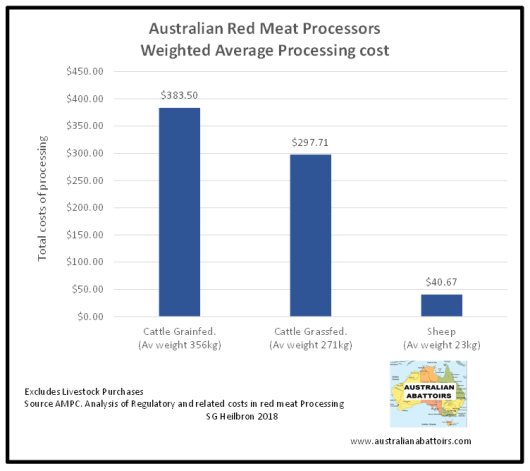
  • The following charts were adapted from the Analysis of Regulatory and Related costs in Red Meat Processing. AMPC. SG Heilbron. Oct 2018.
    • This project identified and quantified the costs of red meat processing, including assessing the regulatory components. It compared costs with key international competitors in United States, Brazil and Argentina72.
    • Information was assessed from 29 facilities representing the national slaughter of 60% cattle and 35%72.

Key cost components. Beef. AMPC. 15_16Key Cost Components Australian Cattle 2015/ 2016. 100% costs excluding Livestock purchase

Weighted Av costs per beast. AMPC 15_16

Weighted Average Processing Costs. Key cost components were assessed based on per head of throughput ratio

Countries compared. AMPC 2015_2016.

Comparison of Operating costs with major competitors, US, Brazil and Argentina.

Sources. Inverell. Est # 218. NSW

  1. ‘5,000 jobs at risk:Abattoirs facing closure’ Sydney Morning Herald 21.05.1996
  2. http://www.bindareebeef.com.au. accessed 27.02.2014
  3. ‘Inverell business community’ Parliamentary Hansard 01.06.1995
  4. ‘Drought, dollar forces lay offs at Inverell abattoir’ The Northern daily Leader. 18.07.2003
  5. ‘Coles, Woolworths to shun beef imports’ Perth Now 02.03.2010
  6. ‘Who is JR McDonald’ The Land 05.05.2010
  7. ‘Bindaree Beef  – Bio digester and Rendering plant’ http://www.mitchelhanlon.com.au. accessed 27.02.2014
  8. Bindaree Beef Preliminary environmental assessment rendering plant
  9. ‘Carbon price secures Inverell’s future’ Tony Windsor MP. Independent for New England 03.07.2013
  10. ‘Bindaree Beef scores unprecedented $23M grant for carbon price’ Beef Central 03.07.2013
  11. ‘NSW meatworks soon to be cooking with biogas’ ABC Rural 03.07.2013
  12. ‘One of Australia’s biggest abattoirs proves Gillespie wrong’ http://www.roboakeshott.com 04.07.2013
  13. ‘Innovative regional thinking behind world first biogas project’ Beef Central 13.09.2013
  14. ‘Beefed-up grant raises eyebrows in New England’ http://www.smh.com.au 09.11.2013
  15. ‘Licence blow to beef plant’ Central Western Daily 17.02.2003
  16. ‘Pay dispute at Bindaree Beef’ ABC News. 24.02.2014
  17. ‘Bindaree Beef and unhappy workers negotiate again on Wednesday’ ABC News 26.02.2014
  18. ‘Bindaree Beef wages dispute’ Parliamentary Hansard 06.03.2014
  19. ‘Bindaree beef dispute heats up’ http://www.farmonline. com.au. 21.02.2014
  20. ‘Bindaree counters union claims’ Stock and Land. 26.02.2014
  21. ‘Bindaree takes new approach to beef brand identity’ Beef Central 03.03.2014
  22. Ausmeat Accreditation listing. accessed 25.05.2014
  23. ‘Bindaree Beef worth $75,000 condemned for high endosulfen residue’ www.erisk.net 24.02.1999.
  24. ‘Bindaree beef in a stink with council’ Central Western Daily 15.12.2002
  25. ‘Rolling industrial stoppages likely at Bindaree’ Beef Central 21.02.2014
  26. ‘Bindaree Beef workers threaten dispute over $2-a-week argument’ www.smh.com. 21.02.2014
  27. ‘Bindaree Beef expansion on hold as council turns down application for funding’ ABC. 16.04.2010
  28. ‘Australia to get it’s first meat waste biogas plant’ www.ben-global.com 06.03.2014
  29. ‘Bindaree dispute continues’ ABC News 10.03.2014
  30. Major projects Planning. NSW 16.06.2014
  31. ‘CEFC finance for Bindaree Beef biogas & rendering upgrade’ CEFC July 2014
  32. www.cleanenergyfinancecorp.com.au
  33. ‘Inverell meat works shows the world….’ 2degreesproject.com.au
  34. ‘Bindaree bio Digester’ Meateng
  35. ‘JR McDonald: a Bindaree Beef legend’ www.northernstar.com.au 11.09.2014
  36. ‘Bindaree Beef Boss on need for red meat reform’ www.ruralweekly.com.au 13.09.2014
  37. ‘No guts, no glory on clean energy’ The Saturday paper 13.09.2014
  38. ‘Bindaree beef carves path to China’ www.farmonline.com.au 29.09.2014
  39. ‘Bindaree plan – bio-digester on the boil’ www.northerndailyleader.com.au 30.12.2014
  40. ‘Bindaree Beef in $500M auction’ www.farmonline.com.au 29.01.2015
  41. ‘Bindaree Beef seeks $100M equity investor’ Beef Central 02.02.2015
  42. ‘Meat Processor Bindaree Beef to merge with meat sales company Sanger Australia’ ABC Rural 08.07.2015
  43. ‘Bindaree Beef and Sanger Australia tie the knot’ www.foodanddrinkbusiness.com.au 08.07.2015
  44. ‘Streamlining supply benefits beef’ www.farmonline.com.au 10.07.2015
  45. Dept Ag. Submission to Market consolidation and the red meat processing sector July 2015
  46. ‘Campbell New Sanger CEO’ The Land 18.08.2015
  47. ‘China’s middle class to get skirt that tastes as good as sirloin’ www.afr.com 03.09.2015
  48. ‘Shandong Delisi to take stake in Bindaree’ www.afr.com 16.09.2015
  49. ‘China abuys 45% stake in Bindaree Beef for $140M’ The Australian 27.10.2015
  50. Bindaree Beef submission Inquiry into meat marketing May 2011
  51. ‘Why Bindaree chose Delisi’ Nth QLD Register 28.10.2015
  52. ‘KVM advises Bindaree Beef on significant Chinese investment’ www.kvm.com. 04.11.2015
  53. John Williams, NSW National Party Senate speech 01.12.2015
  54. ‘Finish line in sight for Abington Bridge….’ www.barnabyjoyce.com.au 14.12.2015
  55. ‘China chilled beef trade re-emerges…..’ Beef Central 07.07.2014
  56. ‘Bindaree beef to China chases premiums’ QLD Country Life 25.09.2014
  57. ‘Bindaree Beef backs ASA 100’ http://www.farmonline.com.au 14.11.2014
  58. Bindaree Beef. Submission 11. Senate Inquiry Effect of Market consolidation. 23.04.2015
  59. ‘Bindaree, Churchill re-opens investment talks……’ Beef Central 22.11.2016
  60. ‘Is Bindaree’s $140M deal with Chinese investor on the rocks?’ Beef Central 15.07.2016
  61. ‘Bindaree Beef sells Majority stake to Hong Kong based Investor’ Beef Central 31.08.2017
  62. ‘Archstone’s plans for 1 million hectares….’ ABC Rural 20.09.2017
  63. ‘China Argentina beef deal highlights our cost pressures’ www.farmonline.com.au 23.01.2018
  64. ‘Bindaree’s Chines partner ‘lacked moral compass’, court says in $31M judgement’ Beef Central 27.01.2017
  65. ‘Bindaree’s Chinese business partner slammed in Senate over avoiding debt’ Beef Central 23.03.2018.
  66. ‘Failed China beef deal turns political’ www.farmonline.com.au. 26.03.2018
  67. Chinatex Voluntary Administration. Grant Thornton. 22.06.2018.
  68. ‘Bindaree launches all-new premium beef brand’ www.farmonline.com.au 23.10.2018
  69. ‘Bindaree Beef workers to walk out after billionaire boss refuses to budge’ AMIEU. Newcastle. 22.10.2018.
  70. ‘Bindaree pay dispute’ ABC Rural radio. 27.10.2018
  71. ‘Devonport closure puts more than 100 people out of work’ ABC News 22.10.2019.
  72. Analysis of Regulatory and Related costs in Red Meat Processing. AMPC. SG Heilbron. Oct 2018

Forbes #656. NSW

Located southwest NSW, built in the 1950’s, owned and operated by Japanese 1988 to 2003. Plant required significant capital upgrades which the owners were not prepared to do and it closed in 2003. Talk of reopening in 2013.

Other Names

  • Lachley meats

Current Operation

  • Unknown

Location   

  • Forbes is located approximately 600km east of Sydney in central NSW, Abattoir located in the Lachlan valley.4

Forbes

Forbes #2

Hema Maps – Australia Truckies atlas.

Owner

  • Lachley Meats ( when closed 2003)1
    • Owned from 1988-20034
    • Japanese owned – The Hannan Corporation2
  • Tasman Group4
    • Currently operates other abattoirs.4

Operation   

  • export beef works2
  • Specialised in grainfed beef for Japanese and Korean Markets5
  • 170ha site, that is 8km from the CWLX livestock selling centre14.

picture 2013._edited-1Source – ‘Abattoir industry in disastous state’ ABC Rural. 16.02.2010.
Forbes abattoir also known as Lachley meats.

History of Forbes #656.

1950’s

  • Built

1987

  • Liberalisation of Japanese beef markets meant reduced import quotas and reduced import tariffs over the next 3 years. (Pg 82)9

1988

  • Plant in operation at this point1.
  • Lachley meats take over2
    • Trading company Mitsubishi were important investors in Australian beef cattle lot feeding and were involved in ‘paddock to plate’ supply chain control. Mitsubishi invested in Lachley meats and Mid Coast Meats – Macksville NSW.(Pg 124)7
    • Japanese firms invested in Australia feedlots and processing facilities especially in QLD, in order to supply the liberalised Japanese market, to ensure product quality and safety standards and to create a more secure supply chain for their parents in Japan (pg 123)7
    • Cattle feedlots in Australia had increased in the 1960’s solely to supply the Japanese markets, when the 1974 (Oil Crisis) occured massive losses occured to Australian feedlotters and producers with little impact on the Japanese buyers as they had little equity in the investments. When trade was rebuilt Japanese importers had to invest in the feedlots to share some of the risk (Pg 81)9

1997

  • At this point Forbes abattoir is Aus-meat registered as an Export Beef, sheep facility11
    • Operator – Lachley meats (Forbes) P/L11

2003

  • August. Abattoir closes.1
  • 170 permanent employees, plus another 70 part-time1
    • company committed to meet all workers entitlements1
  • Another article cites 300 jobs were lost due to the Forbes abattoir closure
  • Forbes abattoir at one stage had employed up to 450 people14
    • 4.5% of the then Forbes population14
  • Unlike Cities of Geelong and Illawarra when Ford factory and Bluescope steel closed, Forbes didn’t receive anywhere near the same level of government support14.
    • Both cities had received about $25M together14.
  • Lachley closed operations rather than invest in capital in a plant that had a bad trading history since 19881
  • Japanese owned pulled the plug on further financial support.2
    • citing high operating costs of an aged plant2
    • shortage of labour2
    • capital requirements needed to comply with by-products results since acquisition in 19882
  • Hannon Corporation was the 2nd largest importer of beef into Japan3
    • Owned a plant in Japan that could process up to 150,000 head a year3
  • Increased tariff on beef imports by Japan earlier had claimed it’s first Australian victim3
    • Major factors are the economic situation in Japan3
    • Situation in Australia and markets is exasperated by the drought3
  • All creditors and liabilities will be paid out in full2
  • Abattoir had closed and re-opened 3 times in the last 20 years.2
  • Local council willing to help to facilitate sale of plant as abattoir or conversion to some other type of factory6
    • Money was available for industrial developement6
    • Special abattoir displacement retraining fund to help retrain people through TAFE6
    • Assist in reducing costs of worker’s compensation, public liability and insurances overall, “..because abattoirs pay right at the top of all those services and that is working against abatttoirs in general” Member for Lachlan Ian Armstrong.6
  • Closure of the abattoir would impact by taking a major premium buyer for cattle out of the market throughout the region.6
  • December. Abattoir sold to Tasman Group services.4
  • Tasman Group also operate Brooklyn (Vic) and Altona (Vic), Yarrawonga (NSW) Longford (Tas) and King Island (Tas)4
    • Also feedlot Yambinya – Wakool4

2010

    • Six red meat abattoirs in Central NSW have closed since 200313
    • Outlook for the sector looks bleak13
      • “It’s disastrous. There are too many processing abattoirs out there and not enough animals to slaughter” Neville Newton, Goulburn abattoir operator13
  • There are currently 29 red meat abattoirs in NSW, down 30% 10 years ago13

2011

  • May. Equipment from the Killarney #22Q. QLD abattoir is used to refurbish Forbes10
    • Equipment is kept in storage and not actually installed but is included in sale deal offered September 201614
  • Sale of facility is thought to have occurred about this time – Australian owner14.

2013

  • Abattoir to be re-opened, had be closed last decade.8
  • Will be over 12 months before improvements are carried out and plant in operation.8

2014

  • NSW Government is questioned if it will offer potential buyers of the Forbes abattoir financial assistance12.
    • Governments reply – Mr Ian Armstrong, Minister of Regional Development, Minister for the Illawarra and Minister for Small business answers that the NSW government would be willing to work with any potential buyer of Forbes abattoir12
    • Grafton #157 NSW had received financial assistance in the past12

2016

  • September. Forbes abattoir attracted strong overseas investment enquiry – principally Chinese10
    • With a view to re-opening as a beef processing plant10
    • Half of the 10 or so interested parties in the purchase were overseas interests10
      • Looking to vertically integrate10
  • Some investors looking to demolish the plant entirely and build a brand new facility14
    • One Korean interest is looking for an Australian shareholder partner14
  • Other facilities in Australia listed for sale at this time

Source ‘Three meat processing plants hit the market…’ Beef Central 14.09.2016

Forbes abattoir

  • Three abattoirs are on at the market in Australia at this time14.
  • Equipment removed from the Killarney abattoir in 2011 kept in storage is included in the sale deal offered at this time14
  • Current owner of Forbes abattoir is thought to have owned the site for 4-5 years14.
  • Stockyards, ponds and office infrastructure are intact at this point in time14
  • October 6. Forbes abattoir site is auctioned14

Source Ian Simpson Property sale advert.

2018


Sources of Forbes #656

  1. ‘Dubbo stands while Forbes falls’ Daily Liberal. 21.08.2003
  2. ‘Meat jobs go at Forbes’ The Land. 28.08.2003
  3. ‘Agriculture’ The World trade review. 16-30 September 2003
  4. ‘Abattoirs revived’ Stock and Land 24.12.2003
  5. ‘Meatworks jobs saved’ The Land 25.12.2003
  6. ‘Council offers aid as abattoir closes’ ABC News 22.08.2003
  7. ‘Japanese investment in the World economy: extract’ Roger Farrell.
  8. ‘Forbes council confirms towns abattoir be re-opened after a decade in mothballs.’ ABC Rural. 30.08.2013
  9. World on a plate. Stephen Martyn 2014
  10. ‘Chinese still showing interest in processing assets’ Beef Central 04.10.2016
  11. Aus meat registration list July 1997
  12. http://www.parliament.nsw.gov.au. Questions 18.09.2003
  13. ‘Abattoir industry in disastrous state’ ABC Rural 16.02.2010
  14. ‘Three meat processing plants hit the market – What’s behind it? Beef Central 14.09.2016
  15. https://www.ruralview.com.au/Real-Estate/1-lachley-street-forbes-nsw/Property-Details-buy-rural-10479908.html. viewed 04.03.2018

Queensland abattoirs listed – regions

North Queensland

Ayr abattoir (QLD)

Small processor located 90km south of Townsville, currently in operation

Biboohra abattoir (QLD)

Historical abattoir closed in 1927, Also known as Baron works, located near Mareeba.

Owned by MJ Munro, operated as a slaughterhouse in the early days and then a cannery.

Bowen abattoir (QLD)

Located 230km south of Townsville on the QLD coast.Was in operation at 1919, went through fires, labour disputes and temporary closures. Purchased by AMH, the final owners and permanently closed in 1997.

Cairns abattoir (QLD)

Cairns (more commonly known as Queerah meatworks) was located in far north QLD received cattle from mainly north Australia, often by Barge from the NT and Normanton that had travelled from the gulf of Carpentaria in the 1960’s to 1975. Began to export in 1950’s closed in 1989 as part of the AMH rationalisation strategy of its abattoir capacity through the 1980’s.

Camooweal abattoir (QLD)

Located 190km northwest of Mt Isa, small processor currently operating that supplies own butchery for retail.

Canon Vale (QLD)

A small local processor currently in operation, located 70 km south of Bowen between Townsville and Mackay.

Cape River abattoir (QLD)

Located  south west of Townsville. Closed in 1986 due to the AMH  rationalisation strategy of its abattoirs capacity through the 1980’s.

Pentland abattoir (QLD)

Built prior to WWII, At one stage was the 2nd largest meatworks in Queensland. Last owned by AMH consortium, closed in 1989

Ross River abattoir (QLD)

Built in 1882, QLD meat export agency formed supplied contracts for supply of product to England. Plagued by industrial action its whole operating life most notably in 19919 when a violent clash between the unions and police occurred. Been through ownership receiver, beef price crash, strikes, droughts and market changes. Smorgons meat processors, last owner collapses in 1994, facility closed in 1995. Site now developed as a residential site with only the chimney still remaining as a historic site.

Tolga abattoir (QLD)

Small processor currently operating near Cairns

Townsville – Stuart

Owned by JBS. Large beef processor located in far north QLD

Tully abattoir (QLD)

Small processor currently operating between Cairns and Townsville

Weipa abattoir (QLD)

Small local processor

Central Queensland

Charleville abattoir – goat processor (Central QLD)

A goat processing facility that is currently operating located in central QLD. This facility exports all its production. Has had past problems of securing visa workers to ensure ability to process production. Floods have affected operations and government costs while plant has been closed at different periods.

Clermont abattoir (QLD)

Small local processor

Cloncurry #1 abattoir (QLD)

Small local processor currently operating

Cloncurry #2, proposed abattoir (QLD)

Proposal sponsored by DAFF 2012. Consider establishment of an abattoir at Cloncurry to process cattle from north west QLD and NT. Based on processing 100,000 heavy cattle per year, costing $49M to build not including land or government services. Marginal return expected on investment.

El Arish abattoir (QLD)

Located near Innisfail, a small processor that is currently operating.

Giru abattoir (QLD)

Domestic abattoir currently operating south of Townsville

Innisfail abattoir (QLD)

Owned by CMG then Teys, Hit by cyclone Larry in 2006, never to be reopened, equipment scrapped and auctioned off in 2011.

Mt Isa abattoir (QLD)

Built in the war years and closed in 1986

Southern Queensland

Beenleigh abattoir (QLD)

Large facility owned by Teys, currently in operation located south of Brisbane.Recently had a number of wage disputes. Invests heavily in new technology to optimise labour efficencies, currently operating 2 shifts processing 1,300 cattle per day

Caboolture abattoir (QLD)

Located in Queensland, one of only 2 abattoirs in Australia accredited for export of horse meat.

Dinmore abattoir (QLD)

The largest meat processing plant in Australia, currently operating and owned by JBS Australia. Located near Brisbane QLD.

Kilcoy abattoir (QLD)

Located northwest of Brisbane and primarily processes grainfed cattle. 4th largest abattoir in Australia, currently operating.

Oakey abattoir (QLD)

Located near Toowoomba, a large processing facility of mainly grain-fed beef, owned by Nippon. Currently processing up to 1300 animals per day. Has undergone significant upgrades to enable traceability for organic certification and assurances, with current work being carried out on methane gas collection. Problems in the past have been market fluctuations, unions and costs of production

Surat abattoir – Kangaroo processor (QLD)

Games meat abattoir located south of Roma. Processes Kangaroo. Started in mid 1980’s, possibly now closed due to floods, debt and costs of services to operate.

Oakey

Located near Toowoomba, a large processing facility of mainly grain-fed beef, owned by NH Foods (Japanese origins). Currently processing up to 1300 animals per day. Has undergone significant upgrades to enable traceability for organic certification and assurances, with current work being carried out on methane gas collection. Problems in the past have been market fluctuations, unions and costs of production. Includes short history of early days of the Japanese/Australian meat trade markets and general QLD market conditions affecting processing

Other Names

  • Toowoomba abattoir
  • Nippon Meat Packers name changed to NH Foods Australia
  • Oakey abattoir
  • Oakey Beef Exports

Current Operation

  • Aus Meat Accreditation registration dated 29/12/2015 #558 – Oakey Beef Exports Pty Ltd.3
    • registered as a Beef, Offal export facility.3
  • Direct employment enquiries to www.nmpa.com.au

Location   

  • Located north west of Toowoomba on QLD Darling downs5

Australia Oakey

Oakey

Source Hema Maps – Australia Truckies atlas.

Owner

  • Nippon Meat Packers1
    • Subsidiary of a Japanese Multinational1
    • Nippon meat packers incorporated 19781

products_edited-1Source Nippon Meat Packers Australia interactive beef products

This is a great diagram that is able to be clicked on in the Nippon website and illustrates where the various cuts of beef and offal are located in the animals bodies

Operation 

  •  Nippon currently own 3 operating abattoirs in Australia,
  • Nippon owned Bowen (QLD) which they closed in 1997
  • Combined processing capacity 2,700 cattle day2.
    • also owns and operates a feedlot1  at Whyalla5 and
      • 3 beef farms1
        • At 2014 land in Texas QLD and Tasmania on King Island5
      • 3 tanneries1
        • Oakey Blue tan factory closed 20127
      • piggery1
        • Piggery assets sold off2
    • Processes predominently grain-fed cattle1
      • 100 to 300+ day5
      • Processing mainly British and European cross steers5
    • All plants are certified organic to process and slaughter.1
    • Sells product  under subsidiary company1
      • Beef Producers Australia Pty Ltd – Sells approximately 20% of Oakey product, marketed domestically1
      • Nippon Meat Packers Australia Ltd (Exporter)1
      • third of product is exported to Japan2
    • Sells products under labels1
      • Nippon1
      • Australian premium beef1
      • Wingham gold1
      • Borthwicks1
    • Vertically integrated supply chain that allows traceabilty from animal’s property of birth through to end user5
      • traceability includes details on animal, workers, defects, yield and volume data5
    • Fully integrated slaughtering, fabricating, chilling, freezing and rendering facility.5

picture_edited-1Source – ‘Productivity a bone of contention in abattoir strike’ ABC Rural. 01.05.2012.
Oakey abattoir facility

brands_edited-1brands #2_edited-1Source. http://www.nmpa.com.au
Various branded products sold from the Oakey facility

Historical and current meatworks, canneries and abattoirs located in Australia can be viewed at;

Australian abattoirs inactive map

abattoirs_edited-1

History of Oakey meat processing facility

Authors Note – As Nippon Meat Packers, now NH Foods is Japanese owned firm I have included some information that is in relation to Australia/Japanese Beef  early trading. I don’t know how directly relevant it would have been to the Oakey abattoir.

1956

  • Oakey Facility established.5

1968

  • Japanese Beef Trade
    • January. Trial shipment of chilled 1500lbs (680kg) meat vacuum packed by Borthwicks from the Murarrie plant on the Brisbane river shipped to Yokohama, Japan (Pg 72).28
      • Product arrived 3 weeks later(Pg 72)
    • Requirements by Japanese were placed on frozen beef, required frozen temperatures at all points of the supply chain, even to small retail outlets (Pg72)
      • Logisitically this was extremely difficult as frozen meat had to be defrosted in advance for retail sale (Pg 72)
      • Chilled beef was much easier to handle (Pg 72)

1969

  • Japanese Beef Trade
    • Market research conducted by Borthwicks identified consumer market preference (Pg73).28
      • 15% high quality meat
        • Significant opportunity for Australia to provide high quality meat
      • 40% middle class meat
      • 45% was low quality
        • Australian cattle were meeting this demand in canned meats, curries and low priced product
    • The First containerised vessels are used in Australia opening up new opportunities to send vaccum packed beef primals to Japan (Pg71).28
  • Growing feedlot industry was developing to cater for the Japanese trade (of which Japan interests had no equity) (Pg 81).28
  • Designated store project in Japan started to differentiate the Australian product at retail level (Pg 84).28
    • by 1971 Japan had 740 Australian meat designated stores.

1970

  • Japanese Beef Trade
    • First full container of cryovac packaged chilled beef primals is shipped to Japan from the Borthwicks Brooklyn plant in Victoria (Pg 72).28
      • One of the first containers of any export commodity to Japan from Australia
      • Initial shipments of the packaged meat was in high quality wooden boxes, with each lid having a printed message about the contents
        • Card that placed inside the box, was protected from moisture damage, also provided a great deal of factual information about the product, it’s shelf life and that it had been chilled, not frozen.
        • Japanese retailers valued the box, some for fuel but also as reliable evidence to customers that this was a superior product
        • Wooden boxes later replaced by reinforced cardboard
        • The boxes and presentation made an everlasting impression and established reputation as Australian beef being of the best quality

1970

  • Alot of work is done at Oakey with Lindgren packaging  to commercialise and develope meat vacuum packs (Pg 74).28
    • Australia world leader in this development

1971

  • Japanese Beef Trade
    • First QLD shipments of beef to Japan occur from QLD (Pg 74).28

1974

  • Oil Crisis occurs (Pg 74).28
    • Oil embargoes (restriction of supply) had occured in 1973 by members of OPEC (the organisation of Petroleum Exporting Countries)
      • economic fallout proved catestrophic for the red meat industry
      • Oil dependent economies feared the effects of the oil restriction and closed their countries to imported beef to protect their currency and own livestock growers (Pg 81)
  • Japanese beef markets are closed (Pg 74).28
    • Australia had a large beef herd at the time
      • Australia and the US sold off their beef herds
      • Prices plummeted from 1974 prices of $350/hd to $40/hd in 1976
      • Australia had limited export markets and therefore sold into the US, producers there were already liquidating
        • US beef and mutton prices crashed, taking the industry with them
        • European beef mountain was created – EU stockpiled beef which they later sold into the early 1980’s furthur supressing prices world wide
  • Australian red meat exports fell by 43% in 1973/74 (Pg 81).28

1975

  • Japanese beef markets re-open (Pg 74).28
    • Much of the investment in chilled technology and production systems had been lost
    • Frozen sector sales to Japan recovered better but chilled took much longer
  • Feedlots that had previously catered to Japanese markets had collapsed with big losses. This inhibited investment into the future due to mistrust of the stability of the market.(Pg 81).28
    • rebuilding of the trade was dependent on Japanese importers investing in the feedlots so that they shared some of the risk

1976

  • Australian National cattle herd reached an all time high of 33.4M head (Pg 81).28

1978

  • Australian slaughter peaks at 10.8M head (Pg 81).28
  • Most abattoirs, both domestic and export are running at capacity (Pg 81).28
    • not uncommon for cheaper cuts to be rendered rather than sold as meat
  • Company of Nippon Meat Packers Australia Pty Ltd is established.29


 1980’s

  • Australian cattle herd has fallen by 11M head (Pg 82).28
  • Australian Sheep herd dropped from 174M in 1970 to 135M in 1985 (Pg 82).28
  • Many abattoirs and meatworks couldn’t source enough cattle to remain viable (Pg 82).28
  • Japanese beef market.28
    • Prior to 1960’s Japan’s main source of animal protein was whale meat and the mainstay of school lunch program (Pg 84)
      • Whale meat accounted for 25% of Japanese meat consumption (Pg 84)
      • Japan enabled a number of sub quota’s for red meat industry into which Australia was able to provide product (Pg 84)
        • supplied various sectors and agencies
          • School lunch program
          • Hotal quota
          • airline quota

1981

  • August. ‘Meat substitution scandal’ occurs in Australia.(Pg 82).28
    • Pet food grade meats, donkey, kanagroo and others were found in shipments to the US. Meat was being transported from northern parts of Australia to southern Australia, reboxed and repackaged and exported.28
    • Leads to Royal commission in the Australian Meat Industry.28
    • Profoundly damages Australia’s meat export reputation.28
    • leads to the evolution of AUS-MEAT.28
      • costs of regulation closed many export abattoirs.28
      • The US significantly step up standards of requirements for meat into the US under the USDA.28

1987

  • Nippon purchase Oakey abattoir1
    • Nippon began in Japan in 1942, establishing the Tokushima meat processing factory, producing ham and sausages (Pg 86).28
      • when supplies of pork were scarce, would substitute other proteins.28
        • rabbit, whale.28
        • By 1960 mutton was found to be a good substitute, which it began to source from Australia.28
        • Company changed its name to Nippon meat packers in 1963 and entered into business with US Swift 1969.28
          • Swift already had connections in Australian meat processing at that time.28
        • Purchase of Oakey was in direct response to Japanese beef market liberalisation.28

1987 purchased Oakey_edited-1

Oakey abattoir. Source www.nipponham.co.jp

  • Japan beef markets are liberalised(Pg 82).28
    • Lead to removal of import quotas and reduction in import tariffs.28
    • Gave companies in Japan opportunity and incentive to expand into meat importation, some who had been restricted prior to the liberalisation (Pg 85).28
    • Previously tenders had protected certain trading houses.28
    • Significant investment had occured in fully integrated supply chains into Japan to realise market potential and commitment to the Japanese market irrespective of market conditions.28Japanese export markets 001

Source World on a Plate –  A history of meat processing in Australia. Stephen Martyn. (Pg 83)

  • US industry analysts thought the US would be the major benefactor of Japanese markets opening up (Pg 85).28
    • US underestimated Australia as it (Australia) had previously only supplied mainly meat from grassfed stock.28
    • Assumed Australia would be confined to commodity meat supplies rather than the premium markets.28
    • Authors note; Significant investment occurred in Australian feedlots at this time to enable grainfed custom feeding of animals suited to specific Japanese meat markets.28
  • Nippon purchase Whyalla feedlot near Texas, NSW.67
    • already a 3,000 head feedlot.67
      • extensively developed latter in 1990.67

1989

  • Nippon also purchase the AMH plants at.28
    • Mackay (QLD) and
    • Bowen (QLD).
      • closed 1996 as part of capacity rationalisation.28
    • Operated boning room through subsidiary Namoi Valley Beef
      • Gunnedah abattoir (NSW)
        • Council operated, service kill facility
        • Closed 1997
      • Mudgee abattoir (NSW)
      • At the time was operated by council as a service kill facility,
        • Had massive debt and went into receivership.28
        • Later purchased by Flectcher’s in 2003, still in operation
    • Nippon is sensitive to it’s position as a foreign owned, non-Anglo company in Australia (Pg 86).28
      • keeps a low profile.28
      • Makes most asset purchases as joint ventures.28


1990

  • Nippon develop the Whyalla feedlot – Oakeys Holdings.28
    • Nippon website says they purchased this site in 1988.29

1988 whyalla feedlot_edited-1

Whyalla Feedlot. Source www.nipponham.co.jp

  • Whyalla feedlot is developed to a unprecedented scale.67
    • previously been a 3,000 head feedlot.67
    • Now scaled to 50,000 head.67
      • Later extended to 56,000 head.67
    • largest Australian single feedlot site.67
      • led the way in ‘US scale commercial feedlot operations.67
    • Australia’s largest feedmilling infrastructure.67
      • 8  18 x 36 inch roller mills.67
      • feeding 750 tonnes  mostly barley based mix a day.67
      • 5 delivery trucks – 4 in use at any one time.67
      • yard can store 100,000t grain.67
      • silos can store 26,000t.67
      • most hay produced on farm.67
      • corn is contracted silage.67
    • Site is licencsed to 75,000 head.67
    • Holds 100% Nippon owned cattle.67
      • 50% straight Angus.67
    • Cattle sourced from QLD, NSW, Victoria, and Central Australia.67
    • Typically induct 3,000 head a week.67
      • similar numbers dispatched.67
      • animals pre-vaccinated before induction.67
      • animals monitored individually.67
    • Yards.67
      • every pen has shade.67
        • unique slattered shadecolth system.67
    • Initially feeding was focused on Japanese markets.67
      • mid to longfed progam out to 300 days.67
        • heavily reliant on marbling-oriented British breeds
      • Now feeds large variety.67
      • most cattle are 120 – 150 day.67
      • Change in feeding length changed annual turnover.67
        • 2014 calendar year turned out 132,000 head.67
        • 2003 turned out 93,000.67
    • Vertical integration of abattoir /feedlots. Not focused soley on Japanase markets and has been versatile in supply to international and domestic markets.67
  • ABARES report – Foreign Investment and Australian Agriculture

8. ABARES Nov 2011_edited-1

Proportion of cattle slaughtered by ownership of abattoirs 1990
Source ABARES foreign ownership 2011 Pg 31

1991

  • 77 Beef export Abattoirs are in operation in Australia at this time.54
    • 27 have some level of foreign ownership.54
    • Ownership dominated by Japan, UK and the US.54

1993

  • Acquire Rochel feedlot in NSW (3000 head) to assist research into cattle performance.28

1994

  • Nippon purchase (Pg 86).28 Wingham (NSW)
    • Wingham is a major beef exports facility.28
    • Tomen sells it’s interest to Nippon.28
      • Major shareholder in Anvic Meat Exports Pty Ltd.28

1997

  • Nippon has invested $200M in abattoirs and feedlots over the previous decade(Pg 86).28
    • 3rd Largest meat processor in Australia.28
    • Exporting to 34 countries.28

NH foods Oakey export_edited-1

NH Foods holdings. Source www.nh-foods.com.au – General Information accessed 21/12/2015

1999

  • Spent $2M in marketing new Barley beef brand to Japanese customers1
  • Nominal capacity estimated at 50,000 head as per 50 weeks3

2001

  • Nippon establish leather wet blue tannery near abattoir to process Oakey hides and from other facilities, including competitors7
    • Prior to GFC hides are worth $110 each7

2003

  • July.Jondaryan Shire Council approve the project 08/07/2003.31
  • Started upgrades to plant and facilities, included new boning room, new slaughter room and a new traceability and control system1
    • Upgrade takes until about 20061
    • Slaughter capacity of approximately 1200 cattle per day1
    • Create 700 new jobs.31
      • Upgrade proposing to lift capacity to 2,000 head a day.31
      • Make Oakey the 2nd largest abattoir in QLD.31
      • Upgrades to take place over 5 years.31
  • $46M expansion using Marel meat equipment4,
    • New boning system includes 4 flowlines to take beef quarters to 96 individual workstations where beef is boned and trimmed before being vacuum packed for further processing in Japan4
    • Old system was meat was cut on tables now it is hanging in front of worker and is more efficent and easier4
    • created 500 new jobs4
    • make Oakey the 4th or 5th largest beef abattoir in Australia and 3rd largest in QLD4
    • New system expected to have effective life of 20 years with maintenance.4
    • key point of Marel system was the traceability, particularly important in latter years when BSE closed market access for US  to Japan and allowed access by Nippon to those markets4
  • “Marel traceability/accountability system …proved to be a magnificant investment, despite its detractors at the time” Pat Gleeson, Oakey general manager. 10.03.2014

2004

  • January. Construction offically begins at the abattoir for the upgrades.32
    • Workforce will lift from 500 to 1,100 workers.32
    • processing and export earnings capacity is to double.32
    • First stage of the project is expected to be completed by the end of 2004.32
  • Expansion of the meatworks will be ready when the industry turns around.32
  • “So even though times are tough at the moment, now is the right time to build rather than waiting until good times and then rushing around trying to build, so it’s a confidence thing at the moment” Jim Vick, Oakey Managing Director.32
  • September. Oakey Ergon Energy power substation causes black out 5.5 hrs, Caused shut down of the abattoir for that time.33
    • Third power failure in 3 weeks.33
    • New $7M power facility will be built.33
  • December. Abattoir extenstions $46M.34
    • Offically opened 03.12.2004.34
    • Facility will use NLIS, seen as controversial at the time.34
      • system guarantees quality, consistency and traceability.34
      • Ensures importers product is high-quality and disease free.34
    • Oakey expansion will mean 500 new jobs over the next 3 years
      • increase of capacity to 2,000 head a day by 2007.34

2005

  • Nippon form a strategic allience with OBE Beef – Australia’s largest supplier of certified organic meat1
    • Plan to export meat to UK and Central Europe under ‘Borthwicks’ organic brand1
  • Strong demand for export product key factor in gains in net profit after tax gains of 60%, with 2005/06 NPAT $21.5M from earnings of $875M (All Nippon meat Packers financial performance combined)1
  • Nippon upgrade hide tanning facility extensively to world-class quality – facility now has capacity to process 20,000 hides a week.7
  • Significant regions of drought across QLD.

QLD Drought 2003_2005_edited-1

Queensland drought situation 2003 – 2005 www.longpaddock.qld.gov.au

2006

  • Sales revenue increased but net loss occured for year (Financial year ending June) $23.2M1
    • Large increase in administration costs of $30M1
    • Increase in wages due to increased employment1
  • Nippon Meat Packers Australia produce 5.9% of Australia’s red meat production in 2006.54
    • 3 abattoirs in operation.54

2007

  • Australian subsidiary earnings struggled in the first half of 2006/2007 due to higher cattle prices , low prices in Japan and high Australian dollar, earnings recovered in early part of 20071
  • Aim to increase profitability by processing more grain fed cattle1
  • Costs for raw materials increased for higher grain and oil prices1
  • May. Oakey shire water plant implement $6M upgrades to connect and treat bore water supplied to businesses in Oakey.35
    • Oakey residents, Oakey abattoir, Army Aviation centre, Jondaryan township.35
  • June. Abattoir is able to deliver system that is able to trace each piece of meat back to property of birth.36
    • system provides vital defect and yield feedback.36
  • Processing 1,000 cattle per shift.36
    • Mostly from the feedlot in Texas.36

2008

  • March.Queensland rail (QR) deem the rail siding west of the works requires upgrading and is currently unsafe.6
    • QR agree with Oakey management to run cattle train to Dalby, abattoir would pay for additional freight to Oakey.6
      • Allows Oakey to access and bid for cattle on Northern and Western district properties6
  • Sales revenue fallen by average of 1.2% in real terms, in contrast industry revenue estimated to have grown at marginal rates in real terms1
  • Nippon launches a large scale reform of Australian business to improve earnings in 2007/20081
    • Involved cutting costs in cattle feeding, processing plants and leather business1
    • potentially reorganising plants1
    • possible closure of piggery1
    • revenue affected by high Australian dollar and weak demand for beef in Japan1
  • Withdraws from restaurant operations and Hog production and sells idle farmland2
  • August. Sulphuric acid leak occurs from a tank, spilling 2,000 lt.37
    • no injuries occur.37
  • November. Nearly all 730 staff are stood down due to a shortage of cattle.38
    • One day, 11/11/2008, staff not paid.38
    • Management not alarmed.38
      • Couldn’t get enough stock for full weeks kill.38
      • Time of year was traditionally slower as was crop harvest period.38
  • Global finanical crisis is also causing a reduction in export sales.38
    • Korea and Russia slowed significantly.38
    • Difficult selling to those overseas countries where the money was difficult to obtain.38
    • Managing Director Howard Halter said Oakey was a lot better positioned to handle current climate than processors in Brisbane and North QLD.38

2009

  • Plans to double processing capacity to 2,000 cattle per day by moving to a two shift system1
    • Employing 750 people1
  • Plant certified for halal production and now exports to halal markets2
    • mostly Middle Eastern markets.30
  • Sluggish growth and weak export demand due to global economic downturn2
  • December. Queensland Rail (QR) informs Oakey they will not stop at Dalby, only unloading the cattle at ‘End of the line’ – Brisbane6
    • Oakey abattoir would have to truck cattle back from Brisbane 200km, from a tick zone and up the range to Oakey6
    • Dalby to Oakey is 50km6
    • Brisbane to Oakey is 200km6
  • Comparative road frieght to rail from Quilpie to Oakey6
    • Road $1.45/km 805km equals $1,167.25 /deck or $51,359 for 44 deck consignment6
    • Rail $1.03 /km 805km equals $829.15 /deck or $36,482.6o for 44 deck consignment6
      • Difference $14,876.40 over 44 decks6
      • QR were now making it uncompetitive if extra freight is incurred from Brisbane6
      • Situation of competitiveness would worsen if the abattoir can’t access channel country cattle.6

2007_2009_edited-1

Queensland drought situation 2007 – 2009 www.longpaddock.qld.gov.au

2010

  • August. 2 employees  sacked for workplace bullying.39
    • Incident occured in July.39
    • Became a Fair Workplace Investigation.39
    • Worker bullied had supported speeding up the chain to 157 beasts, others wanted slowed to 155 beasts
  • October. Worker who claimed workplace bully and led to 3 people being sacked is now centre of a workplace bully allegation himself.40

IBIS Jun 2010_edited-1

Major Companies in the Australian Red meat processing industry

Source IBIS world June 2010

2011

  • January. Devastating floods across Central and southern QLD and large parts of NSW and Victoria.48
    • affected slaughter numbers to abattoirs.48
  • March. Pittsworth abattoir -Located 30km south of Oakey closes
    • Regional abattoir that did private kills for farmers and supplied local butchers.41
      • employed 35 people.41
      • Lack of available stock and persistent rain were the reasons for closure.41
  • June. 3 workers  in July 2010 incident reinstated.42
    • ‘Booing, mooing and barking” was part of the workplace’s culture.42
    • Video footage used as evidence.42
    • Oakey abattoir ordered to reinstate and pay undiclosed sum for renumeration to one man, another man had withdrawn unfair dismissal claim.42
  • July.National slaughter rates decline 5%.43
    • Australian currency pressures.43
      • A$ is now above US108c.43
      • economic news out of US could send currency even higher.43
      • higher A$ would cripple Australia’s already limited price competitiveness for beef in international markets.43
    • QLD which does approximately half of Australia’s processing capacity.43
      • Down 8% from the previous week.43
      • lowest kill recorded in QLD in July for past decade.43
      • Down 21% on same period last year.43
      • Significant number of QLD plants only killing 3-4 days.43
    • listless export beef demand.43
    • Meat processing and export is low-margin business due to.43
      • Import duties.43
        • Indonesia 9%.43
        • Korea 40%.43
        • Japan 38%.43
      • New AQIS charges on meat inspection would add millions to processor costs.43
    • Was currently a big build up of meat in cold stores due to difficulty in selling into sluggish markets, Japan and the US.43
  • August. Top chefs tour the abattoir as part of a south east QLD tour.44
  • Cattle are in short supply, 2008 & 2009 had been drought periods.45
    • with seasonal pressure lifting producers are retaining females for breeding.45
    • Period of drought that lasted 10 to 15 years.45
    • “We’re paying for the numbers of store cattle that were killed in the droughts up until 3 years ago” Kurt Wockner, Oakey Livestock manager.45
  • Expected diversion of northern cattle displaced by the Indonesia live export ban won’t come to the processors until April 2012.45
  • September. Oakey abattoir hold an open day for active suppliers.46
    • Inspection tour of the plant.46
    • Boning room – features four production lines.46
      • provides individual animal traceability from the animal to the vacuum -packed primals in cartons.46
      • Oakey processing 1,100 per day single shift.46
  • Change in production emphasis from primarily being dedicated grainfed plant to much broader range of cattle.46
    • grassfed export steers.46
    • grain and grassfed yearlings.46
    • bulls.46
    • cows and.46
    • high quality EU grain and grassfed.46
  • A$ now us103c.47
  • Some QLD southern plants operated only 6 shifts for the week down from 10.47
  • General shortage of killable cattle across Eastern Australia.47
    • AACo lifted 4,000 from Brunette downs and 2,000 from Anthony’s Lagoon to processors.47
    • Weights for cattle are expected to be heavier later in the spring and early summer 20-30kg above normal.47
  • November. ABARES foreign ownership 2011 report is released

7. ABARES Nov 2011_edited-1

Red Meat throughput Australian abattoirs, Foreign and Australian owned 2011 Source ABARES foreign ownership 2011 Pg 29

2012

  • January. Nippon close down ‘New Wave Leather wet blue tannery’  located at Oakey site.7
    • High Australian dollar and increases in direct processing costs forced tannery to cease operations
    • facility had capacity to process 20,000 hides per week7
    • Employed 38 full time and 15 casual staff7
    • was leading blue tannery supplying value-added blued hides to the international market7
    • Nippon deny had tried to sell business outright and may reconsider re-opening.7
    • Hides from the Oakey abattoir would now be salted and exported raw to China, where labour and other input costs and regulatory pressures are low.7
    • Hides currently worth $457
      • Prior to GFC $1107
      • 2009 $10 and less7
  • Japan export market has stagnated and Nippon shift focus to emerging markets in Russia and the Middle East2
  • Strength of Australian dollar is declining and increased competition from US will make breaking into new markets more difficult2
    • also competition from Brazil increasing2
  • Oakey commence season after traditional Christmas/New year season in 2nd week of January.48
    • on a reduced kill.48
  • ABARES release a report into foreign ownership in the red meat processing sector See Nov 2011.49
    • report ‘underwhelming’ adding nothing to current industry knowledge.49
  • Australian dollar has continued to climb US106c.50
  • Export demand North Asia and Russia remains subdued.50
    • current state of export market ‘woful’.50
    • some strengthening in the grinding meat market.50
  • Beef stocks held by processors are starting to decline.50
  • Many QLD processors were forced to close due to rain,.50
    • record 24 hour and 48 hour rainfalls in parts of QLD.50
  • Oakey plan to close for 1 day 03/02/2012.50
  • April.
  • AMIEU give notice 19/04/2012 of 2 hour protected industrial action to occur on 27/04/20128
    • AMIEU gave notice 27/04/2012 to Oakey management work stoppage to occur 27/04/2012 ending Friday 04/05/20128
      • originally planned a 2 hour protective action for Friday only, “The company responded to that by progressively locking out workers indefinitely, workers responded with this week-long protected industrial action” Brian Crawford, AMIEU QLD branch secretary10
    • AMIEU advised  that further 24 hour stoppage to occur 04/05/2012, work to resume Tuesday 08/05/2012 as Monday was a public holiday8
    • 600 workers on strike, not to be paid during action9
    • Management response  cease processing Friday 27/04/2012.8
    • AMIEU refused to allow members to bone out Thursday 26/04/2012.8
      • management conducted process themselves8
      • May 7 article claims 400 carcases still hanging in chillers11
  • Oakey and Management been in negotiations since May to finalise new Enterprise bargaining Agreement8
    • Oakey require productivity offsets required for plant to remain competitive with domestic and internation markets, current unfavourable trading conditions particularly in grain-fed business could not be sustained.8
    • Members of AMIEU not happy about productivity push, which includes increasing the speed of the boning room chain9
    • Workers want compulsory Saturday work to be wiped from the contract10
    • AMIEU want 4% wage increase, but won’t accept staff work faster12
      • management want to increase chain speed in boning room by 15 minutes12
      • other places are working faster and they have agreements with AMIEU that are signed and certified12
  • Workforce would prolong strike if agreement was not reached10
  • The shutdown would hurt local businesses, retail had not been great in the region.51
  • May. Toowoomba’s Labour day celebrations, abattoir workers among meatworkers marching with signs that read “Scab labour will not be tolerated”, non-unionised salary workers would be bought in.11
  • AMIEU – Main issue is the chain speed in the boning room and complusory Saturday work.52
    • Workers walked off 27/04/2012.52
    • Scheduled to resume 03/05/2012.52
      • Now they won’t go back until 04/05/2012 (Saturday?).52
  • May 4. Protected action scheduled to finish today.53
    • AMIEU has not been told when operations can resume.53
  • AMIEU say will not return to work at earliest 08/05/2012 unless an agreement is reached.55
  • 10 day strike led by AMIEU ended midnight 9th May. Management had continued to lock workers out with the AMIEU waiting to be advised of how long it would continue13
  • May 11th AMIEU Brian Crawford currently in talks with Oakey management Pat Gleeson.14
  • Management continues to lock staff out, even though strike ended, will not open until an agreement is reached.56
  • May 20, Oakey management release statement “..the decision of the workers to continue to strike is regrettable, but the company intends to continue to  negotiate in good faith to bring about an acceptable outcome that addresses the fundamental issue of productivity with its workforce”16
  • May 21. Workers return to work, compromise on wage increase and chain speed reached.17
    • 4% pay increase.58
  • Members of Construction forestry Mining and Energy union from Acland Coal mine have encouraged and supported AMIEU workers since start of strike14
  • Local businessmen say protracted action at the abattoir has hurt local retail trading as they rely on everyday people to walk into stores.15
  • Businesses have felt the impact from the strike and will continue to for couple weeks after work restarts.57
  • EBA negotiations had been occurring for 18 months11

Industrial dispute Oakey. 2012_edited-1

Industrial Dispute Calendar – Oakey Beef Exports 2012.

  • current high Australian dollar is particularly damaging to manufacturers and exporters alike.8
  • Boning room supervisor Bob Costello wins prestigious manufacturing industry-wide award.59
    • Manufacturing Student of the year.59
    • Nominated by the employer.59
    • Diploma of meat processing course.59
    • Bob Costello made major contribution to improving plant efficiency.59
      • saved thousands of dollars worth in daily savings to the facility.59
      • based on preliminary work on the carcase while hot to improve yield and reduce waste.59
      • Worked in the industry for 28 years, working his way through different levels of processing.59
  • November. Major southeast QLD processor say they have ample cattle supply in coming weeks to meet current requirements and international demand.62
    • Seasonal conditions are deteriorating.62
    • Large areas have had bushfires.62
  • Superstorm – Hurricane Sandy hit the US east coast and affected some imports.62
    • damage to US processing facilities and infrastructure was significant.62
    • Port of Philiadelphia (largest port of entry for beef) is open.62

 Profit Margins_edited-1Nippon Meat Packers Revenue Source IBIS world 2010,2013

revenue_edited-1

Nippon Meat Packers Profit Earnings Source IBIS world 2010,2013

2013

  • March. AACo conduct service kills for it’s brand products of 1824 and Waygu beef are being conducted at Oakey and Toowoomba (QLD) JBS Beef city.63
    • AACo don’t harvest and retain all of the material from the animal.63
      • processor (Not AAC0)keeps red & white offals, blood products, meat and bonemeal and tallow.63
      • AACo are in direct competition with major processors JBS, Teys/Cargill and Nippon in brand products.63
      • AACo began building their abattoir near Darwin.63 Livingstone abattoir (NT)
  • September. Pasturefed Cattle Assurance System (PCAS) registration process has begun at Oakey plant with information for suppliers to follow to establish PCAS certified grassfed supply chain18
    • cost of audit was likely to be point of resistance early in PCAS development18
  • Companies industry related revenue estimated to have contracted by 1.7% due to Australian chilled beef prices remaining flat over 2008/09 and 2009/102
    • weak export demand due to global economic downturn2
  • Oakey plant had killed same number of cattle in 2013 as it did for entire period of 2012 season.19
    • Daily kill 1200-1300 head are 30% above last year at the same time19
    • Kill weights are reflected by the drought.19
      • Average carcase weights back 20-25kg compared to 2012, due to lighter average weight of steers and significantly higher proportion of female slaughter19
    • In general Eastern states kill tally recorded by the National Livestock reporting services up 15% on same week last year19
  • October. Queensland abattoirs being charged up to $27,000 a month through a religious levy on meat exports in Jakarta to raise money for Islamic schools and mosques20
    • Scandel has stopped QLD halal meat exports to Indonesia, abattoir operators boycott expensive Halal certifiers endorsed by the Indonesian council of Ulama (MUI)20
    • certifiers must donate a share of their revenue to mosques and Islamic schools.20
    • Australian Halal food services (AHFS)was charging quarter of other certified endorser – was suspended by MUI for engaging in unfair competition that could weaken halal certification20
    • DAFF have no control over approvals for religious certifiers.20
    • Oakey relied on AHFS for certification and were now unable to sell Halal meat in Indonesia21
      • Indonesia was an important market for Oakey product21

2014

  • Nippon Meat Packers Pty Ltd changes name to NH Foods.29

Logo NH oakey exports_edited-1

NH Foods Australia Logo Source  www.nh-foods.com.au

  • January. Lack of rain and failure of the northern monsoon has left many areas critically short of feed in western and southern QLD.64
    • Dry areas extending across northern NSW.64
    • critical decision time for drought impacted producers.64
    • One processor states its is the worst start-of-season outlook in 35 years of business.64
    • first quarter of 2014 looking to be period of extreme high cattle turnoff.64
    • Some large processors not booking prices only kill slots.64
      • due to uncertainty over cattle supply.64
      • high placement rate in feedlots late in 2013.64
      • catch up of grain-fed kills due to seasonal break.64
  • February. Forecast of very difficult next 12 months due to supply of animals if drought breaking rains received.24
    • Herds rebuild and producers retain cattle24
    • Plans are to maximise numbers of cattle on feed which will help to insulate from predicted shortages in 3 months.24
  • currently employing 700 people24
  • upgraded trucking and spelling facility at abattoir that can hold 1000 head on feed in seperate area from plant operations24
  • Installation of Covered high rate Anaerobic (COHRAL) lagoon to extract green energy biogas from waster water streams to replace millions of dollars worth of natural gas currently consumed22
    • Uses concentrated anaerobic bacteria to digest 70% of organic matter of high chemical oxygen demand to produce effluent of far higher quality than typical open lagoons22
      • collect 6000 cubic metres of methane each day, calculated to produce a saving of about 50,000 gigajoules of natural gas used in boilers each year23
      • methane will produce 1 mega watt electricity each day23
    • floating membrane will draw gas off as soon as produced and held in specific bladder tanks for use until required.23
      • methane is cooled before use, moisture and sulphides removed before being used in boilers.23

CST wastewater_edited-1Illustration of process of gas recovery of an Anaerobic lagoon
Source CST wastewater solutions

  • reduce plants carbon footprint22
  • reduce waste water22
    • noval distribution system along bottom of lagoon will allow water retention period lower from 25 days to 15.23
  • Plant expects to repay cost of construction within 5 years22
    • $5M – with return on investment in 4 years23
      • $4M in capital works alone
    • reduce annual gas bill by 42%23
  • after 5 years continue to deliver benefits and profitability virtually to perpetuity22
  • gaurd against future price rises in cost of energy and imposts such as carbon tax22
    • energy is a significant and rising component of operating, Diesel, electricity and gas23
  • Project is entirely self-funded and did not attract support under former Federal government carbon abatement grants23
  • Project research funding partially from Australian Meat Processor Corporation & MLA donar company as a Plant initiated Project26
    • If implemented the process can provide a number of direct and indirect economic, social and environmental benefits to abattoirs across Australia26
    • Funding is through private investment, matching governement dollars, and producer levies are used.26

Beef central 28.08.2014_edited-1Oakey abattoir Source Beef Central 28.08.2014

  • project should be finished by late 201523
  • Is the first to use covered lagoons, other installations use reactor tanks of cement or steel23
  • project may help to handle future expansion of plant23
    • vision that will process 1500 head per day using 6 day operation within 3 years23
      • depends on national herd recovery after the drought ends23
  • other plants at Mackay and Wingham will be considered for installation of COHRAL23
  • plant needs to have diligence of staff to ensure chemicals don’t affect bacterial action23
  • currently 750 people employed at Oakey22
  • March. Sod turning ceremony to begin biogas development.65
    • Oakey is sending 75% of its beef production to export.65
    • of the 1,000-1,300 head that go through each shift 500 come from the companies own feedlot.65
  • April Frozen beef shipments to Russia are temporarily suspended from 07/04/2014.81
    • A similar suspension occurred 31/03/2014 for chilled beef.81
    • Temporary suspension of beef offal imports occurred 27/01/2014.81
  • Oakey exports meat to Russia, along with another 29 Australian establishements.81
  • Russia placed new requirements of detection of Trenbolone.81
    • Australia placed additional requirements on its testing requirements.81
    • Russia detected Trenbolone 21/03/2014.81
    • Australian authorities held an immediate meeting with Russian counterparts.81
      • providing details of testing and invited Russia to inspect Australian meat establishments.81
      • Trenbolone is not produced from cattle treated with HGP’s.81
      • Russia has a zero tolerance, most countries have a maximum residue limit.81


  • Russia may consider Asia, Chinese port and Indian buffalo meat imports to replace decrease is supplies from the US, European union and Australia.81
  • Australia has been a traditional beef exporter to Russia since the 1970’s.81
    • To July 2012 – June 2013 exported 24,000 tonnes
    • To July 2013 – February 2014 20,000t
    • Trade is worth more than $170M a year
    • Russia is a declining market for Australian beef exports
    • Calendar year to date Russia taken only 1,221t beef
    • Full year exports 2010 and 2011 topped 60,000 tonnes


  • June. Currently killing to capacity on a single shift with overtime25
    • Looking to extend production hours in the coming year to service markets25
  • Currently killing 1,200 head per day25
    • 2014 has been a massive year for production25
    • record kill year to 12 months to March25
    • Female component of grasskill component has been close to double normal level in response to drought in supply area.25
      • Mt Isa, Julia Creek and Northern NSW25
    • Normally female kill of grassfed is 35-40% – has been 60-70%25
  • Big cattle numbers have impacted on prices to producers25
  • Oakey marketers able to keep product moving due mature and developing markets25
    • Big 3 – USA, Korea and Japan25
    • China has also been big markets25
  • Nippon Meats Whyalla feedlot account for approximately half of plant’s kill.25
    • Authors note – 600 / day on 5 day kill, 50 weeks operation = 150,000 head25
  • Oakey plant buy up to 95% of cattle on weight basis25
  • July. Oakey abattoir is 2nd only to the Australian Defence force when it comes to employment in the area.27
  • Currently employs 750 people27
    • 3 main catagories of employment27
      1. Administration & Management27
        • Production supervisors, export, shipping, quality assurance, livestock purchasing, export sales, marketing, micro-biology, accounting & environmental management, human resources, laboratory technicians & information technology27
      2. Production and Maintenance27
        • Meat processing roles – salughter, boning, slicing, packing, labour and cleaning.27
      3. Engineering27
    • Lifestyle benefits in meat processing.27
      • Most work start between 5-6.30am – end 2-3pm27
    • Processing facility operates year round except closure over Christmas and New Year27
  • Enterprise bargaining agreement was supported by employees27
    • In principle agreement was reached of EBA 16/07/2014.78
      • Explanatory document was given to employees, which they voted in a secret ballot within 10 days.78
  • $20M investment in infrastructure planned over the next 3 years27
  • Whyalla Beef  feedlot – has 50,000 head capacity supplies half to two thirds of cattle processed at Oakey.27
  • Oakey is currently processing 1,200 head per day for domestic and international markets.27
  • December. Biogas equipment is in the final stages of installation.66
    • 6,000 cubic metre capacity polyester flexible storage ‘balloon’ collects biogas from nearby covered lagoon.66

ABC rural 10.04.2015_edited-1

Oakey abattoir biogas ‘sphere’ Source  ABC Rural 10.04.2015

MLA case study. covered lagoon_edited-1

Covered Anaerobic lagoon that captures the biogas. Source MLA case study – May 2015

2015

  • January. MLA forecast.80
    • Australian cattle herd has gone from 35 year high (2013) to 20 year low (2015).80
    • Australian cattle herd slip to 26.8M head by June 2015.80
      • by 2016 expected decline to 26.5M head.80
      • by 2020 27.9M head.80
    • Adult cattle slaughter expected to slump 15% year on year.80
      • 2015 to 7.8M head.80
      • 2020 expected 7.9M slaughter.80
    • Long term Female average in 2014 52%.80
      • Normally female kill percentage 47%.80
      • Only in years 1977, 1998 & 2003 has female kill been above 50%.80
    • Beef exports record levels in 2014 1.39M tonnes shipped weight.80
      • Expected to drop 20% to 1.3M tonnes in 2015.80
  • February. Whyalla Beef Feedlot is ranked as 3rd largest in Australia according to Beef Central, one-time operating capacity.67
    • One-time operating capacity 56,000 head.67
    • Turnoff in 2014, 178,000 head.67
    • See Years 1988 & 1990 for details of holding capabilities
  • March. Cyclone Marcia cross the Capricornia Coast some plants were damaged.70
    • Supply is exceeding capacity in QLD at this point.70

Cyclone Marcia Feb 2015_edited-1

Impact of Cyclone Marcia February 2015. www.longpaddock.qld.gov.au

  • Oakey has re-activated Saturday boning shifts to keep up with high demand and rates of kill.70
  • April. Nippon have invested $100M in Oakey facility since taking ownership in 1987.68
    • Biogas will produce 183.3 gigajoules of energy per day.68
      • represents 40% of the current useage of natural gas.68
    • Annual production will lift from 298,000 to more than 560,000 head.68
    • Staff levels will rise from current 750 to 1,400.68
  • Increase in production proved the need to revitalise the western rail lines to towns such as Quilpie, Charleville, Morven & Roma.68
    • removing cattle trucks from the roads.68
      • easing up supply chain process.68
  • Funding that was applied for under the Gillard government was scrapped under Abbott in 2013.68
    • Project was built without any taxpayer funding.68
  • July. The following charts are from a submission by the Australian government Department of Agriculture to the Senate rural and regional affairs and transport references committee inquiry into Market consolidation and the red meat processing sector.

abattoir capacities dept ag sub consolidation_edited-1

Capacity of major beef abattoirs in QLD. Pg 15

T2 Throughput state beef_edited-1

Share of throughput by state for beef in 2014. Pg 16

T4 processing companies market share_edited-1

Major Processing companies by market share May 2015. Pg 16

M4 direct cattle movements NLIS QLD_edited-1

Cattle Movements to abattoirs. Pg 25

F12 hourly labour costs food manufacturing_edited-1

Hourly labour costs for food manufacturing industry Pg 30

  •  Oakey abattoir wants to access rail services to help increase through-put to 12,000 head a week.72
    • Rail is a critical part of strategy to double weekly kill.72
    • Current employees’s 730 people could be increased.
    • Rail line passes 300m from Oakey abattoir site.72
      • QLD rules don’t permit Oakey to receive cattle by train because there is no rail siding in place
    • Oakey are in advanced negotiations with QLD government to allow rail access
    • Oakey could utilise the rail for outgoing containers
      • currently delivers 100 containers of beef a week to Port of Brisbane
        • Many are underweight due to road limit restrictions
        • Many delivered by road could be moved by rail
  • QLD government currently subsidise Aurizon to provide rail services to rural and regional areas.72
    • restrictions had been placed on producers if they wanted to send cattle via rail they had to book the entire train – 800 hd.72
    • Last 4-5 years cattle rail service has virtually stopped.72
      • 12 years ago Quilpie would see 9 trains loaded a week.72
        • sending 100,000 head annually.72
      • Past 3 years only 5 trains have left Quilpie.72
        • 3 left in 2015.72
      • ‘ghost train’ Aurizon is funded to provide 27 cattle train services a year on the Western rail line
        • Only 7 ran last finanical year (2014/15)
        • Only 2 abattoirs are contracted to receive cattle from the rail JBS Dinmore (QLD) and Teys Beenleigh (QLD)
  • Lack of rail access  has seen large number of cattle drawn south towards abattoirs in Southern Australia.74
    • If rail enables cheaper freight those cattle could be coming back to QLD.74
  • New airport at Wellcamp has opened – 16km from Oakey facility.74
    • enable air-freight access to export customers, Asia & Middle East.74
      • United Arab Emirates is largest destination of air freight from Oakey.74
    • Increased opportunity to market shelf-ready portion controlled product.74
      • Particularly China – large potential growth area
  • Industrial relations progress.74
    • Old agreement meant 7.6hr shifts / 5 days a week with significant penalties for operating outside those restrictions.74
      • Could only operate the plant for 38 hours a week.74
    • New EBA 9.5hr shifts in the boning room and flexibility to move to 7 day operation.74
      • would allow plant capacity to increase to 1,650 per day over 7 days.74
      • length of employment of A grade Slaughterman in Australia was 25 years.74
  • Food safety and shelf life.74
    •  Americans sell their product 60-70 day shelf life.74
    • Australia sells it’s product 140 days.74
  • October. 10 mayors from Southern QLD form a mayoral group to act as a united lobby group for their region.76
  • represent 25% land area of QLD, quarter of QLD cattle and 75% of grain and crop production area.76
    • support the Oakey abattoir push for rail transport improvements.76
    • $2M in State and Federal funding is required to fund new rails sidings.76
      • Federal government feel that private investors should fund the improvements themselves.76
  • Oakey currently process 6,400 head a week.76
    • Announced plans to expand further but rely on the plant’s ability to source greater numbers of cattle.76
    • plans to increase to 11,500 head a week.76
      • add to processor competition in the area.76
    • Only 2 abattoirs are currently contracted to be supplied cattle on the Western line.76. JBS Dinmore (QLD) and Teys Beenleigh (QLD)
      • Oakey is to be added, starting January 2016.76
        • Contractually Oakey can recieve cattle but as they have no rail siding this is not physically possible.76
      • Oakey has to commit to transporting a minimum of 25,000 head per annum by year three.76
      • equates to 28 services per annum.76
        • increasing to 40,000 head after 3 years.76
  • December. ATO publishes tax data for agribusiness corporates.77
    • Data interpretation – Companies do not pay compay tax on revenue (total income) they pay on profits after paying all expenses, including wages, capital replacement, supplier costs and other operating expenses.77
    • Income tax information is for 2013/14.77
  • NH Foods produced Total Income $845,824.273.77
    • Nil taxable income and nil tax payable.77
  •  AACo have animals processed at Eastern abattoirs as service kill.63
  • See year 2013.63
  • Gross processing costs had increased in the 6 months to September 2015.63
    • $1.13 risen to $1.21/kg, 7% increase year on year HCW.63


2013_2015_edited-1

QLD Drought Situation 2013 – 2015 www.longpaddock.qld.gov.au

Sources – Oakey – Toowoomba. Nippon

  1. ‘Meat Processing in Australia’ IBIS World. June 2010
  2. ‘Meat Processing in Australia’ IBIS world. September 2013
  3. ‘Competition and Exit in meat processing’ Agribusiness review. Vol 7. 1999
  4. ‘… And the Beef goes on’ Marel meat news, undated
  5. www.nmpa.com.au
  6. ‘QR stops cattle trains to Oakey abattoir’ QLD Country life. 10.12.2009
  7. ‘Nippon’s hides processing plant closes it doors’ Beef Central 19.03.2012
  8. ‘Industrial action forces six-day Oakey closure’ Beef Central 30.04.2012
  9. ‘Productivity a bone of contention in abattoir strike’ ABC Rural. 01.05.2012
  10. ‘Strike action into 2nd week’ The Chronicle. 05.05.2012
  11. ‘Marchers send message’ Gympie Times. 07.05.2012
  12. ‘Oakey abattoir strike rolls on’ ABC rural 07.05.2012
  13. ‘Meatworkers left in limbo’ The Chronicle 10.05.2012
  14. ‘Meatworkers hope for answers’ Caboolture News 11.05.2012
  15. ‘Hope Oakey abattoir strike could end next week’ ABC rural. 11.05.2012
  16. ‘Fat lazy useless union bosses at it again’ Meat trade News Daily 20.05.2012
  17. ‘Abattoir workers return to work’ The Chronicle 21.05.2012
  18. ‘Critical mass shapes as next PCAS pasturefed program challenge’ http://www.certifiedpasturefed.com.au 05.09.2013
  19. ‘Weekly kill: Oakey figures highlight 2013’s drought impact’ Beef Central. 22.09.2013
  20. ‘Religious levy costs QLD abattoirs thousands each month’ The Courier mail. 20.10.2013
  21. ‘QLD abattoirs hit with thousands in Halal certification fees’ Food Magazine. 21.10.2013
  22. ‘Oakey abattoir’s world first’ QLD Country life. 07.03.2014
  23. ‘Self funded Oakey methane project looks to slash millions off energy bill’ Beef Central 10.03.2014
  24. ‘Nippon rides it out for long haul’ QLD Countrylife 13.02.2014
  25. ‘Oakey abattoir tips steady production’ QLD Country Life 26.06.2014
  26. ‘Environment: Processing waste water moves from problem to profit’ Beef Central. 28.08.2014
  27. ‘Oakey Beef Exports carves out many career options’ QLD Country Life 31.07.2014
  28. ‘World on a plate – A history of meat processing in Australia’ Stephen Martyn.2014
  29. NH Foods website & history
  30. NH foods OakeyBeef Exports
  31. ‘Abattoir revamp to boost job numbers’ ABC News 08.07.2003
  32. ‘Work begins on big meatworks revamp’ ABC News 16.01.2004
  33. ‘Oakey ire at power cut’ Caboolture News 11.09.2004
  34. ‘Beattie has a bone to pick with detractors’ Caboolture News 04.12.2004
  35. ‘Construction begins on Oakey water plant’ Caboolture News 17.05.2007
  36. ‘QLD smart award for abattoir’ ABC News 08.06.2007
  37. ‘Acid spill forces meatworks evacuation’ ABC News 12.08.2008
  38. ‘Cattle shortage cuts abattoir production’ Caboolture News 15.11.2008
  39. ‘Don’t say boo’ Caboolture News 14.08.2010
  40. ‘Victim faces claims of bullying’ Caboolture News 08.10.2010
  41. ‘Worrying time after abattoir shuts’ Caboolture News 31.03.2011
  42. ‘Booing meatworkers reinstated’ Caboolture News 28.06.2011
  43. ‘Caualties emerging as export kill pressure continues’ Beef Central 25.07.2011
  44. ‘Top chefs tour abattoir’ Caboolture News 05.08.2011
  45. ‘Where are all the cattle’ Beef Central 16.08.2011
  46. ‘Open day showcases Oakey facility’ Beef Central 31.08.2011
  47. ‘Kill rates edge upwards, despite flat meat demand’ Beef Central 12.09.2011
  48. ‘Slow season opening for processors’ Beef Central 11.01.2012
  49. ‘ABARES foreign owner processing assessment underwhelming’ Beef Central 20.01.2012
  50. ‘Weather disruptions unlikely to stimulate sustained price lift’ Beef Central 31.01.2012
  51. ‘Meatworkers stage walkout’ ABC News 30.04.2012
  52. ‘Striking meatworkers’ demand reasonable’ ABC News 01.05.2012
  53. ‘Uncertainty surrounds meatworkers’s return to work’ ABC News 04.05.2012
  54. ABARES foreign ownership 2011
  55. ‘Strike action into second week’ Caboolture News 05.05.2012
  56. ‘Meatworkers to decide on new enterprise deal’ ABC News 14.05.2012
  57. ‘Meatworkers return to work after pay deal struck’ ABC News 21.05.2012
  58. ‘Abattoir workers return to work’ Caboolture News 21.05.2012
  59. ‘Manufacturing skills award to Oakey staffmember’ Beef Central 23.05.2012
  60. ‘Award win a huge honour’ Caboolture News 24.05.2012
  61. ‘Oakey Abattoir’s world environmental initiative’ CST wastewater solutions
  62. ‘QLD kill eases 6%, but not for any supply reasons’ Beef Central 05.11.2012
  63. ‘AACo’s Darwin abattoir projected to be strong finanical performer’ Beef Central 18.03.2013
  64. ‘Dark clouds loom for start to 2014 slaughter season’ Beef Central 14.01.2014
  65. ‘Beef plant to halve energy costs by turning cattle waste into biogas’ The Courier-Mail 09.03.2014
  66. ‘Oakey’s biogas sphere delivers greener credentials, energy savings’ Beef Central 10.12.2014
  67. ‘Top 25 Lotfeeders: No 3 Whyalla Beef’ Beef Central 18.02.2015
  68. ‘Biogas plant fuels Oakey abattoir expansion’ Caboolture News 10.04.2015
  69. ‘The new biogas plant at Oakey Beef Exports in Oakey, Southern QLD’ ABC Rural 10.04.2015
  70. ‘Cyclone impact reflected in lower tally’ Beef Central 03.03.2015
  71. MLA case study – Waste to Energy technology May 2015
  72. ‘SW QLD abattoir pushes for more rail services for cattle’ ABC Rural 22.07.2015
  73. Dept Ag. Submission to Market consolidation and the red meat processing sector July 2015
  74. Oakey on track with rail, air plans’ Beef Central 04.09.2015
  75. ‘Agriculturally rich councils join to form lobby group’ Caboolture News 19.10.2015
  76. ‘$2M only barrier to better rail access for cattle’ Beef Central 20.10.2015
  77. ‘ATO publishes tax data for agribusiness corporates’ Beef Central 18.12.2015
  78. http://www.amieuqld.asn.au – negotiations oakey
  79. MLA Top 25 Red Meat Processors
  80. ‘MLA forecasts beef market adjustment’ The Land 27.01.2015
  81. ‘Update on Russia’s suspension on Australian beef’ Beef Central 03.04.2014
  82. AUS-MEAT Accreditation Listing 29.12.2015

Cygnet

Other Names

  • Cradoc Hill
  • Cradoc Blue Hill abattoir

Current Operation

  • Currently operating at time of writing 03.01.2014

Location   

  • Cradoc Hill is located approximately 10km north west of Cygnet. Cygnet is located approximately 70km by road south west of Hobart in southern Tasmania

Australia. Cygnet

CygnetHema Maps – Australia Truckies atlas.

Owner

  • Dave, Rita Stephens and Michael Munnings8
  • James Lord (2011)1

Operation   

  • Cygnet is only major abattoir south of Cressy abattoir (Tas) in the northern Midlands.4
  • A small service kill abattoir for the use of local producers who may only have one or low number of animals to process.3
  • Some product is now commercially being sold to retailers under brand names7
  • Producers may retain ownership of product and use for their own purposes or value add and further sell to retail.7
  • Process large animals cattle7
  • Process small animals calves, sheep, lambs, deer, rabbits, poultry and pigs.2

History

2009

  • Cygnet is featured in the ‘Gourmet Farmer’ SBS series with local producer Mathew Evans3
  • In reference to Cygnet abattoir and  taking two of his pigs to be slaughtered there3

” ..is run by people who want to help smallholders. Who understand you may only have one sheep, one pig to kill at at time. They make it easier for people who want to rear their own meat, to get it killed legally and affordably. If there’s one thing I’m happy about with the death of my pigs, it’s that the abattoir at Cradoc hill will do the right thing by them” Mathew Evans3

2011

  • June. Dave and Rita Stephens had operated the abattoir for a number of years and wished to retire.1
    • Possible a consortium of interested parties may pool resources to buy the freehold and operate the business1
  • Loss of this abattoir to the community would have been a severe blow to the local producers small and large.2
    • Important to know the animals are free-range and killed humanely with many producers following their animal through process of delivery to final product of meat cuts.2
    • some producers larger animals sheep and cattle while others have pigs, goats, rabbits.2
    • Some are niche market meats and by-products2
    • Economies of the dairy and fleece buisinesses would be marginal or impossible without access to an abattoir, local market for vealers and wethers2
    • Producers would be forced to send stock to northern processing works – some over 4 hours drive from Cygnet3
    • Products also sourced for bone, pig ears for pets, blood and bone for gardens, organs for university and forensic research2
  • July. Abattoir closes for two weeks when new buyer moves in.2
  • James Lord purchases Cygnet facility2

2013

  • Development of two meat brand logos7
    • Blue Logos – Cradoc Hill meat – targets premium interstate markets7

logo _edited-1Source – Cradoc Hill website – Logo used to promote products to Interstate markets.

meat selections _edited-1Source – Cradoc Hill website – Example of meat cuts offered in a box sale being offered direct to door of customers through website sales.

meat selections _edited-2Source – Cradoc Hill website – Example of meat cuts offered in a box sale

    • Green Logo- Huon Valley meats – targets the Hobart market and surrounds.7

Huon valley logo _edited-1Source – Huon Valley Meats website – Logo used to promote products local markets.

“We source our produce from farmers we know and trust, We are particular in who we work with, seeking out growers who genuinely enjoy raising their stock and who take pride in growing the highest quality produce” James Lord

  • Cygnet now processing 20-30 cattle, 100 lambs and 20-30 pigs a week.7
    • employs 8 people, 4 permanent and 4 casual7

Sources

  1. http://www.theviewfrommyporch.blogspot.com.au
  2. ‘Save Cradoc Hill Abattoir’ Tasmanian Times 14.06.2011
  3. ‘Killing the pigs’ Gourmet Farmer. SBS. 18.12.2009
  4. ‘James meats his destiny’ The Mercury. 29.07.2011
  5. Huon Valley Meats website
  6. Cradoc Hill website
  7. ‘Huon meat goes for fine dining’ The Mercury. 20.12.2013
  8. http://www.buffaloaustralia.org

Devonport

Devonport abattoir, located in Tasmania and owned by JBS, a multi species abattoir with a checkered past.

Other Names

  • North West Rendering8
  • Devonport City abattoir.

Current Operation

  • Aus Meat Accreditation registration dated 29/12/2015 #13T – JBS Australia Pty Ltd (Devonport).18
    • registered as a Beef, Sheep and Pig, Domestic facility.16
  • Direct employment enquiries to www.jbssa.com.au

Location   

  • Devonport is located approximately midway on the Northern coast of Tasmania

Australia. Devonport

DevonportHema Maps – Australia Truckies atlas.

Owner

Operation 

  • Multi species abattoir located ajacent to Devonport saleyards1

    • Processes beef, sheep and pork1
    • Capacity 150 beef daily and 1,200 Smallstock daily (Lamb, mutton, Veal and Pork)1
  • Employs 150 people1

History

1977

  • Devonport rendering plant had been in operation6
    • Note – some conflict of when abattoir operations began, not sure if 1977 was a previous owner prior to Devonport City abattoir acquisition.

1980

  • Meatworks operation began9

1995

  • August. Employee Ian Sutton sacked by abattoir for mistreatment of sheep, Industrial relations hearing of Ian Sutton was supported by AMIEU for unfair dismissal – court dismissed and sacking held.10

1997

  • Expanded rendering works.5

2000

  • October. Quoiba Progress Association Ltd v North West Rendering Pty Ltd. – Resource Management and Planning appeal tribunal found that the rendering works had caused material harm in breach of section 52 of the Environmental Management and Pollution Control Act.5
    • Facility was to cease operating unless after 12 months it could reduce emissions of odour by 2 odour units.5
    • NWR given 18 months to fix odour problems7

2001

  • Rendering works was the only facility in Tasmania taking external meat waste from around the state to5

2002

  • March. Contested hearing conducted – regarding Rendering works – to consider if had complied with tribunal orders5
    • residents still experiencing odour problems7
    • Works operators and Director of Environmental management submitted to hearing that rendering works had “substantially complied”5
    • Quoiba Progress association disputed claim.5
    • Tribunal found rendering works hadn’t complied – effectively ruling that after 27 April 2002 operation of the rendering works at the current premises in Quoiba was unlawful5
    • Given 12 months to relocate7
    • NWR commenced supreme court action challenging original decision5
      • Judge ruled testing regime for acceptable odour emissions as set out in original orders was too unclear7
      • Matter set back to original tribunal panel to decide if any fresh orders should be made.7
  • June. Smithton abattoir (Tas) retrenches 21 workers.11
    • Blue Ribbon (owners of Smithton) insolvent and collapse.12
  • Devonport says it is doing well but calls for inquiry into the state meat industry11
  • September. Agreement reached for new site for rendering plant8
    • Previous negotiations had considered operating hours and ungrades.8
      • Planning & Appeals tribunal decreed odour still unacceptable.8
    • NRW have agreed with Websters to purchase 65ac near Parramatta creek.8
    • Cost of $3M8

2003

  • August. Installed $125,000 bio-oxygen odour control generator at the rendering plant6
    • Local residents had complained of smells since 19776
  • Abattoir had considered relocated but was unable to find suitable land in the last 12 months6
  • Would have to sack 200 people if business was closed6
  • September. Resource Management and Planning Tribunal would rule on decision to allow plant to operate or close it down6

2004

  • Devonport City abattoir had owned Wignalls – sold to Tasma smallgoods in Hobart.
    • focus on contract killings at Devonport (Quoiba) site

2005

  • July.Tasman Group purchase Devonport facilities.9
  • Resource Management and Planning tribunal hearing7
    • North West Rendering Pty Ltd (NWR) confirmed that the rendering plant and land had been sold and the company was no longer involved with the operation of the plant – to Tasman Group Services (JBS)7
    • NWR changed name to Brown and Grey No2 Pty Ltd.5
    • Quoiba progress Association to work with new owners to address odour problems.7
    • Tribunal was unable to make any orders in relation to ongoing plant operations7

2006

  • Tasman Group Chairman – Giuseppe Catalfamo brided Cole’s head of supermarket merchadising Peter Scott (Coles fired Scott in 2007).13
    • Scott had acquired million dollar bayside apartment from Catalfamo13
    • Considered a breach of retailers code of conduct – Tasman group main supplier of beef in Victoria and Tasmania13
    • Catalfamo been caught bribing and meat substitution in past – horse-meat substitution scandel that threatened Australia’s export industry 20 years ago, fined and banned from exporting to the USA for 10 years.13
  • Devonport abattoir provides Woolworths with fresh sausages for 29 Tasmanian stores13
  • Tasman Group – report ending 200513
    • sales had increased 30% but profit halved to $6.3M13
    • Company borrowings total nearly $62M13
      • Main creditors – National Australia Bank, ANZ and Japanese meat company Hannan Corporation13

2008

  • JBS purchased as part of Tasman group when entered Australia with acquitsition of AMH3
  • Tasman Group consists of abattoirs in Tasmania – Longford, Devonport and King Island14
    • Tasman group 3 abattoirs in Tasmania including King Island and 3 in Victoria.14
    • JBS paid $US150M14
  • JBS also purchased Smithfield Group $US565M14
    • Has four abattoirs14
  • JB also purchase National Beef $US560M14
    • Has three abattoirs14
    • 2 meat processing facilities14

2011

  • JBS elect to combine it’s US and Australian beef processing results into a common finanical report presented at ‘US beef’.22
  • Impossible to distinguish Australia’s performance and contribution to the overall result.22

2012

  • JBS Australia split into two operating entities to make Northern and Southern regions in relation to abattoirs and feedlots within those areas15.
    • South – Victoria, South Australia and Tasmania15
    • North – NSW and QLD.15

2013

  • Closure of King Island abattoir (Tas) assisted the supply of cattle to Longford.
  • JBS “Company is still pleased with its decision to close (King Island)” John Berry. JBS director2
    • Islands King Island and Flinders supply 200-450 head cattle a week, higher in spring run.3
    • Longford process 450 cattle a day – 4 day week roster.3
  • King Island cattle supply receives freight subsidy – sliding scale – $26 into Stanley in proximity to Smithton abattoir (Tas), $30 into Devonport4.Where cattle can be sent to Devonport or Longford abattoir (Tas)
    • Scale acts as disincentive to increase freight efficency.4
  • September. JBS launch brand launch.20

Beef central 27.09.2013 logo

Great Southern Logo. Source Beef Central 27.09.2013

  • Great Southern grassfed beef and lamb.20
    • Products first of their type in Australia.20
    • third party audited program JAS/ANZ ISO.20
    • 65 accredited farm quality assurance programs backing the brand.20
    • huge demand in domestic and global customers for traceable fresh grassfed meat.20
      • supplied by best practice producers with better livestock genetics.20
      • MSA graded for eating quality.20
      • Farmers would receive premium prices.20
        • 10c/kg premium applied to grid for UK.20
        • 650 farmers through NSW, Vic & Tasmania accredited to supply the program.20
        • Audit costs (for farmers) are paid by JBS.20
          • Audits conducted by AsureQuality.20
        • Animals are consigned driect to JBS.20
        • forward pricing.20
        • Animals consigned through saleyards would not be eligible.20
  • “Today the margins are so tight that if you want a point of difference and that premium or no discount, you have got to be involved with quality assurance” Jeremy Upton, Producer.20
  • November. JBS Swift Australia install closed-circuit television camera’s (CCTV) in it’s Australian meatworks.21
    • For the purpose of animal welfare and meatworker safety issues.21
    • CCTV for internal use by only JBS, with no plans to allow outsiders to view the footage.21
  • JBS’s US beef division (which includes Australia) delivered drop in net sales and earnings in it’s third quarter financial results.22
    • Australia’s division performance and overall contribution to the overall result is impossible to distinguish due to inclusion with US and Canadian beef processing results.22
    • Earnings before tax $134M,.22
      • Down by 22.5% on previous quarter.22
      • Down by 28.4% on third quarter last year.22
    • result reflection of domestic North American markets.22
      • Improved performance had occured in Australian.22
        • Demand had increased in Chinese markets.22

2014

  • April. Devonport currently employ 150 people.19
  • July. JBS Australia across all facilities in operation kills daily.15
    • 8,500 cattle,15
    • 24,000 smalls – which includes lambs15
    • Employs more than 8,000 people15
  • December.
    • JBS currently operate 12 meat processing plants across 5 Australian states16
      • Wages & local procurement $730M (Excluding livestock purchases)16
      • Employs 8,500 people at the facilities16
        • Employs 12,000 people in Australia16
      • Total revenue of $6.5B16

    JBS plants 2014_edited-1

    JBS processing plants in Australia

    Source JBS submission #50 Market Consolidation.

    • JBS estimates its current share of four eastern states beef kill – 20% (excludes service kill)16
      • JBS share of Australian beef production 16%16
      • Market share of national small (lamb, mutton & goat) 16%
    • JBS spent $2.4M on halal certification costs of approved religious certifiers in 201416

    2015

    • June. Cost of processing in Australia 1.5-3 times the cost of processing animals in another country16
    • cost of processing grain-fed cattle in Australia is twice of the USA16
      • lower levels of productivity in Australia in regards to kg per unit of labour16
      • 2 major differences between Australia and the USA8
        1. Government regulation
          • $10 a head more in Australia16
          • Dept. of Australian Agriculture fully recover costs of meat export inspection and certification16
            • Australia wide DAFF costs $80M16
            • JBS contribute $14.5M16
          • Export plants don’t use DAFF but use approved employees, which plants fully cover costs16
            • JBS estimate an additional $30M at Export level16
          • USA & Brazil governments provide services at no or minimal costs to processors16
        2. Energy Costs
          • $15 a head more in Australia16
      • Technical barriers to trade (TBT’s)- Total value in Australia estimated at $1.25B as identified costs16
        • 261 TBT’s in 40 key markets16
          • 136 have significant trade distortion impacts16
  • December. ATO publishes tax data for agribusiness corporates.17
    • Data interpretation – Companies do not pay company tax on revenue (total income) they pay on profits after paying all expenses, including wages, capital replacement, supplier costs and other operating expenses.17
    • Income tax information is for 2013/14.17
    • JBS Holdco Australia Pty Ltd produced Total Income $4,040,948,610.17
      • Taxable Income $419,882,525.17
        • Tax Payable $44,809,334.17


Sources Devonport Tas. JBS

  1. http://www.jbsswift.com.au
  2. ‘Abattoir closure continues to bite’ ABC News 14.09.13.
  3. ‘Expansion plans ahead for JBS Longford – One of Australia’s most versatile meat plants’ Beef Central 18.10.13.
  4. ‘King Island freight subsidy fight’ ABC rural. 17.09.2013
  5. Environmental Defenders Office (Tas) inc. Bulletin Dec 2002.
  6. ‘Hope for NW abattoir jobs as stink fades’ Examiner 04.09.2003.
  7. Journal – ‘Impact’ – #79 Sept 2005.
  8. ‘NW rendering plant to Move’ ABC rural 04.09.2002
  9. ‘Devonport abattoir sold’ ABC rural 15.07.2005
  10. AMIEU v Devonport City Abattoir T5776 of 1995
  11. ‘Devonport City abattoir doing well’ ABC rural. 26.06.2002
  12. ‘Australia: Smithton abattoir to reopen tomorrow’ Just foods. 04.03.2002
  13. ‘Woolies sticks by kickback butcher’ SMH. 15.01.2007
  14. ‘Big Beef producer cuts deal with Tasman Group’ The Age. 06.03.2008
  15. ‘The next Swift Shift’ The Weekly Times. 30.07.2014
  16. sub50_JBS Inquiry into the effect of market consolidation on the red meat processing sector
  17. ‘ATO publishes tax data for agribusiness corporates’ Beef Central 18.12.2015
  18. AUS-MEAT Accreditation Listing 29.12.2015
  19. ‘JBS expands its books’ Stock & Land 24.04.2014
  20. ‘JBS unveils new QA driven southern grassfed brand program’ Beef Central 27.09.2013
  21. ‘Swift CCTV camera action’ Weekly Times 13.11.2013
  22. ‘JBS delivers lower third quarter beef sales, revenue’ Beef Central 14.11.2013

Cressy. #19. Tas.

Cressy abattoir is better known as TQM. Located in Tasmania and processing sheep and lambs for export markets.

Other Names

  • Tasmanian Quality Meats

Current Operation

  • Currently operating at time of writing December 2013.

Location   

  • Cressy is located on the Mainland of Tasmania approximately 50km south of Launceston

Australia. Cressy

CressyHema Maps – Australia Truckies atlas.

Owner

  • Tasmanian Quality Meats (TQM)1
    • Co-Owners – Brian Oliver & John Talbot4
    • Managing director – Brian Oliver1

Operation

  • Processes and send lambs to export3

ABC rural sheep photo_edited-1Source ABC Rural ‘ Stopping Sheep disease..” 16.09.2013

  • Skins salted and sold3

School Salted skins_edited-1Source – Agricultural studies school visit abattoir. – Salted skins being packed.

  • non-meat body parts processed into fertiliser3
  • Employs 70 people3

Other abattoirs in Australia

Go to this link to view Location of Australian Abattoirs

abattoirs_edited-1   

History of Cressy #19.

1997

  • Established business2
    • Plant previously used to process small numbers of wallbies and venison4
  • Cressy processed 100-120 smallstock a day6
    • 12 staff6
    • battled with this processing level for 3 years as stabilised business6
    • Selling into the domestic market

2001

  • Blue Ribbon Smithton abattoir (Tas) – Tasmania’s largest processor went into receivership6
  • Coles asked Cressy to process and distribute beef, sheep and pork to its Tasmanian stores6
  • Cressy leased and operated Smithton site processing 500 units a day and 52 staff.6
    • as production increased so did costs6
  • Cressy developed new beef processing floor, beef chiller and larger smallstock chiller6

2003

  • Built meat processing floor providing a service kill for veal and lamb for butchers and wholesalers throughout Tasmania and mainland Australia

2004

  • Expansion of facilities at Cressy should be finished by April – allow for processor to explore new export market opportunities.1

2010

  • Tasmania  required a small stock export plant
  • Cressy start work on a new state-of-the-art processing floor

2011

  • January. Processing 4,000 units per week6
  • August. Cressy abattoir achieved export certification5
  • September.Processing floor developed in 2010 commissioned – achieving Tier 1 Export registration

2012

  • January. Processing 5,500 units per week6
  • Since export accreditation sent 86,000 lambs to Middle east and killed 75,000 for domestic market.5
    • Once Halal slaughter introduced stopped production of pigs immediately on religious grounds6
  • May. Ceased beef kill operations – only killing 50 head a week and return was unviable6
  • Further expansion of slaughter line occured6
  • October. Cressy announce significant expansion at their meatworks2
    • grant $250,000- Tasmanian Government Innovation and Investment Fund2
      • total cost is $538,000 TQM invest $288,0002
      • One of five companies to receive grant5
    • Convert old beef floor into 500 unit lamb/mutton chiller2
    • Need for greater chiller space due to market availabilty fluctuations of supply5
    • Lift processing to 10,000 lambs a week5
    • Focus is to build export markets for local product2
    • Since establishment has undergone 4 major upgrades2
    • currently employing 17 FTE, 41 casuals.2
    • 12-15 new full time and part time jobs will be created with expansion2
    • allow TQM to ship direct to markets on Australian mainland and key overseas export markets2
      • switch to exports incurred additional costs due to shipping.4
      • Shipping to Melbourne can be as costly as sending produce on from Melbourne to Southeast Asia4
  • Productivity increase – by 25% to 2000 units a day2
    • decreasing fixed costs and improving efficencies2

2013

  • January. Processing 9,000 units per week6
    • processing all of Tasmania’s bobby calf production6
    • 1,000 lambs processed and shipped to Brisbane under Royal Reserve brand6

    ABC rural photo carcases_edited-1Source – ABC Rural ‘Stopping sheep…’ 16.09.2013

  • Tasmania had good competition and processing for beef but large portion of sheep and lamb was being shipped live to Victoria for processing6
  • Tier 1 Export Licenced audited by AQIS6
    • restricted export opportunities to 22 countires6
    • 2nd Tier requires outsourcing to Victorian abattoir to meet freezing, packing and cutting requirements of markets6
      • double handling and extra costs
      • When sent then has Victorian stamp  when its actually Tasmanian product6
      • Plans to build blast freezer  with extra boning  and cutting room renovations to aim for Tier 2 application.6
  • Pre stuns sheep prior to slaughter4
  • Cressy is Halal accredited – Customers Dubai, Jordan, Bahrain, Kuwait and Vietnam4
    • also sending to Qatar5
  • Currently processing 2,000 animals a day4
  • Local market is shrinking due to undercutting by giant supermarkets4
    • Cressy weren’t competitive, their domestic market small and export opportunities limited4
    • Changed focus direction, invested and innovated around the problems of high Australian dollar – now supplying halal meats in a growing number of international markets.4
    • Cressy is tapping into growing markets and air-freighting product4
    • preferable to exporting of live animals according to owners of abattoir4
      • Lamb killed at TQM Monday can be at Customer Middle East Wednesday.4
      • Tasmania is only state prohibiting use of HGP’s4
  • Employing 80 people4
  • Cressy recently named regional exporter of the year.4
  • September. Have an open door policy to suppliers to observe, learn and improve7
    • Quality assurance manager – Chris Cocker – selected as a finalist for biosecurity Farmer of the year.7
    • Animal health workshops to assist farmers to identify, educate, knowledge and combat diseases.7
    • More than 120 producers have taken opportunity to see their own stock processed7
      • liver fluke, cheesy gland, sheep measles and Ovine Johnes disease7
      • Sarcocysts comes from cats and is a problem due to feral cats7
      • Producers wear cost of disease due to downgrades in carcase7
      • Cressy supply a feedback sheet to producers – giving percentagaes of diseases or what processor has found.7
      • Carcase costs $8-$10 per animal to process if it is condemned to meat meal, producer receives nothing.7
  • November. Tasmania Quality Meats  – Announced as winner of Regional Exporter of the year category at 51st Australian Export Awards.8
    • “The company’s change in direction to becoming a direct exporter is a major milestone, and is to be congratulated” Award Judges.8
    • No direct export sales in 2011 financial year to $12M in export sales 20138
    • Last few years from 20 staff have now employed 75.8
    • Produce certified Hala and HGP free chilled and frozen whole -carcase veal as well as 6-way boxed veal.8
    • Products including frozen veal, mutton, lamb and offal processed in accordance with Halal requirements and sol as Halel in  markets such as Bahrain, Jordan, Qatar and the United Arab Emirates.8

Logo_edited-1Source:‘National Exporter award to Tasmania Quality Meats’ Beef Central 27.11.2013
Tasmania Quality meats Logo.

2017

  • This year has been very difficult due to10;
    • high stock prices10
    • Shortage of workers10
      • Had gained some workers from other abattoirs that have closed Flinders Is and Longford #195. Tas.10
  • Currently processing 1,700 livestock a day10
    • Using 65-70 workers10.
  • Flinders Island facility moved some of its service kill process to Cressy10
  • Current Manager – Ralph Jak10
  • Cressy is currently operating service kill and own branded products10
    • Diversification allows better adaptability to current market conditions10
      • Trade lamb products10
      • Mutton  in 3 or 6 way cuts to the Middle East10


Sources

  1. ‘Cressy abattoir upgrade’ The Examiner 08.03.2004
  2. ‘Further investment in Tasmanian Livestock Industry’ 11.10.2012
  3. Agricultural studies visit Tasmanian Quality Meats
  4. Reuters Market Analyst – Clyde Russell 18.12.2013
  5. ‘Middle east demand spurs Tasmanian lamb abattoir upgrade’ ABC rural. 15.10.2012
  6. ‘What’s in store: Big steps in small stock’ Stock and Land. 22.04.2013
  7. ‘Stopping the spread of sheep diseases a winner’ ABC rural. 16.09.2013
  8. ‘National Exporter award to Tasmania Quality Meats’ Beef Central 27.11.2013
  9. ‘Tas Quality meats back on track after a tough year’ ABC rural. 18/12/2017. Audio

Warragul

Other Names

  • Radford’s1
  • R Radford and Sons abattoir3

Current Operation

  • Currently operating at 16.11.2013

Location   

  • Warragul is approximately 120km south east of Melbourne.

Australia. Warragul

Warragul 001Hema Maps – Australia Handy map – 9th edition

Owner

  • Radford’s1
    • Family-owned meat processing business3
    • Managing director – Robert Radford1

Operation  

  •  At 2011 processing 120,000 sheep and lambs and 80,000 cattle per year2
  • Operate 5 days a week, 52 weeks a year3
    • 1,400 cattle and 2,500 lambs a week3
    • Currently processing sheep and cattle but looking to process goats in the future5
    • Currently domestic processing 18-21kg carcases boutique markets5
    • Process lamb for different domestic cultural and religious festivals5
      • lambs need to be very lean 116-18kg5
      • Italian community like 18-20kg5
      • Vietnamese and Chinese want very lean 20-22kg, no fat5
      • Warragul own a retail shop in Kyneton, this has added to tourist trade5
    • Export markets
      • Middle east require a very lean carcase under 18kg5
        • cook meat slowly and too much fat congeals at top of pots5
      • Lamb and mutton exported both whole and 6-way cuts, fresh and frozen air freight5
    • 15% production is certified organic5
      • 40-50% growth in organic meat processing in lst 3-5 years5
  • Animals sourced all over Victoria, In SA Mt Gambier and Naracoorte, In NSW as far as Gunnedah, at times also Tasmania.3

Warragul stock sourceSource Hema maps – Australia Handy map 9th edition

Figure 1 – showing area from which Warragul abattoir source animals across South east Australia

  • Animal Welfare practices3
    • animals are stunned with electric stunner, cattle knocked unconcious prior to slaughter3
    • Stunning is audited and people are specifically trained for the stunning role3
    • Primesafe -Victorian meat authority conduct regular audits at least 3-4 times a year3
    • Audits are unannounced inspections3
      • Focus on animal welfare is critical to the success of an abattoirs relationship to its suppliers and customers” Robert Radford, Manager5
      • There are sound business reasons to conduct rules of treatment and slaughter of animals.3
        • business can be closed instantly for breaches3
        • Plant invested heavily to allow animals to rest prior to slaughter3
        • Stock yards are covered in sawdust to soften footing. – then is reused as fertlizer3
        • stressed animals create poor quality meat cutting so better welfare is a better animal carcase produced3
          • stockyards are undercover and allow 750 cattle to be held.3
          • Animals allowed up to 48 hours rest before slaughter5
    • Prediction of meat quality use3
      • PH level as indication3
      • hanging method of carcase is tender stretching and not hung from achilles3
    • Resources used3
      • water was a major problem in the drought – using 100,000 litres per day,3
        • not connected to mains water and had no access to ground water3
        • developed a recycling of own effluent waste3
        • developed with help of governmentm cost $1.1M3
    • Products
      • skins – are all sold as tenders to various markets and graded to their quality3
        • skins often to China – car seat covers, shoe lining, clothing5
      • Offal and other byproducts are value added, producing tallow and meat meal5
    • Business
      • need to constantly look at Research and development to consider productivity, running costs and new technology to increase through-put3
      • Looking to enter Halal export markets5
      • Domestic Halal is common, enables offal byproducts to be sold for human consumption5
      • Only some victoria abattoirs allowed to do Kosher processing5
    • Slaughter process
      • Last 20 years focus is meat processing and wholesalers5
      • After each kill – meat buyers mark up (rate) bodies at 5am each morning, looking at quality and matching to orders4
        • Average 120 bodies – 60 will get top money, 30 OK, 15 barely cover costs and 15 probably lose money due to bruising or cutting dark4
        • You’ll get your money on 50% of the beef bodies, the next 20-30% you’ll make a bit on, and the rest you’ll go backwards by about $40 to $50 a body” Danny Hood – Meat Wholesaler4
        • Being a perishable item, aim is to have the kill sold and placed within 7 days4
        • Price spread across beef bodies of 100c/kg carcass weight4
        • Domestic to wholesaler mark up is approximately 50-70c/kg4
        • 200kg carcase from abattoir has markup about $140 by wholesaler to cover transport, processing fees and delivery charges.4
    • Employees
      • Warragul employees average 10 years of continuous service6
      • In 60 years of trading not lost a single day to industrial disputes6
      • All employees require Certificate 2 status in food processing6

History

1944

  • Father began business as one-man slaughterhouse
    • on-man slaughterhouses were in most towns, Warragul had 6.


1946

  • Radfords – Warragul established6

2007

  • Involved in delegation of 200 Victorian food manufacturers to develop worlds first  global halal brand, invited by the Brunei government.1
  • Note from Managing director R Radford and Son – 28/02/2014 – Radfords were a participant in the delegation to Brunei, any publications stating or implying that R Radford and Son process meat for halal markets are incorrect. R Radford and Son do not and have never processed meat for halal markets and have not sought accreditation.1

2011

  • Won awards2
    1. NAB agribusiness leader of the year2
      • In past decade Warragul have doubled processing to 80,000 cattle and 120,000 sheep and lambs a year.2
    2. Environment and Energy management2
      • Reduced consumption of electricity by 4.17%2
      • Reduced gas consumption by 30.5%2
      • Reduced fuel use by 19.2%2
      • Reduced water use by 44.5%2

    2012

  • Up to 2012 had invested $8.3M in new plant. equipment and supporting infrastructure

Sources

  1. ‘Victorians work on first global halal brand’ The Age 24.09.2007
  2. ‘Abattoir leads way’ Pakenham Gazette star community 07.12.2011
  3. ‘A cut above’ ABC Landline 21.10.13.
  4. ‘Story behind beef retail prices’ Weekly Times 10.10.2013
  5. ‘Abattoirs cater to emerging markets’ Stock Journal 26.09.2013
  6. http://www.radfordmeats.com
  7. Inquiry into the impact of food safety regulation on farms and other business 18.10.12.
  8. Personnal Communication. R Radford. 28.02.2014