Urapunga

Current Operation

  • Closed 19891

Location             

  • Urapunga station – Roper River. Roper Gulf NT

Owner                 

  • Ray Fryer1

Operation          

  • killed 10-20 a day, meat chilled and boned  then boxed and sent south1
  • Expensive to build $80,000 – $100,000, had to be good quality and meet standards of NT Health and Safety standards1
  • Employees – Slaughterman, boner and two helpers1
  • Operated May to October1
  • Offal, gut and hide was buried, blood and water pumped onto paddocks1
  • Licensed to sell anyway south, NSW, SA and Victoria1

History                

  • Built a small abattoir on the property, as a diversification for income by way of selling direct to the interstate market.1
  • Ray went to Urapunga 1968, left 1989. Early days road transport was non existant, Roper Highway was only built up in 80’s, initially only gravel. Access depended on the Roper bar crossing being accessable. Prior to the abattoir, cattle had to be walked to Elliott – several weeks drove, where they were dipped and sent to other sale points.
  • Sometimes buffalo sent to Darwin live for slaughter at Angliss abattoir2
  • Early 80’s – Was receiving $50 per head for bulls delivered Katherine abattoir, cost $15 freight. Often couldn’t get cattle booked into abattoir. Katherine operation very erratic, would start and stop2
  • Mainly processed bulls, Called a Slash/cut beef, meat was boned out and boxed, snap frozen for 24 hours on property and then placed in refrigerated trailers for transport to Darwin where agent on sold meat to NT, NSW and SA2
  • Large aboriginal community lived close by, Ray would kill buffalo and cattle for them and give them meat from the abattoirs2

 1983

  • Built own small abattoir at Uranpunga2

1989 

  • Closed when sold Property2

 Urapunga abattoir

Source – ‘Red dust rising’ – The story of Ray Fryer of Uranpunga – Marion Houldsworth

Slaughtermen skinning a carcase in the abattoir at Urapunga

Sources

  1. ‘Red Dust Rising- The story of Ray Fryer of Urapunga’ Marion Houldsworth 2004.
  2. Personal Communication #1 07.03.13.

Point Stuart

A small abattoir that was in operation prior to  BTEC was being conducted, Processed buffalo and cattle.

Other Names

  • Jimmy Creeks meat works

Current Operation

  • Closed

Location   

  • 150km E of Darwin

Point Stuart abattoir ruinsSource – Northern Territory Library. Not dated.

Point Stuart abattoir ruins.

Owner                                 

  • Epitoma Pty Ltd1

Operation


History

1970’s

  • Alan Woods worked as an accountant for the abattoir.6

1973

  • Bulls and other cattle being delivered to site by Tom Fawcett from Old Mt Bundey station(Pg 162)4

1975

  • Paddy Heatley carted buffalo from Walgait reserve to Pt Stuart (then called Jimmy’s creek)5

1980

  • abattoirs closed for a period (Pg 244)4

1983

  • AMEU served logs of claims to set up tally system2
  • Workers contracted, unskilled workers earned $50-$60 a day2
  • Skilled slaughterman earn $350 day2

1984

  • AMIEU set up picket line3

1987  

  • Closed prior to 871

Source

  1. Savanna Responses to Feral Buffalo in Kakadu National Park (2007)
  2. Mudginberri revisted: a case study of a secondary boycott. Green Left. 16.01.13
  3. Mudginberri dispute. Wikipedia 16.01.13
  4. ‘The Privileged Few’ Jeff Hill. 2008
  5. http://www.roadtransporthall.com
  6. ‘NT live exporters mourn loss of founding identity Alan Woods.’ Beef central. 18.02.14

Tennant Creek

Authors Note – I may have confused information from 2 sites for abattoirs at Tennant Creek,  there was possibly another beef processing facility that I’m yet to find information on.

Other Names

  • Tennant Creek North
  • Horseworks

Current Operation

  • Closed (1982)

Location             

  • Tennant Creek is located 500km north of Alice Springs
  • This facility is located on the eastern side of the Stuart Highway approximately 16km north of Tennant Creek township.

Tennant Ck. #1

Tennant Ck. #2

Owner                 

  • commissioned – Edward Souery’s (NT) 1980

Operation          

  • Operated seasonally – April to End of November – 80 & 81 seasons1
  • Capacity to process 70 head a day2
  • Originally built as a horse processing plant.4
    • exported meat to Europe for human consumption4
  • Slaughtered Beef when owned by Brunei Meats.4
    • Note this may be in relation to Tennant #2.
      • June 1997 Brunei Government purchased the Brunei Meat exports company which purchased shares in the Tennant abattoir6
      • Ensured Brunie customers would continue to have reasonably priced and genuine halal producers from a halal accredited abattoir6
  • Fundamentally this abattoir was built in the wrong place.5
    • Water supply shortage was a recurring problem
    • Building it above the Tick line (Elliott) would have enabled better welfare of stock and increased throughput.5
      • All major export abattoirs in QLD are above tick line – dated 2007.5
      • Producers incurred extra expenses in clearing animals of ticks.5
      • Additional handling and strees associated with clearance plunge dipping of animals5
      • Increased risk of chemical exposure to meat.5
      • Horses can’t be treated with Amitraz – which is preferred treatment for cattle and buffalo5
      • Amitraz had a nil with-holding period5

History  

Unknown time

  • First Australian domestic abattoir to be granted an export licence for beef.4
    • Note this may be in relation to Tennant #2, not the horseworks.
  • Richard Vincent Hammond – employed as consultant to set up the boning room1
    • ran his own boning out operation in Richmond – was deemed fraudulent by the Royal commission, substituted pet meat for beef. Hammond sold his product through Edward Souery subsidiary in Melbourne 1

 1980 

  • Souery’s operated
  • Bribed DPI ‘gratuity’ payments. Most inspectors bribed with $100 per week – Main DPI Ronald Stow. Stow originally worked at Alice Springs as grade 2 inspector – bribed there too. Katherine know to do as well. Bribes in return for trimming bruising from carcases rather than stopping the chain for employee to do so. Practice of bribes started as early as 1963. 60 inspectors worked at Tennant ck, 200 through NT/SA knew of bribe system1

1981 

  • Cartons beef rejected by USA- ‘off condition’ and ‘unspecified contamination and pathological defects’. Adelaide inspectors thawed and inspected some cartons – contained pieces of bone, hide, blood clots – described as ‘floor sweepings’1
  • Boning room foremam paid 3c extra a carton, quality of workers was very poor, unskilled, labour turnover high and slow1
  • ‘snow shoot’ method of injecting carbon dioxide into the containers to freeze meat sometimes didn’t work or wasn’t checked enough to ensure meat remained frozen
  • Abattoir ceased to kill beef, started to slaughter horses for export, Ran out by December1
  • NSW accepted no meat, QLD very hesitant, Victoria refused any from Tennant ck1
  • Meat sent  to Darwin – condemned

1983 

  • Brian Francis Hale – pleaded not guilty – 8 charges of receiving secret commission3
  • Ronald Keith Stow – convicted earlier in year – receiving secret commissions3

1984

PhotoSource NT Library. hdl 10070/9732

Tennant Creek abattoir – dated 1984.

1988/89

  • Tennant was operating as a export abattoir for horses and cattle7
    • Note may be Tennant #2.
  • Horse numbers slaughtered for 88/89 574 head.7
  • Horse abattoir at Tennant closed.7

2005

Abattoir Front from Southern Gate_edited-1Source J. Purdie. October 2005.
Looking at Tennant abattoir from Southern gate at Highway.
Packaging shed is to the far left, cool rooms – centre. Right side of the road is shed and generators.

Abattoir Front from Northern Gate #2_edited-1Source J. Purdie October 2005
Looking at Tennant abattoir from Northern gate at Highway

Demountable is to far left, rooms joining main processing shed centre, kitchen. Packaging shed to the right with the coolrooms behind it covered by the main roof structure.

Abattoir From NE_edited-1Source J.Purdie. October 2005
Tennant abbatoir – Looking from North East
Standing at unloading ramp for the trucks, looking at yards leading into facility. Demountable or rooms to the right.

Abattoir from SE_edited-1Source J. Purdie October 2005

Tennant abattoir Looking from the South east.
Animals enter through yards from the right, knocking box at the right end of the shed and main processing area to the left.

2014

 17.10.2014 227_edited-1


Source J Bloomfield. October 2014
Looking at facility from southern main road gate.

Racks and equipment had been stacked infront of the coolrooms.

17.10.2014 229_edited-1Source J Bloomfield October 2014
Structure and frame of a shed and boilers and generators. Abandoned tractor in the centre.

17.10.2014 230_edited-1Source J Bloomfield October 2014
Standing at building and looking east into yard and unloading ramp.

17.10.2014 236_edited-1Source J Bloomfield October 2014

Inside slaughter room, looking at the knocking box where animals were stunned. They would have fallen out otherside to enter processing area.

17.10.2014 235_edited-1Source J Bloomfield October 2014
Inside initial processing area, some equipment and railing still there.

17.10.2014 239_edited-1Source J Bloomfield October 2014
Abandoned forklift tractor. Still sitting in the exact same place as 9 years previously

 Sources

  1. Royal Commission into Australian Meat Industry. A Woodward 1982
  2. ‘Northern Australian Beef Industry – Assessment of risks and opportunities’. ABARE 2012
  3. ‘Ex-Inspector on 8 counts’ Centralian advocate. 02.11.1983
  4. J. Purdie. DPI Meat Inspector.
  5. ‘A pre-feasibiltiy study of supply and demand issues for multi species abattoir in Northern Australia’ G. Niethe 2009
    • Contains extracts of ‘The Meat industry of the NT’ Lorraine Corowa 2007
  6. Far East & Australiasia 2003 – Regional surveys of the world.
  7. ABARES year book 1990
  8. DPI Technical Annual Report 88/89

Oenpelli. NT

Aboriginal owned  and operated abattoir through ILC. Domestic abattoir that processes cattle from Indigenous land corporation properties with sale of product into local aboriginal communities. Employs 13 people directly and another 12 on properties, provides training and important income for members of the indigenous communities.

Other names

  • Oenpelli abattoir is also known as Gunbalanya abattoir as it is located on Gunbalanya station

Current Operation

  • Closed December 2017.

Location             

  • East Arnham Land, 320km east of Darwin,  Gunbalanya station

Aust. OenpelliPic. Location of Oenpelli (Gunbalanya) abattoir east of Darwin.

Other Australian abattoir locations

Owner/s                 

  • Indigenous Land Corporation2
  • Manager – Dion Henderson2
  • Gunbalanya Meat supply Pty Ltd1.
  • Gunbalanya community is owned by the Kunwinjku people20

Operation          

  • Small plant. Capacity to kill 50 head per week1.
  • Cattle and Buffalo – kills 50:501
  • Supplies local indigenous communities1
    • Supplies meat to six grocery stores4
  • Gunbalanya station receives other cattle from ILC properties and finishes also for LE1
  • Employs 25 at the meatworks and Gunbalanya station2
  • PIC TEDG06923

History                

1960’s

  • established by community to service local demand4
    • had limited financial success4

1974

  • Oenpelli abattoir was first registered20

2008

  • July. At this time there are 2 other Aboriginal abattoirs operating in communities of the NT13.
  • Oenpelli Manager at this time – Jim Allison13
  • Operation process of the facility13
    • Cattle are shot outside in a stockyard and bled13
    • Carcase is lifted with a chain hoist to the bleed-out over a second drain13
    • Whole carcase is laid on a bed (frame) and skinned there13
    • Carcase is re-lifted to allow hide removal completely13
    • Carcase is processed further in boning room after gutting13.
    • Meat is packed into bags13
  • Local aboriginal men are employed under ‘Work for the dole’ program13
  • 3-4 bodies are processed a week13
    • 3 bodies can be processed in one morning13
  • Abattoir supplies local store, service station, women’s resource centre and nearby stores and bakeries13.
    • Meat is sold for $8/kg13
      • Retailed at $13/kg13
  • September. Since 1995 the Indigenous Land corporation (ILC) have acquired 221 properties across Australia14
    • ILC now manage 70,000 cattle on various Aboriginal-held properties14
  • ILC have leased one property – Wliburru, formerly known as Hodgson Downs Station in the Roper gulf for 11 and a half years14.
    • ILC will invest heavily to improve the property14
    • ILC will turnoff cattle from Waliburru to have cattle fed on grassplains at Oenpelle to supply the abattoir and live export trade14

2009

  • ILC are in the process of acquiring the abattoir to cater to both local and interstate markets15
  • Expansion of Oenpelli abattoir facility is planned15
  • Meatworks’ aim is to supply inexpensive, quality beef and buffalo meat to community stores servicing 1,100 indigenous people in Arnham land and the island communities of Darwin20
  • Presently only 3,000 head are run on the floodplain14
    • With only a few head a week killed at the abattoir15
  • Plans to process minimum of 20 head per week15
    • Run up to 8,000 on the floodplain15
    • Stock will be sourced from Hodgson Downs and Elsey15
    • Intention that what stock isn’t suitable to live export will be slaughtered at the works15
  • Manager of the ILC Pastoral Development program at this time – Paul Blore15
  • Indigenous Land council facilitator – Dave Armstrong15

2010

  • Re-opened – $3.1M provided by ILC for upgrades2
    • Properties supply live export and supply animals for processing at works4

2011        

  • New retail outlet added2

2012

  • ILC sign an agreement with traditional owners and Northern Land council to take a 15 year lease over the land.5
  • At this time employed 10 workers that were funded under the Federal Governments Community development Employment project5
  • Property had room for 1,000 head due to lack of infrastructure5
  • Meatworks slaughtering 5 head a week5
  • Revamp of property $3.1M allowed 300km station fencing, solid yards and watering points5
    • Now property can carry 8,500 head in the dry and 2,500 in the wet.5
    • Property production is to target live cattle export turnoff5
  • Meatworks received upgrades of $1.5M, new coolrooms and modern infrastructure5
  • 31 new trainess start in 2012 /2013 with 22 continued on from 2011 /20125

2013

  • Single largest employer of Indigenous people in the community and is now selling meat prodcuts on a commercial scale for the first time in 37 years.4
    • Processing approximately 426 head from own properties.4
  • Meatworks now processing 35 head a week5
    • increase to 45 head as markets expand5
  • Cattle for slaughter are mustered every Tuesday5
    • Slaughtering on Wednesdays5
    • Everyone except newest trainees skin, bone and gut the carcase.5
  • Meatworks produces 2-3 t fresh meat per week5
    • Shane Townsend – Retail butcher recently took over as manager.5
  • Supplies 8 community stores, city and regional wholesale and retail outlets.5
  • Supplies prime- beef cut orders for Ayers Rock Resort and Kimberley’s Home valley station tourism business.5
  • Processes 15-20 buffalo a month5
    • supplies restaurants Kakadu & Sydney5
  • June. Advert is placed in NT News for Meatworks Manager17
    • 3 year fixed employment17
    • Must be Australian resident17
    • Run all activities of the meatworks including the butcher shop17
    • Manage livestock within the meatworks17
    • market beef and buffalo products17
    • oversee management and training of indigenous people in the meatworks17
    • Applications close 05/07/201317

2014

  • February. Meat of buffalo and beef is being flown out to Jabiru each week to be transported to Darwin9
  • Manager at this time – Shane Townsend9
  • Is unsatisfied demand for local beef in northern Australia local communities, mining and tourism.6
  • Involvement in meat processing by Indignous communties could develope local beef processing facilities.6
    • Kalkarindji abattoir (NT). Kills 5 head a week, currently operating.6
    • Palumpa (NT), kills 20 head a week is currently operating2
    • Mataranka (NT) – partially built but has been abandoned.
    • Peppimenarti (NT) proposed.6

photo building_edited-1Source – Managing Indigenous Pastoral Land. Module 9. 14/025

Gunbalanya Abattoir.

2015

  • January. Flooded rivers and road closures have forced the meatworks to fly it meat to NT markets.7
  • Currently processing buffalo and beef.7
  • Loads a plane each Wednesday to unload the meat at Jabiru.7
    • From Jabiru the meat is trucked to Darwin or other top end customers7
    • 3 tonnes is flown out each week.7
    • Abattoir needs to keep supply up through the wet so as to keep customers.7
    • Costs facility 50c / kg more to fly out the product.7

meat flying out_edited-1Source ‘The steaks are high as floods force Indigenous abattoir to fly meat to markets’ ABC rural 19.01.2015
Gunbalanya boxed meat ready to be air freighted.

  • March. Tropical cyclone Nathan causes the delay of orders due to planes being grounded.8
  • July. Processing first buffalo of the year10
    • have some on buffalo on the station but they are difficult to capture during the wet season as they can swim across the floodplains10
    • First load of buffalo had come from Beatrice Hill10
  • Transport of meat is reduced as roads have weight limits until they are opened properly10
  • Want to promote buffalo meat more widely as it is in high demand10
    • Want to move beyond supplying buffalo as a niche market to more of a mainstream market11
  • August. Oenpelli abattoir donates 50kg of scotch fillet buffalo to the Darwin Pitchfork festival11

Source

2016

  • Administrative officer position is advertised.18
    • Casual employment18
    • Report to ILC’s finance officer located in Adelaide18
    • Supervise and provide training to indigenous trainees

2017

  • December. Oenpelli abattoir is shut down12.
    • Indigenous Land council (ILC) sub-lease the Gunbalanya meatworks and station12
      • Federally funded newly formed subsidiary12
        • Australian Indigenous Agribusiness Company12
      • Chief executive of ILC – John Maher12
        • Had acknowledged there were issues with employees12
    • Local Aboriginal people say they were not informed of the closure or reasons for it12
    • 10-person board of Gunbalanya Meat Supply have written to the ILC lamenting they have lost trust and respect in regards to the ILC12
      • Board Chairman – Henry Yates12
  • Long term manager. Shane Townsend had lost his job earlier in the month12
  • Closure of the abattoir had affected the local community with no meat for Christmas and no income12
    • Workers had been employed from other communities in recent weeks12
      • Workers from Wave Hill and Elsey12
    • Meat for the community was being purchased from Darwin12
      • Approximately 1,100 people at Gunbalanya12

 Sources

  1. ‘Northern Australian Beef Industry – Assessment of risks and opportunities’. ABARE 2012
  2. ‘Gunbalanya meatworks expands again’ ABC rural 02.11.11
  3. NT PICS http://www.nt.gov.au
  4. http://www.ilc.gov.au – Gunbalanya Station and Meats
  5. ‘Back on Station’ RM Williams Magazine. Issue 95 Jun/Jul 2014
  6. Managing Indigenous Pastoral Land, Module 9 Small scale abattoirs. 14/025
  7. ‘The steaks are high as floods force Indigenous abattoir to fly meat to markets’ ABC Rural. 19.01.2015
  8. ‘Cyclone Nathan stops Top End Indigenous abattoir meat delivery’ ABC Rural 24.03.2015
  9. ‘Flood forces NT abattoir to transport meat by air’ ABC rural 05.02.2014
  10. ‘Buffalo meat back on the menu as Indigenous abattoir…..’ ABC Rural 03.07.2015
  11. ‘Top End buffalo stars at the Darwin Festival’ ABC Rural 14.08.2015
  12. ‘Local meat shortage, families without income ahead of Christmas…..’ ABC Rural 22.12.2017
  13. ‘Rare bush abattoir’ ABC Rural 07.07.2008
  14. ‘Cattlemen muster pride’ The Australian 22.09.2008
  15. ‘Gumbalunya abattoir set to expand’ ABC Rural 06.04.2009
  16. http://www.territorystories.nt.gov.au/bitstream/10070/246081/142/ntn22jun13410x.pdf
  17. Gunbalanya Administrative officer advert. 25.05.2016
  18. https://www.ilc.gov.au/Home/What-We-Do/Project-Profiles/Gunbalanya-Station-and-Meats. Accessed 22.12.2017
  19. http://www.ilc.gov.au/Home/News/Marrying-Indigenous-Land-Management-and-Economic-D. Accessed 22.12.2017

Munmarlary

Current Operation

  • Closed

Location

  • West Alligator River, 190km E of Darwin, 60km W of Canon Hill & Mudginberri

Map. Munmarlary. jpg

Owner


Operation

  • Species Cattle / Buffalo1

History

 1984

  • Closed prior to 871

Sources

  1. Savanna Responses to Feral Buffalo in Kakadu National Park (2007)

Mudginberri

Current Operation

  • Closed. Built 1970’s

Location 

  • Inside Kakadu National park. 250km E of Darwin

Map. Mudginberri. jpg

Owner   

  • Jay Pendarvis8
    • John David Pendarvis (09/09/1932 – 02/01/2004).9

Operation

  • Workers mainly itinerant and worked in dry season only.
  • Workers were not contracted directly to Jay Pendarvis but through 3 contractors
  • Intended to process large number of feral buffalo, particularly when BTEC in operation.

History

1974

  • Government offered contracts to catch Buffalo out of the South Alligator area (Kakadu National park) (Pg 163)8
    • All animals caught around South Alligator, East Alligator, Swamps of Canon Hill and Magilla creek went to Mudginberri. (Pg 164).8
    • Mangilla swamp – 1000 buffalo caught – within an area of 10 kilometres from abattoir. (Pg 164)8
    • All buffalo caught were carted to Mudginberri meatworks – Jay Pandarvis manager at the time (Pg 163)8
  • From 1974 to 1977 Mudginberri and Jimmey’s Creek abattoirs were the only 2 export abattoirs licenced to export to West Germany (EU).9
    • A west German, Australian Veterinarian and a DPI meat inspector were on site.9
  • Jay Pandaris is reported to have developed the first portable cattle panel that was used in mustering.9

Insert photo of current red panels that are based on similar type of Jay Pandaris’s.

Photo – G. Beere. Mudginberri abattoir, unloading buffalo. Unknown date.

1976

  • Geoffrey Beere is manager of the facility at this time.9
    • “We were excited to be part of a system that was paid on kilograms into a carton and when we finished loading the 20 tonne reefers and the DPI seals were placed on the doors, the cheque was in the bank account” G. Beere (Manger).9

Photo. G. Beere. Mudginberri. Extract of a personal letter sent to G Beeres from Jay Pendarvis. 24/04/1975

    • “I was very proud, years later when I learnt that a Brisbane Export Boning room adopted what they called the Mudginberri system” G Beere. (Manager).9
    • 6c was paid per pound x 5 workers (In cartooned 64 lb export boxes.9
  • All workers at the time were financial members of the AIEMU.9

Photo. G Beere. Mudginberri. Unknown date.

Photo. G. Beere. Mudginberri. Wayne Finn. Unknown date.

1977

  • Geoffrey Beere is manager of the facility at this time.9

1983 

  • 1983-85 AMIEU dispute symbolised the fundamental crisis facing Australia in 1985 as there was sharply declining prosperity within Meatworks due to poor productivity and trade-union intransigence4. Pg 49
  • AMIEU served log of claims to set up tally system at Mudginberri (M) as it was operating under its own agreements with workers.


Note on Tally system.

Tally system was work place arrangement prior to 1995 – Plant operated on single shift, Kill / Slaughter quota, when quota for day reached slaughter of animals was stopped6.

Normal operation was start 6am end 2pm

Enterprise Bargaining Agreements (EBA’s) introduced – Previously tally system has set rates of pay and also rate of productivity. Any new investment in efficiency meant workers just reached minimum tally in a shorter time. Tally system removed, increased production levels3.

EBA allowed multiple shifts, reduced penalties and shift loads, longer working days and increased pay rates. 30-40% increase in effective capacity. Lead to 40% reduction in unit costs3.

1984

  •  Australian Meat Industry Employees Union (AMIEU) set up picket line outside Mudginberri.10
    • AMIEU claim that all employees should be paid under a wages system known as the tally system.10
  • Mudginberri at the time didn’t employ labour directly. They engaged contractors who in turn hired men to carry out the work. These workers were on individual contracts.10
    • This is 2 decades before the era of Work Choices and Australian Workplace agreements.10
  • July. Mudginberri management won court orders and the picket line was disbanded.10
  • The Conciliation and Arbitration Commission made an award that didn’t adopt the tally system but included a provision enabling the use, on certain conditions, of a system of payment by results.10
    • Workers accepted this award but AMIEU rejected it.10
      • AMIEU reneged on an earlier undertaking to abide by the commissions decision and re-established a picket line.10

1985  

  • May. Union workers from Katherine abattoir and others picketed Mudginberri starting 9th May, lasting 4 months. Actual workers at Mudginberri didn’t participate.
  • ACTU at this time endorsed AMIEU
  • Government meat inspectors refused to cross the picket line, for fear of being fired.
    • Production at Mudginberri stopped and didn’t resume until 24 June.
    • Only NT government inspectors were authorised to enter the facility which meant the meat was only allowed for domestic consumption, which was  ½ price earnings of export.
  • AMIEU refused to lift picket and were fined, AMIEU assets were frozen – All Australian meatworkers went on strike, reportedly 20,000 people. Then included maritime and transport workers strikes in support
  • Mudginberri was member of NTCA who are members of National Farmers Federation (NFF)
  • NFF sponsored Pendarvis legal actions.
    • NFF built a $10M fighting fund.10
    • Pushed for changed in the Industrial relations system.10
      • Mudginberri sought to establish a right for employer and employee to negotiate terms and conditions which best met the particular nature of an abattoir’s operation.11
  • NT gov guaranteed $2M loan to abattoir on condition would sue AMIEU
  • Mudginberri was the first time the Trade Practices Act was used successfully against a trade union.10
  • Full arbitration commission allowed the contract system but also stated decision was only applicable in the NT
  • 27 court cases, 2 years litigation.
    • Jay Pendarvis awarded $1 759 444 damages
    • Huge personal toll to Jay Pendarvis, 21 days of intense cross examination during the damages action.10
  • Robert Bright who owns Batchalor abattoir (NT) buys Mudginberri (pg 248)8
    • ran on terms of kill one day, bone the next (Pg 249)8
    • Only needed one crew,8
    • workers applied for jobs and half selected8
    • working crew went on strike in sympathy for others not selected.8
    • Bright gave choice to had been originally cut out if they wanted to replace the first picks, they did and stayed until closure (Pg 249)8
  • Foreman at Mudginberri at the time – Tom Turnbull (pg 249)8
  • John David Pendarvis (Jay Pendarvis)  is named 1985 Australian Newspaper – Australian of the Year.9

1986 

  • The Mudginberri case (1986) set a major precedent for law – Secondary or indirect boycotts – Anti competitive conduct – ss 45D-45E

The Mudginberri Case (1986) AMIEU v’s Mudginberri station Pty Ltd (1986) 161 CLR 98.

Finding by court – A union carried out a secondary boycott by stopping another union from providing services to a ‘target’ corporation.

AMIEU blockaded Mudginberri station after it refused to pay workers the AMIEU pay rates. Meat inspectors who belonged to another union refused to cross the picket line which meant the Mudginberri meat couldn’t be approved for export.

Federal court held – That AMIEU was engaged in an illegal secondary boycott. Court granted injunction to stop the blockade

The union ultimately paid nearly $2M in damages and fines of $2000 per day for each day the picket remained after the injunction was granted.5

1987

  • Mudginberri closed down, it was the  last of the Alligator River abattoirs to be closed


2004

  • Jay Pendarvis passes away. Special permission is gained from Aboriginal elders for Jay Pendarvis’s ashes to be spread over Mudginberri Billabong.9
  • A memorial for Jay Pendarvis is installed at a cemetary site on Mudginberri.9

Photo. G. Beere. Mudginberri. Memorial of Jay Pendarvis.


image. 03.06.13.Source – Splashingpaint.blog.com.

Mudginberri abattoir – Abandoned

M. Outside.Source – Splashingpaint.blog.com

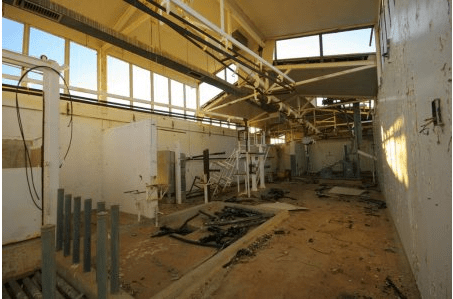
Mudginberri -InsideSource – Splashingpaint.blog.com

Inside the disused Mudginberri abattoir. The animal entered the kill box on the left, when slaughtered hang chain progressed to rear of shed.

Special Mention – The site Splashingpaint.blog.com has some of the most beautiful scenic and wildlife shots of the Northern Territory I have ever seen. it is well worth a view.

 Source

  1. Mudginberri revisted: a case study of a secondary boycott. Green Left. 16.01.13
  2. Mudginberri dispute. Wikipedia 16.01.13
  3. Savannah Responses to Feral Buffalo in Kakadu National park
  4. ‘Australian Livestock Export Trade’ Nigel Austin 2011
  5. ‘Australian Business Law’ 7th Edition. Vickery/Flood 2012.
  6. Competition and Exit in Meat Processing:A QLD Case Study. Agribusiness review 1999
  7. References with their articles (Rolfe 1988),(Reynolds and Sangster 1998b)
  8. ‘The privileged few’ Jeff Hill 2008
  9. Geoffrey Beere. Personal Communication. 23.10.2017.
  10. Price for all when union power met its equal. 12.06.2014.
  11. australianpolitics.com-Andrew Robb Lib-Goldstein Maiden Speech. 29.11.2004.

Australian Abattoirs – Organisation of information

I am still in construction phase of this site and trying to work out what does or doesn’t work. If you have ideas on layout or advice to enhance the capabilities of this site I would be greatly appreciated if you wrote a comment as to what they may be.

Each abattoir is listed under its suburb name, at times this is difficult to ascertain as particularly in WA some people refer to the abattoir by the owners names.

Each abattoir is organised in a basic format.

Name (suburb)

Other known names.

Current Operation

Lists if the abattoir is currently operating as at time of writing.

It doesn’t show if the abattoir opened and closed in periods of its existance.

Location

Location relative to the closest major town centre

Map – Approximate placement in Australia

Detailed map – of its location.

Owner

Listing of owner or owners, company name if available.

Year in brackets is time when that owner took over operation

If available the manager for the time is also listed

Operation

Information in regards to

  • construction costs,
  • types of animals processed
  • Ausmeat accredited.

History

Timelines – years are intended as broad references, they are not always exact and may conflict with other articles.

More recent years the month is also listed

Sources

Most information is sourced by a number.

More detailed information on source information is available in the Information tab, which I intend to add in the future.

Sources are not numbered the same number for article in different abattoirs listings.

Marrakai

Other names

  • Wild Bore

Current Operation


Location 

  • 100km SE of Darwin

Owner   

  • Wild Boar Abattoir

Operation            

  • Pet meat abattoir, couple hundred metres from licensed premises.

History   

1979 

  • Pet meat (horse)was being packed as Buffalo for human consumption1
  • Pet Meat 30c/kg – Buff $1.40/kg1
  • Other litigation pending at Wild Boar at this time


Sources

1.       Royal Commission into Australian Meat Industry A. Woodward 1982

Katherine #2 (Victoria Highway)

Other Names

  • Hookers
  • Northmeat.
  • Katherine
  • Tancreds
  • Teys Bros

Current Operation

  • Closed (2002)

Location              

  • 300km S of Darwin, Victoria Hwy Katherine 3km.

Steers - Slaughter floor

Source – Steers Sale Catalogue September 2012

This was the slaughter floor prior to the auction sale in 2012. Much of the equipment is now removed.

Katherine abattoir

Source – Cattleproducer. Taken February 2013.

Inside the Katherine #2 abattoir boning room.

Steers - Plate FreezersSource – Steers Sales Catalogue. September 2012

Each of these plate freezer rooms could hold one tonne of boxed meat. All these are removed now.

Coolroom areas

Source – Cattleproducer. February 2013.

Inside one of the many coolrooms

Owner/s

  • Hookers – Traded as Northmeat (1963)
  • Manager 1974 – Dick Condon60
  • Norwest – 1976 to atleast 1984. Oprational Manager Ron Goldspring38
    • General Manager Peter Taylor43
    • Managing Director of Norwest Beef Industries (1985) Ron Ibbotson45
  • Northern Meat Exporters12
  • Tancards – Manager Paul Herrod
  • Teys Bros2
  • Teys merged –

Operation          

  • Workers mainly permanent residents

History                

1895

  • Royal commission into the Northern Pastoral Industry recommends the eestablishment of a freezing works for the area45

1950’s

  • Abattoirs in the north were still operated ‘frontier mentality’
    • short processing seasons of 20-25 weeks
    • largley itinerant labour
    • Living and working conditions were dangerous
    • Animal welfare standards were low
    • Sanitation compiled to UK market standardsfor quarter beef, were well below standards for emerging US markets of boxed beef (Pg 64)
  • US grinding beef market of the late 1950’s suited the cattle that were present in the north (Pg 64)
  • Plants were encouraged to upgrade to meet USDA standards (Pg 64)

Prior to 1960

  • Prior to abattoirs being built in Darwin and Katherine cattle had been been previously walked along the Murranji stockroute and others to be processed in facilities in QLD, or to the railhead at Alice Springs. Stock walked North would be sent to abattoirs at Wyndham or prior to that put on barges there and sent to Robbs Jetty, Perth to be processed there33

1960   

  • Hookers took over VRD26 including holdings owned Katherine abattoir & Wyndham30.

1962

  • July. Colonel Rose, former director of the Animal Industry and now in private practice as a consultant urges government to back the proposed Katherine abattoir meatworks63
    • Meatworks is the only chance for a prosperous future in the area63
    • Reports of insufficient cattle to keep the works in operation is not true63
      • Annual surplus of 20,000 head over local requirements with cattle being walked to QLD63.
  • Peter Playfair of the Australian meat packing family is raising finance63
    • reported to already have £200,00063
      • Have applied for aid from the Development bank63
  • Peter Playfair is a senior member of Playfair meat company64.
    • Peter Playfair (DOB 03/04/1920) is a 5th generation of Playfair family65
      • Great Grandfather – John Thomas Playfair (04/03/1833 – 15/11/1893) served as Alderman and Mayor of Sydney for 18 years65
      • Established Homebush saleyards 1882 for £60,00065
        • Homebush became 2000 Olympic venue site
      • Laid foundation stone of Sydney Opera house65
  • Peter Playfair is involved in a serious car accident in Sydney suffering severe injuries requiring brain operation64
  • Hookers Pastoral company begun preparations to build an export abattoir. Peter Fairplay – Meat processor from Eastern states and a backer of scheme. – formed the Northern Meat exporters Association23
  • Northern Meat Exporters Pty Ltd consisted of
    • support of station owners within 500km of Katherine(Pg 64)61

40% – Hookers – who also lent money for operating expenses which was repaid in one  year.
John Swire & Sons Pty Ltd
Killen family
Australian Agricultural Company
Craig Mostyn & Co Pty Ltd
WD & HO Wills (Aust) Ltd
Retreat Holdings Ltd
PH Playfair
RF Condon
33,000 shares also offered to Katherine pastoralists(Pg 145)25

  • Another investor was China Navigation Company, subsidiary of Swire group.(Pg 64)61
    • Held a strategic investment in the abattoir in the 1960’s and early 1970’s.61
    • stimulated export of beef on its vessels from the north.61
  • Built to specifications of US department of Ag – US lean boned out MX markets25
  • Met stringent USDA (USA Dept of agriculture) hygiene regulations4
  • Combined with Darwin – capacity of 60,000hd per year, first time NT had export killing capacity4
  • Built to kill 600 cattle per six day week(Pg 64)61
    • Slaughtering on the first floor, hides and offal treatment below.61
    • Sides  of beef went by ‘lowerator’ to 2 ground floor chillers61
    • Each chiller could hold a days kill61
    • Further cold store could hold 2 days production61
    • After freezing product was trucked to cold stores provided by the commonwealth government in Darwin 300km away.61

1963   

  • Opened Owned by –Operated as  Northmeat8
  • Opened mid season 1963, took 6 months to erect, initial capacity 125 hd a day. Supervisor Richard (Dick) Condon23.
    • R Condon had previously managed Anderson’s works at Roma (Pg 64)61
  • Coincided with opening of the US hamburger trade – ‘Class 3’ or ‘grinding beef’23

“The situation was more amazing in that the export trade was not to consist of Australia’s finest meat from premier producers but, miracle of miracles, bull meat and as much as could be procured!” – Bull meat can absorb at least 20% its own weight of water, therefore could yield 120% when processed23

  • Syndicate of owners formed and export meatworks, Northmeat was built. “This revolutionised the disposal of our cattle. The meat was mostly exported to the USA as hamburger meat!”16
  • Exports to USA from Katherine meatworks– US lean boned out meat worth £7,000
  • Road transport of animals was replacing droving on stockroutes. Murranji stockroute, where cattle normally walked to Wyndham or south, to eventual QLD or Alice Springs declinded to finally stopped being used 1967.33
  • Beef roads project to improve roads in the NT was instrumental in assisting with access and transport of livestock45

1964

Northmeat rego_edited-1

Source http://www.trade.mar.com
Northern Meat Exporters licence.

Wording – Meat in cartons or carcass form for export or local consumption from Katherine, Australia. Reg renewed 09/02/1984, Accepted 03/12/1964, Reg renewed 27/05/1965, Reg 18/12/1969

  • Mr Bryce Killen. Managing director of Northern Meat Exporters66
    • Elected as president of the Federal Inland Development Organisation (FIDO)66
      • Vice president of NSW Graziers Association66
      • Mr Killen owns property at Nyngan (NSW)66
    • FIDO have been pressing federal government to build the Pioneer Highway66
      • Link Bourke with the Barkely Highway with a fully bitumised road66
      • Would link Darwin and the south and open up huge areas of QLD channel country66 .

1965/66

  • Contractors caught bulls on cents per pound meatworks rates – was a better result as the station got less bruising and contractor was paid to look after the animals(Pg 174)60
  • “Katherine meatworks made a big difference to all Territory graziers. It gave them a market for the thousands of bulls being shot because no one wanted to buy them – thank goodness for the Yanks wanting hamburger beef. Up until then the Darwin butchers and the live export trade to the Philippines were the main outlets” Neville Hood. (pg 234)60

1967

  • Exports to USA from Katherine meatworks – US lean boned out meat worth $4M

Aust News Info 1967 A1200_L64219Source Australian News and Info Bureau 1967. A1200 L64219
Cattle at Katherine abattoir waiting for slaughter

Aust News_Info 1967 A1200_L64304Source Australian News and Info Bureau 1967. A1200 L64304
Carcases moving from top processing/slaughter floor to down levels to chillers and boning.

Aust News Info 1967 A1200_L64306Source Australian News and Info Bureau 1967. A1200 L64306
Inside chillers

Aust News Info 1967 A1200_L64300 (2)Source Australian News and Info Bureau 1967. A1200 L64300
Boning Room

1968

  • Laurie Howard – contract Buffalo catcher supplied buffalo to abattoir from Dorisvale (then manager at Dorisvale – Leo Whitely) (Pg 189)60
  • US quota diversification scheme took effect (pg 64)61
    • disadvanteagd northern works who were most suited to grinding markets.61
    • R Condon was chief spokesperson that argued for special consideration of northern works under the US beef quota system61
    • Number of Northern plants received special allocations for US beef quota.61
    • Alice Springs abattoir was given 2,000t quota.61
    • US quota was worth $1B at the time61

1969       

  • Northmeat Meatworks destroyed by fire, rebuilt in 4 months17
  • Significant industrial unrest at the time (Pg 64)61
    • Claims the arson was intentional.62
  • Royal Australian airbase at Tindal was used to fly in parts for the rebuild (Pg 64)
  • Rebuild cost $650,000, capacity 2,000 head a week, a considerable increase on previous operation25
  • Properties were opportunistically harvesting bulls and taking them as they caught them to meatworks  – sometimes 20 head a day during the dry season (Pg 122)60

1970’s   

  • Beef Crisis 1974-7725
  • Opened Easter, killed mainly bullocks and cows prior to July, then culls and bulls after July, closing late dry season3
  • Heavier steers went to SA abs as they paid better than Katherine who did mainly hamburger trade.
  • Lost USDA listing – No clean up had occurred of prior days kill floor and inspector from America seen. Industrial problems and workers were on strike day and a half12

1970         

  • Couldn’t meet USDA standards – lost export licence, so did Derby, Wyndham, Darwin and Katherine4
  • Average price paid, dressed 37.5c/kg28
  • Animal health position taken up by Terry Crowson. palpating lungs for pleuro lesions – pleuro eradication program was drawing to a close60

1972  

  • Average price paid, dressed 48.5c/kg28

1973         

  • Northmeat built a butcher shop in Main street17
  • Katherine meatworks was operational taking bulls and bullocks from Montejinni station (Pg 27)60

1974  

  • Average price paid, dressed 57.3c/kg
  • Manager at site – Dick Condon looked after producers, paying immediately animals were killed.(Pg 121)60
  • Abattoir closed for a period (Pg 122)60

Katherine 1974 PH0091_0114

Source NT Library. hdl 100709545
The Katherine abattoir 1974

Camera shot is looking north. Stockyards that are partially covered in the forground, ramp to the slaughter and processing centre. Main engines and boilers to right, Administration top right, ammenities and canteen to the far left.

NT Library hdl 100705008

Source NT Library. hdl 100705008
The Katherine abattoir 1974

Camera shot is looking south. Workers accomodation in centre, main processing top, administration to the right, hide processing shed to the left.

1974-75  

  • DPI Bribery – $17-20 weekly cash to inspectors – meant to be in lieu of living conditions, payments made 1963 – 197512
  • Most workers living rent free, free electricity in reasonable accommodation1
  • False labelling 1974-1977 – Cow Meat ‘C’ labelled as Steer meat ‘S’, continued even after management confronted about it12

1976  

  • Management bulldozed caravans of workers to fragment
  • Norwest Beef Industries take over operations.38

1976        

  • New management didn’t pay DPI bribes or mis-label meat packaging12
  • Royal commission notes – Abattoir was experiencing problems in other directions12.

1981     

  • Employer tried to induce non union contracts – workers revolted bound by industrial award
    • Old system – Tally – workers slaughtered a set number of beasts a day50
    • New system – court ratified contact – workers paid on productivity50

1982

  • Brucellosis and Tuberculosis eradication program (BTEC) testing beginning57.
    • Aim is to eradicate TB by 199257
    • All properties must reach TB incidence of lower than 0.1% by January 1989 or property will be compolsory destocked57
    • In 1982 – 17 of the 38 properties in Gulf District – (latitude 14’S – 18’S) had a testing programme57
  • Gulf District turnoff – 20,215 cattle – from 33 stations, 72% went to meatworks – Katherine or Tennent Creek – 14,601 going to meatworks – 51% were females57.
    • Turnoff from properties was governed by wet season, road condition and opening of meatworks57
    • Katherine meatworks paying $105 (160kg dressed ox at 65.75c/kg)57
    • Of 18 stations 55.5% had operating costs per beast turn off of $30 to $150 per head sold.57
    • Of 38 stations 13 had herd of 2000 to 4000 head.57
    • Of 38 stations 47.3% had herd with Bos Indicus breeding 60% or greater57
    • Of 38 stations 86.8% had branding rate of 50% or less57
    • Of 18 stations 55.5% had Operating costs of property below $100,000pa57

1983   

  • AMIEU applied to have all abs in NT under wage conditions not contracts. Employers at Katherine opposed
  • Oct. NT Minister for Primary Production seeked certification of NT meatworks to be certified as Halal suitable, Estimated to be worth $200M a year in markets to NT35
  • Nov. Noel Buntine takes over from failed business Buntines Transport to establish – Roadtrains Australia (RTA), orders 14 new prime movers. Will be ready for 1984 season with 17 trucks and fully reconditioned trailers.36
    • Trucks 440hp, total legal length was 17m, this is prime mover and one 40′ trailer40
  • Dec. BTEC campaign, Federal ALP offer $2.4M to accelerate program in NT, is 60% of what was offered Australia wide37
    • Some reports say total $6M for BTEC allocated with $4.4 released immediately, scheme started in 1970, more funding allocated $73.2M by mid 1987.42
  • Funding had been witheld due to an investigation into the program by Federal government41

1984

  • Mar. Loss of Beef export markets from Malaysia, Singapore, Middle East and some EEC markets cost $100M in 1983/1984. Markets lost to competition of South America, 36 of 44 export markets taking less Australian beef. Japanese markets being lost to America38
  • April. Katherine employs 160 people, mostly locals, seasonal operation – April to November average slaughter of 280 head daily, Most beef is sold to US some to Japan, Middle east and UK markets, Up to 1983 season 600,000 head had been slaughtered at Katherine39
  • June. 24 Buffalo slaughtered to trial as a feasiblity study to process Buffalo43

1985   

  • Pastoralists boycotted the abattoir due to AMIEU, Was a drought on NTCA refute vote for boycott was made.
  • Abattoir closed down temporarily1
  • Northwest didn’t open for full season, 140 people umemployed, could be reopened with 30-40 men but not under Union onlyunder NT meat employees Act.49
  • Hookers tried to have all workers on penalty rates, meant menial jobs paid very large, tried to implement same status in Wyndham and Katherine30
  • Had wet canteen on plant site (grog), major problems with reliability of workers30
  • Feb. Northwest put abattoir on market to sell.49
  • Mar. Katherine branch of NTCA (Northern Territory Cattlemans Association) is formed44
  • May. Editorial in paper.“Every year it becomes a farce whereby the meatworks and the meatworkers have a slinging match against one another”48
    • Abattoir still closed up to May from wet season normal closure.48
    • Pat Roughan – National organiser AMIEU – letters to paper. Wants the contract system abolished in smaller abattoir such as Victoria river and Mudginberry. “These picket lines have been gallently manned by Katherine meant workers in protective defence of union conditions and principals”48
    • 11,600 cattle, 1,200 buffalo across NT abattoirs, YTD 20,300 cattle 16,00 buffalo47
    • 10,000 t worth $30M held in cold storage in Australia due to lack of shipping services. causing delays and extra costs47
    • Cattle Prices dressed47
      • Bulls >250kg 85-148c/kg,
      • Steers 180-250kg 65-158 c/kg
      • Cows 160-200kg 55-151c/kg
  • July. Local meatworkers concerned about ‘travelling interstate knife men’ replacing their employment45
  • August. Mudginberri meatworks operator offers to buy Katherine meatworks – to have operating within 4 weeks.49
  • AMIEU – Jack O’Toole refuse to negotiate staff requirements49
  • Katherine abattoir kill costs $158.40 / beast, other abattoirs less than $50, Katherine had highest processing works costs of any abaottoir in Australia
    50

    • Mudginberri & Victoria River used contract system – lifted productivity 4 fold, carcase cost fallen from $150 tp $4050
  • Katherine stronghold of AMIEU. Abattoir management siad last season would not open unless change in award conditions.50
    • AMIEU claimed closing Mudginberri & Victoria river would ensure Katherine remains open50
    • “it is about time that the public realized this is not jsut a dispute over awards but the right of a democratically elected union to negotiate on behalf of its members” Les George – meatworker51
  • 300,000 cattle normally slaughtered in NT, 2/3 sent interstate.50
  • AMIEU disputes disrupted 4 abattoirs – Pt Stuart – bankrupted, Tennent ck – opening halted, Mudginberri & Victoria River.50
  • 70% of cattle from Katherine area, poor quality, feral shorthorns whos meat is used for manufacturing purposes50
  • National Farmers Federation raise $800,000 so far of target $2M for fighting fund to assist Jay Pendarvis53
  • Dispute had so far caused 2 24 hour national meatworkers strikes and a national waterfront strike52
  • Nov. Workers indicate they are willing to work under NT meatworkers award54
  • Katherine meatworks now been closed for 2 years, only about 60 of previous employees remained in town.54
  • Overseas markets would have to improve to enable works to open54
  • Wage comparison –
    • Meatworker at Mudginberri 36 hour week earning $1000/week52
    • NT Government postion advertised – Library traneeship – 1986 – Adult wage $16521 – $18351 pa ($317- $352 week)55
  •          

1987 

  • New owners (purchased Wyndham as well) used material from Wyndham abattoir to improve and enlarge Katherine1
  • Shut Wyndham down completely30
  • Teys were major Australian meat processors in own right before buying the NT abattoir, purchased to use quota for USA orders30
  • 1st year – processed 50,000 – over years up to 300,000 cattle, mainly bulls, 10,000 buffalo a year1
  • New management reopened. Contract system no Unions. Known union activists were blacklisted,half work force of previously1
    • 250 people apply at newly opened works for employment56
  • Teys worked plant for a number of years – Purchased about 1985. Before closure manager sent a letter to pastoralists asking if they would supply to ab, needed minimum 20,000 hd to be profitable to process, was assured 23,000 hd. Teys still closed as they didn’t view as viable, Teys owned other plants in QLD13.
  • Plant could have been scaled back to only 150/day, could have survived, idea was to set up small boning room on floor next to kill floor, hot bone meat and plate freezers30.
  • At height of BTEC – had 13 boners, killed 750 head a day and worked 7 days a week1.
  • Selling markets – US – 90-95CL and Korea  ¼ ‘s frozen, also cattle from Alice – if 4 tooth processed to EU1.
  • Cattle cheap – cows $70, foetal blood $120/lt – Cancer research, tripe /Stomach/Honeycomb  to Japan selling more than fillet, killing costs about $110 hd1.
  • Heavy bullocks cost $40 to process30
  • Buff selling to Germany $4/kg. Only wanted feral, not domesicated1
  • Buffalo – able to be processed and freighted for $2/kg
  • Transport –
  • Was costing 3.5-4c /kg to transport meat to Darwin –transporter changed and AQIS required meat to be exported via Brisbane, eventually had to go through Brisbane costing 40c/kg1
  • Survived because hot boned– comes away from bone better, bagged then blast freezed1.
  • If plant shut down cost $20,000 a day, yards could hold 5000hd1
  • Made substantial saving by reprocessing of tallow to use for furnaces, Initially had to transport in Furnace oil at $300/t from Townsville, by using own tallow were able to reduce costs by over $100/t
  • AUSMEAT, caused huge problems – Korea liked meat in a particular colour bag, Ausmeat dictated another colour, AQIS Rejected a whole consignment because not in right bags, Korea rejected other colour bags and lost whole market1
  • 1000lt of water for every beast processed1
  • Processed Camels at times, and horses but welfare for horses (pet meat)was extremely difficult due to panic in transport, only tried once30
  • Normal operation was 4 month shutdown over ‘wet’, do maintenance and repairs30

1989-99  

  • Was a Chinese buyer interested but Teys refused to sell to control market, wanted to have pastoralist pay for freight of delivery of animals to eastern abs, transport was very costly once boxed30
  • Plant not active4
    • Inbetween period of 1993-1997 – Historic article notes – trouble plant closes, article is unclear when or how often it closes.56

1992

  • Department of primary production aim to eradicate both tuberculosis and brucellosis from the NT57
  • AMH considered making a bid for the Katherine works.(Pg 68)61
    • at the time they had Mt Isa, Tennant creek (NT), Townsville and Pentland (QLD)61
    • Economics of the operation of the other works and Katherine were dependent on them not being competitive against each other.61
    • AMH inspected and made a bid on the plant but were out bid by Packers Consolidated Meat Group (CMG)61
  • Transport efficencies made cattle more marketable from the NT by moving them to QLD processors and fattening areas. (Pg 67)61

2001    

  • Teys closed – Stated couldn’t compete with LE6
  • Factors affecting closure (Pg 67)61
    • Lack of competitive shipping service, especially containers.61
    • Lack of skilled labour61
    • Industrial unrest61
    • US quota arrangements61
    • seasonality of operations61
    • ongoing abattoir rationalisation61
    • Growth of the Live export trade in to SE Asia(Pg 67)61
      • Between 1990-1996 live cattle exports increased from 97,556 to 723,085 head61
      • A processing plant working for 180 days, processing 500 head a day would require 90,000 head61
      • Live exports represented 6-7 meatworks61
      • Producers could turn off younger cattle and not hold for 4 years for local processors.61

2002        

  • Last kill5
  • Teys Bros and CMG Merge18
  • CMG consider reopening to meet demands of US beef quotas28
  • Maintenance work had been kept up to date at plant so it still retained its current export licence28
  • Rockhamptons Lake Creek was having industrial problems, oversupply of cattle in QLD due to lack of rain and US market uncertainty28
  • Strength of LE had kept plant in mothballs for last 2 years28

2003

  • Feasibility study conducted by Teys to determine Katherine meatworks future. Chairman – Alan Teys, said the abattoir was unable to compete with the Live export trade19.
  • Feasibility study found not viable to re-open the meatworks, considered feasibility of processing 30,000hd20

2004

  • Consideration by Teys to re-open20.
  • Decrease in LE has provided some opening, LE would have to continue to decline to ensure profitability in the long term22
  • Free trade agreement with USA would have little benefit to the Abattoir22

2009  

  • Consideration given to process camels – Ivan Coulter21
  • Proposal – Multi species abattoir. Processing each year 60,000 camels, 800 buffalo, 50,000 brumbies

2010   

  • Darwin Investment Group – CEO John Hughes,considered purchasing6
  • John Hughes – was former general manager for Teys – when owned Katherine11
  • Requires $5-6M not including Government support10
  • To process 500 animals a day 5 days a week11
  • Accommodation shortage was issue in Katherine, no land releases had occurred in 10 years in area11
  • Plans to reopen abandoned – ferals, camel, buffalo & donkey, maybe horses and cattle outside 350kg Indo weight restrictions5
  • Require $20M – power, water – Unable to source Federal or state funding5
  • July – Darwin investment group withdraw – due to lack of financial support, government and others???? Water licence on the site required upgrading, aswel as power. Freight was an issue15
    • “Katherine has challenges in relation to labour, We know accommodation is short in Katherine, so it’s always going to be difficult, In the ideal world Darwin is the best place for a northern abattoir with its proximity to transport and infrastructure” Luke Bowen NTCA CEO34
  • Export prices for steers ranged from $1.85/kg – $2.10/kg57
  • 2010 Pastoral Industry survey57
    • Katherine properties 78% Brahman, Top End 83% Brahman herds.57
    • Turnoff to Live export – Katherine 80% of turnoff, Top End 87%, Barkly 39%, Alice Springs region 8%57
  • August. Northern Territory cattle being sent interstate for processing58
    • Between 30-50 decks of Territory cattle heading to QLD and NSW meatworks a week.58
      • About 900-1500 head a week58
    • Alice Springs had sent 10,000 head from Territory to South Australia and Victoria so far this year58
      • Another 10,000 expected to follow over the next few months.58

2011

  • Teys decide to liquidate Katherine #2 and Innisfail abattoir (QLD)59, closed since 2006.
    • Assets to be cut up and sold as scrap metal.59

2012

  • September – Assets sold from Katherine Abattoir7

2013  

Jo Bloomfield views.

Difficulty in re-establishment of this plant even though seemingly so much is still in place.

  • Some equipment is gone from inside the abattoir, plate freezing facilities, some specialised equipment from the slaughter floor, boning and packing rooms.
  •  Technology is so out of date whole abattoir requires gutting, Ausmeat, CL, computerised technology and processing facility efficiency. Had assesments done for gas/refrigeration for Katherine and Batchalor – Batchalor was most feasible32.
  • Feasiblity of Katherine estimates $40,000 a day just to run32.
  • I would doubt that government would give permission to allow the abs to restart due to close proximity to the urban areas of Katherine.
  • Effluent ponds and much of the outside landscape is changed too or removed. To meet Environmental requirements doubt if would be able to obtain permission.
  • reportedly $20M to meet current AQIS requirements, unsure as to what capacity this was intended. Says needed substantial investment from government for water, electricity and gas supplies.

Source

  1. Personal Communication #1 Oct 2012
  2. ‘Another northern Abattoir bites the dust’ABC rural 21.09.11
  3. Personal Communication. #2  Jan 2013
  4. ‘Sailing ahead’ Annabelle Coppin 2009
  5. ‘Teys Bros take back Katherine meat works’ Meat trade daily 14.08.10
  6. ‘Katherine abattoir set to reopen and go feral’ ABC rural. 07.06.10
  7. ‘Katherine abattoir finally put down’ ABC rural 15.09.11
  8. www.darwineguide.com.
  9. ‘Meat Monopolies’ Northern Standard 07.03.47
  10. ‘Katherine abattoir bought with high hopes’ ABC Rural 08.06.10
  11. ‘Katherine abattoir plans could create 200 jobs’ Nth QLD Register 18.06.10
  12. Royal Commission into Australian Meat Industry A Woodward 1982
  13. Personal Communication #3 Feb 2013
  14. ‘The Track: 1000 miles to war’ NT Library
  15. ‘Katherine abattoir plans shelved’ ABC rural. 15.07.10
  16. D.M Carment. Recollections. 2000.
  17. Katherine Museum. 25.02.13
  18. ‘Teys/CMG Merger’ QLD Country Life. 19.10.02
  19. ‘Feasibility study to determine Katherine Meatworks future’ NT country Hour 19.09.03
  20. ‘Future of Katherine meatworks still uncertain’ NT Country Hour 20.10.04
  21. ‘Camels on the agenda for Katherine abattoir’ ABC rural. 26.08.09
  22. ‘Teys kills off hopes of Katherine slaughterhouse’ NT Country Hour 12.02.04
  23. ‘Wild Cattle Wild Country’ Ann Marie Ingham. 2007
  24. ‘Katherines No lady’ Winsome Maff
  25. ‘The Big Run – The Story of VRD station’ Jock Makin 1970
  26. ‘Pastoral Australia: Fortunes, Failures & Hard Yakka: A historical view..” M. Pearson, J Lennon. 2010
  27. ‘Meatworks project for N. Territory’ The Canberra times. 21.11.52
  28. ‘Economics of Agricultural development in Northern Australia’ B Davidson 1974.
  29. ‘CMG new hope for Katherine’ QLD country life. 11.07.02
  30. Personal Communication – #3 17.03.13.
  31. Cattleproducer.wordpress.com Photos – 28.02.13
  32. Personal Communication. #4.23.03.13.
  33. ‘The Murrranji track – Ghost road of the drovers’ Darrell Lewis. 2007
  34. ‘Future Katherine abattoir no certainty’ http://www.efarming.com.au. 16.07.10
  35. ‘Tuxworth wants muslim meat market’ Katherine Times 13.10.1983
  36. ‘Buntine is back in transport business’ Katherine Times 24.11.1983
  37. ‘Collins on BTEC campaign’ Katherine Times 01.12.1983
  38. ‘Loss in beef exports’ Katherine Times 29.03.1984
  39. ‘Abattoirs’ Katherine Times 05.04.1984
  40. ‘Mack Superline in 17 metres’ Katherine Times 12.04.1984
  41. ‘Brucellosis and TB Funds’ Katherine Times 10.05.1984
  42. ‘Senator calls for increased BTEC funding’ Katherine Times 14.06.1984
  43. ‘Buffaloes Slaughtered’ Katherine Times 14.06.1984
  44. ‘Cattlemen meet in Katherine’ Katherine Times. 28.03.1985
  45. ‘Roger Steele meets with meatworkers’ Katherine Times 11.07.1983;
  46. ‘Station profile’ Katherine Times 06.06.1985
  47. ‘Cattle and Buffalo Market report’ Katherine Times 01.08.1985
  48. Editorial and letters to Editor. Katherine Times. 30.05.1985
  49. ‘Works sale halted’ Katherine Times 15.08.1985
  50. ‘Industry roped and ready for slaughter’ Katherine Times 22.08.1985
  51. ‘Proud to be a meatworker’ Katherine times 29.08.1985
  52. ‘Pendarvis worried despite picket retreat’ Katherine times 12.09.1985
  53. ‘NFF says arbitration should be bypassed’ Katherine Times 12.09.1985
  54. ‘Union to work meatworks’ Katherine Times 21.11.1985
  55. Advertisement, Katherine Times 28.11.1985
  56. ‘History of Katherine’ Katherine Times 12.06.2013
  57. ‘The Elsey and Gulf districts Cattle industry survey 1982’ Agdex 420/853. J.Mitchell.
  58. ‘Government’s lack of support hurt Katherine abattoir plan’ Willem Westra van Holthe MLA 04.08.2010
  59. ‘AAco on track for Darwin abattoir’ Beef Central 26.09.2011
  60. ‘The privileged few’ Jeff Hill, 2008m
  61. ‘World on a plate – A history of meat processing in Australia’ Stephen Martyn 2013
  62. Personal communication. J.Condon.
  63. ‘Opposition to abattoir’ Centralian Advocate 27.07.1962
  64. ‘Mr Playfair’s Injuries serious’ Centralian Advocate 27.07.1962
  65. Playfair descendants. www.airgate.com.au
  66. ‘FIDO president is NT land holder’ Centralian Advocate 26.06.1964

Alice Springs #1 (The Gap)

Current Operation 

  • Demolished 1968. New abattoir built Alice Springs #2 (Ghan Rd)

 Location 

  •  North of The Gap, South of  Gap view Motel. Area is now a grassed reserve.

Map. Alice Springs


Operation

gap-abattoir-1958

Source – National Archives – Dated 1958

History

  •  1st abattoir- The Gap
  • Built by army2.

1870

  • South Australian Government undertake building a telegraph line from Adelaide to Darwin to link with the international system coming from the Far East4.

1871

  • March 11. A gap is found through the MacDonnell Ranges, Area now called Alice Springs4.

1872

  • First Pastoral lease of the Alice Springs area is granted4.
    • Undoolya station, Aboriginal meaning ‘Shadow’

War years

  • Abattoir was built by the army and handed to government administration after the war5

1949

  • Central Australian Pastoral lessees Association approach Commonwealth government to establish a meat works in Alice Springs3

1954

  • Alice Springs butchers apply for increase in price of all meat to cover increased government fees of slaughter and inspection charges conducted at the abattoir5
    • Cattle
      • Old fees. Inspection 1/6, slaughtering 3/65
      • New fees. Inspection 5/-, slaughtering 33/65
    • Sheep and Goats
      • Old fees. Inspection 6d, slaughtering 33/65
      • New fees Inspection 1/6, slaughtering 6/65
    • Pigs
      • Old fees. Inspection 9d, slaughtering 1/95
      • New fees. Inspection 2/-, slaughtering 15/65
    • Increases amount to an extra £3,000 per year, 800% increase on previous rates5.
  • Up to the 30/06/1954 following numbers of stock were slaughtered for  local consumption5
    • Cattle 788 head5
    • Sheep 2,770 head5
    • Pigs 381 head5
  • Government had maintained the abattoir at a loss5
    • employed one man full time to clean and maintain the facility5
    • Stock inspector visited 3 times per week5

1960

  • Major drought in the region4
    • Became the worst in history at the time, not breaking until 1966

1963

img_0023

Source. Alice Springs Library. Town Planning 1963

Town Planning map of 1963 showing the location of the Slaughter reserve in ‘The Gap’ area of Alice springs. Now the area is a grass reserve

1966.

  • Major drought that began in 1960 is broken by one fall of 6″4
    • further rains followed several weeks later

1968 

  • Buildings sub standard and no longer met hygiene standards2
  • Demolished and new abattoir site Ghan Road. Alice Springs #2.

Sources

  1. Removed
  2. ‘$370,000 abattoir’ Centralian Advocate 23.03.68
  3. ‘Pastoralis want meat works here’ Centralian Advocate 29.07.1949
  4. ‘Pastoral Properties of Australia’ Peter Taylor 1984
  5. ‘Butchers hit by abattoir fee increase – apply for a price rise’ Centralian advocate 13.08.1954