Current Operation
- Closed, burnt down 1988.
Location
- Smith St beside railway siding, is now abandoned and derelict with some area of the lot used as a storage and freight depot.

Locations of other Australian abattoirs
Owner
- As at 1984. Wales meat. (Sydney based)6
Operation
- Employed 130 workers4.
History
- 1st abattoir- The Gap
- Built by army2.
- Buildings sub standard and no longer met hygiene standards in 1968. Location was in a increasinly urbanised section of town and a major access point through the Gap.
Authors Note. In researching this site I came across a number of adverts which I think illustrate that period of time technology and thoughts. They are not necessarily in relation specifically to the Alice Springs Smith street abattoir.
1960

Source. Beef in Northern Australia – JH Kelly. 1971. Pg 9
1962
- Australian Labor party branch meeting complain of deplorable conditions at the Alice Springs abattoir (Alice Springs #1. The Gap). Describing conditions as a major health hazard for Alice Springs12.
- Consideration is urged to build a new abattoir further from the town.
- Local butchers were disgusted with the slaughter conditions and lack of fly proofing of the facility with meat often covered in flies.
- Meat was at time blown by the time it was collected.
- Blood and offal was allowed to lie in heaps on the open ground
- Complaints had been made in the past 12 months with some improvements occurring.
- A pressing need was for a cool-room to be constructed to hold slaughtered meat
1963
- Darwin. A £300,000 export and home market abattoir will be opening in Darwin in Mid May13..
- Being built by William Angliss – a subsidiary of the British company Vesteys Limited.
- Company paid £5/10/0 per 100lbs dressed weight
- The highest price paid to Top End Cattlemen ever.
- Hong Kong markets pay 5 and half d. per pound on the hoof.
- A private company has lodged plans to open an abattoir in Katherine costing £200,000
- Katherine company announced it would pay £5 per 100lbs dressed weight and would be operating by the end of March
- Two abattoirs in the Top end will mean the first competitive market that Top End cattle have ever had
- “It could lead to increased prices and stability in a shaky industry” Director of Animal Industries Mr Whittam
- October. Katherine and Darwin abattoirs are forced to delay killing stock as their coldstores are full due to delays in ships loading meat at the Darwin Port87.
- Katherine abattoir may be forced to close a month early for the season87
1964
- July. Katherine abattoir operation is being impacted by high electricity and freezer charges, shocking road conditions and inadequate loan funding from the government14.
- Drought conditions are prevailing in the Alice Springs area with some areas having received only light falls in early June15..
- Cattle are generally in poor condition in the area
- September. Top End abattoirs may be forced to slow down operations due to uneconomic levels because of low cattle number supply for coming season16..
- Reports indicate Katherine and 10 mile abattoir were currently working at capacity
- Numbers of stock were available but higher meat prices needed to paid and better control of stock on properties was required.
- Mataranka station was fencing at area at £300 a mile
- prices of fencing were considered crippling unless higher stock prices were received
- 30,000 cattle were killed at the 2 meatworks this season
- Each was expected to end their seasons in a few weeks
- Mataranka station was fencing at area at £300 a mile
1965
- March. Unsigned Letter to the Editor of Centralian Advocate indicates that a new abattoir site is being considered beside the one being suggested at the current trucking yards (Smith Street)88
- Water supply is an issue as water is gravity fed in Alice Springs at this time88
- there is a bitumen road to the site and cattle are already trucked there to reach the railway siding for loading88
1968
- US quota diversification scheme took effect (pg 64)10.
- disadvanteagd northern works who were most suited to grinding markets.10
- R Condon – Katherine #2 (NT) was chief spokesperson that argued for special consideration of northern works under the US beef quota system10
- Number of Northern plants received special allocations for US beef quota.10
- Alice Springs abattoir was given 2,000t quota to US.10
- US quota was worth $1B at the time10
- March. Announcement in Canberra calling for tenders to build new abattoir2
- Based on a plan would allow for expansion to overseas export markets2
- Costs of Killing charges would have to be adjusted for new facilities, cost to build $370,0002
- June. Difficulty in settling contracts for construction and tenders3
- Intended to be a multi purpose – as in kill local and export3
- Building intended to start before the end of the year3
- October. Site was constructed west of town, next to railway trucking yard4
- Contractors to build – West Australian Contractors Universal constructions Pty Ltd4
- Scheduled to open March 19694
- Provided the sub-contractors were ready to begin
- Work had begun on the killing floor (first floor above the ground)
- require 160 cubic yards of concrete
- Cattle race and another for pigs and sheep had been poured and wooden slats would be laid in them
- Frames and floor of the skin drying shed have been completed
- Earthworks around the abattoir had been completed except diversion of the creek.
- mains water had been laid
- Set up to kill cattle, pigs and sheep
1969
- February. Abattoir is nearing completion of first stage and is available for lease or purchase17.
- Applications could be made and received to the close of 2pm 28/03/196917
- Government was under no obligation to accept any offers17
- Government had always intended that private enterprise take over the abattoir19
- Abattoir had been built to plans prepared under the supervision of the Commonwealth department of Primary Industries17.
- Would initially only cater to local requirements17
- Met the standards of export and modern hygiene requirements18
- Complete on the rail dressing
- carcases never touched the floor
- Large storage chillers
- Complete on the rail dressing
- Design allowed for considerably higher kill capacity than old facility18
- as requested by the pastoral community18
- take advantage of opportunities to export interstate chilled quarters18
- as requested by the pastoral community18
- Designed for throughput of 10,000 head per year19
- Capable of further expansion if required
- Construction was hoped to be finished by late April17
- November. New Alice Springs abattoir would be opened by mid December18
- Government charges would be significantly increased for inspection and slaughter with the government subsidising by about $3 per head18
- Killing charge from $1.95 to $10.70 per head
- Butchers estimate charges would raise price of meat 7c per lb
- Comparable abattoirs – Darwin were charged $10.25 per head including the killing.
- Alice Springs butchers were expected to provide their own labour while the government ran the abattoir pending a lease or sale
- Minor items of equipment remained to be installed18.
- Government were expected to soon close the old abattoir at Gap road (Alice Springs #1) and withdraw the inspector there18.
- Force the new abattoir to be used as no meat can be sold for human consumption unless it has been inspected
- Higher kill capacity resulted in higher interest and depreciation charges on a “per head” basis
- Costs would be reviewed.
- December. 2 butchers announce they will refuse to use the new abattoir under the planned charges19
- Mr Terry Leigh and Mr George Summers
1970
- March. Abattoir is sold to an Alice Springs Company $452,30019
- Company. Alice Springs Abattoir Pty Ltd19
- Chairman of Directors Mr Terry Leigh (butcher by trade)19
- Directors. Ted Hayes, Brian Bowman, Wally Mason and Tony Chisholm20
- Secretary Mr Peter Batty20
- Board comprised of town people, pastoralists and butchers19
- Mr George Summers is involved in the company19
- General Manager Mr Gerry Gentle20
- Shareholders include current town Mayor. Mr Jock Nelson20
- 25 shareholders in total90
- Local kill was planned initially19
- for local butchers and delivery to their shops
- By Products plant was being installed costing $70,00019
- Produce blood and bone, manure and tallow
- Installation of the by-products plant would enable better economic operation of the plant and it could better kill chilled beef for southern states19
- Anticipated that initial kill would be 100 head of cattle per week19
- Killing to occur one day a week
- Employing 10 people
- Government was now installing bitumen access roads19
- Company. Alice Springs Abattoir Pty Ltd19
- Local pastoralists are trucking cattle via the trains south to Maree and South Australia19
- Agreement to purchase at $452,000 based on a 40 year low-interest loan90

Source – National Library of Australia. Alice Springs abattoir 1970

Source – National Library of Australia. Alice Springs abattoir 1970

Source – National Library of Australia. Alice Springs abattoir 1970

Source. P. Bloomfield. 1970’s
Cattle in the yards at the Ghan rd abattoir.
 Source P. Bloomfield. 1970’s
Shorthorn steers at the Ghan road abattoir.
 Source P. Bloomfield. 1970’s
Cattle train – Alice Springs.
1972

An advert in the Centralian Advocate for Haulmark Trailers dated 18/05/1972
- May. Alice Springs Abattoir Pty Ltd is threatened with closure due to unpaid debt20
- Building contractors – Ferrari and Co were proceeding against the abattoir for $20,73120.
- Built and amenities block and an concrete enclosure for transformers
- Before the petition for winding up the Alice Springs company abattoir could be presented the Alice Springs abattoir company obtained a interlocutory injunction to prevent it (petition) being lodged for one week20
- Delegation from the company and NT governments meet in Canberra with Prime Minister Mr McMahon20
- Delegation were to discuss obtaining guarantee of a loan to allow the abattoir to continue functioning under its present ownership
- More than $100,000 of the paid up capital was from local sources
- Locals and pastoralist would be hurt by the closure
- Alice Springs abattoir company had rejected an offer to manage the abattoir by John Nankervis (Mudginberri)20
- Mr Nankervis was part owner, director and works manager of the Victorian meat company, H.W.Wilson Pty Ltd
- Would have sought and interest, likely a controlling interest to manage the facility
- Building contractors – Ferrari and Co were proceeding against the abattoir for $20,73120.
- October. Minister for Primary Industries Mr Ian Sinclair inspects facility and listens to suggestions for improving its throughput21.
- Acknowledged financial difficulties of the operating company
- Suggestion that the mutton chain should be removed21
- Tuberculosis-reactive cattle were now being killed at the facility21
- Meat went through certain processes and was safe for human consumption
- America were still buying this sort of meat
- South Australia would likely come into line and implement a program to eradicate TB and Brucellosis21.
- Federal government would ramp up the national TB and Brucellosis eradication campaign21
- Failure to eradicate the disease would affect export markets21
- It was hoped a scheme of compensation to the producers for the campaign would be formulate21
- Pastoralists were now getting ‘decent’ money for beef cattle and had the chance to meet the changing demands of the market21
- December. Rainfall for the year is a record 903mm recorded at Alice Springs Post Office99
- 778mm recorded at the Airport99
1973.
- Australia answers a request by US Nixon administration to increase beef exports at short notice to the US to solve a domestic supply problem101
1975
- October. Industries Assistance Commission releases ‘Meat report’89
- Doesn’t recommend freight subsidies to Central Australian Cattle Producers89
- If a farm business is deemed non-viable by rural reconstruction authorities there could be provided a living for up to one year equivalent to unemployment benefits of the time89
- Loans limited to $15,000, at interest rates below 4%. Repayment after 2 years for purpose of carry-on finance89
- Meat export charge of 1.6 cents per pound remains. 0.6c goes towards BTEC program, 1c is used to recoup export meat inspection costs89
- Some beef producers were unable to turn off cattle as costs of freight to markets was costing more than was being received for sale of the animals89
- further supply of cattle to already low markets could actually drive prices lower89
- Mustering assistance was not made to producers who were bringing cattle together for the BTEC program89
- Some beef producers were unable to turn off cattle as costs of freight to markets was costing more than was being received for sale of the animals89
- 3 local producers and a butcher propose building a third abattoir90
- Wamboden abattoir NT
- Dissatisfaction with the operation of the Alice Springs abattoir90
- Producers think the works should look beyond supply of only the domestic market of Alice Springs
- Alice Springs abattoir would lodge an objection to Wamboden but was unlikely to be successful in stopping the proposal90
- Current manager. Terry Leigh90
- Secretary Geoff Holdich90
- Alice Springs was currently killing 160 – 200 head a week90
- Capacity was 400 per week90
- Value of the works was now estimated at $1M90
- Loan agreement taken out in 1970/ 71 purchase was arranged for 40 years as low-interest90
- Payments to the government would be up to date by December 197590
- Current assessment of market opportunities made upgrades to the facility to meet export requirements not profitable90
- Upgrades would cost $300,00090
- Installation required of boning room, blast freezers, more cold storage and general improvements such as tiling throughout the works90
- Upgrades would cost $300,00090
- Meat quality was an issue with quality of stock on the general market too fat and not sought after by southern butchers90
- Most Centralian beef was exported for manufacturing purposes90
- A local restaurant was advertising it only served meat imported from the south.90
- Profitability of serving a wider market was doubtful under present market conditions90
- Stock purchased from Haasts Bluff area (200 east of Alice Springs) for $10 per head on property90
- Transport to Alice cost $13.70
- Killing fee was $29.29 (slightly less than Adelaide)
- Freight to Adelaide $16.27
- Re-inspection and insurance $6.50
- Made the average carcase cost $75.76 landed Adelaide
- Price paid was 10c pound, average carcase weighed at 651 pounds90
- Average carcase returned $65.10
- Loss of $10.66 realised
- Average carcase returned $65.10
- Local meat wholesalers were negotiating further contracts with southern retailers increasing a planned order to 200 carcases per week90
- Stock purchased from Haasts Bluff area (200 east of Alice Springs) for $10 per head on property90
- Alice Springs abattoir committee management had approached Wamboden group opportunity to obtain financial interest and take part in management at the Alice Plant90
- Wamboden group declined90
- Wamboden abattoir begins operations and supplies meat to Gillen Meat store, IL Sorrentino and Woolworths91

Source Centralian Advocate 13.11.1975
Advertisement placed to sell meat from the local butcher IL Sorrentin Butchers
- Cattle turnoff in November from the Alice Springs area totalled 898 head92.
- 451 to local butchers
- 376 fats and 75 store
- Alice Springs yard trucked 407
- MacDonnell yard trucked 185
- Finke yard trucked 306
- 451 to local butchers
- December. Cattle train from Alice Springs is cancelled as producers are concerned freight costs will exceed sale price of the stock93.
- Good rains are received in the area with cattle prices also improving94
- Large numbers of stock in the region due to build up and result of low prices and good seasons
- December. Rainfall recorded for the region99
- Alice Springs Post Office 684mm99
- Alice springs Airport record 600mm99
1976.
- January. Cattlemen’s Association of North Australia (CANA) feels better beef prices are about to occur100
- Current president of CANA Bill Tapp100
- Forecast $15 per 100kg at the opening of the season100
- Return to the producer has been low100
- Expected beef prices to improve by 30%100
- Government were negotiating better export deals100
- 90 – 96% of beef is being exported100
- US market forecast to take 300,000 tonnes in coming year100
- Note – later document states that 300,000 will be the increased amount.
- represent 4% of total American consumption100
- Japan is expected to take 80,000 – 90,000 tonnes100
- Rest of export will go to SE Asia and Europe100
- 90 – 96% of beef is being exported100
- Rising abattoir costs and lack of slaughtering capacity in the NT for expected 190,000 cattle turn off is affecting producer returns100
- Abattoir capacity in the NT at the present time only had 100,000 head capacity100
- US increase beef import quotas101.
- Quota will be 4.2% above the previous year101
- Secure an additional 300,000 t101.
- US export represents 52-53% of total American imports101.
- Irish had been given a quota in 1974 that they did not take up and could be possibly given to Australian exporters101
- Quota will be 4.2% above the previous year101
- February. Alice Springs abattoir meat inspector is withdrawn for one week until minor repairs are conducted on the killing floor102
- re-packing of corroded insulation covers on some steam pipes102
- Current abattoir manager – Terry Leigh102
- Significant flooding in the area had affected stock supplies102
1977
- March.Wales Australian Resources Pty Ltd, owners of the facility give assurance that it would kill stock for the local market in Alice Springs95
- $2M investment will be used to purchase and upgrade the facility to export standard95
- Hopes to gain US export licence through government assistance95
- Meeting was held 07/03/1977 with interested persons and government to consider the matter95.
- US export market would allow the abattoir to purchase all types of stock including cows and store cattle that were presently unsaleable95.
- $2M investment will be used to purchase and upgrade the facility to export standard95
- Managing director – George Whitaker95
- Current local market within the NT was insufficient to make the works viable for supply of only domestic product95
- Properties were currently overstocked which was of concern to the Government and NT Soil conservation Board95
- Abattoir is hoped to be back in production by the end of May95
- June. Alice Springs abattoir operators delay commencement of killing from expected May 3022.
- company would not commence killing for the domestic market before killing for the export because it may prejudice the grading of the export licence requirements22
- Killing was now expected to begin mid July22.
- New Owners of Alice Springs abattoir are said to have invested millions of dollars22.
- No guarantee and export quota would be allocated to them
- If the abattoir applies for a licence it will require Australian and American inspections
- If USDA quota is allocated it would enhance the viability of the facility
- At the moment there is only one standard of export licence that currently satisfies the USDA requirements
- The abattoir has important function to process domestic kill for export and local sale.
- Alice Springs area if heavily overstocked at the present time
- September. Facility is opened after a $2M refit of equipment23
- November. Facility is shut due to rain and lack of markets forced a shutdown23
- Of the 150 employees 145 were laid off
- Peak of production 450 cattle a day were being killed
- Capable of throughput of 600 head
- At operation of 600 head a day the facility would have employed 200 people
- Capable of throughput of 600 head
1978
- January. Centralian beef producers support their claim for an American beef quota for the Alice Springs abattoir28
- Meat and Livestock Corporation had decided not to grant an export quota to Alice Springs28
- newly constructed facility had to earn a quota under the meat diversification scheme
- that could take a long time
- Blue tongue virus restrictions prevented cattle being allowed to move interstate
- Alice Springs was free of Blue tongue but was a buffer zone.
- QLD had recently lifted transport restrictions with NSW currently considering lifting them also
- SA still had a ban in place of cattle transported from the NT
- Alice Springs would like 10,000 t of the as yet unallocated 30,000t
- If the abattoir could not get a quota then an assistance scheme for local producers should apply to allow livestock to be transported to Adeliade28
- newly constructed facility had to earn a quota under the meat diversification scheme
- Meat and Livestock Corporation had decided not to grant an export quota to Alice Springs28
- Operations were scheduled to resume 10/01/1978 but will depend if markets can be found23
- future largely depended on the allocation of a quota
- Current manager of Alice Springs abattoir. Mr Lindsay Hart23
- No other markets were available that warranted opening of the facility23
- Australian Meat and Livestock Corporation (AMLC) allocate quotas according to past performance of the facility103
- Put Alice Springs at a distinct disadvantage to other processors103.
- perpetuated benefits to established exporters103
- New works were being locked out of the lucrative USA, Japan and Canada markets103
- Alice Springs was the only area in Australia without a quota103
- Cattlemen claimed that an export quota would ease their financial and overstocking problems as there was no economic market for low grade stock because of high freight costs103.
- Some reports say Alice Springs region is overstocked by 50%
- Cattlemen claimed that an export quota would ease their financial and overstocking problems as there was no economic market for low grade stock because of high freight costs103.
- Alice Springs facility was undecided to complete further work on improvements or even re-open under present circumstances103
- Possibility facility would give a guarantee of price increase $10 -$20 per head above last year if a quota was made available103.
- Company had invested $2M into the facility so far103.
- may well have been a mistake if a quota is not received103
- Primary Industry minister – Ian Sinclair. says quota is not the answer to local cattleman’s problems103
- other measures needing reduction in restrictions were live exports overseas and into South Australia with reduction of blue tongue impositions103.
- Put Alice Springs at a distinct disadvantage to other processors103.
- Alice Springs facility was sending 2,500 tonnes of meat to markets in USA, Canada and Japan through quotas of southern meatworks103.
- US special quota is received of 2,000 tonnes104.
- Had producer support104
- Once-only allocation approved by other growers104
- Other producers jealously guard their own abattoir interests and wanted to allocate only 500 tonnes to Alice Springs104.
- South Australia is expected to lift the import ban of cattle from Central Australia because of a suspected outbreak of bluetongue105
- only apply to fat cattle intended for slaughter105
- Stock must be sold through Pooraka yards near Adelaide105
- NSW and Victorian interests would purchase Central Australian stock through these facilities105
- March. A new type of railway container is used that utilises low temperature gas to keep goods cold on the 1600km trip to and from Adelaide24

Alice Springs abattoir advert in the Centralian Advocate 09/03/1978
- September. Fumes from the abattoir are causing complaints of vomiting, headaches and nausea in the town residential regions25
- Scrubbers would be fitted to the air filters.25
- worked on principal of passing contaminated air through a spray of water
- Scrubbers would be fitted to the air filters.25
- Abattoir was in a healthy financial state in spite of low beef quotas25
- Some residents claim the abattoir was being irresponsible and was denying there were problems with the operation25
- chimney of the cooking stack was too low and did not allow the cooking smell to be lifted high enough and carried away
- appropriate legislation would be introduced if the facility didn’t rectify the issue of smell.
- Some residents claim the abattoir was being irresponsible and was denying there were problems with the operation25
1979
- January. Saleyard prices of cattle were likely to increase this year26
- Slaughterings expected to decline and prices increase about 20% above the previous years26
- Peak in slaughter animals of NT abattoirs from 1979 to 1983 was due to increase cattle supply following beef slump of the mid 1970’s11.
- Southern Part of the NT was experiencing good seasons at this time
Insert chart of Number of cattle slaughtered at NT abattoirs 1978 – 1987
- Alice Springs abattoir is told by Producer group to appreciate the US quota it received and get on with the job
- April. Work begins on the clearance of a site at Tennant creek to build a $2M abattoir27
- Governments development corporation would lend $1M repayable over 7 years
- Tennant creek area case indicated that the meatworks would be able to almost operate year-round27
- May. Smell from the abattoir is plaguing Alice Community29
- Hearing is held that voices opinions of the public that the government are aware of the smell issue but will not take action to force the abattoir to rectify it
- US Import agreement for 10 years is made38
- Based on 8% of the US demand38
- Hamburger trade of meat that was then mixed with American product for sale as hamburgers38
- Half of the supply was coming from Australia38
1980
- Brumbies are a significant issue on pastoral properties30.
- The Alice Springs abattoir rule out the killing of horses at the plant as it can only be used for beef export and would also require major change at the present complex
- Current export licence that is the highest that can be obtained forbids the slaughter of horses at the facility
- A mobile abattoir similar to that used in the Top end for Buffalo processing is considered for the horse issues.
- February. Alice Springs abattoir will open for the 1980 season on 20/02/198031
- Current manager Mr Tom McDougall
- Interviews for general labour were being held at the plant
- Stations in the region are in need of rain after an extended dry period32
- Drought relief policy is to be considered for the region
- Kulgera trucking yards are near completion allowing the first south bound rail shipment of cattle to occur in the next week32
- Kulgera is located 250km south of Alice Springs on the Stuart Highway
- June. Legal action has been instigated by 2 residents against the abattoir to take action about the noxious fumes have been in the region for more than 3 years33
- Scrubbers had been installed at the facility but had little or no effect
- Meat industry Royal commission is hearing matters into ‘Roo in the stu’ substitution racket.
- A major scandal erupts due to Gratuity payments to meat inspectors at Tennant Creek, Alice Springs and Katherine abattoirs35
- Gratuity had been accepted to cut out excessive bruising of stock by the inspectors instead of stopping the carcase chain each time and having a worker perform the task35
- Tennant Creek had paid inspectors up to $150 each a week35
- Similar payments occurred at Alice and Katherine35.
- If the payments were not made the inspectors would adhere so closely to the government regulations as to make the plants operation impossible35
- Payments were to ensure the slaughterhouse production remained at optimum levels36.
- Payments had been disguised at ‘DPI’ or called handling charges35.
- No other meat inspectors around Australia outside of the NT received extra payment for the function36.
- Tennant Creek had paid inspectors up to $150 each a week35
- Present arrangement of NT export abattoirs were supervised by DPI officers and inspectors based in Adelaide36.
- Gratuity had been accepted to cut out excessive bruising of stock by the inspectors instead of stopping the carcase chain each time and having a worker perform the task35
- September. USDA annual US meat quota has been removed37
- 90% of the kill in past years had been exported to the US
- There was still 3 months and about 18,000 cattle left to slaughter in the season
- Quota opened at 307,000t in January and was already half filled when the Territory season began37. Authors note – Think the quota of 307,000 is for just the NT abattoirs
- October. Throughput at the abattoir is a record kill of 11,000 head since it’s opening in August 197734
- Average of 2,500 – 3,000 animals per week
- Average monthly kill is usually about 10,000 head
- Was hope that a kill of 80,000 would be killed this year prior to Christmas period
- Current Manager is Lindsay Hart34
- Abattoir is faced with loss of a market and rising operating costs37..
- Electricity costs have risen by 34% in one year.
- Labour costs have risen by 15-20%
- Currently employs 155 people
- Freight costs have risen 15%
- Drought elsewhere means southern buyers are competing for cattle in the territory to keep their meat works at working capacities37
- Special consideration is requested of government for territory abattoirs37
- Beef trade between Australia and the US was expected to remain strong38
- Scandal of meat substation played down in American media to protect their own industry38
- Present Australian drought was likely to lead to a supply bulge early next year
- Current prices38
- $65 to $150 a head for cows
- $100 to $300 a head for bulls
- Freight costs to Adelaide were about $40 per head
1983
- AMEU served logs of claims to set up tally system
- Costs $580,000 every year for electricity and diesel fuel5.
- Consideration given to building another abattoir at Roe Creek yards5
- AMIEU – Ray Evans “..new abattoir is the only way out for Alice Springs”5
- Intended cost $1.5-$2M, possible site at Roe Creek cattle Yards, south of Alice Springs
- Alice Springs cost $60-70 to slaughter a beast – SA cost $234
- April. Tennant Creek abattoir hold a stop work protest because they refuse to have routine health checks to assure free of transferrable diseases to the meat38 .
- Stoppage costs Tennant Creek facility $7,000 a day 38
- 1,500 cattle slaughter cancelled and redirected to other abattoirs in the NT and interstate38
- A union worker with past bad behaviour and was not allowed return to his job39..
- 400 men applied for 160 jobs39.
- Estimate wages of 160 jobs cost $100,000 to $150,000 a week39.
- May. Workers return to work in Tennant Creek after 3 weeks strike39.

Extract of article ‘Meat men start work’ Centralian Advocate 15/05/1983.
Illustrates the peer pressure to support other workers while striking at Tennant Creek and attitude of people in the community.
- August. Slaughtermen at Tennant Creek abattoir at height of the season can earn up to $1,250 per week40
- Production of carcases at Tennant Creek abattoir could be valued at $21,000 per hour40
- October. Angry crowd of 100 workers meet Federal Primary Industries Minister, John Kerin in Alice Springs41.
- concerns over the number of cattle leaving the Alice Springs region to be slaughtered in other states41
- 173,000 head left the Territory this year41
- 100,000 head were slaughtered in South Australia41
- Drain of cattle was affecting the Alice Springs abattoir viability41
- 173,000 head left the Territory this year41
- Other issues were high electricity, freight and transport costs41
- Federal Government had increased the kill levy41.
- Meat substitution scandal had forced increases in cost due to increased inspection demands of overseas buyers41
- Was $1.80, now $5.40 per head41
- Meat substitution scandal had forced increases in cost due to increased inspection demands of overseas buyers41
- Mr Kerin could not offer relief to workers in one abattoir without giving assistance to other facilities41
- Government would not dictate to producers where they could send their cattle41
- General outlook for the meat industry was gloomy due to drought conditions41
- some processors in other states were buying cattle only to maintain their export quotas41
- TB campaign was expected to cause a decline in NT cattle numbers in the future41
- NT Government officials had said that Territory pastoralists were reluctant to send their cattle to local meatworks because they would be caught up in industrial disputes41
- AMIEU denied this claiming only 3 days of industrial action had occurred since 197741
- Claimed higher level workers had not had an increase in pay since 197741
- Wages were not linked to the CPI41
- no penalty rates, overtime, holiday or sick pay41
- Warned abattoir was in danger of closing with 70% of workforce prepared to leave the area to find other work41
- Claimed higher level workers had not had an increase in pay since 197741
- AMIEU denied this claiming only 3 days of industrial action had occurred since 197741
- concerns over the number of cattle leaving the Alice Springs region to be slaughtered in other states41
- October. Federal Member for the NT Mr John Reeves proposes building a new meatworks42
- Federal Government is responsible for the areas of the workers major concerns
- A new facility should be built at Roe Creek (10 km south of Alice Springs) and the Alice Springs abattoir on Smith st subsidised in in the interim42
- Advantages of new facility42
- freight reduction of $50,000 pa
- run on reticulated gas and cut down on fuel costs
- Currently electricity and diesel cost $580,000 pa
- New site could suit local production and export needs
- Meat industry summit would be held in a few weeks to consider the issue
- New abattoir would cost $1.5 – $2M
- Costs would be expected to be quickly recouped
- If the proposal for a new abattoir is not accepted it would likely close42
- Alice Springs abattoir cost $60-$70 per beast to operate42
- South Australia costs were $23 per head
- Current workers at Alice Abattoir injected about $2.6M into the local economy42
1984
- January. Closed at this time6
- Wales Meats – “doing everything possible to reopen”. “get the works back in tip-top condition”.6
- Prices not paid comparable to southern abattoirs6
- April. Court dispute over the electricity bill means the abattoir will not open until May44.
- Owner of the Meat Works44.
- Sydney based. Wales Meats owns the company called Alice Springs Abattoir Pty Ltd44.
- Manager Mr Manfred Hochwallner44.
- Facility had been leased to another company Alice Springs Abattoirs NT Pty Ltd, had gone into liquidation44.
- Left an electricity bill of $100,00044.
- Sydney based. Wales Meats owns the company called Alice Springs Abattoir Pty Ltd44.
- NT Government have directed that all outstanding money to to be repaid before the power will be reconnected44.
- Owner of the Meat Works44.
- Killing season normally begins at the start of April in Alice Springs facility44.
- Facility had been inspected by a freelance abattoirs consultant44.
- Mr Dough Vout ” (Alice Springs) was one of the best small meatworks in Australia“
- May. Facility would be opened first week in June45.
- NT Government have allowed the abattoir to open under special condition that Wales meat would pay a deposit of $100,000 and pay their electricity bill on a monthly basis45.
- Court case to be heard in the last week of May regarding the unpaid electricity45.
- Maintenance had already started at the plant45.
- requiring $300,000 – $400,000 to have the plant up to standards45.
- Approximately 130 people are employed at the plant48
 .
.
Cartoon appearing in the Centralian Advocate 11/05/1984 in regards to the re-opening of the Alice Springs abattoir
- July. 70 workers for a picket line to force the abattoir to pay them under an award47.
- Picket line would be manned continuously until a award equal to Tennant Creek abattoir was given47.
- Contract for this year was believed to be considerably less than previous years51
- Meatworkers were asked to sign an agreement stating47
- that “Evidence of workers’ compensation to be provided to the company by the group”46.
- the abattoir “wants to operate as in previous years”
- Previously the company, not the group had paid workers compensation
- If the workers paid the compensation it would be 25% of their earnings
- Meatworkers industry was one of the last in the NT to be brought under an award47.
- If the workers were under contract they were not able to claim
- holiday pay, sick pay, termination pay or travel allowance
- Unlike other abattoir workers Alice Springs workers were expected to buy, maintain and launder their own work clothes
- They would pay their own taxes on wages
- If the workers were under contract they were not able to claim
- Territory wide action was taken at other abattoirs not covered by an award47
- Point Stuart
- Mudginberri
- Katherine and Tennant creek already operated under an award47
- “The only abattoirs that don’t go broke are those which have an award wage system” AMIEU QLD Assistant branch Secretary Mr Nelson Williams47
- Katherine closed officially 2002, reported last kill at this time but other reports say had been mothballed since 200048
- Tennant Creek. Authors note – think this facility closed around sometime 1990
- “The only abattoirs that don’t go broke are those which have an award wage system” AMIEU QLD Assistant branch Secretary Mr Nelson Williams47
- August. Workers return to work following 5 weeks of industrial action49
- Hearing before the Full Bench of the Arbitration Commission49
- Hearing was held in Darwin51
- President Sir John Moore51
- Commissioner MacKenzie55
- Decide if the workers would work under an award49
- An interim award was handed down51
- Waiting upon further submissions and would make a final decision in early September51.
- Return to work would be under terms that operated in 198351
- Final Decision handed down in September51
- contract system of employment was appropriate for the Territory Industry51
- But only for payment for work actually done51
- Concerned51
- Employees may be kept waiting in a remote area until slaughtering started51
- present contract system didn’t give employees proper award coverage51
- Full Bench did not prescribe a unit tally system51
- AMIEU had pushed for tally system51
- Set a minimum of $269.70 wage for 40 hour week55
- Additional awarded penalties to cover sick leave, annual closure, annual leave and overtime55
- increased the total pay to $330 per week55
- Additional awarded penalties to cover sick leave, annual closure, annual leave and overtime55
- Full Bench did not extend the terms of the agreement applying at the Katherine meatworks to any other Territory abattoir51
- AMIEU had been seeking private agreements such as the QLD Meatworks Industrial Agreement Award 1979
- AMIEU wanted same conditions of pay as those at Katherine
- Most abattoirs welcomed the decisions handed down55
- Except clause 33c55
- Gives employees the rights to negotiate their terms of employment with the owners, if necessary outside the AMIEU55
- Preference was to be given to union members over non-union members55
- National Farmers Federation, NT Cattleman’s Association also supported the commissioner findings55
- Except clause 33c55
- contract system of employment was appropriate for the Territory Industry51
- Hearing was held in Darwin51
- Meatworks operators were re-examining the situation including the lateness of the season49
- Hearing before the Full Bench of the Arbitration Commission49
- Abattoir is unlikely to open this season50
- two thirds of the stock mustering in the area was already completed50
- Appears that this late in the season there wouldn’t be enough stock to process50
- Facility would require several weeks to reach optimum level50.
- September. Abattoir would not open this season51.
- No point in opening this late in the season51
- Was hopeful it would open in 198551
- recent rains in the area has also hindered mustering51
- Peak of the season is June through to September51
- Stock had been in the yards ready to kill when the workers went on strike for 5 weeks51.
- Member for MacDonnell, Mr Neil Bell believed the abattoir had not been serious about opening this year51
- No point in opening this late in the season51
1985
- February. Some Meatworkers in the Territory could earn up to $1,000 per week52.
- Employees employed on daily or weekly basis52
- No notice if no work was available52
- Meatworker in Adelaide were earning $400 -$500 per week for 50 weeks of the year52
- Other isolated abattoirs were paying $600 – $1,000 a week52.
- Some Members of Alice Springs had back tax bills of $15,00052
- Employees employed on daily or weekly basis52
- Tennant Creek would not be opening this season due to high costs of operation52.
- Other reasons were limited sources of poor quality cattle for the hamburger trade52.
- Less than 20% of the workers at the abattoir lived permanently in the area52
- April. Wet season had been poor in the Top end53.
- Top end abattoirs expecting a short season53
- Only some Southern stations receiving summer rains53
- Many having to consider destocking some cattle in the coming months if rain didn’t occur53.
- Alice Springs station owners expected to initially rush to destock some animals to conserve fodder53
- BTEC was still in progress and forced slaughter of breeding stock would cause disasterous vacuums in restocking programs53
- UD demand largely determines the contract prices of the whole of the Pacific Basin54.
- 60% of the Pacific Basin Beef trade is to the US54
- A large volume of highly subsidised meat from the European Economic council through Europe, North Africa and the Middle East54
- May. Sales through Alice Springs agents has been heavy55
- Normally 2,500 head per week55.
- Currently selling 3,000 head per week55
- 95% going to Adelaide as Export bodies55
- 20% retained at stores for fattening55
- 95% going to Adelaide as Export bodies55
- Rail system has helped producers with 390 cattle vans going from Alice Springs railhead weekly55.
- Currently selling 3,000 head per week55
- Normally 2,500 head per week55.
- BTEC funding would be scaled back by $36M56
- Castrated the Territory and Kimberley BTEC programs56
- Funding was to compensate testing and upgrading of properties56.
- Castrated the Territory and Kimberley BTEC programs56
- Federal government were considering eliminating the fuel freight subsidy scheme56
- 4c per litre56
- Tailtagging of cattle with a PIC (Property Identification Number) is made mandatory57

Article appearing in Midweek Territorian 22/05/1985 Instructing how to apply a tail tag.
- Major confrontation is looming between meatworks and facility58
- Major issue is Incentive payments58
- AMIEU had been meant to meet a week earlier but had not turned up, AMIEU says representative had been caught up in Tennant Creek58.
- AMIEU plans to picket the works58
- Current meatworks operator Mr Con Stamos58
- Stamos has leased the facility from Wales Meat Exports for a trial period63
- If the killing season for 1985 was successful he may consider buying it63
- UNION claim Stamos is only the manager63
- If the killing season for 1985 was successful he may consider buying it63
- Stamos has leased the facility from Wales Meat Exports for a trial period63
- Works are being prepared for start in June58
- Power struggles within the AMIEU are seen as attempting to the destroy the Territory cattle industry and not representing the workers59
- AMIEU repeatedly hammer the point that “employees have no say in running of the union whatsoever” Federal Industrial director of the Meat and Allied Trade Workers Employers Association, Ron Burdis59
- Employees say they have to accept a 50% cut in wages if the union leaders instructions are accepted59.
- “Industry is being taken over by paid union employees from other states who have little comprehension or consideration of Territory conditions” Ron Burdis59
- Territory meatworkers are the last to be employed under the ‘payment by result’ system59
- Others having adopted tally system many years59
- has been disastrous to the prosperity of the abattoirs, the cattlemen and the workers alike in those states59
- Others having adopted tally system many years59
- Australian and New Zealand beef suppliers to Taiwan are facing stiff competition from EEC and in particular Swedish packers60.
- 1983 / 1984 Australia and New Zealand supplied 23,000 metric tonnes of low grade meat to Taiwan60.
- In 1985 Sweden is expected to take 30% of market with heavily subsidised meat60.
- First shipments to occur in December60.
- Chilled knuckles from Australia $US2.53 kg60.
- Equivalent from Swedan purchased for $US0.80 – $1.76 per kg60.
- Chilled knuckles from Australia $US2.53 kg60.
- Quality of some meats from Swedan had been downgraded to be advantageous to Australia60.
- First shipments to occur in December60.
- Mudginberri, Victoria Valley and Menaling (Batchalor) are still embroiled in protracted strike action61
- Vic River abs. Example of a workers wage61
- Gross $167 week61.
- Deductions Tax $50, Board $50
- Net $67
- Deductions Tax $50, Board $50
- Gross $167 week61.
- Vic River abs. Example of a workers wage61
- Further dispute is occurring within the AMIEU due to wording of clause 33c61.
- Employees are given alternative to negotiate own agreements with employers61
- Industrial award was intended to only apply to NT workers61.
- Arbitration Act 1925 clearly states individual agreements is against union rules61
- Expulsion or fine of $1,000 as penalty61
- interstate unions wish to affect control over the whole of Australia61
- “Some people need protection for their own benefit, as many enter into agreements that leave them clearly disadvantaged” Trevor Surplice, Industry Employees Union secretary61
- Employees are given alternative to negotiate own agreements with employers61
- Meatworkers picket begins 27.05.1985 after discussions fail the previous week62
- Workers want the tally system used elsewhere in Australia62
- Don’t want the cents per carton incentive scheme as proposed by management62
- Union president Mr Werris Noble62
- Scheme doesn’t reward fast individual workers64
- Workers were paid on an hourly rate65
- Preferred to be paid according to number of head killed65
- No penalty rates for overtime64
- Scheme was less than pay received 2 years previously64
- Previously 6 boners had processed 700 beasts a day and received $400 for the weeks work66
- Don’t want the cents per carton incentive scheme as proposed by management62
- Workers want the tally system used elsewhere in Australia62
- Workers had already been out of work for a year62
- 80 people who still were in the town who had worked for the abattoir62
- Protest was entering 4th week64
- June. 14 Meeting is held64.
- AMIEU were preparing a new set of rates64
- Include a guarantee of no further industrial action for the rest of the season64
- No limit on the kill64
- AMIEU were preparing a new set of rates64
- Unclear when the abattoir would re-open64
- Reported plans to kill 700 head per day and management were buying cattle64
- Some station properties in the Central Australian region are drought declared86
- July 12. Mudginberri picket in the Top end is outlawed by the Federal Court by Judge Mr Justice Morris.66
- AMIEU refuse to lift the picket 66
- AMIEU are fined $100,000, imposed for contempt of court66
- already been fined $40,000 for defying an order to lift the picket line66
- May also pay $3.1M in damages to the Mudginberri abattoir 66
- Final decision of $1.8M in damages was awarded to Mudginberri76
- Mr Jay Pendarvis, owner of the Mudginberri abattoir is named Australian of the year because of his defiance of the union system69
- AMIEU refuse to lift the picket 66
- August. Supreme court hand down a decision in favour of NT Electricity commission to apply $50,000 in payment from the deposit/bond paid in May 198471.
- AMIEU claim that the decision to re-open the abattoir rests entirely with the management96.
- Abattoir manager – Con Stamos96.
- AMIEU wanted Mr Stamos to approach the AMIEU to talk about the type of work pay system used96..
- AMIEU wants to work under tally system96.
- Con Stamos wants to use contract system96.
- AMIEU wanted Mr Stamos to approach the AMIEU to talk about the type of work pay system used96..
- Abattoir workers had placed a ban on processing any stock owned by Grant Heaslip, who was president of the NTCA and owner of Wamboden (NT)96.
- NTCA in conjunction with NFF had threated to picket any NT abattoir working under the tally system96.
- Workers felt it was hypocritical to protest against the tally system while sending cattle to other states for slaughter under the same system96.
- Primary Production Minister – Steve Hatton calls for a branch office of Australian Meat and Livestock Corporation to be established in Darwin97.
- The “whole meat industry debacle was caused because the AMIEU did not accept a decision handed down last year by the full Bench of the Arbitration Commission” NT Confederation of Industry and Commerce spokesperson Shane Coyne98.
- AMIEU had pickets works throughout 198498
- Agreement had been made to cease all industrial action and argue case in the commission98
- Now AMIEU refused to accept the decision and should expect legal action against them98
- September 3. Abattoir begins operations after not having processed any cattle for 2 years65
- 72 head of cattle had been trucked through the picket line65
- Picketers yelled abuse at workers unloading cattle65
- Picket has been in place for 3 months65
- Tents had been set up outside the gates65
- AMIEU QLD secretary Mr John Brady in attendance65
- Any meat processed would be declared ‘black‘65
- AMIEU achieved one of it’s aims in picketing when the work’s export licence had been revoked65
- “AMIEU picketers were working to having the local export licence revoked and the abattoir declared non-operational when the picket was lifted” President of the Alice Springs AMIEU Mr Wirri Noble65
- Alice Springs abattoir is flooding local market with cheap meat65
- Only 7 workers were inside the facility slaughtering and processing the cattle65
- Graziers and stock agents were no longer supporting the works and sending cattle south65
- National Farmers Federation comfirmed union fears that NFF wish to us Mudginberri and the new Territory meat processing award as a precedent to establish contract labour throughout Australia’s abattoirs66
- December. Problems with Alice Springs carcase disposal sites and effluent in a near by creek.67
- Management deny the problems are due to the abattoir as waste product is piped to holding pits and there are not problems with them67.
- Council health authorities insist any potential health hazards from the abattoir are rectified before operation begins68
- Abattoir had been releasing wastes into the creek, diluted paunch material taken from cattle’s intestines. pipeline had been blocking up68
- Abattoir had not been in operation for over 5 weeks and it was unclear by authorities as to how the waste material had been placed there68
1986
- January. Future of the abattoir is in doubt for the 1986 season70.
- If it will reopen and whom the manager will be is unknown70
- Con Stamos would not be considering the matter for some time70
- Alice Springs abattoir Pty Ltd43
- Managing Director / Owner Mr George Whitaker43
- Application of renewal for export licence would have to address the waste issue into the creek at the abattoir that had been originally denied by the operators71.
- February. Meatworks advertises for a new manager to start in March71
- other job positions advertised were, cattle buyer, supervisors, mechanical engineer, boners and slicers71
- Adverts appeared in interstate papers71
- Territory government has taken further action to recover unpaid electricity bills from 1984, $50,000 to $100,00071
- March. Devastating drought has been in the area for some time with hugh stock losses and soil erosion72
- April. US import controls may be triggered when imports into the US from Australia reach 25,000 tonnes of a level73.
- could mean restrictions are activated in Mid 198673
- At a time when large numbers of drought cattle are being trucked from properties and slaughtered73
- Prime Minister Mr Bob Hawke was meeting with President Ronald Reagan to negotiate that Australia be allowed to maintain it’s shipments to the US73
- Australia was critically dependent on the US market73
- Territory was currently in severe drought with a significant cost price squeeze73.
- some local properties had been drought declared in June 198575.
- Alice Springs abattoir begins slaughter74.
- Held a 5 day test period74.
- 70 meatworkers, with most already trained and others in training74.
- Abattoir wished to attract cattle and regain the confidence of producers74.
- Many stock were being sent to Adelaide or Perth74.
- June. Alice Springs abattoir had obtained an export licence with permission to export to America75.
- It is unable to secure significant numbers of local livestock75
- some stock have come from the Barkly region75
- Stock agents claim the problem is the drought75
- NFF, NTCA, private businesses, form a fighting fun to fight the AMIEU77
- also have the support of NT Government and Westpac bank77
- Territory cattlemen are in a relatively bad position at the moment77.
- Drought
- Introduction of Capital Gains taxes
- What they see as ‘suffocating union demands’
- Australian dollar has plummeted
1987
- April. Unlikely the abattoir will open this78
- Meant to start on April 16.
- Maintenance staff of 20 and general manager were laid off last week
- $1M installation improvements had been installed with upgrades to the chain78 .
- Believed the facility is in financial difficulty78
- AMIEU blame management and management blame AMIEU
- AMIEU claim management refused to negotiate with the AMIEU when employees elected the AMIEU to represent them on 4 occasions
- Alice Springs was capable of processing 400 – 500 head a day79
- Tennant Creek abattoir is currently being dismantled78
- plant and equipment to be sold 28/04/1987
- works operating at a loss for some time
- experienced labour had been difficult to source
- Industrial action meant the abattoir only operated for 13 weeks of last season78
- AMIEU claim cattle were unable to sourced and it wasn’t union strife that caused the losses, as industrial dispute only lasted 2 days.
- Tennant had a policy of working only 5 days which limited overtime
- Had employed 100 – 180 people
- Tennant was capable of processing 400 head a day
1988
- March. Abattoir is placed up for sale. expectation of $4M79
- Tenders for the sale will close April 2079
- Point Stuart Abattoir is also for sale for $2M79
- Capable of processing 200 – 300 head per day79
- Wales Meat – George Whitaker owns both facilities79
- Abattoirs will be sold together or separately on a walk in walk out basis79
- June. Computer Décor Pty Ltd trading as Alice Springs Meatworks enter occupation of the Alice Springs abattoir lot43
- Director Mr Milson Hayward43
- Business to be conduc/ted by brothers, Milson and Elton Hayward
- Wilson Hayward had /reviously worked at the abattoir
- Court action is taken 08/08/1997 to recover unpaid electricity costs for the period June to October 198843.
- Director Mr Milson Hayward43
- At this time the abattoir was processing cattle and stock were arriving using the stockyards to which electricity was connected43.
- Electricity costs43
- 08/06/1988 – 07/07/1988 $2,289.40
- 07/07/1988 – 22/08/1988 $46,061.84
- 22/08/1988 – 20/09/1988 $35,945.88
- 20/09/1988 – 20/10/1988 $18,380.20
- October 4. Fire destroyed the facility87.
- Abattoir was in operation with freezers and chillers stocked with meat87
- 100 workers lost jobs.87
- fires destroyed chillers, boning room and loading bays7
- Unknown if the buildings would be repaired or re-opened87
- Suspicion was insurance claim – truck caught fire in building8

Centralian Advocate news headline 05/10/1988. Fire has destroyed the abattoir
- Northern Territory Government has been urged to assist the meatworks by unions and politicians80
- “Nice to have another local outlet for beef, but the Centralian cattle industry would probably not be adversely affected if the abattoir never opened again” DPI southern regional manager Mr Dave Tabrett80.
- Management claim that they will need some form of assistance to re-open80
- Estimate loss of 120 jobs80
- AMIEU said the government should help to get the works up and running again80
- AMIEU suggesting the government assist by funding a refrigerated site where boning and packaging could continue80

Centralian Advocate comic appearing 07/10/1988

Open letter appearing in Centralian Advocate 28/10/1988 written by the NT Organiser AMIEU Trevor Surplice
- Victorian investor expresses an interest in building an abattoir at Brewer Estate, south of Alice Springs81.
- No response had been received from the Territory government81
- Had planned to spend several million dollars and process greater numbers than the old abattoir81
- No response had been received from the Territory government81
- Victorian investor had been negotiating buying the Alice Springs (now burnt down) facility for $3M prior to the fire81
- November 29. Receiver and Manager is appointed by Westpac Bank a secured creditor of the Mr Whitaker43.
- Alice Springs and Point Stuart abattoirs are both placed in receivership83
- Another 3 companies of Mr Whitakers are also in receivership83
- Point Stuart abattoir closed 3 weeks ago83
- Government will not act on any proposals for the Alice springs abattoir to rebuild or support until the insurance assessment is completed82
- At this point in time no settlement has been reached82
- December. Alice Springs meatworks operator Milson Hayward expresses an interest to buy the works83
- Victorian group are also interested with the Point stuart facility included83.
- Police report on the fire was completed83.
- No evidence of arson83
- faulty battery charger in the abattoir storeroom had started the blaze83.
- Personal Communication. Abattoirs are required to use electric forklifts in store-rooms etc to lesson exhaust fumes and contaminents. A battery charger used on a forklift was faulty and where the forklift was stored overnight was near or in the same store room used to house the cardboard boxes flat packed for use after the meat is processed84.
- Tennant Creek Kimberg abattoir hopes to open as a horse and beef export works next year with a trial kill occurring85.
- Formerly only killed horses and has not been in operating since 198785..
- Would process 50-60 head per day85.
1989
- Insurance hadn’t been paid, wouldn’t until coroners report9
- Operators – Milson and Elton Haywood, waiting to hear from government concerning relocating9
- Barkly producers had been sending cattle east, more convenient than Alice9
- Government had indicated before the fire that the abattoir would have to be relocated away from residential developement9

Advert for sale of Alice Springs Abattoir appearing in Centralian Advocate 08/11/1989
1990
- Slaughter of cows in NT abattoirs increased in 1990 and 1991 due to the completion of BTEC destocking11
1991
- December. Alice springs abattoir offer to settle outstanding electricity bills 60%43.
- Nothing was paid43
- Reduction in number of NT operating abattoirs from 10 in 1987 / 1988 to 5 in 1991 due to completion of commercial BTEC destocking and the growth of the live cattle export industry11
1997
- Court action is taken place in the Supreme Court of the Northern Territory to recover electricity costs that were unpaid in June – October 198843.
- Power and Water Authority v’s Alice Springs Abattoirs Pty Ltd #381 of 199143.
2017
- June. Authors Note. The current owners of the Alice Springs abattoir kindly let me stickybeak around the old building. It has the majority of its equipment removed and still shows evidence of the fire that gutted it. As it is a serious state of decay I was not able to access the higher levels to take photos.

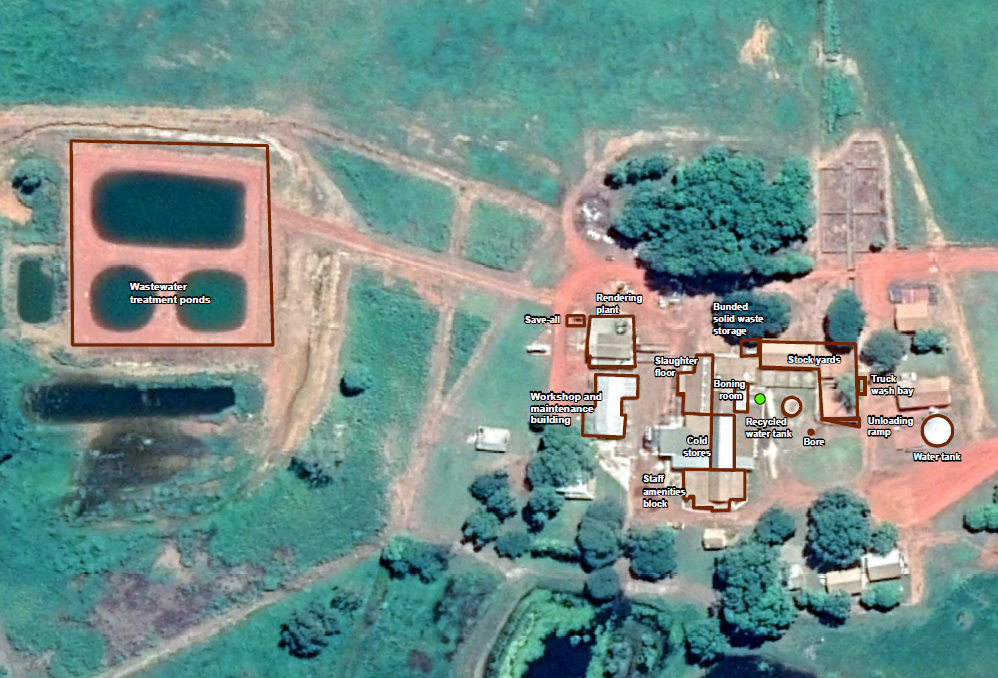
All stock yards have been removed. Stock would have entered the yards either through the offload ramp which is behind the camera or another large offload ramp further back. Larger holding pens then fed to smaller holding cement floored pens that then flowed to these pre slaughter wash yard pens. I don’t know the use of the crushes. It is possible that BTEC positive cattle may have been slaughtered in the lower kill box at ground level pictured to the left and clean cattle went up the cement ramps that are on the right. Horses may have also been killed in the lower kill box.

The lower level kill box.

Ramps leading to the upper level of the abattoir. I assume both ramps were used with a person walkway on the far left.

Alice Springs abattoir. Looking at the main truck access/load area is to the right. Stock would enter the facility on the ramp that is in the air behind the tree. slaughter area was in the top floor with initial carcase break up at that level and the boning room and further packing in both and upper levels.

A boning or packing room. There is a very large cement raised area to the right of this area of the building that original had shed structures either housing coolroom storage or general storage goods.

Inside the packing or boning area room. A large floor opening from the upper levels is located at the top right and may have housed some form of conveyor equipment.

Faded sign outside the building reads “Gut down area only. Do not use for entry to the boning room”

Looking at the now cleared cement floored space. Boning room is located to the left with the abattoir slaughter upper floors to the top rear. Engines, generators and various by products processing were located in the rear and right hand buildings.

Possible tallow, boiling vat areas.
Generators, electrical and refrigeration equipment may have been housed in this area.

Large shed structures at the rear of the abattoir now used for other purposes.

Administration building is located to the right front, with government inspectors offices to the middle and amenities, cafeteria and staff rooms are located to the left. The photo is taken from what would have been the pre- slaughter pens.

Note. Not sure how dated this sign is. It was located under a very protected eve a the gate entry. If it is relevant to the abattoir period it would indicate the stressed relationship between the operator and workers at the time.
Sources
- Personnel Communication deleted.
- ‘$370,000 abattoir’ Centralian Advocate 23.03.68
- ‘No decision Yet on management of abattoirs’ Centralian Advocate 27.06.68
- ‘New abattoir building is well up to schedule’ Centralian Advocate 31.10.68
- Personal Communication – Ben Hayes. 16.03.13.
- ‘Abattoir reprieve offered’ Centralian Advocate 06.01.1984
- ‘Inferno’ Centralian Advocate 04.12.88
- Personal Communication. Rob 16.03.13
- ‘Abattoirs future is undecided’ Centralian Advocate 22.03.1989
- ‘World on a plate – A history of meat processing in Australia’ Stephen Martyn. 2013
- ‘Territory Stockies and Government Vets – The Northern Territory Animal Health System from 1965 to 2012’ NT government.
- ‘Deplorable conditions at abattoir’ Centralian Advocate. 30.03.1962.
- ‘Vesteys to open £300,000 abattoir in Darwin shortley’ Centralian Advocate 25.01.1963
- ‘High Costs and bad roads mar Katherine abattoir’ Centralian Advocate 16.07.1964
- ‘Alice Springs district still most drought affected area in NT’ Centralian Advocate 16.07.1964
- ‘Enough cattle for abattoirs – Says Director’ Centralian Advocate 03.09.1964
- ‘Abattoir for sale’ Centralian Advocate 06.02.1969
- ‘New abattoir open in a fortnight’ Centralian Advocate 27.11.1969
- ‘Abattoir Sold – $452,300″ Centralian Advocate 09.03.1970
- ‘Government may save abattoir’ Centralian Advocate 25.05.1972
- ‘Minister inspects abattoir and sees difficulties’ Centralian Advocate 19.10.1972
- Question Paper Q1977 16 June.
- ‘Re-opening hinges on talks with Minister’ Centralian Advocate 12.01.1978
- ‘The Frozen food breakthrough’ Centralian Advocate 09.03.1978
- ‘Fumes from abattoir cause illness’ Centralian Advocate 21.09.1978
- ‘Beef looks Better’ Centralian Advocate 04.01.1979
- ‘Work begins on Tennant’s $2M abattoir’ Centralian Advocate 12.04.1979
- ‘Quarantine tightens squeeze on producers’ Centralian Advocate 05.01.1978
- ‘Govt gutless over abattoir’ Centralian Advocate 31.05.1979
- ‘Is mobile abattoir the answer’ The Star 06.02.1980
- Abattoir workers advert. The Star 13.02.1980
- ‘Stations need rain’ The Star 20.02.1980
- ‘Reader air views on abattoir smells’ Centralian Advocate 12.06.1980
- ‘Abattoir record kill’ Midweek Territorian 08.10.1980
- ‘Gratuity for meat inspectors’ Canberra Times 22.06.1982
- ‘Secret Money for NT Meat inspectors’ Centralian Advocate 23.06.1982
- ‘Meat Market’ Centralian Advocate 08.10.1982
- ‘Jobs on Line’ Centralian Advocate 29.04.1983
- ‘Meat men start work’ Centralian advocate 18.05.1983
- ‘Bribe charges’ Centralian Advocate 22.08.1983
- ‘Meat Industry outlook bleak’ Centralian Advocate 28.10.1983
- ‘Build new meat works’ Centralian Advocate’ 02.11.1983
- Power and Water Authority v’s Alice Springs Abattoir Pty Ltd #381 of 1991. 08.08.1997
- ‘Abattoir opening delay’ Centralian Advocate 06.04.1984
- ‘Abattoir all set to open’ Centralian Advocate 11.05.1984
- ‘Economics of Agricultural development in Northern Australia’ B Davidson 1974.
- ’70 Workers form picket’ Centralian Advocate 13.07.1984
- ‘Welcome news on meatworks’ Centralian Advocate 11.05.1984
- ‘Meat Row: It’s up to abattoir, now’ Centralian Advocate 13.08.1984
- ‘Abattoir unlikely to open’ Centralian Advocate 31.08.1984
- ‘Abattoir too late to open’ Centralian Advocate 21.09.1984
- ‘Meatworkers’ wages on par with rest’ Midweek Territorian 06.02.1985
- ‘What is the future of Territory beef industry’ Midweek Territorian 10.04.1985
- ‘Trade flows affect our beef markets’ Midweek Territorian 17.04.1985
- ‘Sales heavy in Alice Springs’ Midweek Territorian 08.05.1985
- ‘Funding freeze threatens BTEC’ Midweek Territorian 22.05.1985
- ‘Tail tagging successful’ Midweek Territorian 22.05.1985
- ‘Picket for Meatworks’ Midweek Territorian 22.05.1985
- ‘Power struggle threat to NT beef industry’ Midweek Territorian 29.05.1985
- ‘Swedish danger to Aussie exports’ Midweek Territorian 29.05.1985
- ‘Industry still in chaos after strikes’ Midweek Territorian 29.05.1985
- ‘Picket line Alice Abattoir’ Midweek Territorian 29.05.1985
- ‘Who owns abattoir’ Midweek Territorian 12.06.1985
- ‘Stalemate nears end’ Midweek Territorian 20.06.1985
- ‘Abattoir opens in anger’ Centralian Advocate 04.09.1985
- ‘Abattoir row part of a 4 year battle over rights’ Centralian 20.09.1985
- ‘It’s just the pits’ Centralian Advocate 18.12.1985
- ‘Meat man gets waste order’ Centralian Advocate 24.12.1985
- ‘Progress and some protests’ Centralian Advocate 03.01.1986
- ‘Meatworks under cloud’ Centralian Advocate 31.01.1986
- ‘Meatworks seeks staff’ Centralian Advocate 28.02.1986
- ‘Drought relief at last’ Midweek Territorian 26.03.1986
- ‘Hawke’s cattle talks crucial’ Centralian Advocate 25.04.1986
- ‘Abattoir killing at last’ Centralian Advocate 25.04.1986
- ‘Mystery of the missing cattle’ Centralian Advocate 20.06.1986
- ‘Joint bid to fight unions’ Centralian Advocate 30.07.1986
- ‘Cattlemen and unions at war’ Centralian Advocate 30.07.1986
- ‘Abattoir’s future grim’ Centralian Advocate 08.04.1987
- ‘Abattoirs tipped to fetch $4M’ Centralian Advocate 30.03.1988
- ‘Govt urged: Help abattoir’ Centralian Advocate 07.10.1988
- ‘Abattoir plan for centre may be lost’ Centralian Advocate 28.10.1988
- ‘Claims on abattoir wrong’ Centralian Advocate 30.11.1988
- ‘Meatworks in receivership’ Centralian Advocate 09.12.1988
- Personal Communication. June 2016
- ‘Export earner for Tennant abattoir’ Centalian Advocate 21.112.1988
- ‘Drought relief money’ Centralian Advocate 20.06.1986
- ‘Cold Store Problem’ Centralian Advocate 03.10.1963
- Letter to Editor of Centralian Advocate 14/01/1965
- ‘Little for NT Cattlemen in report on beef industry’ Centralian Advocate 16/10/1975
- ‘Pastoralists seek licence to open a second abattoir’ Centralian Advocate 16/10/1975
- ‘Killing at new abattoir’ Centralian Advocate 13/11/1975
- ‘Turnoff of cattle’ Centralian Advocate 31/12/1975
- ‘The Year that was – July’ Centralian Advocate 31/12/1975
- ‘The Year that was – October’ Centralian Advocate 31/12/1975
- ‘New abattoir owners will supply locally’ Centralian Advocate 24/03/1977
- ‘Abattoir decision rests solely with management’ Centralian Advocate 07/08/1985
- ‘Office – Hatton’ Centralian Advocate 07/08/1985
- ‘AMIEU cause of meat industry chaos’ Centralian Advocate 07/08/1985
- ’75 wet but no record’ Centralian Advocate 08.01.1976