Category Archives: Australian Abattoirs

Cranbourne

Cranbourne abattoir (Wagstaff) is located SW of Melbourn, extensively damaged by fire in 2013, multi species plant employing 250 people.

Other Names

  • Ralph’s Family abattoir2
  • Wagstaff abattoir2

Current Operation

  • fire extensively damaged the facility March 2013 – Not sure of current operation.

Location   

  • Cranbourne is a south western suburb of Melbourne, approximately 35km from the CBD.

Australia. Cranbourne

Cranbourne

Hema Maps – Australia Truckies atlas.

Owner

  • Ralph founding family members.2

Operation  

  • Two tier export licensed plant2
  • Has capacity to process 300 cattle and 2500-3000 sheep a day2
  • Employed 250 people2
  • provided service kill and boning program for local producers and suppliers.2
  • Multi species processing abattoir2

History

1908

  • Established to service the growing population of Melbourne.2

2006

  • Chronic labour shortage in meat industry and meat processors are accussed of using 457 temporary visa programs to bring in skilled labour but underpaying and using the people for other work positions.1
    • Visas granted to industries nationwide (not only meat processors) jumped 40% from previous year.1
    • Freeze was placed on 457 Visa applications to meatworks by Government over concerns of breachs of conditions. – Delays are said to be hampering meatwork operations1
      • lack of employees have some processors throwing product away rather than be processed due to lack of labour and is causing missed opportunities in export markets1
    • 457 Visa means worker must stay with employer for 4 years, Meant to meet criteria of skilled slaughtermen and only used for that position, not as unskilled labourers, boners.1
    • Recruitment companies find the workers and match to employer, usually the employer finds accommodation and deducts rent and travel from workers salaries – AMIEU claim exorbitant rents are being charged1
    • Union complaining that 457 Visas workers. “Workers who are being brough into Australia are in many cased being exploited.are being abused , and not being paid correctly and being misued at work” Graham Bird AMIEU1
    • Cranbourne employ 20 Chinese workers – they are bussed to the abattoir from homes rented by the company, all 457 visas. – Cranbourne say its operations all above board1
    • Murray Bridge abattoir (SA) subject of Government investigation of if 457 Visa holders are doing other jobs.1
    • Western Australia had 36 Investigations, 80% of employers found to be in breach of conditions and WA department of employment protection recovered $200,000 in underpayment of wages (Authors note – article didn’t specify if across all industries or only meat processing)1

2008

  • Operations changed and Ralph’s Meat company spilt – one extension taking over Cranbourne facility (Operates as Wagstaff)  and the original company operating a another abattoir at Seymour (Operates Ralph Meat Co)2

2013

  • March. Fire caused extensive damage to approximately 60% of the building2
    • Thought to have begun as an electrical fire in the roof.2
    • Insulation used in refrigertion make abattoir fires notoriously hard to control2
    • Sheep and cattle  were penned in close proximity to the building on fire, they were able to be moved but 2 sheep died from stress.2

Sources

  1. ‘Meat Industry accused of exploiting foreign workers’ ABC 7.30 report 31.07.2006
  2. ‘Fire guts Victoria’s Cranbourne meatworks’ Beef Central 25.03.13

Pakenham

Pakenham abattoir is located in Southern Victoria and is the one of the largest export abattoirs in Southern Australia. Processing high quality grass and grainfed beef.

Other Names

  • G & K O’Connor’s

Current Operation

  • Operational – As at time of writing. 23.12.13.

Location   

  • Pakenhan is a south eastern suburb of Melbourne

Australia. Pakenham

Pakenham

Hema Maps – Australia Truckies atlas.

Owner

  • G & K O’Connors1
    • partially Japanese shareholding1

Operation   

  • One of the largest export abattoirs in Southern Australia1
  • Employs 300 people1
  • Processes high quality grass and grainfed beef1
  • exports approximately 70% of production1
  • supplies to markets Halal, EU, China and Japan1
  • Sells product under number of brand names including O’Connor1
  • Sources majority of supply from Gippsland region, east and north of Melbourne.1

History

1977

  • Established1

2013

  • Amendment C176 to the Cardinia Planning Scheme allow future expansion of the abattoirs site and security due to other infrastructure planned by govenernment including roads and access.

Sources

  1. ‘O’Conner gets land use approval for future development’ Beef Central 23.12.13.
  2. ‘$315 million boost for Pakenham abattoir’ Edward Donohue. Member for eastern Victoria. 25.02.13.

Kilcoy

Other Names

Current Operation

  • Currently operating as at December 2013.

Location   

  • 120 km NW of Brisbane in Brisbane valley

Australia. Kilcoy

Kilcoy  001

Hema Maps – Australia Handy Map. 9th Edition

Owners

  • Kilcoy Pastoral company1
    • CEO – Tony Munns appointed 1999, succeeded by David Foote.1
  • Harmony Investment fund – Singapore based – Harmony Capital management3
    • Harmony purchased in 20074
  • Pacific Alliance Group (2012)3
  • New Hope Investment Fund – Chinese4

Operation   

  • Marketing strategy – Naturally Identified, Safe environment (NISE) Beef export program1
  • Dedicated grainfed, export focussed plant.3
  • Capacity to process 285,000 head per year3
  • Employed 750 staff (as at 2012)3

History

Year

1950’s

  • First established by Kennedy Family4

1999

  • Appointed new CEO – Tony Munns1

2002

  • Major improvements epected to provide 10% production boost and 50 full time jobs.2
  • Currently employing 340 people (plus the extra 50 to add)2

2003

  • Volume had increased through the plant by 35% to same period in previous year.2
  • Further Funding provided by Federal Government – Dairy Regional Assistance Program $880,0002
    • Further enhance production capacity and improve efficiency2
    • Improve primary freezer capacity, improve ability to process by products and improve the standard and quality of effluent disposal2
  • Previous 12 months had been difficult in world markets2
  • Target Pacific Rim countries in particular Japan and Korea2

2007

  • Harmony Capital Management’s Harmony Investment Fund4
  • Throughput for 2007 was 54,000t carcase weight, 160,000 cattle.5
    Note by author (Jo Bloomfield) if average yield is 337.5kg, estimate live weight processing 52% dressed Is approximately processing animals live weight 650kg.

2009

  • Australian Agriculture Co’s largest shareholder – IFFCo flag interest in purchasing abattoir5
    • Would be acquired by IFFCo under assigned put-and-call option – allows later transfer of ownership to AA Co5
    • IFFCo is large international red meat processor – killing 10,000 buffalo daily in India5
    • AA Co considering cost-benefit studies of owning meatworks as adjunct to branded beef business5
      • Currently utilises service kill at Grantham and occasionally at Casino5
  • Kilcoy provides strong marketplace competition against larger players Swift and Teys grainfed cattle processing5
  • Kilcoy is has current kill capacity 570 head a day, single shift, seven day operation5

2011

  • Processed 250,000 head, emplyed 750 staff.3

2012

  • Harmony Investment Fund – had owned a majority share of 80% sold to Pacific Alliance Group3

2013

  • Chinese investment fund – New Hope Investment fund purchase facility4
    • Purchase price about $80M6
    • one of the biggest operators of feedlots in China4
  • Kilcoy Abattoir is currently fourth largest abattoir in Australia4
  • Is currently processing 265,000 grain fed cattle a year4

2015

  • July. The following charts are from a submission by the Australian government Department of Agriculture to the Senate rural and regional affairs and transport references committee inquiry into Market consolidation and the red meat processing sector.
  • abattoir capacities dept ag sub consolidation_edited-1

    Capacity of major beef abattoirs in QLD. Pg 15

    T2 Throughput state beef_edited-1

    Share of throughput by state for beef in 2014. Pg 16

    M4 direct cattle movements NLIS QLD_edited-1

    Cattle Movements to abattoirs. Pg 25

    F12 hourly labour costs food manufacturing_edited-1

    Hourly labour costs for food manufacturing industry Pg 30


Sources

  1. ‘New Heads for Kilcoy, ACC abattoirs’ QLD Countrylife 13.10.1999
  2. ‘Kilcoy abattoir upgrade’ QLD Countrylife 29.05.2003
  3. ‘Harmony sells stake in Kilcoy, Harvey Beef’ Beef Central 06.12.2012
  4. ‘Kilcoy abattoir sold to Chinese Investment Fund’ The Australian 06.12.2013
  5. ‘IFFCo eyes Kilcoy abattoir in AAco deal’ Stockjournal 18.06.2009
  6. ‘Stations now in hot demand’ Nth QLD Register 10.07.2014
  7. Dept Ag. Submission to Market consolidation and the red meat processing sector July 2015

Bordertown

Other Names


Current Operation

  • Aus Meat Accreditation registration dated 29/12/2015 #1614 – JBS Australia Pty Ltd (Bordertown).8
    • registered as a Sheep export facility.8
  • Direct employment enquiries to www.jbssa.com.au

Location   

  • Bordertown is located 270km south east of Adelaide in South Australia

Hema Maps – Australia Truckies atlas.

Owner

Operation   

  • Establishment # 1614
  • Lamb, Hoggets and mutton1
  • Employs 4001
  • Daily capacity 5,200 head1

History

2009

  • JBS buy plant operations2
  • Invested $6.5M on robotic technology on the kill floor2

2012

  • JBS Australia split into two operating entities to make Northern and Southern regions in relation to abattoirs and feedlots within those areas5.
    • South – Victoria, South Australia and Tasmania5
    • North – NSW and QLD.5

2013

  • Sept. Launches own brand – Great Southern2
  • Oct. Will introduce a second shift of operation2
    • increasing throughput from 4000 to 8000 sheep and lambs a day2
      • current livestock purchases are $140M per year3
      • Utilites including power and water currently $3.1M per year3
    • employing 150- 180 more permanent staff2
      • Wages budget is $25.2M3
      • Extra shift will increase wages by 40%3
      • Extra shift  and business decisions will provide continuity of employment through the year3
    • needed due to improved access to China and increasing demand for high value chilled and frozen lamb in European Union and USA2
    • Looking for financial supportfor on-site cold storage – project costing $12M3
  • Local town looking to improve its houseing and infrastructure to support new workers2
    • Priority to Migrant support servicesand re-opening of Migrant resource centre2
  • High cost of meat processing in Australia was a constant challenge – at about 2.5 times the cost of the US” – and while technology and training added to efficencies, the state and Federal governments need to provide direct financial support to investments such as JBS are making” John Berry ( JBS director)2
  • “..with a high percentage of our product destined for hihgly competitive international markets and competing against animal proteins from around the world” John Berry (JBS)2
  • Installation of automated prcessing technology3
    • $6.5M – x-ray primal saw machine in boning room3
      • determines dimensions of major bones before moving along the chain past rotating blades, cuts the carcase into forequarter, middle, loin and leg sections3
      • Process up to 10 lambs a minute3
      • cutting tolerance of 5mm3
      • is just one of two machines in Australia3
  • Middle machine will be first of its kind in Australia when installed.3
  • November. JBS Swift Australia install closed-circuit television camera’s (CCTV) in it’s Australian meatworks.10
    • For the purpose of animal welfare and meatworker safety issues.10
    • CCTV for internal use by only JBS, with no plans to allow outsiders to view the footage.10
  • JBS’s US beef division (which includes Australia) delivered drop in net sales and earnings in it’s third quarter financial results.10
    • Australia’s division performance and overall contribution to the overall result is impossible to distinguish due to inclusion with US and Canadian beef processing results.10
    • Earnings before tax $134M,.10
      • Down by 22.5% on previous quarter.10
      • Down by 28.4% on third quarter last year.10
    • result reflection of domestic North American markets.10
      • Improved performance had occured in Australian.10
        • Demand had increased in Chinese markets.10

2014

  • July. Expected to replace two dimensional x-ray imagery with Dual Energy Xray Absorption (DEXA)4
    • Will find the skeleton but at the same time produces a lean meat yeild estimate4
  • July. JBS Australia across all facilities in operation kills daily5
    • 8,500 cattle,5
    • 24,000 smalls – which includes lambs5
    • Employs more than 8,000 people5
  • July. JBS Australia purchase majority shareholding in NSW based Andrew Meat.11
    • specialise in high quality, portion cutting and further processing of meats for domestic and international restaurant and foodservice customers.11
    • produce ready-cooked meals.11
    • company banner Creative Food Solutions.11
    • Andrew Meat will allow JBS expansion into high growth retail and value-adding segments.11
  • Expansion of the Andrew Meats business will start in November .12
    • JBS global strategy to expand into value added meat protein – opportunity to expand margins.12
    • JBS have an existing value-added division – Food Partners.12
      • supplies food service customers like Pizza Hut and Domino’s with toppings.12
    • Andrew Meats focus will be produce ready meals.12
      • ‘grab & go’ beef roasts, designed to compete head on with hot cabinet roast chickens sold in supermarkets.38
      • Domestic markets were very immature but also with significant growth potential.12
  • At this time JBS operate.11
    • 10 processing facilities.11
      • Daily processing capacity of more than 8,000 cattle and 21,000 small stock.11
    • 5 feedlots.11
  • December. JBS currently operate 12 meat processing plants across 5 Australian states6
    • Wages & local procurement $730M (Excluding livestock purchases)6
    • Employs 8,500 people at the facilities6
      • Employs 12,000 people in Australia6
    • Total revenue of $6.5B6
  • JBS plants 2014_edited-1

    JBS processing plants in Australia

    Source JBS submission #50 Market Consolidation.

    • JBS estimates its current share of four eastern states beef kill – 20% (excludes service kill)6
      • JBS share of Australian beef production 16%6
      • Market share of national small (lamb, mutton & goat) 16%
    • JBS spent $2.4M on halal certification costs of approved religious certifiers in 20146

    2015

    • June. Cost of processing in Australia 1.5-3 times the cost of processing animals in another country6
    • cost of processing grain-fed cattle in Australia is twice of the USA6
      • lower levels of productivity in Australia in regards to kg per unit of labour6
      • 2 major differences between Australia and the USA6
        1. Government regulation
          • $10 a head more in Australia6
          • Dept. of Australian Agriculture fully recover costs of meat export inspection and certification6
            • Australia wide DAFF costs $80M6
            • JBS contribute $14.5M6
          • Export plants don’t use DAFF but use approved employees, which plants fully cover costs6
            • JBS estimate an additional $30M at Export level6
          • USA & Brazil governments provide services at no or minimal costs to processors6
        2. Energy Costs
          • $15 a head more in Australia6
      • Technical barriers to trade (TBT’s)- Total value in Australia estimated at $1.25B as identified costs6
        • 261 TBT’s in 40 key markets6
          • 136 have significant trade distortion impacts6
  • July. The following charts are from a submission by the Australian government Department of Agriculture to the Senate rural and regional affairs and transport references committee inquiry into Market consolidation and the red meat processing sector.
  • T2 Throughput state beef_edited-1

    Share of throughput by state for beef in 2014. Pg 16

    T4 processing companies market share_edited-1

    Major Processing companies by market share May 2015. Pg 16

    M4 direct cattle movements NLIS QLD_edited-1

    Cattle Movements to abattoirs. Pg 25

    F12 hourly labour costs food manufacturing_edited-1

    Hourly labour costs for food manufacturing industry Pg 30

  • December. ATO publishes tax data for agribusiness corporates.7
    • Data interpretation – Companies do not pay company tax on revenue (total income) they pay on profits after paying all expenses, including wages, capital replacement, supplier costs and other operating expenses.7
    • Income tax information is for 2013/14.7
    • JBS Holdco Australia Pty Ltd produced Total Income $4,040,948,610.7
      • Taxable Income $419,882,525.7
        • Tax Payable $44,809,334.7

Sources Bordertown – SA. JBS

  1. ‘Our plants – Bordertown’ http://www.jbsswift.com.au Accessed 13.11.2013
  2. ‘Second shift at JBS meatworks’ Stock Journal 03.10.2013
  3. ‘Robot Revolution’ Stock Journal 17.10.2013
  4. ‘Technologies take quantum leap’ The Land 24.07.2014
  5. ‘The next Swift Shift’ Weekly Times 30.07.2014
  6. sub50_JBS Inquiry into the effect of market consolidation on the red meat processing sector
  7. ‘ATO publishes tax data for agribusiness corporates’ Beef Central 18.12.2015
  8. AUS-MEAT Accreditation Listing 29.12.2015
  9. ‘Swift CCTV camera action’ Weekly Times 13.11.2013
  10. ‘JBS delivers lower third quarter beef sales, revenue’ Beef Central 14.11.2013
  11. ‘JBS takes stake in Andrews Meat’ www.farmonline.com.au 09.07.2014
  12. ‘What’s behind JBS taking a big stake in Andrews Meat Value adding Businnes? Beef Central 10.07.2014

Warragul

Other Names

  • Radford’s1
  • R Radford and Sons abattoir3

Current Operation

  • Currently operating at 16.11.2013

Location   

  • Warragul is approximately 120km south east of Melbourne.

Australia. Warragul

Warragul 001Hema Maps – Australia Handy map – 9th edition

Owner

  • Radford’s1
    • Family-owned meat processing business3
    • Managing director – Robert Radford1

Operation  

  •  At 2011 processing 120,000 sheep and lambs and 80,000 cattle per year2
  • Operate 5 days a week, 52 weeks a year3
    • 1,400 cattle and 2,500 lambs a week3
    • Currently processing sheep and cattle but looking to process goats in the future5
    • Currently domestic processing 18-21kg carcases boutique markets5
    • Process lamb for different domestic cultural and religious festivals5
      • lambs need to be very lean 116-18kg5
      • Italian community like 18-20kg5
      • Vietnamese and Chinese want very lean 20-22kg, no fat5
      • Warragul own a retail shop in Kyneton, this has added to tourist trade5
    • Export markets
      • Middle east require a very lean carcase under 18kg5
        • cook meat slowly and too much fat congeals at top of pots5
      • Lamb and mutton exported both whole and 6-way cuts, fresh and frozen air freight5
    • 15% production is certified organic5
      • 40-50% growth in organic meat processing in lst 3-5 years5
  • Animals sourced all over Victoria, In SA Mt Gambier and Naracoorte, In NSW as far as Gunnedah, at times also Tasmania.3

Warragul stock sourceSource Hema maps – Australia Handy map 9th edition

Figure 1 – showing area from which Warragul abattoir source animals across South east Australia

  • Animal Welfare practices3
    • animals are stunned with electric stunner, cattle knocked unconcious prior to slaughter3
    • Stunning is audited and people are specifically trained for the stunning role3
    • Primesafe -Victorian meat authority conduct regular audits at least 3-4 times a year3
    • Audits are unannounced inspections3
      • Focus on animal welfare is critical to the success of an abattoirs relationship to its suppliers and customers” Robert Radford, Manager5
      • There are sound business reasons to conduct rules of treatment and slaughter of animals.3
        • business can be closed instantly for breaches3
        • Plant invested heavily to allow animals to rest prior to slaughter3
        • Stock yards are covered in sawdust to soften footing. – then is reused as fertlizer3
        • stressed animals create poor quality meat cutting so better welfare is a better animal carcase produced3
          • stockyards are undercover and allow 750 cattle to be held.3
          • Animals allowed up to 48 hours rest before slaughter5
    • Prediction of meat quality use3
      • PH level as indication3
      • hanging method of carcase is tender stretching and not hung from achilles3
    • Resources used3
      • water was a major problem in the drought – using 100,000 litres per day,3
        • not connected to mains water and had no access to ground water3
        • developed a recycling of own effluent waste3
        • developed with help of governmentm cost $1.1M3
    • Products
      • skins – are all sold as tenders to various markets and graded to their quality3
        • skins often to China – car seat covers, shoe lining, clothing5
      • Offal and other byproducts are value added, producing tallow and meat meal5
    • Business
      • need to constantly look at Research and development to consider productivity, running costs and new technology to increase through-put3
      • Looking to enter Halal export markets5
      • Domestic Halal is common, enables offal byproducts to be sold for human consumption5
      • Only some victoria abattoirs allowed to do Kosher processing5
    • Slaughter process
      • Last 20 years focus is meat processing and wholesalers5
      • After each kill – meat buyers mark up (rate) bodies at 5am each morning, looking at quality and matching to orders4
        • Average 120 bodies – 60 will get top money, 30 OK, 15 barely cover costs and 15 probably lose money due to bruising or cutting dark4
        • You’ll get your money on 50% of the beef bodies, the next 20-30% you’ll make a bit on, and the rest you’ll go backwards by about $40 to $50 a body” Danny Hood – Meat Wholesaler4
        • Being a perishable item, aim is to have the kill sold and placed within 7 days4
        • Price spread across beef bodies of 100c/kg carcass weight4
        • Domestic to wholesaler mark up is approximately 50-70c/kg4
        • 200kg carcase from abattoir has markup about $140 by wholesaler to cover transport, processing fees and delivery charges.4
    • Employees
      • Warragul employees average 10 years of continuous service6
      • In 60 years of trading not lost a single day to industrial disputes6
      • All employees require Certificate 2 status in food processing6

History

1944

  • Father began business as one-man slaughterhouse
    • on-man slaughterhouses were in most towns, Warragul had 6.


1946

  • Radfords – Warragul established6

2007

  • Involved in delegation of 200 Victorian food manufacturers to develop worlds first  global halal brand, invited by the Brunei government.1
  • Note from Managing director R Radford and Son – 28/02/2014 – Radfords were a participant in the delegation to Brunei, any publications stating or implying that R Radford and Son process meat for halal markets are incorrect. R Radford and Son do not and have never processed meat for halal markets and have not sought accreditation.1

2011

  • Won awards2
    1. NAB agribusiness leader of the year2
      • In past decade Warragul have doubled processing to 80,000 cattle and 120,000 sheep and lambs a year.2
    2. Environment and Energy management2
      • Reduced consumption of electricity by 4.17%2
      • Reduced gas consumption by 30.5%2
      • Reduced fuel use by 19.2%2
      • Reduced water use by 44.5%2

    2012

  • Up to 2012 had invested $8.3M in new plant. equipment and supporting infrastructure

Sources

  1. ‘Victorians work on first global halal brand’ The Age 24.09.2007
  2. ‘Abattoir leads way’ Pakenham Gazette star community 07.12.2011
  3. ‘A cut above’ ABC Landline 21.10.13.
  4. ‘Story behind beef retail prices’ Weekly Times 10.10.2013
  5. ‘Abattoirs cater to emerging markets’ Stock Journal 26.09.2013
  6. http://www.radfordmeats.com
  7. Inquiry into the impact of food safety regulation on farms and other business 18.10.12.
  8. Personnal Communication. R Radford. 28.02.2014

Brooklyn

Other Names

Current Operation

  • Operational as at 13.11.2013
  • Establishment #06882
  • Export accredited abattoir processing Beef, Sheep, Goat and Offal.2

Location   

  • Brooklyn is located 14km from Melbourne’s CBD1

Hema Maps – Australia Truckies atlas.

Owner

Operation   

  • Establishment #6881
  • Beef – grass and grain fed1
  • lamb, hogget, mutton & veal1
  • Employees – 6881
  • Processes 5,200 daily1
  • Largest multis species processing facility in southern hemisphere1

History

2001

  • June. Fire had gutted the plant3

2002

  • March. SBA foods sell to Tasman Group Services, new trading name Belandra Pty Ltd.3
    • Brooklyn export abattoir operated in conjunction with Westgate coolstores
    • $25M deal included purchase with Longord abattoir (Tas) and King Island abattoir (Tas) mothballed Altona meatworks in Melbourne west and 8,000 head Yambinya feedlot at Wakool near Deniliquin NSW.3
  • Brooklyn facility still in reasonable condition, efforts to re-open had failed but SBA has spent $10M on the beef slaughter chain, chiller and boning facilities in the past 4 years.3

2005

  • June. Trade halted on export of meat to Malaysia over doubts concerning halal status of Australian meat6

2006

  • January. Market access to Malaysia suspended7
    • Malaysians concerned that pneumatic stunning and use of the thoracic stick (Used to speed up bleeding of carcase) were being used to speed killing process.7
  • April. Brooklyn receives Halal approval from Malaysian Islamic Development department.6
    • AQIS allow milder level of eclectrical stunning and thoracic stick at least 2 minutes after slaughter7
    • Grantham abattoir (QLD) and Wodonga abattoir (Vic) also gained approval7
    • Kilcoy abattoir (QLD), Longford abattoir (Tas) failed the accreditation tests.7

2008

2010

  • December. JBS Swift locked out cold storage workers under the Labor workplace relations regulations.4
    • Workers had rejected a proposed new enterprise agreement4
    • JBS offered wage adjustment 2% a year over 2 years4
    • Shifts increase from 8 hrs to between 9.5-12.6hrs affecting workers overtime and weekend penalty rates4
    • Union claim its a real wage cut given rate of inflation
    • Mostly immigrant workers striking granted a one-of payment of $250 and not normal wage on strike time, payable when picket disbanded.4
    • Union shut down picket on December 22 to revive on January 44
  • Work had continued at the plant with workers flown in from QLD and others sourced from a labour hire agency4

2012

  • JBS Australia split into two operating entities to make Northern and Southern regions in relation to abattoirs and feedlots within those areas8.
    • South – Victoria, South Australia and Tasmania8
    • North – NSW and QLD.8

2013

  • February. Received carbon abatement grant $212,512 towards equipment replacement worth $425,0005
    • replace boiler network with a higher efficency boiler and heat exchanger.5
    • Expect to reduce carbon emissions by 35%, saving $60,000 in energy costs per year5

2014


  • July. JBS Australia across all facilities in operation kills daily8
    • 8,500 cattle,8
    • 24,000 smalls – which includes lambs8
    • Employs more than 8,000 people8


Sources

  1. ‘Our Plants – Brooklyn’ http://www.jbsswift.com.au Accessed 13.11.2013
  2. Aus meat List 28.02.2014
  3. ‘SBA foods sells to Tasman groups services’ Stock and Land. 19.03.2002
  4. ‘Australia: Union shuts down picket of locked out meatworkers’ http://www.wsws.org 28.12.10
  5. ‘Teys, T & R in latest round of carbon abatement grants’ Beef Central 18.02.13
  6. Headlines for week ending 21.04.06 http://www.profarmer.com.au.
  7. ‘Abattoirs supply Malaysia again’ Farm Weekly, 19.04.2006
  8. ‘The next Swift shift’ The Weekly Times. 30.07.2014

Deniliquin. #2123. NSW

Deniliquin was an export abattoir accredited to process beef, sheep, goat and offal.

Deniliquin temporarily closed in 2007 due to drought with plans to re-open. It was re-opened in 2014 after it changed hands and was refurbished with the assistance of government funding. It closed again in 2017.

Last registered Aus meat export October 2017. Site was visited in March 2020, it was derelict and undergoing demolition.

Current Operation

  • Currently undergoing upgrades to reopen.6
  • Aus-Meat Registration as at 02/10/2017 #2123

Location   

  • Deniliquin is located South west of NSW about 75km from the NSW/Victoria border and city of Echuca in Victoria.
  • 285km north of Melbourne, 723km south west of Sydney3
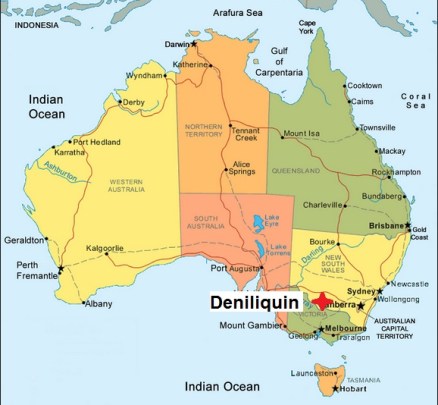
Australia. Deniliquin 16.06.13

Deniliquin

Hema Maps – Australia Handy Map. 9th edition

Owner

  • Klastin (2007) – Managing director – Tony Karuse1
  • Famicorp – Owned by Farouk Fami, inherited from the Estate of Nordon Becker3
  • Global Crown9
  • Tasman Group – Managing director Joe Catalfamo

Outside building _edited-1Source – Steers Auctioneers – Meat Processing Plant Deniliqiun, 28.08.2007

Operation 

  •  Halal and HACCP accredited5
  • Small stock abattoir – sheep, small calves,lamb and goats.3
  • Uses an inverted chain system3
  • Processing capacity 3500 sheep/lambs per day5
  • 8 hanging carcase chillers – 5 carton blast freezers5
  • Export registered – Japan, Egypt, Korea, Taiwan, Indonesia, Russia, South Africa, Mexico5
  • modern Ammonia refrigeration plant5

Inside #2 _edited-1Source – Steers Auctioneers – Meat processing plant – Deniliquin 28.08.2007

Inside #2 _edited-1Source – Steers Auctioneers. Meat Processing plant. 28.08.2007

Yards #1_edited-1Source – Steers Auctioneers – Meat processing plant. Deniliquin 28.08.2007

History

Deni_edited-1Source History of Frozen Meat. Undated.
Historical picture of the Deniliquin freezing works – known then as the Riverina Freezing works

  • Authors note. The original freezing works I guess would have been situated near a main water source, in Deniliquin that would have been the Edward river a tributary of the Murray River. I don’t think the original Freezing works owned by the Riverina Freezing Company would have been where the current meat works is.

1990

  • Halal certified3

2002

  • Closed – reasons cited due to drought and limited numbers of livestock2
    • Employed 120 people on kill days, mainly casuals.2

2003

  • Meat processors hard pressed meeting their requirements because of major shortage of lambs bought on by the drought9
  • Prices as high as $158 a head, five years ago was $80 a head at Deniliquin9
  • Meat processors forced to pay high prices for good quality lambs to keep thier abattoirs operating and to retain market share9

2006

  • Begun to employ overseas workers to fill vacant meatworker positions1
    • 6 workers through a Vietnamese employment agency1
    • Advertising in Australia failed to fill postions1
    • If had not got Vietnamese workers the plant would not be operating1
  • Abattoir is closed at some period during this year18


2007

  • Klanstin with drew from the facility – closure5
    • Was only meant to be a temporary closure
    • Operated with Halal accreditation from 1990 to closure in 2007 due to drought
  • Issues with market and meat industy had forced temporary closure4
  • Closure due to issues of sourcing quality stock13

2011

    • Deniliquin has faced a gradual but sustained and significant reduction in population over the past 15 years.2
      • Centralisation of policies of both state and commonwealth governments2
        • RTA divisonal headquarters closed9
        • Department of education – regional headquarters9
        • Murray Health headquarters9
      • prolong drought that have prevailed in much of last decade.2
    • If MDBP implemented2
      • result in 58% reduction in the amount of water available to irrigated agricultural activities.2
      • Deniliquin is heavily reliant on irrigated agriculture for its ongoing survival.2
      • If MDBP implemented would jeopardise abattoir and rice mill re-opening due to reduction of water available.2
    • Current circumstances in Deniliquin2
      • Deniliquin abattoir currently closed2
      • Negotiations currently underway for the abattoir to be sold and re-opened given improved rainfall and forecast availability.2Deniliquin council write a submission  to the inquiry into the impact of the Murray Darling basin plan (MDBP) guide in Regional Australia.2
  • Region has suffered a decade long drought26
  • Abattoirs in operation in NSW with more than 50 full-time equivalent (FTE) staff – 477
    • Includes meat processors, poultry and pigs.
  • Meat processing facilities closed in NSW since 2000 with more than 50 FTE – 97
    • Includes meat processors, poultry and pigs
  • November. facilities advertised for sale, land, equipment, structures and fittings3
  • Attorney for the Estate under instructions to liquidate all assets3

2012

  • December. Abattoir sold to Global Crown9.
  • Chief executive of Global Crown – John Wynan
    • Facility could reopen 20139
      • Would focus solely on sheep, production runs 1,000 sheep a day9
      • Goal to increase production to 3,500 sheep a day9
      • Halal certified with full accreditations for export9
    • create up to 100 jobs9

2013

  • January. Global Crown Pty Ltd – John Wynan negotiation for sale, settlement delayed due to ‘legal issues’4
  • Proposes to open abattoir this year4
  • November. Abattoir has been purchased and is expected to reopen
  • Tasman Group purchase9
    • estimate to employ 80 people9
    • Upgrades to some facilities is required.9
    • would continue as Halal slaughterhouse – for which it was fully accredited9
    • would focus solely on sheep, production starting at 1000 head a day to process building up to 3500 head.9
  • Australian Meat Group Pty Ltd (Formerly known as Tasman Group)13
    • Tasman group previously operated abattoirs at31

2014

  • March. Joe Catalfamo is confirmed as purchaser of Deniliquin11.
    • Has also purchased Dandenong #3085. Vic11.
      • Dandenong is focused on cattle processing11.
    • Plans to create state of the art processing sites at each facility11
  • Seasonal conditions at the time have decimated livestock numbers in QLD and NSW11
  • August. Deniliquin abattoir is still not in operation10.
  • Plan for the facility to be refurbished10
    • Facility has now been out of operation for 7 years10
  • NSW government will provide support to the Australian Meat Group to re-open the plant10
  • Facility is anticipated to employ up to 130 full time jobs in the first year10
    • After 5 years expected to increase to 460 full time equivalent positions10
  • NSW government pledge to provide $1M to upgrades for the facility13
    • Upgrades will allow facility to meet best practice standards13
    • Improve efficiency and provide full range of meat cuts13
  • Total cost of upgrades wasn’t able to be confirmed13
  • Australian Meat Group Pty Ltd (Formerly known as Tasman Group) have purchased the facility13
    • Managing director Gilbert Cabreal13
  • Detailed Environment Impact Statement is yet to be completed13
  • Preparatory work has begun at the facility13
  • Pending development application for facility improvements13
    • upgrades to the kill floor, receiving yard and amenities13
  • Plans for a new boning room, rendering plant and cold storage facility13
  • November. Property investment in the Deniliquin area has increased in recent weeks due to the abattoir plans to re-open15
  • Facility will be opening Mid December or early January 201515.
  • 50 staff have already been appointed15
  • Kill trials are expected to start in November16
  • Deniliquin plant manager – David Bridge from Gundagai16
  • Deniliquin Operations manager – Bernie Cabral16
  • Opening is expected to be early February 201516.
  • Audit has been completed but some refurbishment still needs to be continued16
  • Submission has been sent for new plant, with construction hoped to begin February16
    • Current facility would be suitable for another 2-3 years20
    • Plans to a new state of the art facility in the process of approval20
  • Deniliquin is in a strong growth phase with the opening of the Rice Mills also occurring16

2015

  • November. Deniliquin abattoir is the 10th abattoir that Joe Catalfamo has remodelled29
    • Deniliquin proposal is construct a new plant on vacant land next to the existing facility29
  • Deniliquin plant is now officially US licensed30.
    • This will allow the company to further develop and expand its product range when the new facility is built next door30.
  • Currently processing 2,200 – 2,500 small stock units per day30
  • Australian Meat Group Livestock Manager – Ben Davies30
  • Location of Deniliquin abattoir is very good because it is centre of Australia’s most heavily populated sheep production area30.
    • Southern most export plant that has road train access30
  • Growing global markets  that can be harnessed for mutton, lamb, goats and bobby calves30
  • December. Deniliquin abattoir is recommissioned and is again in operation17
  • $5M were spent on refurbishments17
  • During the commissioning phase the facility will process 1,000 sheep a day17
    • Working up to 3,000 a day at full capacity17
  • 70 people are now employed17
  • Second stage of production will employ a further 250 people17
    • Accommodation and houses are yet to be available to accommodate some workers17.
  • Abattoir production will be both domestic and export17
  • Exported meat will go to;17
    • Japan, Middle East, Vietnam17
    • Plans to secure a US export licence soon17

Source ‘Renovated Riverina abattoir re-opens driving property boom’ ABC Rural 14.01.2015

2017

  • February. Meat processors are finding conditions very difficult with livestock prices increasing for both beef and lamb99
    • Prices to consumers expected for meat to increase by at least $1 per kg19
  • Lambs at some saleyards are selling for 750c per kg99
  • Also a shortage of lamb supplies19
  • Numbers for kills is expected to be less by 1M head across Australia19
  • March 17. Deniliquin abattoir operations are temporarily halted20
    • due to unsustainable lamb market20
    • Complete shutdown is hoped to only last 2-3 weeks20
    • Return to operation depending on market conditions20
      • Australian dollar was currently very high21
  • Currently 180 workers were employed at the site20
  • Have been operating the facility for 2-3 days a week due to stock prices20
  • Focus on markets is currently into South America20
    • Current stock values were at $6 /kg carcase weight20
      • To be competitive the abattoir needs the value to be $5/kg or less20
  • Company had decided not to pursue further infrastructure developments at the site20.
  • April. Other abattoir closures are occurring around Australia due to stock availability and prices24
  • Some facilities that have significantly reduced operations24
  • Over-capacity in the lamb processing industry relative to supply pool is exasperated by the expansion of formerly only domestic plants now being export accredited and having export market access24
    • Export markets are unwilling or unable to pay more for Australian meat24.
  • Reports equipment from the Deniliquin facility is being removed25
  • Operations and Managing directors aren’t responding to calls95.
  • Employees under 457 visa’s have been sent home25
  • Lamb prices have actually risen higher to $6.60 /kg25
    • Indications are that the lamb prices will stay relatively strong25
  • Prices hit 700c /kg proving to be a breaking point for some abattoir operations
    • Total setback of 6 closures (not including Esperance) in eastern Australia will result in 50,000 less lambs processed in Victoria and NSW27
  • September. “With a high currency, low numbers, and high cost of production and processing in Australia, we are a little bit like the Murray Goulburn of the beef industry” – Australia’s red meat processing sector is in crisis. MLA CEO Richard Norton26

2020

  • March. Author visited this site, property and buildings were derelict and obviously not used for some time.
    • scrap metal workers actively removing equipment and items
    • All stock yards and infrastructure around the facility was removed.

Sources  – Deniliquin #2488

  1. ‘Deniliquin abattoir defends hiring overseas workers’ ABC News. 11.09.2006
  2. Deniliquin shire council submission to senate inquiry, Murray Darling basin plan. 22.01.2011.
  3. ‘Deniliquin abattoirs – For sale’ http://www.famicorp.com.au 04.11.2012
  4. ‘Deniliquin abattoir sale stalls’ http://www.mmg.com.au 08.11.2013
  5. ‘Meat Processing plant – Deniliquin NSW’ Steers Auctioneers 28.08.2007
  6. ‘Deniliquin abattoir to reopen’ The Pastoral times. 05.11.13
  7. Mr Buckingham questioning Minister of roads and ports. http://www.parliament.nsw 31.05.11
  8. ‘Lamb prices soar as suppliers struggle to meet demand’ Sydney morning herald. 14.09.2003
  9. ‘Sale deal close on abattoirs’ The Border mail. 19.12.2012
  10. rel_stoner_20140820_deniliquin-abattoir
  11. ‘Abattoir plans for Deni’ The Land 20.03.2014.
  12. ‘New life for old export abattoir’ Liberal Party of Australia 21.08.2014
  13. ‘Cash for abs’ http://www.mmg.com.au. 22.08.2014
  14. ‘Deniliquins abattoir to reopen with investment from NSW Government’ The Weekly Times 26.08.2014
  15. ‘Meat money flows’ http://www.mmg.com.au. 25.11.2014
  16. ‘Abs trial’ http://www.mmg.com.au 25.11.2014
  17. ‘Renovated Riverina abattoir re-opens driving property boom’ ABC Rural 14.01.2015
  18. https://www.ipart.nsw.gov.au/files/6feefd0b-6076-4cce-b3e6-8b0d06615116/Council_Improvement_Proposal.pdf
  19. ‘Record lamb prices killing off country abattoirs’ ABC News 24.02.2017
  20. ‘Abs work halted’ Shepparton News 17.03.2017
  21. ‘Meat Commitment – Administrator to meet with abattoir executives’ Shepparton News 21.03.2017
  22. ‘Sawmill could fill lost jobs’ Shepparton News 24.03.2017
  23. ‘Statement of temporary closure of Deniliquin abattoir’ Edward River council 17.03.2017.
  24. ‘Indefinite closures for JBS lamb plants, as supply challenge reaches critical point’ Beef Central 20.04.2017
  25. ‘Fears for abattoir’s future’ Deniliquin Pastoral Times 11.04.2017
  26. Deniliquin council submission to inquiry into the impact of the Murray Darling basin plan. 22.01.2011
  27. ‘Door shuts on sixth abattoir’ QLD country life. 11.05.2017
  28. ‘Red meat crisis the new MG says MLA boss’ The Weekly times. 27.09.2017 27.09.2017
  29. ‘Catalfamo’s abattoir industry return’ The Stock and Land 11.11.2015
  30. ‘Deniliquin: sheep, lambs, goats, calves’ Stock and Land 11.11.2015
  31. ‘What’s iin store: pointy end of the year’ Stock and Land 09.11.2013

Coonamble

Coonamble is located Northern NSW and closed in 2001 citing GST and crippling government charges. It is currently undergoing renovations for reopening in 2014.

Other Names

Current Operation

  • Is currently undergoing renovation to reopen in 2014

Location   

  • Coonamble is about 230km direclty south of the NSW/QLD border, Large cities closest Tamworth 292km by road or Sydney 700km in a straight line South east.

Australia Coonamble

Coonamble

Hema Maps – Australia Truckies atlas.

Owner

  • Castlereagh – Bill Scott1
    • Other directors John and Len Scott2
  • 2012 – Nasser Beydoun

Operation  

  •  Operated butcher shops in Coonamble.3
  • Employed 52 workers.

History

1974

  • Scott Brothers took over operation of abattoir3

2000

  • May. Impending GST set to force sale or shutdown of abattoir2
    • Under GST – Meat processors required to pay GST on all stock purchases and claim tax back as refund2.
    • Problem is purchases need to be settled in 7 days and refunds not received for 2 months.2
    • Coonamble would require $200,000 in additional interest chargesto cover GST in first month of reporting period, then another $400,000 while waiting for refund2
    • represent a liability of $50 per head for owning a beast 24 hours.
  • Martin Ferguson (Labor) claims GST  was responsible for Coonamble closure1
  • Bill Scott – owner – “Cause of closure lies squarely at the feet of the Carr Labor government”, he called “never ending regime of charges and regulations”1
    • Government implemented pay roll tax, workers compensation changes and state departmental fees and charges – Bill scott identified as buisiness killers1
  • July. Abattoir closed.
    • Citing GST as catalyst and crippling state government costs3
    • Works to be mothballed but maintained to export standards for immediate start up.3
  • Operational costs in NSW higher than QLD.3
  • Coonamble had been larges buyer of yearling cattle in NSW3
  • On closure had 40 on last week payroll, and bought 1/3 of yarding at Coonamble sale3

2001

  • Offically closed.4

2008

  • Coonamble Shire Council commission a study which found the facility was a viable option.4
    • Used results of study to attract an investor4

2012

  • June. Business sold to a Sydney Company4
    • when reopened will employ 30 people4
    • Produce Halal certified beef and lamb4
    • buy livestock from North west NSW and southern QLD4
  • refurbishment of abattoir currently 80% complete with opening expected in September4
  • July new owners, Nasser Beydoun, owner, manages sodt drink and dip business, first foray into meat5
    • Will start with 30 employees, number likely to grow5
    • working with council to ensure meet licensing requirements5
    • producer halal certified beef, lamb and goat meat5
    • Require new boilers, cookers, doing up slaughter room, power is upgraded and have started work on fridges and cool room8
  • Opening of an abattoir after being mothballed so long (11 years) is almost without precedent7
  • Halal meat – growing metroplitan market8
  • Expect to be opened January or February 20148
  • New owners are buying houses for staff in town of Coonamble8
  • Government’s upgrading program a loop line will be provided with new siding and loading area at Coonamble railway – is a good outcome for the abattoir operations9
  • Oct. Shire talk of developments to date of abattoir’10
    • 1 meat inspector position has been filled with another advertised10
    • Owners notified council – sheep and cattle to be processed in one line10
    • 17 points yet to be addressed prior to reinstatement of licence10
      • Previous operations residents on the opposite side of the river had complained of odour10
    • Consideration given to selling local sheep yards as they weren’t being used10
      • sheep yards were part of saleyard enterprise10
      • Sheep yards to remain11
  • Nov Coonabarabran abattoir (NSW) (located 112km SE of Coonamble) closed6.
    • Closed due to inability to recover from $190,000 fine for effluent spill & Owner had been diagnosed with leukaemia and unable to work6

2013

  • Mar. Meeting held with owners, still compliance and investment funding issues12

Sources

  1. ‘Ferguson wrong again on abattoir closure’ John Anderson Dpt Prime Minister Media release. 05.07.2000
  2. ‘Coonamble abattoir early GST victim’ Stock Journal 31.05.2000
  3. ‘State rules shut abattoir’ The Land 06.07.2000
  4. ‘Plans to reopen Coonamble abattoir’ ABC news 11.07.12
  5. ‘Prosperous future of Coonamble abattoir’ ABC news 12.07.12
  6. ‘Closed Coonabarabran abattoir up for sale’ The Northern Daily Leader 13.11.12
  7. ‘Coonamble plant to re-open’ Beef Central 08.11.13
  8. ‘Coonamble abattoir reopening to create local jobs’ ABC news. 29.07.13
  9. Coonamble shire council meeing minutes 11.07.12
  10. Coonamble shire council meeting minutes 10.10.12
  11. Coonamble shire council Ordinary meeting 12.12.12
  12. Coonamble Shire council. Business paper 15.05.13

Camperdown

Camperdown abattoir was located close to Sydney and closed in 1991 following violent industrial confrontations over pay and conditions.

Other Names

Current Operation

  • Closed 19911

Location   

  • 8km SE Sydney CBD

Camperdown

Hema Maps – Australia Truckies atlas.

Owner

  • Famicopr – Farouk Fami1

Operation

History

1991

  • May. Fired 130 workers2
  • Oct. Mounted police charged meatworkers picketing abattoir 26th October 19912
    • Body Hire firm – ‘Troubleshooters Available’ assis abattoir to find contract labour2
    • Camperdown 1st abattoir to be staffed by contract labour2
  • Violent protests between unions against police and contractors over pay conditions and pay.1
  • Mangement decided to employ contract workers, never reached an agreement with unions, abattoir closed.1
  • Bitter and violent industrial confrontation forced plant’s closure1
  • Troubles arise from attempts by some exporters to cut  meatworkers wages and conditions” Bill Malcolm – Senior lecturer in Agricultural economics at Melbourne University
  • Several closures in Victoria abattoirs as a result of shortage of livestock
  • QLD meat industry seen as having advantage over Vic-
    • QLD – increasingly lot fed animals receving higher export prices, ability to export quicker to Japan2
    • Vic – grass fed animals,
      • Extracting difference in profit margins from meatworkers2

2007

  • Poperty is carved into 6 lots and beng advertised for total price of $800,000 (dated 10.12.2007)1
    • old abattoir site nearly 10ha for sale for $230,0001
    • Is an abandoned site, in shocking repair, has asbestos1
    • Shire council asked management to clean up site1

Sources

  1. ‘Derelict abattoir for sale’ The Standard. 10.12.2007
  2. ‘Mounted Police attack abattoir pcikets’ Green left weekly. 30.10.1991

Blayney

Other Names

  • ANZCO abattoir

Current Operation

  • closed 19982

Location   

Australia. Blayney

Blayney

Hema Maps – Australia Truckies atlas.

Owner

  • McPhee Meats2
  • 1996 – ANZCO1
  • Manager – Neville Newton, now managing Goulburn4

Other abattoirs in Australia

Go to this link to view Location of Australian Abattoirs

abattoirs_edited-1   

Operation  of Blayney #155

  • Sheep processing facility6

History

1900

  • Freezing works3

1957

  • abattoir opened, had been a freezing works prior. Latter tannery and pet food plant3

1976 – Not sure if this is correct because in 88 frieght company say they worked for Blayney’s last 43 years.

1963

  • February. At this time is an export facility operated by Blayney (Abattoir) County council6
    • Has chilling, freezing and freezing storage facilities6

1976

  • Tenders for contract to build beef facilities1
    • 2 story building, 1,800 sq m, able to process 100 head cattle per hour1
    • Electrical, Mechancial, Ventalation, Visera tables1
    • To commence construction November 19761

1987

  • Nov. Is registered at this time as an export facility
    • Operating under the name – Blayney Abattoir

1996

  • ANZCO bought insolvent abattoir from MPhee Meats – left unsecured creditors owed $6M2

1997

  • July. Is registered at this time as an export facility8
    • Operating under the name ANZCO foods Pty Ltd8

1998

  • April. Operations scaled back in recent weeks, Some 1,600 staff had previously been employed, now there was barely 1005
  • May. Closed – reason cited by ANZCO- stock shortage2
    • Industry sources say ANZCO left with large stocks or unsol meat as a result of Asian currency crisis2
    • NSW Meat Industry Authority (MIA)”there is definitely no shortage of stock or supply”2
    • “This year cattle killed in abattoirs have averaged 43,000 head a week an increase on average of 10,000 head over last the last year(dated 10.03.1998) Richard Tpnner, MIA2
    • AMIEU – suspect economic factors rather than stock shortages were behind closure2
    • sacked workers given one weeks notice – 580 people2
    • AMIEU accused ANZCO avoiding termination payments and redundancies – could be millions of dollars. – by citing seasonal factors allows ANZCO 8 month lee period before being deemed at closed for purpose of redundancy liability2
    • Blayney refus to indicate how long plant closed for.2
  • Refrigerated transport business who carried livestock and refrigerated meat for abattoir last 43 years also closed and selling 14 prime movers and trailers – abattoir was seasonal and not suited to transport company2
  • other recent closures Grafton, Gunnedah and Canberra2

2010

  • March. Aus meat listing of March 2010 doesn’t show Blayney #155 abattoir as a registered facility9.

2014

  • September. Proposal is put to council to build a new goat abattoir in the region20
    • Proposed $38M10
      • Facility would be attached to existing Blayney Sealink Cold store complex10
      • Plans have been submitted to council11
        • Expectations to commence building middle 201511

2016

  • June. Approval has not yet been received for development to go ahead11
    • Environmental concerns with 25 objections received11


Sources

  1. ‘New beef facilities – calling for tenders’ The Age 08.09.1976
  2. ‘600 sacked workers given just a weeks pay’ Sydney morning herald. 10.03.1998. http://www.abattoirs.com.au
  3. http://en.wikipedia.org/wiki/Blayney,_New_South_Wales
  4. ‘Abattoir industry in a disastrous state’ ABC Rural 16.02.10
  5. Parliamentary Hansard. Speaker Mr RW Turner. 30.04.1998
  6. World on a plate – A history of meat processing in Australia. Stephen Martyn. 2014
  7. http://www.abc.net.au/news/2014-09-12/2438-million-goat-abattoir-proposal-for-blayney-sparks-efforts/5739222
  8. Aus Meat July 1997 Listing
  9. Aus Meat Mar 2010 Listing
  10. ‘Investing $38M at Blayney’ The Land 18/09/2014
  11. ‘Developers expect $38M Blayney …….’ Central Western Daily 07/06/2016