King Island

Updated 28th Dec. 2013. King Island is located in Bass Strait off the North western tip of Tasmania, midway between Tasmania and Victoria. It is approximately an area of 1098km2. Abattoir is currently closed

Current Operation

  • Closed September 20121

Location

     Australia. King Island 

Map - King Island 001 Source – Hema Maps. Australia Truckies Atlas     

Owner

  • JBS (Australian subsidiary)(2008), operates 11 facilities in Australia, world’s biggest meat producer – chief Executive Andre Nogueira4
    • JBS operates another plant on Tasmania mainland – Longford abattoir (Tas)9
    • also own and operate Devonport (Tas)20.( not yet added to blog)

 Operation

  • 70workers2
  • 100 Workers1
  • 105 workers, Island only has population less than 20004
  • Could process 800 head a week7
  • JBS Australia’s facility is the only meat processing plant on the island and production is only limited by the availability of animals” JBS website accessed 13.11.2013.13
  • Daily processing capacity – 180 head13

 abattoir - ABC. photo_edited-1Source – Tasmania Times Article ‘States $12M fails to save abattoir’ 10.09.2012
King Island abattoir facilities – photo 2012.

History

2002

  • SBA Foods sell to Tasman Group Services – $25M34
    • Includes King Island34
    • Altona abattoir – Melbourne (currently mothballed) – been closed for last 2 years34
      • Past 4 years had $10M spent on improving beef slaughter chain, chiller and boning facilities34
    • Yambinya feedlot – Wakool, Deniliquin.34
    • Tasman Group already owned – Brooklyn abattoir – gutted by fire June 2001 and still closed in 2002.34

2003

  • October. King Island receive 600 head from Tasmanian feedlot32
    • King Island currently only operating 3 days week32

2005

  • King Island Industrial agreement 2005 registered (T12142 of 2005)38
    • AMIEU Tasmania branch/Tasman Group Services trading as King Island abattoir compass recruitment38

2007

  • AC Nielson Poll showed King Island brand logo was the most recognised beef brand in Australia15

logo _edited-1Source – www.kingisland.net.au. Logo as used currently, sourced 28.12.13.

2008

  • JBS Purchase7
    • Asset purchase included brand identity ‘King Island beef’15
  • JBS purchased as part of Tasman group when entered Australia with acquitsition of AMH19
    • Tasman Group consists of abattoirs in Tasmania – Longford, Devonport and King Island33
      • Tasman group 3 abattoirs in Tasmania including King Island and 3 in Victoria.33
      • JBS paid $US150M33
    • JBS also purchased Smithfield Group $US565M33
      • Has four abattoirs33
    • JB also purchase National Beef $US560M33
      • Has three abattoirs33
      • 2 meat processing facilities33

2009

  • April.Closed for one week, 100 workers stood down without pay5
    • Producers not informed of closure until it actually happened35
      • Some producers had only ever sold every animal they produced to abattoir for last 20 years35
      • some producers selling culls to abattoir but better quality to competitors – Some received $180 more delivered at feedlot on mainland Tasmania than at abattoir on King Island35
      • King Island abattoir wasn’t always getting premium meat going through35
      • Competition from buyers supports prices but too many cattle leaving island undermines abattoir.35
  • JBS citing structural issues with factory and yield issues35
    • Power on King Island is twice price as mainland Tasmania and 3 times price in Melbourne35
      • Power was costing 25c/kw hour37
      • Government had installed renewable energy project on King Island $45M – covered two thirds of Islands power needs.37
    • Effluent disposal needs to be improved35
      • King Island is only recouping $35 per head offal, other plants $70-$8035
    • freight subsidy given to producers for live animals leaving the island made JBS uncompetitive in cattle purchasing.35
      • Federal subsidy doesn’t cover exports – offal and hides is exports35
  • Govt negotiated with JBS to reopen plant5
    • Government agreed to underwrite company losses for couple of months35
  • Govt will reimburse the company for losses it may incur over the review period (8 weeks)as a direct result of reopening the facility, JBS Swift undertake a review of their operations and cost structures during that time5
    • all employees reinstated on full pay23
  • December.$12M – 15 year loan from Gov to JBS, to facilitate significant capital investment program by JBS6
  • Loan to support  capital investment program worth $14M, allow company to upgrade facilities and improve operational efficiency6

 This money will secure the establishment of a world-class processing facility in King Island and ensure its ongoing viability” Tasmanian Premier John Bartlett6

  • Loan was repaid in full22
    • Government have first option to buy because of loan22
    • loan repaid in full days before decision was made to permanently shut the business down
  • Producers set up fighting fund to protect industry brand  – padi $1 a head levy cattle processed at island’s abattoir to ensure only beef produced and processed locally was branded ‘King Island Beef’15

2012  

  • July. Livestock ship Mathew Flinders runs aground with 300 cattle on board.36
    • allegations meat workers tampered with propellor36
  • September.Despite investing millions of dollars into upgrading, the Tasmanian abattoir has never been profitable since his company purchased it’ John Berry CEO JBS.2
  • JBS has cited high freight and operating costs and variable livestock supply as reasons for the closure and is in talks with the 70 employees of the abattoir about redeployment2
    • Cited number of reasons of closure including power and energy costs20
    • Costs in terms of utilities and domestic and export freight costs as key reasons21
    • Increase in Australian dollar21
    • leakage of cattle to processing plants in northern Tasmania28
      • local price often less than other works – producers shipped stock live to mainland Tasmania28
      • King Island abattoir only had capacity to process two thirds of animals produced each year35
      • JBS can process 900 King Island cattle in Melbourne in less than one day at fraction of cost of processing in King Island35
      • Smithton abattoir (Tas) alway sourced 12,000 – 13,000 head of cattle from King Island and had done each year 2008-201331
  • Closure was total surprise to producers who had supplied and working with management to improve efficencies14
    • Livestock immediately devalued by $100 per head.28
  • JBS has welcomed producers processing animals at their Longford abattoir (Tas)14
  • Additional costs to transport to Longford is expected to be $70/hd14
  • TFGA (Tasmanian producer organisation) urgently calling on government to address red and green tape which is making business in Tasmania and Bass Strait so costly, including crippling costs of freight14
  • October.JBS refuse to sell or lease the vacant facility3.
  • Tasmanian government pledges $80,000 to determine whether a new abattoir on the island would be feasible3
  • Costs producers $10 head to transport to abattoir on the Island, will cost $110 to transport to Longford, on mainland Tasmania, South of Launceston3
  • JBS offer a community development scheme – $60,000 – $80,000 a year.24
    • JBS want to retain 50% of Islands annual beef turnoff to continue production of King Island beef brand24
    • Scheme administered by a local committee and JBS staff – $3 per head sold to Devonport or Longford plants on mainland Tasmania24
    • Scheme will be paid on a monthly basis.24
  • JBS had injected $100M into King Island economy during 4 year ownership of abattoir24
  • JBS met with community for protecting and continued use of King Island beef brand from other abattoirs24
    • farm assurance scheme – involves segregation of livestock in transit24

2013 

  • February. Formally Closed. Not opening after regular 6 week break. Closed without warning.8
  • Citing – high cost of doing business on a remote island, rising power prices, uncertainty of cattle numbers and transport logistics. More expensive to export box of beef to mainland than to overseas8
    • 80 jobs lost
    • Worth about $3.5M in wages to local economy28
    • Employed four out of 5 islanders29
  • Half of labour, employed seasonal Korean students and NZ workers as only operated a few days a week and locals shunned irregular part-time work8
  • May. Effect on community29
    • Businesses suffered downturn of 5% up to 50% in sales29
    • Multi-species abattoir committee29
      • look at processing bobby calves, sheep.29
      • Local consumption use of product29
      • Wallabies are major problem on King Island – look into processing them29
      • seeking a government grant of $400,000 to put towards small multi species abattoir on island29
  • June. Feasibility study released and found that a new abattoir could be built on King Island for $30M8.
    • Tasmanian Government commissioned report in Sept. 2012.8
    • $48,000 study conducted by Felix Domus consulting.9
    • Report says abattoir capable of processing 40,000 head, cattle.8
    • Most of Island producers would need to fully commit to supplying the abattoir to succeed.8
    • 75% of King Island producers would need to commit, with a reliable supply of 39,000 head a year10
    • 31,400 cattle processed would cover costs and make 6% profit of $840,000 per year25
    • 39,000 cattle would enable profit $1.9M25
    • prior to closure 800 young cattle were being processed a week, remaining 12,000 shipped to Longford abattoir (Tas), Devonport abattoir, Smithton abattoir (Tas)25
      • Average King Island abattoir throughput was 28,000 head annually28
    • King Island beef needs to be better marketed – especially to high end retailers and restaurants10
  • Feasibility study of King Island abattoir proposal attached
  • Another processor located on Tasmania mainland at Smithton abattoir (Tas), operated by Greenhams, Producers are paying $112 per head to send cattle from King Island to mainland9
  • The associated brand new multi-million dollar producer and taxpayer funded effluent plant remains unavailable for use” Tasmanian Greens MP. Paul O’Halloran11
  • JBS, who own Longford abattoir (Tas) on the mainland threaten to close it down if another abattoir is built on KI. Saying that not receiving cattle from KI would hurt its business at Longford12
    • JBS – John Berry denied making this claim, saying Tasmanian Greens MP Paul O’Halloran had raised it as a possibility in State parliament11
  • July. ACCC had considered investigating why JBS refused to sell King Island – ACCC won’t carry out investigation as “The act does not apply to a company that merely holds an asset and takes no action in relation to that asset” ACCC statement26
  • September. Subsidy is offered by government for frieght of live cattle to Tasmania.16
    • King Island package – $1.246M for 12 months, one-off short term response to significant shock experienced due to abattoir closure17

    Package is intended to assist producers to transition to a new model that involves off-island transport to mainland Tasmanian processors for slaughter” Minister Bryan Green – Tasmanian Primary Industries minister.17

    • Sole freight service for King Island – Searoad Shipping and Logistics – do a triangular service from Melbourne, Devonport and then Port of Grassy (King Island)25
    • Current vessel Mersey capacity of 4000t could be put out of commission for newer larger vessels.25
    • Larger vessels can’t dock at Port Grassy25
    • King island import all fuel and would require export beef.25

    boat for transport #3_edited-1Source – ABC Rural ‘ King Island freight Subsidy’ 17.09.2013Barge that transports cattle from King Island to mainland Tasmania

boat for transport #2_edited-1Source ABC Rural ‘King Island freight subsidy’ 17.09.2013

Open deck of barge used to transport King Island cattle to mainland

  • Problems with shipping on Bass strait due to severe wind conditions29
    • If the swell is large the ship can damage the wharf.29
    • Situations when cattle are waiting to be loaded but had to be taken back to properties due to dangerous swell.29
  • Freight subsidy covers only one third cost of freight16
    • Equivalent to $30 per head transported17
    • King Island local producers are struggling after abattoir shut down.16
    • Flinders Island has no freight subsidy – boat ride from Flinders Island to mainland Tasmania – 8 hours, costs $65 after Tasmanian Freight Equalisation scheme17
  • Freight subsidy could be sliding scale – $26 into Stanley, $30 into Devonport27
    • would act as disincentive to increase freight efficency27
  • Actual costing of freight30
    • King Island to Tasmania – $154.30/head30
    • Tasmania to Victoria – $111.5530
      • Authors note – these costings were done May 2008.
    • Difference $42.75 – Victorian abattoirs on occasion have processed King Island cattle.30
  • $300,000 public wharf upgrade was funded by Tas Ports, LD shipping and Smithton abattoir (Tas) operated by Greenhams.27
  • New operation has saved 7 hours off transport time for King Island cattle to Smithton abattoir (Tas) abattoirs. (Compared to delivery to Devonport)27
  • Port Stanley upgrades completed, closest port to Smithton travel by ship takes 7 hours.31
    • King Island to Bernie port delivery takes 12 hours.31
    • Stanley port upgraded due to investment by Smithton31
      • Smithton will source 12,000 -13,000 King Island cattle each year31
      • Ships travelling 3-4 times a week, carrying 240 head each sail.31
  • JBS “Company is still pleased with its decision to close (King Island)” John Berry. JBS director16
    • Islands King Island and Flinders supply 200-450 head cattle a week, higher in spring run.19
      • King Island supplies 20% of the States beef herd29
      • Some producers sending cattle at 300kg on boat to feedlots in Tasmania to grow animals out to 600kg.28
      • 1,000 – 1,500 animals can’t be shipped – will be shot on island28
      • Bobby/Veal calves can’t be sent as too young,29
    • Longford process 450 cattle a day – 4 day week roster.19
  • November. ACCC charge a Victorian Butcher, Hooker Meats Pty Ltd $50,000 for using King Island logo15
    • King Island 140 beef farmers fought many years to protect regional brand reputation.15
    • There are manufacturers of King Island rabbit – King Island has no rabbits35
    • There are manufacturers of King Island wine – King Island has no vineyards.35
    • National food do producer and market King Island cheese.35
  • December. Tasmania to receive Farm Finance Package18
    • Last state to do so and halved from original allocation to reallocate funds to drought stricken QLD producers18
    • Funding $15M, Loans up to $650,000, interest rate initially at 4.5% and interest only payments for up to 5 years18
    • Available for debt restructuring and mitigate impact of tough seasonal conditions.18
    • Producers not happy with allocation – “It’s become difficult to farm over here during the past 20 years” David Amos. Swansea sheep producer.18


Sources

  1. ‘King Island mounts facebook defence’ Weekly Times 10.10.12
  2. ‘King Island Abattoir to close’ ABC rural. 10.09.12
  3. ‘King Island abattoir plan’ Weekly Times 30.10.13
  4. ‘Famed beef producer King Island has closed its only abattoir’ Meat Trade News daily 13.09.12
  5. ‘Swift’s King Island abattoir reopens’AFN  03.04.09
  6. ‘King Island Beef brand to live in with abattoir rescue package’ AFN 23.12.09
  7. ‘King hit to abattoir leaves island in shock’ The Australian 23.02.13
  8. ‘Study finds new King Island abattoir viable’ ABC News 18.06.13.
  9. ‘Support for KI meatworks’ The Mercury. 18.06.13.
  10. http://www.kingisland.tas.gov.au/webdata/resources/files/KIAFSG%20final%20report%2017%20Jun.pdf
  11. ‘Abattoir closure claims unfounded’ The Land. 27.06.13
  12. ‘Abattoir closure warning’ http://www.themercury.com.au  26.06.2013
  13. http://www.jbsswift.com.au
  14. ‘Abattoir closure devastates King Island farmers’ http://www.tfga.com.au
  15. ‘ACCC swoops on King Island beef brand claims’ Beef Central 13.11.2013
  16. ‘Abattoir closure continues to bite’ ABC News 14.09.13.
  17. ‘Flinders farmers seek gaurantee’ Stock and Land. 21.11.2013
  18. ‘Reduced Farm finance share open for Tas” Stock and Land 20.12.13
  19. ‘Expansion plans ahead for JBS Longford – One of Australia’s most versatile meat plants’ Beef Central 18.10.13.
  20. ‘States $12M fails to save abattoir’ Tasmanian Times 10.09.12
  21. Parliment Hansard. Richard Colbeck. 10.09.2012
  22. ‘Jobs in balance as abattoir closes’ ABC News. 11.09.12
  23. ‘King Island abattoir set to reopen’ Stockjournal 27.05.2009
  24. ‘Australia – JBS Australia abattoir on the King Island’ Meat trade News daily. 14.10.2012
  25. ‘Tasmania looks into new abattoir for King Island’ http://www.fullyloaded.com.au 18.06.2013
  26. ‘ACCC says no to King Island abattoir inquiry’ ABC news. 13.07.2013.
  27. ‘King Island freight subsidy fight’ ABC rural. 17.09.2013
  28. ‘Cattle Stranded’ ABC Landline 18.11.2012
  29. ‘King Island Beef farmers battle their own live export crisis’ The world today 31.05.2013
  30. ‘Tasmania Freight subsidy reforms’ Letter Grant Ryan. 01.05.2008
  31. ‘Port of Stanley ready to receive cattle ships’ The Advocate. 04.07.2013.
  32. ‘Tasman services fulfill final payouts’ The Examiner 23.10.2003
  33. ‘Big beef producer cuts deal with Tasman Group’ The Age 06.03.2008
  34. ‘SBA foods sell to Tasman Group Services’ Stock and Land 19.03.2002
  35. ‘Long Live the King’ ABC Landline 11.05.2009
  36. ‘King Island meat company’ AMIEU Tasmania 09.07.2012
  37. ‘Power costs short circuited JBS’ Nth QLD register. 11.09.2012
  38. http://www.tic.tas.gov.au. 04.07.2005

Murray Bridge

 Current Operation

  • Accredited to AUS-MEAT
    • Establishment Number 0533.

Location

Australia. Murray Bridge16.06.13

Map Murray Bridge

Owner

  • (1999)T & R (Murray Bridge) Pty Ltd   www.tandrpastoral.com.au
  • Thomas and Rowe Families. (2008 Thomas’s bought out Rowe’s)
  • Thomas Foods International (name change from T & R)March 2013.4

Operation

  • Export abattoir
  • Beef, sheep, goats1
  • T & R is the largest family-owned multi species export processor, with 120,000 sheep and lambs + 5000 cattle processed across 3 states each week3
  • Also own abattoirs Lobethal (SA), Tamworth (NSW), Wallangarra (NSW)3
  • T & R is biggest lotfeeder in SA – 6500 cattle on-feed Wanderribby Feedlot, Meningie3
  • Headquarters based at Murray Bridge3
  • Purchased 50% share of diversified wholesaler/distributor Holco meat5
  • Turnover of $1.3B, is nations largest lamb and mutton exporter and significant beef, exports 80% to more than 80 countries5
  • 80% of beef is value added – Brand labels – Country Fresh, FoodComm (USA) & Holco3

Employment

http://thomasfoodscareers.com/

 History

1954.

  • District ratepayers vote against a proposal, conducted at a recent council election, to establish a district abattoir at Murray Bridge.66
    • For 466 votes, Against 845 votes.66

1956

  • March 2.High court in Melbourne ruled that South Australia (MEAB Gepps Cross (SA)) could not challenge the validity of the commonwealth regulations in regards to being sole authority of meat export in that state (Pg 88).8
  • July 4. Privy court in London ruled South Australia’s claim was invalid to be sole authority of slaughter of stock for meat export in that state (Pg 88).8
  • Noarlunga Abattoir (SA) victory in the courts effectively spelt the end of the monopoly held by Gepps Cross works and saw a number of other abattoirs begin operation with a view to export meat (Pg 89).8

1963

  • Meat Trader RK Bartholomew and trade Buyer RF Hooper purchase Murray Bridge Meatworks(Pg 89).8
    • RK Bartholomew of Bartholomew Meat, Lobethal
    • RF Hooper of Murray Bridge

1965

  • Owners of Murray Bridge hold talks with councillors and business people to expand the works
    • Intend to process per year (Pg 89).8
      • 250,000 sheep and lambs
      • 25,000 cattle
      • 10,000 calves
    • Would use Charles David Pty Ltd (Sydney based) for business administration and export services
  • Expansion of the Murray Bridge site would reduce the number of animals transported to Victoria for processing (Pg 89).8

1991

  • T & R at this time are part owners of Murray Bridge with Adelaide Steamship subsidiary Metro Meat.27
    • Adsteam went broke and sold their share to Chinese investment conglomerate Citic.27

1999  

  • Abattoir facilities purchased by T & R3.
  • T & R buy the Chinese share (Citic), having to make a decision to sell with them or buy them out27
  • T & R purchase the Murray Bridge abattoir from Citic Australia10
    • At this time the facility employed 250 people10.

2006

  • Darren Thomas becomes CEO of T & R.27
    • Mr Darren Thomas is the son of the part owner of T & R, Chris Thomas.27
    • Bob Rowe owns share of T & R27
  • Chronic labour shortage in meat industry and meat processors are accused of using 457 temporary visa programs to bring in skilled labour but underpaying and using the people for other work positions.6
      • Visas granted to industries nationwide (not only meat processors) jumped 40% from previous year.6
    • Freeze was placed on 457 Visa applications to meatworks by Government over concerns of breach’s of conditions. – Delays are said to be hampering meatwork operations6
      • lack of employees have some processors throwing product away rather than be processed due to lack of labour and is causing missed opportunities in export markets6
  • 457 Visa means worker must stay with employer for 4 years, Meant to meet criteria of skilled slaughtermen and only used for that position, not as unskilled labourers, boners.6
  • Recruitment companies find the workers and match to employer, usually the employer finds accommodation and deducts rent and travel from workers salaries – AMIEU claim exorbitant rents are being charged1
  • Union complaining that 457 Visas workers. “Workers who are being brought into Australia are in many cased being exploited, are being abused , and not being paid correctly and being misused at work” Graham Bird AMIEU6
  • Cranbourne abattoir (Vic) employ 20 Chinese workers – they are bussed to the abattoir from homes rented by the company, all 457 visas. – Cranbourne say its operations are all above board6
  • Murray Bridge abattoir is subject of investigation into whether it is using visa holders to do other jobs6
  • Subject of Government investigation, if 457 Visa holders are doing other jobs.6
  • Western Australia had 36 Investigations, 80% of employers found to be in breach of conditions and WA department of employment protection recovered $200,000 in underpayment of wages (Authors note – article didn’t specify if across all industries or only meat processing)6
  • T & R subscribe to 457 visa program for 457 standard business visa’s and 457 visa’s under Labour agreements across its’ 3 production facilities16

2008.

  • Thomas’s buy out the full share of the Rowes holdings in T & R.27
    • Bob Rowe is currently 72.27
  • Murray Bridge is currently processing 3,000 sheep and lambs and 300 cattle a day27

2009

  • T & R purchase a 50% share of Foodcomm International10.
    • Foodcomm International operated primarily in the USA10

2010 

  • Major refurbishment of plant – Capacity 700 cattle, 8000 lambs a day5
  • Cutting edge technology – loin, leg and trunk lamb boning machines, site prepares value added product5.
  • USDA accredited, contracts approved for McDonalds, Burger King, Woolworths and Coles5.
  • January. A new product brand is launched – Thomas Farms Meat.10
  • July. Turnover for 2009 / 2010 $800M10.
    • T & R is the largest Australian-owned meat business10
    • At this time many other processors had been struggling but T & R has continued to expand into domestic and export markets10.
      • High Australian dollar and tough economic conditions globally10
    • Exports for the 2009 / 2010 period totalled $600M10
  • South Australia processed more lambs than New South Wales for the first time ever10.
  • T & R currently employ 16 livestock buyers10
    • Don’t rely on the auction system, apart from top-ups10.
      • Allows a more consistent supply of livestock for processing10
  • T & R currently employ about 1,600 people across two facilities of Murray Bridge and Lobethal (SA).10
  • T & R has recently purchased NSW Country Fresh Australia on July 5, 201010.
    • T & R now employ 2,000 people nationally10
    • Daily capacity of 26,000 sheep and lambs and 800 cattle10.
  • Darren Thomas, T & R Chief Executive predicts a prosperous 5 years ahead for the industry10

2012 

  • Organic processing. 80-300 head a week.

2013

  • February. Receive $3.25M carbon abatement grants – Clean technology allocations2
  • Project cost $9.744 involving 4 sub projects – reduce emissions by 29% saving $1.1M year
  1. convert single meal processing line into 2 higher efficiency streams
  2. replace 4 natural gas fired boilers with 2 new boiler packages using LPG and biogas
  3. replace current blood drier with more energy efficient one
  4. replace current odour burners with bio filter2.
  • March.  Changing brand and identity – Now Thomas Foods International (TFI)
  • July. Facility is evacuated due to a liquid ammonia leak in the roof.12
  • October. Bob Rowe, Founder of T & R dies13
    • Bob and a partner Alan Turner had established T & R Pastoral, a livestock trading operation in the 1970’s13
  • TFI purchase potato producer – Mondello farms38
    • Mondello had gone into receivership early in 2013.38
      • Mondello had undertaken rapid expansion, but also had a price squeeze on potatoes in the supermarkets27
    • One of Australia’s biggest growers and packers of potatoes38
    • Revenue of $50 – $60M, based in Adelaide38
  • New beef kill floor had been completed this year17

2014

  • March. Announcement is made of plans to spend $30M on a wastewater-based biogas generation and utilisation project and upgrades at Murray Bridge37.
    • $10M wastewater storage treatment facility37
      • 2 covered lagoons, producing 8,000 cubic metres of methane daily37
      • Gas used to offset natural gas use in the facility37
        • Generate 30% of the facilities energy requirements.14
        • reduce carbon emissions by 6,800 metric tonnes of CO2 per year14
      • Capacity to store 4ML of water a day37
        • 120 ha or surrounding pastures irrigated.37
        • Storage lagoons will be 5 times larger in size than the Adelaide Oval.14
    • $11M sustainable energy program.37
      • Two 10 megawatt dual-fuel boilers.37
      • reduce carbon emissions under the Federal Governments Clean Technology Investment Program (CTIP)37
      • T & R contributed $7M while receiving $3M for this project.37
  • “We see it as vital to our future growth in the global red meat industry that we continue to innovate and to be an efficient processor promoting world’s best practice and hygiene, health and safety” Mr David McKay. TFI director of operations.14
    • $5M upgrade to the Beef plant component of Murray Bridge37
      • Increase the output of the facility by 25%27
      • State Regional Development to contribute $2.5M64
      • Improvements to create 200 jobs.64
    • $5.5M expansion to the lairage facilities, holding yards and receive yards.37
      • Setting benchmarks for animal welfare standards37
  • T & R current director of operations. David McKay37
  • T & R facilities across Australia currently processes 120,000 lambs and sheep, and 5,000 cattle per week37
  • T & R reveals it knocks back offers almost weekly from foreign companies and foreign investors looking to buy its booming business15
  • T & R want to stay locally, family and Australian-owned15
    • Increasingly difficult to raise enough capital within Australia to fund the companies expansion.15
  • Thomas Food International (TFI) currently process 6,000 cattle and 120,000 lambs and sheep a week.15
    • Plans to launch its own line of branded lamb and beef in Australia within the next 6 months.15
  • April. T & R purchase a 50% share of Holco Meat, wholesale / distributor.63
    • T & R and Holco had a long term relationship of working together.63
    • Holco has an annual turnover of $130M63.
    • Holco will distribute T & R’s Country Fresh branded products63
    • Holco deliver fresh beef, chicken, lamb and pork to restaurants, cafes, supermarkets, commercial caterers, mining sites and healthcare organisations.63
  • T & R currently have a turnover of $1.3B63
    • Australia’s largest lamb and mutton exporter and a significant beef exporter.63
    • 80% of produce is exported to 80 different countries.63
      • One third of exports are high-value grass-fed beef and lamb to US markets.15
        • Generates revenue of $300M38
        • $20M being currently spent on improvements in facilities in Philadelphia38
  • T & R currently operate 4 abattoirs, including Murray Bridge,63
  • T & R currently employ 2,500 people, Holco will add a further 300 employees63
    • TFI had worked hard with unions to keep  labour costs of employees down15
    • 150 Chinese workers had been brought into the facility on 457 visas.15
      • Importing of workers had been very good with many bringing their families and growing up in Murray Bridge area15
  • Murray Bridge facility has current capacity for 700 cattle, 800 lambs a day63
    • Is USDA and EU-accredited.63
    • Has approved contracts with McDonalds, Burger King, Woolworths and Coles.63
  • Darren Thomas, TFI chief executive warns of other food business’s becoming pre-occupied with China and it’s food demand growth predictions.15
    • TFI had found other markets more profitable and easier to trade with15
  • TFI has a war chest of $100M for further acquisitions in the food industry and to bolster overall business.38
  • TFI have annual turnover approaching $1.6B38
  • There would be further rationalisation in the meat processing industry in Australia in a low-margin, high-volume sector where size is becoming increasingly important to extract economies of scale38
  • July. Thomas foods encouraging adoption of Individual Electronic identification (IED) of sheep7
  • Note NLIS is compulsory for cattle in Australia but currently mob identification is acceptable for sheep.7
  • Sheep IED costly, $0.83 per head in Victoria – where it is subsidised but $1.10 per tag in other states.7
  • European Union all ready do IED, could force onto Australian producers7
    • highly likely in the next 3-5 years7
  • TFI anticipate an increase of sales growth above 10% in the 2014/2015 period.38
  • TFI have subscribed to 457 visa programme since 2006.16
    • Visa program has delivered significant frustrations across the business.16
      • Temporary Skilled Migration income Threshold (TSMIT) is too high and is higher than local enterprise agreements (ETA) creating an unfair balance between local workforce and rates established under ETA’s16
      • Most meat process workers are having difficulties in passing an English language requirements.16
        • TFI are not able to attract and recruit appropriately skilled people.16
      • TFI suggest that a condition of visa be that the worker must stay with nominated employer for the whole of the duration of the visa16
        • poaching is occurring of workers which increases costs of recruitment, retention and training.16

2015

  • January. Regional development fund contribute $2.5M to the Murray Bridge new boning facility upgrades.64
  • Upgrades are nearing completion.64
    • Stage 1 was to the boning room.64
      • Enabled incorporation of cutting edge technology, increased shelf life and processing efficiency.17
      • Single chain using side chain boning. Believed to the first time this full process has been used in an Australian red meat plant.17
      • Extensive use of CIP (Clean In Place) belts in the conveyor system17
    • Stage 2 and 3 will be to fit out value-adding area and increase chilling capacity64
      • Latest technology in refrigeration, conveyor systems, sortation, vacuum packaging and hygiene.17
        • 3 large rotary sealed air cryovac machines installed17
      • Unique feature is an industry first Trim sortation that used analyse to specific meat grades that allowed further value adding along the chain.17
        • Allows for blending / mixing facility and multi batching the product.17
        • Allows a large scale production facility to package to the highest value by blending up.17
      • Purpose built air handling facility that allows constant room temperature that is well-filtered, clean and efficent17
      • 2 large plate freezers to be installed near the end of the year17
  • Upgrades are expected to cost $25.4M64

BC 20.03.2015

New Beef boning room at Murray Bridge

Source –‘TFI’s new Murray Bridge boning room re-sets standards for processing’ Beef Central 20.03.2015.

  • March. First shift in the new boning room occurs.17
    • New facility if built directly below the plants existing lamb boning room that was built in 2010.17
    • Project has been in the planning and construction for 2 years.17
    • Expansion has not compromised the plant’s lamb kill which is currently 11,000 head a day.17
    • Only a week missed between the last boning day in the old facility to starting in the new.17
  • Murray Bridge now likely to employ about 1,550 people17
  • The new Beef line will increase to an intended 1,200 head per day.17
    • Moving from a two-shift daily boning on the old boning room capable of 850 head a day to a single shift in the new boning room with a capacity of 1,200 head per day over a 6 day week.17
    • the original boning room will be re-purposed with half to additional chiller capacity and remainder and expanded and improved value added facility17
  • TFI is the largest private employer in the regional area.17
  • July. TFI revenue now about $1.5B18
  • TFI is operating 4 abattoirs, processing 7,200 cattle and 131,000 small stock a week plus service kills through Casino (NSW).18
    • Also had 40,000 cattle on feed at Wanderribby feedlot at Meningie, Iranda feedlot at Tintinara and Myola feedlot in NSW18
  • TFI had managed to continue to grow against mass abattoir rationalisation and a plummeting national sheep flock18
  • TFI have spent $300M over 15 years to improve efficiency and environmental sustainability of its plants18
  • AMIEU delegate, Greg Mitchell tells a Senate Inquiry into 457 Visas that;
    1. half of the abattoir staff at Murray Bridge are backpackers or on 457 Visa workers.19
    2. That 5 employment companies supply the workers and underpay them.19
    3. Workers are charged $400 employment fee and accommodation costs.19
  • TFI’s Chief Operating Officer David Mckay denied the ‘outrageous accusations’19
    • The company was forced to turn to international labour because “Some Australians lack the work ethic, or failed drug tests at recruitment” D. McKay.19
    • TFI had been allocated 140 workers on 457 visa’s, he didn’t know how many were backpackers but denied it was as high as 60019

2016.

  • March. Magistrates Court of SA finds a labour hire employer who supplied a worker to Murray Bridge guilty of failing to provide a safe system of work, failure to provide information, instruction, training and supervision after a worker had suffered severe burns from caustic soda.20
    • Employer was convicted and fined $240,00020
  • April. TFI release media advert looking for employees.21
  • TFI across the group now employ nearly 3,000 people21
  • May. TFI release media advert looking for employees22
  • November. Foodbank, a relief organisation for people in need announce a partnership between TFI and Fletcher International Exports to expand the meat program that enables Foodbank to supply 800,000 sausages annually to people25

2017

  • April. TFI join the Pasturefed Cattle Assurance System (PCAS)39
    • PCAS is an assurance program that enables industry to prove claims relating to pasturefed or grassfed production methods. www.pcaspasturefed.com.au
  • TFI are currently processing 120,000 sheep, goats and lambs per week and 5,000 cattle across Australia.39
    • Australian and 85 overseas destinations.39
  • June. South Australia power prices to rise to the highest in the world40
    • An Adelaide plastics recycling company announced it was forced into liquidation due to power prices that seen its monthly bills increase from $80,000 to $180,000 over the last 18 months.40
  • July. One of the TFI plants is included in a suspension list of facilities that supply meat to China, due to labelling concerns.30
    • Lifting of China’s suspension doesn’t get resolved until October 31, 2017.
    • 6 plants delisted had supplied 30% of Australian exports to China.
    • Loss of the trade is estimated at $1M per day.
  • September. Malaysia suspends imports of meat from 3 Australian Facilities.30
    • Included TFI30
  • November. TFI announce forward lamb contract for Murray Bridge and Lobethal.41
    • 18-32 kg cross bred lambs delivered December to March.41
      • Requirements of 2-5 score paying 600-620c/kg41
      • Minimum consignment of 100 head.41
    • Merino lambs 590c /kg to the end of January 2018.41
      • Reducing to 570c/kg. after that.41
    • TFI were offering 50c/kg upside to give producers market confidence.41
  • TFI purchase 1.5 year old first cross ewes for their own property production near Millicent.65
    • TFI Pay a record $366 per head for sheep.65
  • Chris Thomas views on future opportunities for Australian Beef;43
    1. Niche products, brands and programs will be where the value exists as the way red meat is sold changes rapidly and consumer demand evolves.43
    2. Vertically integrated, collaborative supply chains is the only way the advanced level of traceability and quality can be delivered, with the flow of factual, genuine information to the consumer.43
    3. There is an over capacity of processing space compared to the number of livestock in Australia and herd rebuilding will be constantly challenged by competing uses of land and environmental constraints.43
    4. Processors are moving further down the value chain into meal solutions, e-commerce, aged care sector, advancements in food safety and even alternatives to meat.43
    5. Employees and the availability of skilled labour, remains the single largest constraint on growth for the processing sector.43
  • Murray Bridge is currently processing 55,000 sheep and lambs and 5,000 cattle per week.43
  • Murray Bridge is capable of processing 11,000 small stock and 1200 head of cattle per day.44
    • Lobethal (SA)processes 25,000 sheep/lambs/goats a week43
    • Tamworth (NSW) processes 50,000 sheep/lambs /goats a week43
    • Wallangarra (QLD) is currently dormant43
    • Mandurah (WA) is currently dormant.43

2018

  • January 3. Murray Bridge plant is engulfed in fire.44
    • Fire was started by a welding spark during routine maintenance near a ‘highly combustible wall (foam insulated panelling)’44
      • Fire containment was difficult due to starting in the basement and ran in to the thick foam linings of the walls, making it almost impossible to extinguish32
    • No livestock or staff were injured due the fire.44
    • Major damage has occurred to the beef and lamb boning room44
  • Facility is fully insured but it could take atleast 12 – 18 months for reconstruction to occur.44
    • Facility is valued at more than $200M35
    • Killfloor, freezing and chilling infrastructure remain intact and in serviceable condition.44
      • Possible animal carcases could be transported to other facilities for processing but raises issues of regulatory and licensing.44
      • Likely Lobethal will absorb some of the small stock capacity of Murray Bridge with a double shift and workers transferred there.44
      • Cattle would likely be processed at another facility interstate.44

Farm online #2 05.01.2018. Peri Strathearn

Murray Bridge abattoir on fire  04/01/2018. Source  Farm Online 04.01.2018.

Adelaide advertiser 04.01.2018

Murray Bridge abattoir on fire 04/01/2018 Source Adelaide Now. 08.01.2018

  • Murray Bridge release a media statement thanking staff and for their actions during evacuation and safe relocation of stock.46
    • Staff will not be allowed to return to the site until the area has been declared safe.46
    • Alternative processing arrangements across the group operations is being made.46
    • Damage is still being assessed to plan the necessary repairs.46

11.1.2018. The land

Murray Bridge abattoir fire. Source. The Land. 11.01.2018

  • January 8. Murray Bridge release a media statement explaining considerations to assist employees affected by the fire at the facility47
    • Management has met with AMIEU to work collaboratively to ensure best outcomes for staff.47
    • Approximately 1,400 people are employed at the facility
      • 900 are permanent53
    • Murray Bridge workforce will be on leave for 2 weeks effective 08/01/2018 as company works through redeployment strategies.47
      • Some employees have been moved to Lobethal (SA)31
    • Labour Hire agencies have been contacted and ceased the temporary employment for 417 visa workers.47
      • Specialised 457 work visas are not affected31
      • Backpackers, seasonal workers have been dismissed.31
        • Thought to be less than half of the 1400 workforce31
    • Numerous offers of employment/assistance have been received from numerous organisations, including government47
    • Access to the site as yet has not been allowed.47
    • Fire is deemed as to have been accidental.47
    • Final damage bill is expected to be tens of millions of dollars.31
  • The fire is still smoldering in places as a clean up begins.48
  • January 11. Murray Bridge release a media statement explaining some redeployment of it’s staff.48
    • Tamworth (NSW)  and Lobethal (SA) plants will increase in production with increase in staff at those facilities48
      • AMIEU Newcastle based official claims no Murray Bridge employees would go to Tamworth50
      • Federal & state governments were assisting with access to Centrelink payments and rent assistance50
    • Wallangarra plant will remain closed.48
    • Rebuilding of the Murray Bridge facility is the long term focus.48

Farm online. #2 Chris Picton

Murray Bridge Fire damage. Source. Farm online. 04.01.2018

Farm online. Chris Picton

Murray Bridge fire damage. Source Farm online. 04.01.2018

  • TFI continue to purchase livestock for processing in auction markets in Victoria.50
    • reassures price support for the general value of livestock in the market.50
    • As yet the loss of Murray Bridge processing has not had a discernable effect on the meat industry.50
    • TFI wouldn’t move away from SA suppliers of livestock as it rebuilds Murray Bridge.50
    • Stock from Southern Victoria are being sent to Tamworth, Stock from Eyre Peninsula have been sent to QLD.50
    • It is intended that TFI will continue to purchase livestock and cause minimal disruption to the market.50
  • JBS and Teys in South Australia advertise for workers at their facilities.51
    • Teys, Naracoorte offered to take about 30 workers.32
  • Bindaree (NSW), Inverell advertise in the local SA papers for workers to move to their site and offer to assist TFI relocate some workers.51
  • South Australian government has set up a taskforce to help with the recovery process.32
  • Many of the TFI workers are Chinese on 457 skilled migrant workers visa’s.51
  • TFI want to retain their permanent workers for when Murray Bridge re-opens. 51
    • Lobethal was thought to be able to take about 20% of these workers51
    • AMIEU deemed Tamworth was not able to take any Murray Bridge workers but Bindaree possibly could.51
  • TFI may be negotiating with two Victorian abattoirs to process cattle32
    • O’Conners at Pakenham (Vic)32
    • Australian Meat Group at Dandenong (Vic)32
  • TFI may be able to slaughter and chill at Murray Bridge despite the fire, but needs other facilities to bone carcases.32
    • depends on meeting safety and health requirements.32
  • TFI major contracts are with Woolworths.32
    • Woolworths said there was no pressure on domestic meat supplies due to ability of the national network of meat processors to process meat.32
    • Rival meat processors were ready to fill the void if TFI didn’t supply.32
    • TFI held two weeks of meat supply, indicating it would not have trouble filling contracts.32
  • January 13. Fire at Murray Bridge abattoir is extinguished. 9 days after it started.52
  • State Government are considering ways to assist Lobethal (SA) facility to accelerate approval for access by B-double trucks to allow increase in production due to movement of stock for processing from Murray Bridge.52
    • A $14M had been underway to improve the roads between Palmer and Lobethal to allow better access to B-Doubles.52
  • January 24. Murray Bridge release a media statement regarding employment53.
    • Approximately 1,400 people were employed at the site prior to the fire
      • 900 are permanent staff.53
    • 340 Murray Bridge employees have begun work at Lobethal (SA)53
      • Another 70 positions to be made available in the short term53
      • Lobethal will double it’s production levels.53
    • 150 positions are being created at the Tamworth (NSW) plant, effective immediately53
      • This is in addition to current recruiting in place for locals at Tamworth.53
      • Tamworth will increase it’s production by 20%53
    • 90 staff remain at Murray Bridge working in specialist areas not affected by the fire.53
  • Other staff were able to be employed through a deal with Hillgrove copper and gold company.35
    • Hillgrove required staff for 2 years and agreed to employ some of the Murray Bridge staff on the agreement they return to Murray Bridge abattoir for employment when it is rebuilt, in 2 years35
  • Approximately 500 casual, backpacker or 417 Visa workers have been let go.
  • TFI have met with the insurers, now consideration is being given to the initial planning stages of a rebuild.53
    • Rebuild is expected to take between 12-24 months.53
    • Demolition work at the site has begun.53
  • February. State Government approve a grant of $1.8M to TFI to retain 50 jobs.57
    • Regional Development Fund grant is being offered to support a $5.5M project that will see the Lobethal site expanded.57
      • Expansion is expected to be completed in 30 weeks (Approximately November 2018)57
        • Increase the Lobethal plant freezing capacity.33
          • Ability to handle 3,000 cartons per day.33
  • TFI place a full page thank-you notice in the South Australian Newspaper Stock Journal58
    • Double production shifts at Lobethal (SA)58
    • Lifted Tamworth (NSW) production by 20%58
    • Sourced additional beef processing in Victoria.58
    • TFI is still seeking small stock or beef supplies from producers.58
  • March. TFI may replace the fire affected Murray Bridge facility to a greenfield site if necessary.33
    • TFI have been working with insurers and intend to rebuild the plant at it’s original location or another site if necessary.33
    • Small stock production is almost to the levels they were before the fire in January 2018.33
      • Lobethal and Tamworth are both working 6 day kills with double shifts33
  • All 900 permanent employees were offered positions34
  • G & K O’Conners, Pakenham, Victoria is processing 1,000 cattle a week so TFI can meet contracts and Woolworths service kills.34
    • Rumours suggested TFI may be engaging with take-over talks with O’Conners have been dismissed by TFI36
  • The TFI claim for Murray Bridge is the single biggest claim of insurance outside of mining for over a decade34
    • Confident of a payment to be received but as at 31/03/2018 there is no payment yet35
  • Some cattle contracts have had to be abandoned in the hope they will return when the facility is rebuilt.35
  • April. Meat processor insurance premiums are reported to be on the rise.36
    • 2 catastrophic abattoir fires over the past 18 months, Murray Bridge in January 2018 and Swickers Pork, Queensland in 2017.36
    • 2 large export processors confirmed they face rises in insurance costs for fire protection36
  • September. Fair Work Commission ruled that employees stood down with out pay after their annual leave ran out was neither fair or reasonable.60
    • Employee had been asked to take his annual leave on January 11 following the fire at the facility. Once his annual leave ran out he was to be stood down but then accepted a temporary role at Lobethal. He was asked by TFI to take a 35% pay reduction. The employee went on stress leave that expired on March 6.60
      • Taken into account was the fact of the fire as catastrophic and TFI dealing with extreme human resource challenge of dealing with over 1,000 employees, insurance, government, customers and media.60
      • Fair work commission deemed that by March 5 the loss of production was apparent and would be likely until the facility was rebuilt.60
      • It was unfair that the employee was stood down without pay some 4 months after the incident with no sign or prospect that the stand-down be brought to an end.60
      • TFI are to pay the employee an amount equal to his redundancy entitlements, any leave owed, plus full pay since March 6. This was about $20,000.60

2019

  • January. TFI are close to a decision to rebuild or relocate the Murray Bridge facility.61
    • A greenfield site has been identified in the Murray Bridge area.61
      • Last 3 months have been spent preparing a feasibility study61
  • TFI has continued to grow internationally.61
    • Opened an office in Japan61
    • Increasing presence in China61
    • Expanding operations in the US61
    • Entering into equity partnership with Luiten Food in the Netherlands.61
      • This would be central sales and distribution centre for Europe and UK.61

Sources – Murray Bridge.

  1.  AUS_MEAT Accreditation list 14.01.13
  2. ‘Teys, T & R in latest round of carbon abatement grants’ Beef Central 18.02.13
  3. ‘SA processor T & R beefs up its business’ Beef Central 13.02.13
  4. ‘New face for T & R reflects changing nature of the business’ Beef Central. 22.03.13.
  5. ‘T & R takes 50pc stake in Holco business’ Beef Central 19.10.12
  6. ‘Meat Industry accused of exploiting foreign workers’ ABC 7.30 report 31.07.2006
  7. ‘EID drives repeat lamb market sales’ Stock Journal 17.07.2014
  8. ‘The Meat Game – A history of the Gepps Cross Abbattoirs and Livestock Markets’ Richard Maurovic
  9. http://thomasfoods.com/
  10. Adelaide Now. ‘$800M turnover puts Murray Bridge meat processors T & R in prime Position’ 20.07.2010
  11. https://www.beefcentral.com/processing/robotics-project-turns-boners-into-androids/
  12. Adelaide Now. ‘Meatworks evacuated, workers in hospital after ammonia leat at Murray Bridge’ 03.07.2013
  13. ‘Vale, Bob Rowe’ Beef Central 10.10.2013
  14. ‘TFI forges ahead with $30M plan’ Stock Journal 24.03.2014
  15. ‘Processor succeeds with risks, 457 visas’ The Australian 27.03.2014
  16. TFI submission for Independent review of 457 visa programme. 30.04.2014
  17. ‘TFI’s new Murray Bridge boning room re-sets standards for processing’ Beef Central 20.03.2015
  18. ‘Meat success tied to trends’ Farmonline 09.07.2015
  19. ‘TFI accused of abusing and bullying workers’ Weekly Times 21.07.2015
  20. Court case. Boland V’s Big Mars Pty Ltd. 17.03.2016. SAIRC 11.
  21. Career Opportunities at TFI. www.thomasfoodscareers.com. April 2016
  22. TFI eyes local job seekers. www.thomasfoodscareers.com 06.05.2016
  23. TFI kicks goals for Lobethal football club. TFI website. 09.05.2016
  24. Foodbank award. TFI website. 10.11.2016
  25. ‘Iranda Beef feedlot grows to 15,000 plus head’ Stock Journal 28.12.2016
  26. ‘The meat and potatoes of Australia’s dining boom’ The Australian 17.04.2014
  27. TFI-HILLGROVE. media statement Feb.2018. pdf
  28. ‘China lifts ban on Australian beef plants’ Beef Central 30.10.2017
  29. ‘Month-long halt to Malaysia meat imports for 3 Australian establishments’ ABC Rural News 19.09.2017
  30. ‘Seasonal workers’ jobs cut at Murray Bridge abattoir following major fire’ Adelaide Now. 08.01.2018
  31. ‘Thomas in rush to meet big orders after devastating fire’ The Land. 11.01.2018
  32. ‘TFI to replace Murray Bridge at ‘greenfield’ site, if necessary’ Beef Central 22.03.2018
  33. ‘TFI boss opens up on fire recovery’ Stock Journal 27.03.2018
  34. ‘Darren Thomas forges blueprint for fire disaster recovery’ The Australian 31.03.2018
  35. https://www.beefcentral.com/processing/processor-insurance-premiums-surge-in-wake-of-recent-plant-fires/
  36. ‘TFI commits to $30M to Murray Bridge biogas project, plant upgrade’ Beef Central 11.03.2014
  37. ‘Meat giant’s $100M war chest’ Farm Online. 15.04.2014
  38. ‘Thomas Foods International joins PCAS’ Cattle council. 04.04.2017
  39. ‘SA power prices to rise to highest in the world…’ ABC News 28.06.2017
  40. sheepcentral.com-TFI releases forward lamb contracts of 600-620ckg for December-March 10.11.17. PDF
  41. ‘What China’s processing suspensions mean for Australian meat exports’ Beef Central 27.07.2017. PDF
  42. ‘How Thomas Foods sees beef’s future shaping up’ Farm online 17.11.2017
  43. ‘Fire engulfs TFI Murray Bridge boning room’ Beef Central 04.01.2018
  44. ‘Major fire at Thomas food international, Murray Bridge, SA’ Farm online. 04.01.2018
  45. THOMAS-FOODS-INTERNATIONAL-MURRAY-BRIDGE-FIRE-STATEMENT-JAN-4-Final
  46. THOMAS-FOODS-INTERNATIONAL-MURRAY-BRIDGE-STATEMENT-JAN-8
  47. TFI-MEDIA-STATEMENT-JAN-11
  48. https://www.sbs.com.au/news/clean-up-to-begin-after-sa-abattoir-fire
  49. ‘Markets up after abattoir fire’ The Land 11.01.2018. PDF
  50. ‘Thomas staff to stay, but where will they go?’ The Land 11.01.2018. PDF
  51. ‘Govt studies access to Lobethal facility’ Stock Journal 18.01.2018. PDF
  52. TFI-RETURN-TO-WORK-STATEMENT-JAN
  53. https://www.inverelltimes.com.au/story/5159229/bindaree-may-take-on-thomas-foods-staff-union/?cs=1901
  54. https://www.beefcentral.com/processing/tfi-redeploys-staff-in-wake-of-murray-bridge-plant-fire/
  55. https://www.stockjournal.com.au/story/5214438/displaced-abattoir-workers-start-at-bindaree-beef/
  56. ‘TFI gains funding boost’ Stock Journal 22.02.2018. News paper clipping
  57. TFI full page advert. Stock Journal 01.03.2018
  58. https://www.theland.com.au/story/5502970/six-months-after-fire-thomas-foods-plans-rebuild/
  59. ‘TFI stand-down ruled unfair’ Stock Journal 13.09.2018
  60. ‘TFI close to decision to ‘rebuild or relocate’ fire-ravaged Murray Bridge plant’ Beef Central 03.01.2019
  61. TFI FAQ FINAL-2
  62. ‘T & R takes a pc stake in Holco Business’ Beef Central 18.04.2014
  63. ‘Growth means Murrayland jobs’. Murrayland Standard. 26.01.2015
  64. ‘South Australian processor pays record $366 for first cross ewes’ Sheep Central. 10.11.2017
  65. Trove article. Border Watch 13.07.1954.

Aberdeen. #736. NSW

Closed Export accredited abattoir that processed beef.

It was intended to be upgraded in 1996 but closed in 1999 due to costs of processing.

Operation

  • Aus-Meat accreditation
    • Facility #7368.
    • Export Abattoir. Beef8.
  • Closed 19991.

Location

  • 13km N of Mussellbrook, 110 NW of Newcastle

Australia. Aberdeen

Map - Aberdeen.

Location relative to other abattoirs across Australia

Go to this link to view Australian Abattoir Locations


Owner

  •  Aberdeen Beef Company
  • Australian Meat Holdings


 History

 1891 

  • 361acres purchased. Australian Chilling and Freezing Co established1.

1892

  • First cargo of sheep and lambs processed1

1894 – 96 

  • Shut down due to drought and typhoid epidemic1

1904 

  • Reopened after many more years of drought1
  • Closed 5 months latter due to low supply1

1914

  • Began to process beef, rabbits and pigs, new areas of business also – butter1

1923-24 

  • F.J Walker1
  • Modernisation in CO2 to transport chilled produce

1939-40 

  • New mutton slaughter house, plus tallow processing1

1981

  • “In NSW 20 abattoirs have ceased operations and 4,000 jobs lost” Mr John Barry Mildren (ALP) Ballarat7
    • 27 meatworks has closed or forfeited export licences across Australia – loss of jobs of 10,571 people. Mr John Charles Kerin (ALP) Warriwa, Leader of opposition at the time7

1983  

  • Elders IXL Group1

1984    

  • Up to 1984 all livestock processed for export and domestic1
  • From 1984 on only cattle processed, graded, weighed, sliced, vacuum packed, blast frozen and stored for distribution1

1986 

  • Elders traded under name Aberdeen Beef Company1

1994

  • AMH purchase the facility10

1996

  • AMH controlled by big US rural commodities trader – ConAgra, a major exporter from North America5
  • AMH accounts for 16.5% of Australia’s beef kill.5
  • currently owns another 8 facilities but will be consolidating to 5 and closing
    • Beaudesert (QLD),
    • Guyra. NSW and
    • Portland (Vic)6
  • AMH continued to own
    • Dinmore,
    • Townsville,
    • Rockhampton
    • and Aberdeen5
      • Author note – not sure of 8th.
    • Intended that 300 jobs would be replaced at Dinmore when expansion completed there10
  • AMH undertaking a detailed study of redeveloping  the Aberdeen plant, would require an additional $50M upgrade to become internationally competitive

1999

  • March 16. Six weeks prior to official closure meatworks had a temporary closure10
  • April 16. Facility officially closes10
  • 400 employees received no income for 6 weeks10
    • Employees weren’t terminated, therefore didn’t qualify for social security10.
  • Chief executive of AMH departs for an overseas trip the day of the Aberdeen abattoir closure10
  • AMH weren’t interested in re-opening the works10
    • More interested in bolstering other sites they owned at the time10
  • AMH didn’t want to offer the facility to be leased but rather it be ‘mothballed’10
  • AMH didn’t act in good faith of workers10.
  • Aberdeen had a population of 1,70010
    • 1 in 4 people in the town had been employed at the facility10.
  • Closed1
    • 109 year old landmark, 400 local jobs2
  • More abattoirs could be threatened in meat industry shake-up.2
    • Other abattoirs in Scone/Hunter area future may not be stable2
  • NSW Opposition called on state government to push for further negotiations with AMH to persuade company to re-open.2
  • Closure reason – cited as stock shortages.3
  • AMH closed Aberdeen to send all cattle to Dinmore abattoir (QLD) – Even with added cost of cartage costs of processing were still $14 per head/cattle cheaper processed in QLD than NSW4

2000

  • November. Hon bob Carr MP, Premier of NSW announces a $12M NSW Meat processing Industry restructuring program to operate over a 3 year period9.
  • Evident that the NSW Meat processing industry has and is likely to experience structural change. Rationalisation within the industry will most likely lead to a net reduction in the number of abattoirs and employee’s required9.


Sources

  1. Aberdeen. http://www.upperhuntertourism.com.au
  2. ‘Hunter’s Meat Axe’ Newcastle Herald 15.05.1999. http://www.abattoirs.com.au
  3. http://www.parliament.nsw.gov.au/prod/parlment/hansart.nsf/V3Key/LA20020314031
  4. ‘State rule shut abattoir’ The land. 06.07.00
  5. US beef exporters force three abattoirs to close SMH 15.05.2013
  6. ‘Guyra abattoir closure’ Mr Raymond Chappell 15.05.96 http://www.parliment.nsw.gov
  7. Parliamentary Hansard, 20 August 1981. Pg 595 – 604
  8. Aus-Meat Accreditation List. November 1987.
  9. Industry training. Clements, Speers

Wyndham

Current Operation

  • Closed

Location              

  • East Kimberley, 120km from NT border

Map Wyndham

map.Wyndham 001Source – Hema Australia Handy map 9th edition.

Locations of other Australian abattoirs.

Owner

  • Project Development Corporation (PDC) prior to 19765
  • Wyndham Meats (1960’s)
  • Hookers & PDC created a joint venture (1976)5
  • Hookers owned outright (1978) operated as Norwest Beef Industries Limited5

Operation

  • Seasonal operation killed May to September1
  • Average turnover was 30,000 hd cattle1
  • 45 yrs of public operation ran at a loss, sold 19661
  • Was export accredited – received cattle from NT prior to 1959 (when Darwin and Katherine) built1

 History

1897

  • JJ Holmes – Member for East Fremantle, member of parliament, at time Commissioner of railways – talked of long range solution to tick problem was formation of freezing works and chilling works at Wyndham. Pg 1777

1906

  • Talk of forming syndicates for chilling and beef-extract works in Wyndham. Pg 2057
  • Richard Tilden – British promotor who had been involved with failed mining schemes in Kalgoorlie, tries to raise capital to establish a floating abattoir.Pg 2337

1907

  • Properties from Kimberley were loading cattle at Wyndham for delivery to Robbs Jetty abattoir (WA), SS Mildura had run aground at North-West Cape and caused drowning of all 700 cattle aboard. Pg 2377
  • Kimberley pasturelands was producing more cattle than WA state could consume and were walking cattle overland to Queensland abattoirs.Pg 2367
  • James Mitchell, Minister for Agriculture promises provide two thirds of cost of construction of works at Wyndham. 40-50,000 pounds. Interest free for first 5 years and thereafter on gaurantee of 5%.Pg 2377
    • People weren’t happy with the meatworks receiving assistance.7

“Why should rich firms like these get large sums of government money free of interest whilst a struggling farmer can get no more than 500 punds and pay 6% for it” West Australian Newspaper.Pg 2377

1908

  • Techinical advisor of a large freezing works in Syndey investigates Wyndham proposal and advises cost to be minimum 100,000 pounds, 25,000 above original estimate.7
    • expert estimate included Jetty and supply of fresh water sourced 20 miles away from site7
    • Government withdraw support of funding. Pg 2597
    • Michael Durack visits William Angliss, who owns meatworks in Footscray, Melbourne, Angliss advises Durack that excluding land the facility cost 50,000 pounds, including freezing, chilling, boiling down and preserving works. pg 2677
  • Bovril Australian Estates show interest in partnering building of Wyndham abattoir. Pg 2937
    • Bovril would latter build Bullocky point abattoir (NT) in 1917, which only operated for 3 years
    • Bovril had just taken up leases in 1908 Victoria River Downs in NT and Carlton near Wyndham.Pg 3157
    • Bovril also said to be considering purchase of a steamer to convert to a floating abattoir7
      • approached Australian government for assistance and wanted to use Asian labour, business would be conducted in Cambridge gulf and not infringe on White Australia policy of the time. Pg 3157
  • Government attempted to assist with cattle movement – as alternative to sea transport subsidised the development of the Canning Stockroute. Pg 3167

1910

  • Kimberley cattle being sold for 3 pounds in Fremantle after shipping from Wyndham and Derby. Pg 3247
  • Live export was opening up to Philippines which would take light weight cattle. Pg 3247

1911

  • Advisor to Bovril that suitable site for an abattoir was on property Auvergne. Pg 3427
  • Government surveyor Sanderson, advises on feasibility of abattoir at Wyndham, with water being sourced from various sources.
    • Project wasn’t an alternative to Manilla live export trade but would be advantage to ship frozen meat to avoid quarantine  problems with stock to be held prior to shipping.Pg 3437
  • If meatworks not established in 1912. Richard Tilden would undertake project at estimated cost of 25,000 pounds, not including water which government was expected to provide. Pg 3497

1912

  • WA change of Government from Liberal to Labor – leader John Scadden. Withdraw support of Wyndham abattoir. Pg 3807
    • The government enter the Wholesale butchery business to reduce price of meat to public. Pg 3807
    • Government also take over shipping along coast. Pg 4377

1913

  • NT government talk of establishing meat works in Darwin, this is not supported by WA producers though a meatworks in Katherine was. Pg 3917
  • Government had already commited to establishment of abattoir in Darwin.7

1914

  • Vesteys sign a contract with government to establish meatworks in Darwin. Pg 4147Bullocky Point abattoir (NT)
  • Declaration of WW1 occured – WA government reconsider establishment of meatworks at Wyndham. Pg 4147

1915

  • March. WA state government sign a contract with building group Nevanas for materials and to construct abattoir for 159,510 pounds. Pg 4217
  • Bullocky point abattoir (NT) construction is well underway. Pg 4287
  • July. Agreement between government and Nevanas ended and Wyndham abattoir construction again under review.Pg 428.7
    • Shipping space to Nevanas had been made unprocurable. Pg 4307
    • 3% of estimate had been paid. Pg 4307
    • government renegotiated with Public works to build abattoir, some materials already delivered to Wyndham. Pg 4307
      • No public tender called and reaction of public was unfavourable.Pg 4307
  • Government supply two more ships for coast transport of people and cattle7
    • N.2. prinz Sigismund – Kaisers private yacht – renamed the Bambra. Pg 4377
    • Kangaroo – new vessel, first diesel engined motor vessel. Pg 4377

1916

  • Wyndham works making progress – mile from town, Water pool is located 20 miles out with 2 25,000 gallon tanks and pumping site.Pg 4417

1917

  • Trade union strikes impeded progress of meatworks construction. Pg 4547

1918

  • Meatworks costs now 723,000 pounds from original estimate of 155,150. Pg 4627
    • Debate on how the works was to be run, by the state or a joint enterprise. Pg 4627
    • Nevanas claimed they had the right to solely operate the facility. Pg 4627
  • Construction finished late in 1918, facility had an electric lift. Pg 4697

1919   

  • Constructed as a public meat works1
  • Meatworks to be operated under Government control7
    • Government offered producers 5-7 pounds less than other markets.Pg 4727
    • Post war markets and freighting costs were still indefinite.Pg 4727
    • Outbreak of pneumonic influenza forced quarantine – disrupted travel, delay in loading and unloading cargo.Pg 4737
  • Government resumed land held near abattoir, 60,000 acres, land was resumed forcefully including all improvements, living quarters, yards, fences and wells, from Duracks with no compensation. Pg 4817

1920

  • VRD cattle (Owner – Bovril Australian Estates) were Wyndham’s largest supplier5
  • Angliss discuss with Durack possibility of leasing Wyndham works.7
    • Angliss has processed in Australia 1,250,000 sheep and 30,000 cattle. Employed 1,000 men at 4 pounds to 4pounds 10 shillings a week. Pg 4907
  • June. Works having difficulties – inexperienced workers and strikes for higher pay. Pg 494.7

1930  

  • VRD supplied one third of 10 568 head slaughtered this year5
  • Abattoir paid £3 1s 5d, compared to realised value on VRD for 4000 head purchased by Sidney Kidman, paying £4 2s 6d5Pg 118.
  • ‘condemns’ chuted to be processed as meatmeal – ‘political reasons’5Pg 144.

Note by Jo Bloomfield – Not sure what this statement was in reference too – think there was strife between the management and workers and more than usual number of condemned cattle occurring, Could also refer to the government overseers.

1942

  • Japanese attacked Darwin, Government at the time were concerned if Japan invaded from the north that they would have a ready supply of meat and food therefore temporaily closed the meatworks down from this time to approximately 1949.6
  • Government also had landholders remove many cattle from northern properties and move south incase of invasion, so as to deny ready food source6
  • Cattle which had normally supplied this abattoir were now walked down the Murranji stockroute, eventually to QLD, 47,000 cattle in 1942, 30,000 from Vestey’s Wavehill alone. Demand for meat had increased on east due to Troops6

1949

  • ‘Airbeef’ Cattle slaughtered on Glenroy station, meat flown to Wyndham and Derby for exports and freezing1

1950’s

  • Abattoirs in the north were still operated ‘frontier mentality'(Pg 64)9
    • short processing seasons of 20-25 weeks9
    • largley itinerant labour9
    • Living and working conditions were dangerous9
    • Animal welfare standards were low9
    • Sanitation compiled to UK market standardsfor quarter beef, were well below standards for emerging US markets of boxed beef (Pg 64)9
  • US grinding beef market of the late 1950’s suited the cattle that were present in the north (Pg 64)9
  • Plants were encouraged to upgrade to meet USDA standards (Pg 64)9

1959

  • Improved to meet stringent USDA (USA Dept of agriculture) hygiene regulations1

1960’s

  • Wyndham Meats – Collective bargaining with Emanuel Exports, including Derby and Broome
  • UK agreement – quarter bone in carcases – meat was of inferior quality. Many condemned and processed into meatmeal5

1966  

  • Abattoir sold to private buyer1.

1968

  • Entire plant is condemned for its wooden structure by USDA reviewer(Pg 64)9
    • Decision was extended to cover all Wyndham beef on the water and in the US9
  • Affected importers and exporters, Wasn’t covered by insurance (Pg 64)9
    • finanical fallout took many years to resolve.9
  • Connections in Eastern Europe and Austria came in to play (Pg 65)9
    • 1,000t of affected product still in Australia was picked up at Wyndham and sold to Romania, with health certificates9
    • Export statistics don’t show shipments to Romania for that year, apparently customs and DPI were not present at loading9

 1970

  • Couldn’t meet USDA standards – lost export licence, so did Broome, Derby, Darwin and Katherine1
  • Beef Crisis was taking effect, many northern abattoirs were losing money.9

1970’s 

  • Ray Fryer – Uranpunga, Roper Gulf (NT) – trucked his own cattle from property to works. 3 day round trip, 1100 miles, 22 bullocks or 20 cows, received $150/hd ($3000 total), cost $500 fuel. “It was the only way to get a bit of money coming in”4

       1974

  • Ian Mc Bean was sending load of cattle from Bradshaw, return of sale barely covered costs of sending the animals (Pg 122)8

1976

  • PDC & Hookers created joint venture in attempt to rationalise the Katherine and Wyndham meatworks, outside shareholdings also purchased5

1978   

  • Hooker Corporation owned outright5

1985  

  • Export beef plant closed June 19851
  • Stayed open longer than other plants as was subsidised by the government3
  • Effluent from the works ran into a drain and straight into the sea, great burly for sharks (Pg 67)9

Sources

  1. ‘Sailing ahead’ Annabelle Coppin. 2009
  2. ‘The Australian livestock Export trade’ Nigel Austin 2011
  3. ‘Northern Australian Beef industry – Assessment of risks and opportunities’ ABARE 2012
  4.  ‘Red Dust Rising- The story of Ray Fryer of Urapunga’ Marion Houldsworth 2004.
  5. ‘The Big Run- The story of VRD station’ Jock Makin. 1970
  6. ‘The Murranji track – Ghost road of the drovers’ Darrell Lewis 2007.
  7. ‘Sons in the Saddle’ Mary Durack.
  8. ‘The privileged few’ Jeff Hill. 2008
  9. ‘World on a plate – A history of meat processing in Australia’ Stephen Martyn 2013

Broome

Current Operation

  • Closed

Location 

       Map. Broome           

Owner

  • Kimberley Meats (1960’s)
  • Green co5
  • Jack Burton – Yeeda Pastoral company2

Operation

  • Establishment – Private abattoir with government funding1

History

  • During WWII, live export was difficult, this abattoir was set up, other cattle were walked to Katherine to be slaughted1

1942

  • Broome abattoir established1

1959

  • Improved to meet stringent USDA (United States Department of agriculture) hygiene regulations1

1960

  • Kimberley Meats – bargained with Emanual Exports – collective bargaining including Broome, Derby and Wyndham3

1970  

  • Couldn’t meet USDA standards – lost export licence, so did Derby, Wyndham,
  • Darwin and Katherine also shut down for a period of times due to being unable to also meet USDA standards1

1983      

  • Export beef plant closed October 19831

1986

  • Meat supply closed May 19861 (Not sure what this actually refers to in article)

1993  

  • Closed4.

“Broome is the preferred location for an abattoir to service the Kimberley and Pilbara, according to consultant’s report prepared for the Dept. Ag WA (SD&D Meateng 2010)4

2010

  • Feasibility study conducted to consider establishment of an abattoir in WA5

Feasibility of WA NW ab.

  • For greatest efficency a new abattoir should be capable of processing a minimum 400 head a day.5
    • would not be commercially viable in competition with strong live export trade, without tangible government support and without significant producer committment to a processing alternative.5
  • Note – the feasibility study worked on average carcase weight of 250kg, at approximately 52% this equates to a minimum 480kg live animal processed. The table on Page 50 talks of yield off the animal of 70%. This is unclear if it includes offal – estimated at 20.14kg (Calculated from total render co products on page 33). Not listed is weight of hide, tallow, bone products.5
  • Input cost of abattoir establishment $33.3M. Pg 515
    • Employment estimate, 53 slaughter, 69 boners, 10 engineers, 28 admin – 160 people.Pg 545
    • Process 100,000 head a year. Pg 555
  • Cost per kg – Abattoir expects to pay for meat (assume Overhooks) to producers. Pg 535
    1. Year 1 – $1.64 – start up year5
    2. Year 2 – $2.21 – start up year5
    3. Year 3 – $1.49 – start up year5
    4. Year 4 – $2.16 – allows for poor season5
    5. Year 5 – $1.66 – allows for poor season5

 Sources

  1. ‘Sailing ahead’ Annabelle Coppin 2009
  2. ‘New lamb abattoir for Jack Burton’ Meat trade daily 27.05.12
  3. ‘The Australian Livestock export trade’ Nigel Austin 2011
  4. Northern Australian Beef Industry – Assessment of risk and opportunities’ ABARE 2012
  5. ‘Feasibility of establishing a Northern western Australia Beef abattoir’ RIRDC.2010.

Derby

Current Operation

  • Closed

Location              

     Map. Derby             

Owner

  • Thiess Bros (maybe early 60’s)2

Operation


History


1949

  • ‘Airbeef’ Cattle slaughtered on Glenroy station, meat flown to Wyndham and Derby for exports and freezing

1959  

  • Improved to meet stringent USDA (USA Dept of agriculture) hygiene regulation

1960’s   

  • Theiss Bros, negotiated with Emanuel Exports – to drive the best price foe cattlemen by collective bargaining with the meatworks2

1970

  • Couldn’t meet USDA standards – lost export licence, so did Broome, Wyndham, Darwin and Katherine1

1980 

  • Export beef plant closed 19801
  • Domestic Meat supply closed November 19801

Sources

  1. ‘Sailing ahead’ Annabelle Coppin 2009
  2. ‘The Australian Livestock export trade’ Nigel Austin 2011

Livingstone. #800 NT

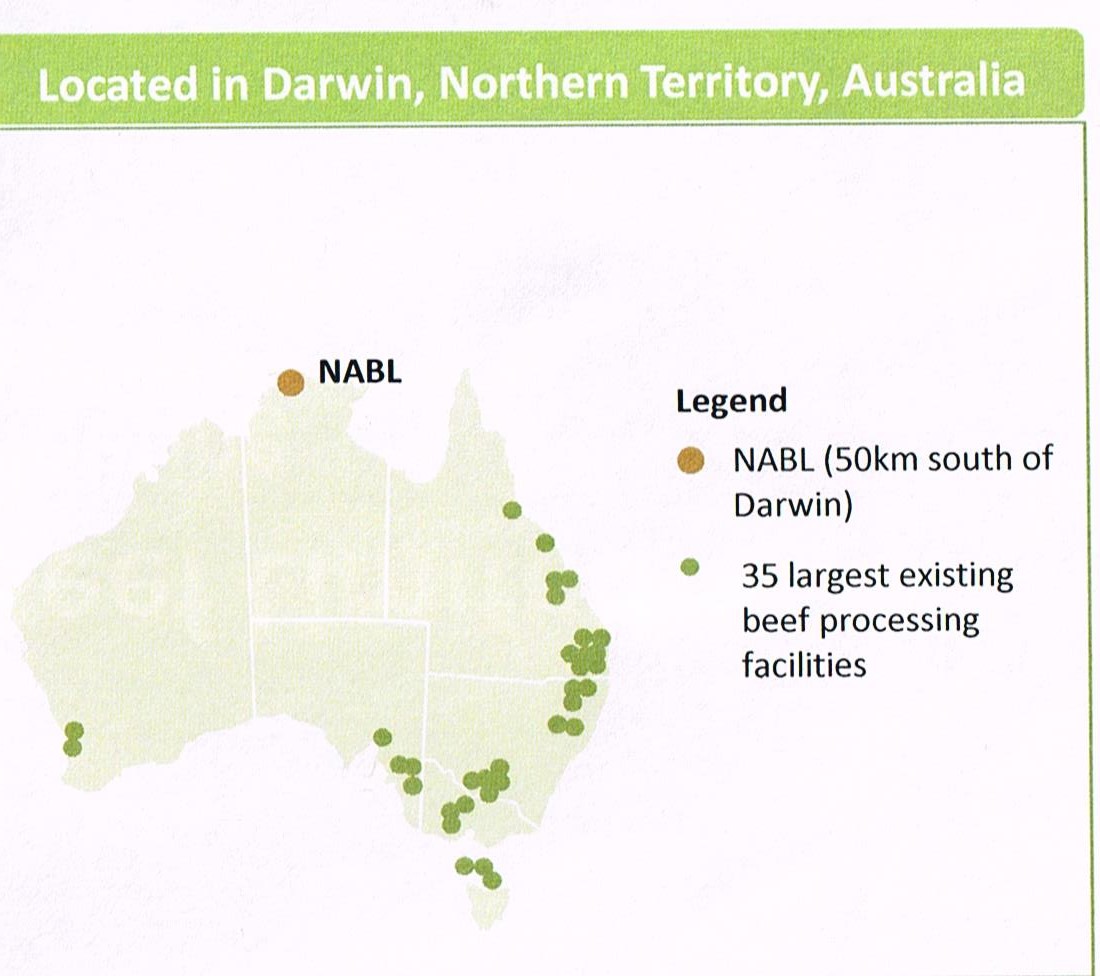
Australian Agriculture Company (AACo) is Australia’s largest beef producer owning in excess of 500,000 head. The building of the Livingstone beef processing facility near Darwin is the first new cattle abattoir to be built in Northern Australia for 50 years. It is the first operational beef export accredited facility operated in the NT for nearly 15 years. Currently mothballed after 3 years of operation.

Current Operation 

  • Livingstone abattoir, Was announced to be mothballed in September 2018.125
  • Ausmeat Accredited #80073 (as of February 2015)
    • Export Abattoir for Beef /Offal.73

Location

  • 50km S Darwin, 600 ha lot, 14ha buildings, rest area used for irrigation, wetlands, ponds and buffer zone.        

Owner

  • AACo, looking for partnership with overseas investor
  • AACo intend to always retain 50% ownership. (AAco own 485000 cattle – will supply 50000 hd through its own Northern supply company)

Historical and current meatworks, canneries and abattoirs located in Australia can be viewed at;

Australian abattoirs inactive map

abattoirs_edited-1

Operation

  • Initially Stage One – 100,000 head capacity with development through modular construction
    • 1,100 head a day, flexability to incorporate carcase chillers when required
    • double shift platform 7 months of year, single shift for another month and closed during wet15.
    • Work 11 months of year atleast 5 days a week
    • slaughter grids HSCW c/kg
    • inject $126M into economy6
    • Day care facilities7
    • Medical facilities to assist with Workers compensation costs7.
  • Darwin site chosen – just 50km from international seaport for exporting meat to key Asian markets. close to Major city to attract and retain workers and other support services for the proposed facility, with other benefits in AW , transport and carbon benefits12
  • Will be hot boning room (Stage 1 low cost production model), chillers and full capacity if fully developed to 225,000 head year.
  • Refrigeration system – one of the most technical and energy efficent installed.58
    • Built by one of the largest industrial refrigeration providers in Australia, Gordon Brothers Industries58
    • Cascade system – Refrigeration is in two parts58
      • Low temperature side operates on Co2 as the refrigerant58
      • High temperature side operates on ammonia.58
      • Designed to allow for future expansion58
  • Market for  cull animals cows and bulls and heavier slaughter weights steers, types unsuited to Live export Indonesia (feeder steers under 350kg)
  • complementing Live export not replacing it
  • Meat exported via Darwin Port to US, Asia including Indonesia, China and Philippines
  • 260 direct and further 530 indirect jobs.
  • Capital injection of $126M a year
  • Will be most carbon efficient plant in Australia, Claims will save 6M truck kilometres by reducing 30% truck requirement to east coast, cattle processed in Darwin expected to fetch premium of $42/hd above existing meat supply chains15
  • IAR – Individual animal recording will be used for management system5
  • ACIL Tasman Report – found a main benefit the proposed AAco abattoir would be providing a market for excess cast for age female cattle and as a result would promote productivity improvement in breeding herds.8
  • Facility is Halal accredited111

History of the Livingstone meat processing facility

MapSource – AACo Handout. Katherine Dec 2012.
Proposed location of AACo abattoir near Darwin comparative to existing 35 largest beef processing facilities in Australia at the time.

2010 

  • July. AACo seeking investors to back its proposed top-end works capable of processing 140,000 per year38
  • Estimates – $35M + $12.5M, If have government support up and running April 201211
  • Estimate $81M to construct (paper 06.06.12), Fed gov haven’t supplied funding as yet (Jan 2013) to project1.
  • Requires another $25M by Fed Government for road re-alignment, power, water, gas, rail, ports, Project not funded in 12/13 NT budget7.
  • Currently one container ship per fortnight is loaded Darwin, Abattoir  will require 2 container ships a week to take supply7.
  • Requires 145 container points at Port of Darwin15
  • Estimate $85 to construct (AACo board 19.10.12)
  • AACo – Wholesale Beef Group – sold 16,900t boxed beef in 2012, 17,000t in 20115
  • Korea – AACo’s largest export market for boxed beef, 20% of annual beef sales16
  • LE ban cost AACo $51.2M16, due mainly to land valuation write downs.
  • Managing director at this time – David Farley.137
    • Led AACo between 2009 to 2013137

AAco. Darwin

Source Northern Beef Limited Phamplet.

Artist impression of built Livingstone abattoir

  • August. Idea put to producers in NT to build abattoir14
  • AACo launch a feasibility study.54
    • facility could take 2 years to build.54
  • AACo believes a northern abattoir could play a key role to allow it become an integrated producer, processor and marketer.54
  • Indonesian weight import restrictions of animals being required to be less than 350kg had affected AACo, who sold 90% of export animals to Indonesia.54
  • October. Looking for support to build abattoir11
    • Problems anticipated – Labour and housing costs11

2011

  • AACo raise $60M from Institutional investors and hopes to raise another $30 from ordinary shareholders39
  • AACo expected to peak this year with ownership of 640,000 cattle39
  • July. AAco sell a QLD property – Meteor Downs $21.6M (17,474ha), south of Emerald.53
  • AACo will consider sales and purchases to re-aling its footprint in North Australia53
  • Hoped Planning approval would occur by Christmas 201153
    • two sites being considered for the facility53
  • construction is expected to take 12 months, employ about 150-180 staff.53
  • Mr David Farley Managing director of AACo, says the facility is not an alternative to live export.53
  • ‘If we had to get to that point we’d need $10 billion, a 10-year planning horizon, major investment in roads, rail, port and electricity – and 10 good men to oversee getting the job done, You’d need to process about a million cattle a year in northern Australia if you want to replace Live export” David Farley53

2012

  • Environmental assessment report conducted. “..there were significant uncertainties that had not been adequately dealt with…these relate primarily to the management of waste water and the need for effective management of odour, noise and dust76
  • February. Plant estimated to cost $80M,
    • Plan to be in opertion at around October 201315
    • Potential price premiums of $30+ a head from overseas meat buyers wanting to source product from low-carbon production backgrounds15
    • International indicators suggest $42/head premiums above existing Australian meat supply chains15
    • Process 135,000 cattle per year and require 260 full time staff15
      • Staff likely flown in from India and Philippines15
  • March. NT Minister for Primary Industries Kon Vatskalis announced at NTCA conference, Darwin $9M to be provided in kind by NT Govt.
    • Federal Government had no applications and funding never occured14
  • AAco post a financial loss for year ending March $8.4M39
    • Cite reasons for loss “Primarily due to flow on effects from the Federal government’s live export suspension of mid-2011″ Don McGauchie, AACo Chairman39
    • Continued high dollar39
  • AACo now estimate related devaluation of Northern Australian properties due to export suspension  devalued by $51.2M39
  • Implementation of ESCAS is challenging “Australia is the only country to attempt to regulate livestock exports from paddock through to processing in another country” Don McGauchie39

AAco cattle sales #2_edited-1Source – AACo Annual Report ending 2012 (March)
Markets that AACo sell their cattle to.

Cattle sales % 2012_edited-1Source – AACo Annual Report ending 2012 (March)
Cattle sales in percentages compared to full year sales.

  • April. Govt support required for highway expansion, port facilities for refrigeration, local health care facilities14
  • May. Government give approval to development subject to 5 conditions being met.35
  • ACIL Tasman report ACIL_EconomicImpact_AAcoAbattoir – May 2012.
    • Capital cost of the plant forecast to be $83M43
      • fully operational by 2014 with full throughput capacity 201643
    • AAco processing minimum of 35% their own stock.43
    • Closest abattoir – Townsville 2000km from Darwin.43
    • Proposed abattoir process 179,000 cattle can be modified to 225,000 with minimal capital expenditure.43
      • AAco anticipates processing 63,000 of their own stock.43
    • Majority of the throughput 80% being cull cows.43
      • Modelled on Average liveweight 430kg, dressing to 50% with saleable meat yield of 72% fo the HSCW43
    • Produce 28M kg of saleable beef and 36M kg offal, 6,900 hides43
    • No current regional market for cull cows and bulls.43
      • development of a cull market will enable younger, more robust, fertile herds reduces mortality and increases calves produced.43
      • Returns for cows would improve 117%43
      • Depending on capacity of plant and supply of heavy animals could increase sale value of animals in north by 31%43
    • Increased investment is required for all weather access.43
      • Abattoir would be closed December periods.43
  • June.  AAco says needs Indian worders to help fill 260 new positions10
  • AAco announce they have purchased 600ha site 50km  south of Darwin – Livingstone35
    • Plant estimated to cost $83M35
    • Initially plant to process 185,000 cattle annually, capacity with further development to 225,00035
    • AAco to always hold 50% equity in plant35
  • Three months to June 2012 – AAco Total cattle sold 68,660 cattle. Av $967/hd21
    • Wagyu beef sold 2,487t21
    • Short fed grain finish beef sold 1,965t21
  • October. Design phase complete, NT Governement has granted various planning approvals7
  • Federal funding in last budget wasn’t provided as they hadn’t received a solid proposal49
  • AAco board approve commencement of civil and construction works36
    • Plant estimated to cost $85M36
  • $14.5M spent by AAco on site to date. Earthworks beginning on site5
  • RSPCA quoted as saying as soon as Darwin ab opens they will be increasing demands for LE to be shut down8.
  • “Federal government committed to promoting economic diversification in Northern Australia9 Joe Ludwig, Current Minister for Agriculture.

Oct 2012_edited-1

Source -The 600ha site for the AACo abattoir at Livingstone – Photo Carl Curtain.

 ‘AAco board finally approves Darwin abattoir’ ABC Rural. 19.10.12

2013 

  • Discussions under way with potential equity partners5
  • February. Changes to water treatment process on site from an effluent dam storage treatment and irrigation system to a dissolved air flotation system13
  • Preparation of site and civil works well advanced,  light wet has been good advantage. Construction phase to begin 11.02.13
  • March. 260 staff required – will use 457 visas16
  • Government threatened to impose further restrictions on 457’s, “ if you want to delay, disrupt or waste Australia’s future then the 457 actions of the Gillard government will do all of that” – David Farley. AACo CEO16
  • April. Completion of first stage of construction17
  • Speculation development may be abandoned40
    • AACo say waiting for equipment to arrive.40
    • AACo announce selling two QLD properties40
  • Northern Territory Treasurer – Country Liberal Government, “There is no money available to support the abattoir” David Tollner, Minister for Business41
  • May. Construction expected to recommence late May17
    • AACo now sourcing capital to finance the abattoir without private investors17
    • Estimates of build now $85M17
    • Uncertainty of government funding and private joint ventures led AACo to fund project independently17
  • June. Three months to June Financials for AACo.21
    • AACo cattle sales  – Total Sold 99,654 cattle, Av $676/hd21
      • Grass fed/finished 28,275 hd21
      • Breeder and Feeder Cattle 37,456 hd21
      • Live export 20,14621
      • Wagyu 8970 hd21
      • Previous year same period – Total sold 68,660 cattle, Av $967/hd21
    • AAco wholesale beef business21
      • 2140t Wagyu21
        • Previous year same period 2,487t Wagyu21
      • Short fed – grain finish 1,699t21
        • Previous year same period 1,965t21
  • August. AAco CEO David Farley is dismissed18
    • Farley had served AAco for 3 years and 8 months20
    • ..investing in a  Darwin abattoir was important strategy to break reliance on large-scale processing competition in Australia, while also protecting the value of AAco’s northern beef properties” Nick Burton Director & Chairman of AAco, commenting on how Farley had helped to reposition AAco through difficult periods.18
    • Concerns are raised that abattoir won’t be built without Farley but at AGM Chairman Donald McGauchie the board has given full approval for the project.28
    • AAco recently sold Brighton property $11.5M18
      • part of strategy to focus capital in North Australia18
    • Finance of the abattoir had caused friction in last 2 years18
    • AAco may need to raise $150M in fresh equity to get its debts in order19
      • currently hold 1% of Australia’s landmass19
        • 600,000 cattle across 7.2M hectares.26
        • Australia’s biggest beef producer26
      • has Gross debt $423M at March 31.2013.19
      • recently sold properties worth combined – $25M19
      • AAco’s current debt to equity is 70%19
        • Ideally would be 30%19
        • Current major stakeholders – Wellington Management cut its holding from 8.1% to 6.5%19
        • Biggest shareholder Malaysia’s Felda Holdings and IFFCO failed to participate in 2011 revenue raising19
        • Tavistock Group, investment company of Britishman Joe Lewis owns 11% of AAco21
      • global beef prices are hovering near 3 decade low19
        • Due to poor wet season and low live export orders19
    • AAco current share price – $1.09c20
    • Meatworks due to be completed first half of 2014.20
  • Livingstone abattoir now estimated to cost $91M21
  • September. AAco shares are placed on trading holt.22
  • AAco announces it wants to raise $299M in capital through a share offer22
    • Share offer to be $219.2M fully underwritten 7 for 10 accelerated non-renouncable entitlement offer.22
    • $80M subordinated convertible notes maturing September 2023.22
      • Capital raising to be used to reduce Net debt from $412M of predominantly secured bank loans to $248M, including the $80M convertible notes.42
      • Gearing will fall from 40.9% to 23.5%42
  • Funds to be used to “support a future refinancing of its existing facilities”22
    • Within 2 days of announcement large investors generate $129.2M23
    • Existing institutional shareholders took up 56% of entitlements23
  • In effort to cut costs AAco move Brisbane headquarters to Fortitude valley consolidating two locations into one.23
  • Abattoir now stated to have future processing capacity of 200,000 hd22
  • Half year Financial results – End of September 2013 AAco report after tax loss of $31.6M26
    • Cattle liveweights fell 12% contributed $20.4M to fall in revenue26
    • Total revenue fell $15.6M to $177.7M26
      • cite reasons for loss as ongoing effects of June 2011 suspension of live exports27
      • below-average seasonal rainfall in North Australia27
        • some properties recorded lowest rains on record27
    • comparisons of earnings to previous years same period27
      • Sept 2013 – delivered 172,517 hd for sale27
        • Sept 2012 – $147,693 hd for sale27
      • Sept 2013 – Average $731/hd, 20% lower than previous period27
        • Sept 2012 – $919 /hd27
      • Sept 2013 – Cattle purchases 14,453 hd27
        • Sept 2012 – 61,181 hd27
      • Sept 2013 – Kilograms produced 44.7M kg27
        • Sept 2012 57.7M kg27
        • Authors Note Kilograms produced is a benchmarking technique taking into account animals born/deaths and differences in weights of sale animals to previous year. It is not simply sale animals weights.

    Livingstone abattoir 002Source – ‘AAco rules out split, plans $299M raising to expand to Asia’ The Australian 13.09.2013
    Global beef price v’s domestic cattle prices / AAco revenue contribution.

  • October. Tavistock Group – owns AA trust – operated by Joe Lewis – Discloses 19.9% in AACo.24
    • has purchased an extra 1.8% – derivative contract.24
      • 20% threshold ASIC – take consideration as formal takeover – 1.8% not physical ownership therefore ASIC/take over panel not concerned.24
    • Bonds of 8% due to convert at fixed price $1.15 will allow Lewis ownership of close to 30% AACo.24
  • AA Trust. Is Bahama based. Is a stable company of Tavistock Group100
    • Lewis could command up to 30% of AACo’s register by September 2014.100
  • Larger foreign shareholders are rumoured to want split the company in two.100
    • Rumours were dismissed with investor said to favour the transformation of AACo into a pure meat processor and exporter to Asia.100
  • AACo purchase 2 NT properties – Labelle Downs and Welltree Station – $27.1M25
    • No cattle included in sale, only plant and equipment25
    • RM Williams had previously owned properties – gone into receivorship25
    • Properties were 180km from Darwin and complement abattoir25
      • ensure continuity of supply of animals through both wet and dry season.25
  • AACo retail component of $299M capital raising is successfully completed97
    • Retail Shareholders subscribing to $46.1M in shares97
    • Institutional offer and convertible notes issuance had been completed in the previous month97
  • Livingstone abattoir is expected to be completed second half of 201497
    • Processing capacity of over 200,000 per annum97
  • AACo appoint contractor Milmeq (New Zealand based) – build refrigeration and food processing equipment in abattoir – worth $21.4M29
    • Were not able to find anyone in Australia who were able to give full turn-key operations29
    • Milmeq have subcontracted to an Australian based refrigeration company some of the tender.29
  • Haarslev – Denmark company won $6.5M contract to build rendering and waste treatment plant29
  • Managing contractor – Sunbuild – has sub-contracted much of the construction work to local companies.29
  • NT Country Liberals Government has enabled removal of red tape to allow agreements that suited both sides better than in the past.29
  • November. AACo report a net loss after tax of $31.6M in first half year results98
    • Domestic cattle prices had slumped – decline of 12%98
      • On-going effects of Federal governments June 2011 Live export ban98
      • Below average seasonal northern rainfall98
  • Acting Chief executive officer currently – Craig White98
  • New Livingstone facility would be crucial to enhancing the group’s profits and well as reducing volatility of the groups earning profile98
  • Lewis – Tavistock Group own almost 20% of AACo99
    • Rumours Joe Lewis wants to break the company apart99
    • Tavistock were the primary backer of the capital raising99
  • December. Facility is based on similar layout to Hunter Valley (EC Throsby – NSW)37 (Not yet added to blog)

2014

  • January. AAco investigate options to enable supply of employees30
    • Providing work for prisoners – Sentenced to a job program30
      • Prisoners would get minimum wages after being trained.30
      • Money would be held by the Territory to pay for their board.30
      • Enables training to devleope skills and then move to full time work before they leave prison30
    • Require 350 workers30
      • locals get priority.30
    • Nik Taylor – Associate professor – Flinders university says using prisonersto work in the Abattoir would be “psychologically damaging”31
    • “We’re asking people to take lives from sentient creatures”, “Theres lots of other work that doesn’t have the kind of moral ambiguity we have around slaughterhouses” – Nik Taylor31
      • Nik Taylor studies links between domestic abuse, child abuse and violence to companion animals32
      • Taylor is an associate of New Zealand Centre for Human-animal studies -“whose research is concerned with the conceptual and material treatment of nonhuman animals in culture, society and history”.34
      • She is also a committee member of ‘Minding Animals Australia’ – Minding Animals International state their main objective as “… to further the development of nonhuman animal studies internationally and to help establish legal and moral protections for nonhuman animals”33
    • Authors Note – At time of writing Karnet abattoir (WA) is a low security prison operated abattoir located in Western Australia
  • Jason Strong is appointed managing director and chief executive officer, was previously the companies general manager44
  • February. Organic farmers in the NT express and interest in buying meat meal from the plant45

#7_edited-1Source – ‘Darwin abbatoir on track for AACo’ ABC Rural. 20.02.2014. Photo Jeanette Button
Construction of the freezing section. Main building for processing of carcasses not yet constructed.
More photos of the site are available on the above link

  • Plant now estimated to have cost $90M47

“We strongly believe that in conjunction with the live export trade this facility will help to improve the overall performance of the Northern Territory beef industry” Mr Donald McGauchie, AAco Chairman47

  • AAco confident of securing cattle throughput to keep the plant viable47
  • Throughput would start at 300 head a day47
  • APA Group – Natural gas supplier announce arrangement of delivery of natural to facility47
    • Gas will be sourced from Amadeus Basin (Alice Springs) arrive via APA existing pipeline and a new 2.8km lateral line.47
    • New gas line and receiving facility will be owned and operated by Northern Beef Australia Beef Limited – a wholly owned subsidiary of AAco.47
    • 10 year agreement with APA group51
    • Abattoir will utilitse cogeneration – using both electricity and thermal heating for meat processing.47
  • Facility will have capacity to kill 240,360 and 520 head per shift48
    • 1000 head per day using 2 shifts per day51
    • Carcass breakdown – collection of red and green offals, renderable products to tallows, meat and bone meal. Dry blood and hide processing to ready for further processing off site.48
    • Hot Boning – Will be conducted in Stage 1 of manufacture with stage 2 being cold boning if further developments are made in the future.48
      • Animal is expected to be processed within 24 hours of delivery48
      • All animals pre-slaughter electrically stunned48
      • From time of stunning to time meat enters freezers – 45 minutes48
    • Facility will have capacity to process buffalo48
    • Cattle will be paid on HSCW (Hot standard carcass weight), manufacturing cattle will have a set price and grid prices for prime.48
    • Online portal for feedback to suppliers to be developed.48

B.Cooper. 28.03.14_edited-2

 Source ‘AACo abattoir set for spring start’ The Land 28.03.14
Site Construction at the site in March 2014. The Packing label is slightly wrong and should be more to the right

  • Plant now cost more than $90M, expected to begin operations in September 201450
    • Processing will start at 300 head a day before steadily increasing50
  • Refrigertion and rendering equipment is now arriving and being installed.51
  • Expected savings of transport of stock from Katherine or the Victoria river area to a QLD plant will be $160 per head or $20,000 a trip48
  • Some within Australia’s established processing industry rate the plant’s chance of long-term success at zero63
  • Plant will contribute more than $120M to the local economy63
  • AACo 2014 report – The Northern Beef Processing Facility will be complementary to AACo’s live export trade, not a competitor, providing a market channel for cattle not destined for live export. (Pg 11)69
  • AACo, current Australian herd (including animals in feedlots and calves) 552,065 at 31/03/2014 (Pg 95)69
    • At 31/03/2013 was 677,217.(Pg 95)69
    • sales occured due to dry conditions necessitated de-stocking across the industry, forcing domestic cattle prices lower (Pg 8)69
    • company has destocked significantly past 18 months due to drought mitigation measures74
      • core breeding herd of 185,000 head74
      • Currently running 467,000 head of cattle across 7M hectares74
    • AACo’s branded beef division increased 329% to $17M gross profit.74
    • Net loss after tax of $40M for the year to March 31.74
  • Abattoir is on track to opening in September 201474
  • May. Author – Blog article I wrote after viewing AACo Beef Processing facility

14.04.14 087_edited-1Source Jo Bloomfield. Livingstone abattoir site at March 2014

  • May. Showcasing product representation through a trial run dummy kill at a QLD export plant.52
    • Brisbane based branded beef group to be responsible for management of sales out of Darwin plant.52
  • Showcasing allows confidence and security around stable pricing out of Darwin plant.52
    • Some of the product went to China52
  • Plant expected to be opened September 2014.52
      • First time slaughter facility has returned to NT on commercial scale since closure of Katherine (NT)52
      • Initial costs in establishing the plant with disproportionate operating expense in first year of set up, on completion management of budget is confident by AACo.52
  • Cattle supply secured from start September to End March 201552
    • Some of AACo’s own stock52
    • Some cattle purchased by AACo to hold for slaughter52
    • Supply agreements locked in with other livestock Northern producers52
  • Initial start up will be half-shift daily – represents 50,000 head cattle a year.52
    • Depending on operating conditions, issues of start up improve will progress to52
      • full shift – 110,000 per year52
      • 2 shifts – 220,000 per year52
  • June.

24.06.2014Source – Photo supplied by AACo. June 2014
Showing Livingstone beef processing facility near completion.

  • July. Abattoir is currently at 80% capacity101
  • August. AAco is no longer a cattle company – it’s a beef company.55
  • Vertical integration from production, processing, sales and marketing.55
    • closed system to maximise profits.101
  • Transition has been happening for several years.55
  • Over 12 years the branded beef has grown from nothing to a division that provides half the companies revenue.55
    • Top Wagyu brands selling for more than $250 /kg55
  • Asia is the main target market for AACo’s production.55
  • Testing is occurring at the plant, securing of some accreditations was still ongoing, Ausmeat, AQIS, USDA and market access accreditations.56
  • ‘Preferred supplier status’ where suppliers who are able to supply in the wet seasons may be given space for kills in the dry, co-ordination by AACo with other producers.56
  • AAco are stocking Labelle Downs and Welltree proeprties so as to supply facility over the wet season.57
    • Manager from Eva Downs on the Barkly – Tim Milne.57
    • Many came from AACo’s own properties at VRD and on the Barkly57
    • One third of the herd is cows for processing at Livingstone57
    • Two thirds are shipper types for live export57
  • AACo have also purchased the Pell Airstrip and Tortilla blocks to enable supply of cattle incase the roads are out to Labelle and Welltree57
    • $8M to buy Pell Airstrip & Tortilla67
  • NT prisoners helping to construct the cattle yards at Livingstone.74
    • Correctional Services won a contract to supply workers74
      • Ahead of a Chinese company74
    • 40 prisoners on project for up to 3 months74
      • Enables prisoners to learn skills74
      • Prisoners pay board, lodgings, pay tax and pay a levy to victims of crime74

SEPTEMBER 2014 – LIVINGSTONE BEEF PROCESSING FACILITY IS OFFICIALLY COMMISSIONED59

  • Begins processing of manufacturing beef to supply Asia, United States and European Markets.59>
  • Initially the plant will only process AACo stock59
    • Expects to process other clients early 201559
  • Will give the live export dependent northern beef industry a fresh option for stock that don’t fit export specifications.59
  • Other areas are watching to see if the abattoir benefits economics of beef production to enable hastening of plans for others.59
    • Northbeef project59
  • One shift is operating at present employing 160 people, processing 520 head a day59
    • Capable of operating 2 shifts, nominal throughput of 220,000 head a year.59
    • At full capacity turn off will be 25 containers a week of frozen and chilled beef, along with hides, offal and tallow.59
  • 85 people currently employed, killing small numbers of cattle but only for training and trial purposes76
    • 90% of employees are local76
  • Facility has to meet standards of an Operational Environmental Management Plan (OEMP) before a licence to operate can be released.76
  • October. NT Environmental protection Authority has concerns with companies management of waste water, noise, odour and dust.60
    • EPA held back commissioning of the facility.60
  • Taken AACo over 5 years to get the facility built and operational60
  • 85 workers already employed60
  • Eventual cost of facility $91M60
  • Plant was close to signing off on requirements around operation and licensing61
  • Next major goal is have staff trained to conduct a single shift of cattle by March 2015.61
    • Already have 43,000 cattle lined up and dedicated to the plant to March.61
    • building up to a single shift will involve a progressive ramp up of supply, training, people and operations.61

OCTOBER 31, 2014 THE LIVINGSTONE PLANT CAN LEGALLY START TO OPERATE.62

  • EPA deliver licence to allow start of operations.62
    • Detailed bureaucratic process, part is negotiation, part is understanding what the requirements are62
    • things had required more detail than AAco had originally thought.62
    • No substantive change had to be made to the plant, design or or manufacture.62
    • 78 conditions of the environmental licence64
      • First of its kind in decades for a new meat processing facility64
      • Not unusal for licences to go through multiple stages before final approval64
    • Annual review will be conducted to ensure facility meets standards set.62
  • First significant abattoir in Northern Australia in 50 years.64
    • Previous facility in operation in the NT Katherine #2 (NT)
    • At different times the north had 10-12 abattoirs, that processing capacity has vanished. Abattoirs in the NT
    • More than 90 abattoirs were lost from Australian agricultural landscape between 1980-200566
  • Killing started immediately – 40 head a day, have been able to do that while commissioning.62
  • Product will accumulate in cold storage before the first sale is delivered in several weeks.64
    • First customer will be un-named domestic manufacturing beef customer on the eastern sea board64
  • AACo are not concerned about rising prices of live export cattle62
  • “We are quiet aware of that (rising LE prices) and we’ve got to remember that a strong, viable live export industry is good for the plant” Jason Strong. AACo Managing director.62
  • Australia’s national cattle herd is set to decline to its lowest level in 20 years
    • Forecasts of July 1 2015 Herd will drop to 26.1M65
  • Plant will face difficulties to get established65
    • cattle supply shortage65
    • find competant workers65
    • establishment of product in a highly competitive wholesale beef marketplace65
    • Maybe AACo plant will survive, others to the south of Australia may not.65
  • November. Financial year earnings released. Pre tax earnings for first half of year negative $8.2M mainly due to cattle sales revenue reducing by $50.4M as company held stock to be processed at the abattoir.68
  • Since original business case developed has been significant improvement in manufacturing beef prices68
    • underpinned by US beef producers rebuilding herds.68
  • First customer was an un-named domestic manufacturing customer on the Eastern seaboard70

2015

LIVINGSTONE BEEF FACILITY IS OFFICALLY OPENED 21ST FEBRUARY 201571

  • February.Facility is listed on Ausmeat Accreditation list, Establishment #800
    • Export abattoir Beef/offal
  • Facility is officially opened by Prime Minister Tony Abbott71
    • nearest existing abattoir 2,500km from Darwin.71
    • Facilities main value will be competitive tension71
  • Intend to have a full single shift in operation and killing 520 per day by March 201570
  • Jason Strong rejected media statements facility would battle to secure stock, due to competition from live export70
    • Live export steers – ex Darwin 275c/kg70
    • Heifers – ex Darwin 255c/kg70
    • Cows – ex Darwin 170c/kg70
      • Note LE cows must be spayed or preg tested empty
  • Facility has started exporting beef with a container sent out of Darwin bound for Hong Kong.72
  • As the facility ramps up production focus will shift to product export72
  • Facility will produce beef products, hides and rendered products for markets across Asia and the US72
  • Some cattle had already been purchased from producers72
  • Prices to producers/suppliers will be either72
    • Over-the-hooks – animals supplied into the plant72
    • Live weight delivered likely to Pell Station.72
  • April. Pell Airstrip property is being transformed as an integral part of the supply chain for cattle to Livingstone processing facility77
    • Large weigh bridge capable of weighing individual trailers of an entire roadtrain.77
    • Accommodation block, hay sheds, commodity sheds, yards and office blocks77
    • Current purchase structure of abattoir will be to those animals delivered to the abattoir facility to be paid over the hooks77
      • Livestock delivered Pell will be paid live-weight on stock delivered.77
    • Pell and Labelle Downs will be used to hold animals to gain more weight prior to slaughter or being attached to groups destined for live export.77
    • hay for Pell is being sourced from Torilla which AACo also own.77
  • NT Environmental Protection Authority (EPA) order AACo to take “immediate action” to solve odour problems coming from the works.78
  • Odour is being caused by poor quality of wastewater being used, possible over-used by AACo for irrigation78
  • EPA had given permission to AACo to start processing cattle so the system could be tested and fine tuned78
  • Maximum cap was place on number of head to slaughter at 250 head a day78
    • AACo volunteered this amount78
  • AACo had presented a plan to mitigate odours and ensure sustainable compliance with the Environmental limits78
  • May. Livingstone facility slaughters 300 head a day for the first time79
    • Milestone to the road of full capacity of 500 head per shift79
  • First container of beef from the works had landed in th US79
    • Past 3 months shipments had gone to Korea, Japan, Hong Kong and Singapore79
  • 2014/2015 Annual results are released
  • AACo earned $9.6M profit,79
    • previous year loss of $39.9M79
    • Boxed beef now account for 77% of AACo revenue79
      • Processed Beef $277M  (includes Livingstone facility)103
        • Wagyu beef accounted for 52% of boxed beef revenue104.
      • the more boxed beef sold by AACo the better the revenue to them79
      • AACo are targeting higher boxed beef turnoff.79
    • Past 12 months to 31st March 201479
      • Cattle sales $120.5M,79
        • fallen in the past 12 months $70.5M79
      • Boxed beef sales $188.2M79
        • Increased in the past 12 months to $267.6M79
    • AACo’s current gearing ratio 32.7% at 31/03/201579
      • Equity 67.3%
      • Debt increased from $225M to $366M103
    • Previous gearing at 31/03/2014 23.3%79
      • Equity 76.7%
  • AACo’s publicly listed status has meant considerable transparency with investors and broader industry and community about the project.80
  • Plant has now entered 6 export markets, exported from Darwin via Singapore80
  • Facility is licensed to access full range of front-line markets80
    • country specific markets like China are not yet included.80
  • Initial domestic supply had been due to management of customer relations80
    • Early volume predictions of production suited the flexibility of domestic customers80
    • Exports require stable output80
      • Stability of supply will improve as volumes increase80
  • AACo do not need to spend significant investment on large volume osmosis equipment to overcome water quality issues80
  • Environmental issues are not constraining processing operations80
  • Cattle held on properties for processing are not causing environmental or welfare issues.80
    • properties have the capability to hold an entire years processing capabilities with no environmental impact.80
    • No outside cattle were contracted for slaughter until March80
  • Plant is not cannibalising profits from AACo pastoral operations80
    • the whole premise of the Livingstone plant is to provide an alternative market for cattle80
    • adding value to cattle that previously had limited market value prospects80
    • Some cattle are still live exported if financially attractive80
  • Plant will continue to run a single shift for operational reasons not environmental80
  • July. Indonesia cuts quota of live cattle imports.50,000 for quarter to Sept 2015.104
    • Same period last year had been 250,000 head104.
  • AACo AGM. The boxed beef transformation has created a more robust business104.
    • making strategic decisions to reduce the number of cattle sold externally104.
    • Volume and pricing of boxed beef sales continues to increase105.
  • August. AACo publically advertise kills space is available for cows of various weight range for September through to October81
  • Prices weighed Pell Airstrip81
    • $1.85/kg for cows over 421kg
    • $1.75/kg for cows 391kg – 420kg
    • $1.50 for cows 340kg – 390kg
  • the abattoir is generally processing cattle not suited to Live export markets but is competing with southern processors81
    • Midfield Group’s abattoir at Warrnambool Victoria has been buying large number of cull cows and old bulls from the NT81
    • prices are very competitive being offered by AAco.81
  • Indonesian import permits for slaughter & feeder cattle is still not released81
  • NT Environment Protection Authority (NTEPA) continues to receive complaints about “foul odours” coming from the new abattoir82
  • Problem is caused by poor quality waste water being used for irrigation82
  • NTEPA met with AACo January to discuss odour issues82
    • Company made improvements to manage odours and seperately applied to the NT Government to build additional improvements to the facility to specifically manage odours82
    • complaints had reduced dramatically
  • NTEPA met with AACo again March
    • NTEPA believe odours can be eliminated entirely
    • Wrote a letter to AACo to improve odour reduction further82
  • AACo did do air quality control report, which recommended an odour audit was conducted – audit wasn’t done82
  • NTEPA instruct under section 48 Waste Management and Pollution Control Act that the audit be carried out issued in August82
    • Conducted by an accredited expert in odour control
    • Will involve a thorough check of all buildings
    • Community interviews
    • How weather affects the odour
    • Recommendations
      • Which NTEPA want AACo to follow
      • Want implementation of improvements by the end of October 2015
  • Currently processing 350  head a day83
  • September. Currently processing 400 head a day83
    • 6-7 cuts from carcasses, as well as mince83.
    • Markets in Korea and Japan83
    • US market – Mince83
  • AACo purchase Thorner Station in QLD – $4.1M83
    • Exit Tipperary Station that had been an agistment agreement83
  • October. AACo’s shift from cattle producer to vertically integrated beef operation is delivering results83
    • increased earnings reflects success of switching from selling cattle to capture value of the herd when converted to beef83
  • EBITA for the first half of 2015 financial year (Ending September 2015) $8-$12M83
    • Last year same period $8.4M loss
    • Beef sales as a percentage of revenue have risen from 47% to 80% year on year
    • Branded program – 1824 that is 100day grainfed
      • 3 years ago processed 26-27,000 head with only 1500-200 being owned by AACo
      • In 2016 processed 60,000 through 1824 and owned 50,000 head of those animals
    • AACo have maintained a herd of 170,000 head83
      • despite liquidation of females due to drought
    • Livingstone abattoir began to process 350 head a day in August increasing up to 400 head a day in September83
      • processing 6-7 cuts from the carcases, including mince
        • established markets to Korea, Japan and US (Mince)

AACo. Half year 30.09.2015. Pg 10

Source 2015_-_28__aaco_fy16_half_year_financial_report___final

Northern Beef Performance as at 30/09/2015. Pg 11.

  • November. Half Year financials AACo report a $97M increase in statutory earnings to $92M and a statutory net profit of $50 for the 6 months84
    • $64M improvement on previous years same period84
    • First time in 8 years that a first-half profit has occurred106
  • “We are selling more kilograms, off the same herd base, for more money” Jason Strong, AACo Managing director82
  • Increased throughput at the Livingstone facility comprising of 16% of group meat sales revenue in H1 FY16.82
  • Boxed meat – particularly wagyu cuts, surged by 90% to $218M106
    • 2 years ago boxed beef represented 47% of total sales, today that stands at 84%106

2016

  • February. NT Environmental Protection agency not satisfied with odour audits85
    • Suggests some errors in estimates in regards to winds and magnitude of the emissions from the irrigated areas85.
    • Local residents are still complaining of odours85
  • AACo plan an upgrade to the site to address all concerns85
  • March. Livingstone facility is currently processing more than 400 head a day86
    • Management were happy with operations through the wet season86
    • 2015/2016 being the first full wet season of operation86
      • Expectation capacity will increase to 500 day in the coming dry season on full single shift86
    • Competition is increasing for cattle86
      • Mix of stock coming from AACo’s own stock and other producers86.
  • Increasing number of producers are sending stock to Southern works such as Warrnambool86
    • Could be traditional markets for those producers86
    • Southern facilities need to keep operating, thus source stock further afield86.
  • Vietnam live export is also strong competitor86
    • Heavy cull cows and some heavy males being exported86
  • AACo Annual report to 31/03/2016. Livingstone account for 16% of overall Meat sales84
    • 16% = $65,523,000 (Total Meat Sales $428,272,000)96
  • AACo Director – Shehan Dissanayake. Is concerned with the disconnect between head office and on the ground staff at properties, is causing the company to underperform.107
  • April. Carbeen Park ( Cattle depot located Katherine and leased by AACo) turns over 40,000 head of cattle in the previous year87
    • Cattle are purchased from WA and AACo’s own properties to spell a the site before being trucked to the abattoir at Livingstone87
    • Most stock are cull cows and bulls unsuitable for live export87
    • Some producers able to sell cattle in small lots that they could never sell before87.
    • Carbeen is also a registered export yard able to pre-export stock, then trucked straight to the port for loading87
    • Carbeen cuts 400ha dryland sarbi and verano grass with 40ha sorghum under centre pivot87.
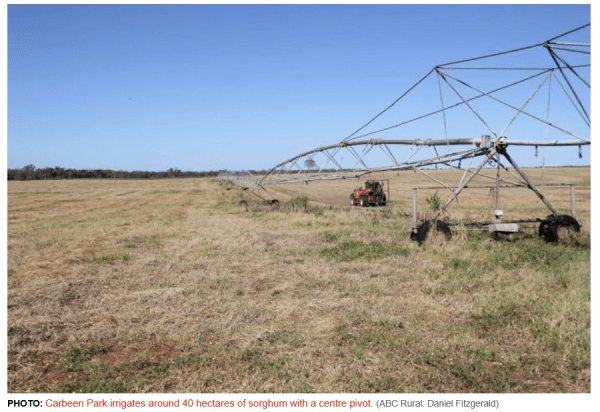
ABC rural .#2 21.04.2016

Source ABC rural. 21.01.201687.

AAC newsletter, April 2016

Source. AACo. Livingstone Beef Operations Newsletter April 2016.

April Newsletter indicating the make-up of the work force at the facility.

Website page. April 2017.

Source AACo Website. Livingstone Operations.  Accessed April 2017.

  • Major share holder in AACo – Tavistock. Managing Director – Shehan Dissanayake.102
    • Mr Dissanayake is an AACo Director.102
  • September. Producers are sending some stock south to higher paying processors
    • 3,000 head have passed through spelling station at Sturt plains in the past 4 months88
      • Southern meatworks were paying freight after weighing at Sturt plains.
  • significantly less cattle have been exported live from Darwin this year88
  • October. Upgrades are made to the wastewater treatment facilities89.
    • Current 12ML capacity will be increased by 25%89
      • 4ML increase in the covered anaerobic lagoon89

ABC rural . 07.10.2016

Source ABC Rural 07/10/201689

  • Current throughput capacity is 520 animals per shift.89
    • Built capacity of the plant was 510-520 head to be processed on a full shift89.
  • AACo launch 2 high end beef brands in Singapore89
    • “Premium luxury brand”89
    • Wylarah brand – Wagyu beef grown in central QLD89
  • Joe Lewis converts 59 of 160 convertible Notes into fully paid ordinary shares in AACo.108
    • Convertible notes were given a fixed share conversion price of $1.148.108
      • significant discount to AACo’s net tangible assets per security of $1.90108
      • Was a further $219M non-renounceable entitlement at $1 per share108
      • Mr Lewis took up his own full entitlement and underwrote any new share that existing shareholders didn’t take up108
        • If other shareholders didn’t take up their offers then Tavistock would buy them108
    • Tavistock now have just under 38% stake in AACo. Worth approximately $350M108
    • Now two Tavistock directors on the AACo board108
  • November. Full runs commercial trial processing buffalo90.
    • 8 head had been processed previously but additional equipment and training of staff had been required90.
      • Equipment was required particularly for the horns90
    • Possible one day a month could be allocated to buffalo90
  • Currently employing 200 people90
    • Both skilled and unskilled90
    • Actively employing local people, require more90.
  • Currently processing beef 480-500 head a day90
    • equates to 75-80 tonnes of meat per shift90
  • AACo announce revenue from meat and live cattle sales has fallen $46M for the 6 months to Sept 30. 201691
  • Half year results91
    • Net profit $47.9M – down $1.9M same period last year91
    • Revenue $214M91
      • Underlying earnings improved by $2.4M91
    • Live cattle sales down $28M – reflective of more stock being processed through the companies own supply chain91
    • Costs have cut 25% to improve earnings in the company91
  • Estimated Asian swamp buffalo numbers across the Top end are 150,000 head92
    • Majority are located in the Arnhem land92.
      • Kakadu National park having 6,500 head92
    • Buffalo management is being assessed but will require government support aimed at culling and capturing some stock92
  • Cost of Production (CoP) $2.77 for every kg of cattle weight added was reduced to $2.09 per kg.109
    • Cuts in CoP were due to slashing of transport costs as the business streamlined its alignment of cattle breeding and grazing on properties with specific abattoirs, feedlots and meat brands.109
    • Two new beef brands launched – Westholme and Wylara109
  • Joe Lewis – Travistock now own 39% of AAco shares.109

2017

  • February 10. Livingstone abattoir is temporarily shut down due to lack of stock93 because supply has been affected by heavy monsoonal rain cutting off road access to many properties93 .
    • 1st time facility has shut due to bad weather93
      • Abattoir is shut down temporarily due to lack of cattle being able to actually be transported into the site.134
      • Shortfall caused by heavy monsoonal rain.134
    • closure will likely be only 1 week93
    • First time facility has shut down due to weather in 18 months of operation134
  • A year round operating abattoir was sustainable in the NT93
    • AMIEU claims 300 workers will be affected93
    • Workers will not receive pay while stood down93 .
    • Other facilities in other states have even opened from the Christmas shutdown yet93
    • Longer shutdown may occur due to weather93 .
  • Jason Strong, AACo CEO still believes it is possible to have a year round abattoir operating through the wet season.134
  • “The plan’s still very solid and the execution of it’s still fine….” Jason Strong. AACo CEO134
  • Approximately 300 workers were affected by the shutdown134
    • Workers will be stood down without pay134
  • March. Australian government announce that China will increase market access for chilled meat products133
    • Chinese FTA has decreased tariffs133
    • Allow the number of meat processors in Australia to increase from 10 to 36133
      • 15 were expected to have approvals fast tracked133
    • South American countries have been squeezed out of the Chinese frozen market133
    • China had banned chilled imports from Australia in 2013 with only 11 facilities being able to regain access.133
  • March. AAC_2017_Annual_Report

Source AAC_AACo_2017_Annual_Report

  • Meat Sales (Including all boxed meat and Livingstone) decreased 11% ($45,236,000) from 31/03/2016112
    • Total Meat Sales 31/03/2017 $383,036,000. 31/03/2016 $428,272,000112
      • Australia – Increased 15%112
      • USA – decreased 33%112
      • South Korea – decreased 5%112
      • Japan – decreased 57%112
      • Other countries – increased 10%112

Source AAC_AACo_2017_Annual_Report

  • Average Value of Stock as at 31/03/2017 $1,207 per head across all stud, breeders, calves, trading and feedlot animals – 662,482 head. (Pg 59)112
    • Breeding herd consisting of 540,000 head113
  • April. Livingstone hopes to export meat to China.110
    • Applied for permission to export to China.110
  • Livingstone currently has access to 27 customers.110
    • USA being the largest customer.110
    • Higher quality beef cuts are mostly sent to Asia110
  • Looking at unutilised quota of 2,250 tonnes of frozen buffalo meat that Australia has with the European Union110
    • Quota had not been accessed since 2003110
  • April 7. Facility is back in full production after it closed a week earlier this year due to lack of cattle in the wet season110
  • Key relationship establishment has allowed the abattoir to operate with minimal disruption through the wet season.111
  • Processing capacity was maintained at 500 head per day.111
    • Only one week shut down in February due to weather affecting access and odd Friday shutdown.111
    • Reduced throughput was widely experienced in the processing sector courtesy of trough trading conditions.111
  • Facility is halal accredited, Hot boning, or immediate boning after slaughter.111
    • Carcase moves through the production line in 45 minutes111
  • Livingstone is supplying 90CL or manufacturing meat mostly to United States.111
    • Four main markets are supplied111
      • Some cuts such as rumps being sold domestically111
  • Three trials of buffalo have been run111
    • Buffalo meat went into domestic market for pies and buff burgers111
    • AACo would like to keep the buffalo production increasing as relationships are established111
  • August. Joe Lewis. Tavistock now own 41% of the 193 year old AACo113
    • Mr Lewis’s representative Shehan Dissanayake is made a senior executive and key member of the leadership team113
      • Dr S Dissanayake owns 2.02M shares of AACo (31/03/2017)112
  • AACo CEO Jason Strong resigns113
  • AACo’s share prices plunges 24% in the past year113
  • September. AACo Livingstone start to commission a new waste water treatment plant that has recently been installed.114
    • Covered anerobic lagoon that captures gas for future use at the plant.114
    • Cost $8.7M114
    • Will take approximately 3 months to be in full operation.114

Source ‘Darwin’s AACo abattoir commissions water treatment facility…’ ABC Rural. 18.09.2017. Audio

  • November. Jessica Rudd, daughter of former Prime Minister Kevin Rudd is appointed as a non-executive director of AACo.116
  • December. New CEO – Hugh Killen115
    • Experienced in finance – three decades in the banking industry including 15 years with Wespac leading its fixed income, currency and commodities business.115
      • Experience in volatile markets having been head of Westpac’s North American business during the global financial crisis.116
    • Has a family background in farming but has never run an agricultural operation or acted as a CEO.115
    • Mr Killen will receive a fixed annual renumeration $600,000, cash bonus max $300,000 and max $150,000 under AACo’s performance rights plan.116

2018

  • March 17. Cyclone Marcus hits Darwin. Category 2 cyclone with winds up to 130km/hr135
  • April. Annoucement is made that AACo was likely to post an underlying statutory loss of between $30M – $40M for the 12 months to March 2018121
    • Livingstone beef operations write down of $60-65M121
      • Facility is expected to have contributed EBIT & Depreciation and Amortization loss $18-22M ending 31/03/2018117
        • Compares to loss of $12.5M ending 31/03/2017117
      • Losses reflected ‘Onerous contract provision’ – the abattoir was committed to118
        • Gas provision supply contract119
      • Deloitte Accounting firm has been engaged to conduct a strategic review process to assess all available options for Livingstone, including improving the operational efficiency of the plant.117
        • Update of the review to be provided in the full FY18 results119
    • Disclosure of the individual performance of the Livingstone facility  had not been done before in reports of financial performance.
      • Segment disclosure would be occurring in the coming FY18 results119
  • Facility currently employs about 200 people117
    • Compares to profit $133.2M in the prior year121
    • AACo shares have slumped to $1.12121
      • Decrease of 31.5% in the last 12 months121
    • Second Review of AACo was being conducted121
      • Company was not considering selling property121
      • Review will focus on process and efficiency within AACo’s supply chains
  • “AACo’s  performance has been affected by external challenges such as increased competitive dynamics in certain markets, a higher Australian dollar, higher input prices, and an elevated cattle price environment for Livingstone Beef” Mr Hugh Killen, AACo CEO.117
  • Recent transition from retaining brand ownership through the supply chain to instead selling cattle is in stark contrast to what previous management teams claimed had pulled AACo out of negative cash flow in the first place.117
  • Key Pillar in AACo’s vertical integration had been the opening of the Livingstone abattoir.119
  • Increased competitive dynamics had occurred in some of the beef product portfolio’s.119
    • Larger exports out of the US and the strength of the Australian dollar119
  • Net debt at years end $348M119
    • Gearing ratio (Net debt/total equity +net debt) 26%119
      • AACo’s stated target net debt 20-35%119
    • Debt refinancing had been completed in September 2017125
  • May. New Chief Operating officer (Pastoral) – Anna Speer.122
    • Currently CEO of online livestock trading company – Auction Plus.122
    • Formerly worked for Australian Consolidated Pastoral122
    • Ms Speer will be responsible for122
      • 16 outback cattle stations in QLD and NT
      • 2 feedlots
      • Livingstone abattoir
      • 500 regional employees and
      • more than 500,000 cattle.
  • May 23. AACo announces it will suspend operations of its Livingstone abattoir.123
    • Facility has commitments through to August.123
    • Likely operation will suspended September 30, 2018.123
      • Possibly earlier stoppage may occur.123
  • Facility has been in operation for 3 years and currently employs 200 people123
    • Blend of local workers and overseas 457 visa holders128
    • Workers will be offered redundancies128
  • Total one-off write down of $74.9M includes123
    • $69.5M in respect to buildings, improvements, plant and equipment
    • $5.4M onerous contract
  • Local pastoralists are concerned old bulls and old cows located on properties now have no where to go123
  • “They couldn’t meet the market with the prices they were giving for cattle which is why a lot of people weren’t actually going there” Amanda Murphy, Pastoralist, Kalala Station123
  • AACo said its earnings were impacted  by a number of factors.123
    • increased competition affecting certain parts of product portfolio123
    • reduced volume due to less reliance on external supply123
    • increased input costs due to dry conditions.123
    • High labour costs126
      • Labour competition with local gas and mining projects128
      • Labour costs were unviable128
    • Inputs were just too dear to make a viable profit at the plant130
    • Staging of cattle to maintain supply through the wet season created an additional cost burden130
  • Potential buyers are welcome to talk to AACo about the future of the Livingstone abattoir.126
    • Could be options with other partners126
  • Facility had relied on non-AACo herds to provide about 80% of its throughput126
    • AACo’s own cattle processed through Livingstone are transferred at observable market rates130
    • Livingstone cattle price problems were due to herd reduction that has occurred across large parts of Australia130
  • Supply chain inputs were far higher than would be expected in southern beef processing environments – including labour contracts at the abattoir126
  • Meat from the Livingstone plant averaged just $4/kg126
    • Sold domestically and to China, Korea, Indonesia and Japan126
    • Livingstone generated one fifth AACo’s revenue in 17/18126
  • Livingstone abattoir has failed to turn a profit since opening in late 2014127
  • Abattoir is not officially for sale127
    • legitimate offers would be considered127
    • If market conditions change the plant could be profitable130
  • AACo had miss-matched the objectives of the NT abattoir127
    • Abattoir to supply low value hamburger mince to US commodity markets127
    • push by AACo’s largest shareholder to become a luxury beef producer127
  • AACo denied hanging onto the abattoir as a hedge or calculated bet that the $1.2B northern Australia live cattle export trade might be banned in the near future because of animal welfare or activist campaigns127
  • Hugh Killen denied that live cattle export was responsible for the failure of the Livingstone Beef plant127
  • Facility will be mothballed with a working crew retained of 12 people129
  • Licences and standards will be maintained to allow re-start in a short time if required129
  • Abattoir will cost $400,000 per annum to simply maintain in a mothball state129
  • Observers say contributing factors to Livingstone predicament are more than just livestock procurement and labour130
    • Some point to AACo’s multi layered and generously rewarded management profile130
    • Poor operational set-up and strategy at the plant130
    • AACo handed over domestic marketing to Australian Wholesale Meats which took $2-3/kg off the margin of sales130
  • Some other processors mystified as to why the plant wasn’t setup as a least cost hot boning plant suited to efficient generation of frozen lean grinding beef130
  • QLD processor Australian Country Choice (ACC) visited the site to offer guidance on set up and operational strategies.130
    • No suggestion ACC has any direct interest in investment or management130
  • Broome ‘Yeeda’ WA abattoir is also recently built.131
    • Processing 1,100 – 1,200 per week and is making a profit selling generic trim grinding meat for hamburgers131
    • Yeeda has been successful due to its simplicity, lack of unnecessary overheads and remained a ‘family show’131
      • All product is forward sold
      • with majority of each boned carcase going to frozen commodity grinding beef pack
      • Relies on older cull cows and bulls not suited to the Live export trade
  • Queensland abattoirs advertise in NT papers to encourage meat workers to their facilities.136
    • Meatworks around Australia were desperate for skilled workers.136
  • Livingstone abattoir had agreed with AMIEU to pay workers $200 a week retention bonus until the facility closes.136
  • It will be very difficult to get the facility in operation again if mothballed and staff move away from the area.136
    • Some staff had come from interstate to work at the abattoir.136
  • Livingstone had been processing stock mostly not suited to the Live export market.136
    • Some slaughter animals may be now sold through Live Export.136
    • Most will have to be sent to other abattoirs in other states136
      • Significant freight costs136
      • Likely negative impact on price136
    • Abattoir had been processing a lot of horned cattle that were unable to be sold to Live export.136
  • June. Former Managing Director – David Farley say’s the abattoir will not stay closed long137
    • Was Managing Director 2009-2013137
    • Facility can make a comeback and be profitable.137
    • Issues exist around labour costs and energy costs were manageable137
    • Largest issue was company’s culture and lack of experience in meat processing.137
    • Opportunities to continue the abattoir operation will likely come through a joint-venture or other style of operation that complements AACo’s other business operations.137
  • Cull cows at Darwin are currently selling $1.70 to $1.85 per kg (Live)137
    • A manageable price conversion through the abattoir should be achievable due to the frozen cow 90CL value.137

2019

  • July. NTCA meet with Chinese owners of Darwin Port to discuss opportunities to export beef from NT to China.138.
    • Landbridge group had already invested in cold-storage facilities at the port and were interested in boxed beef trade between NT and Shandong Province.138.
    • Chinese were circling other mothballed abattoirs in the Territory.138.
    • NTCA had a vision of “network of meatworks” through the central NT corridor to include.138.
      • Batchelor, (NT)
        • Currently undergoing refurbishment with likely operation to begin March 2020.
      • Livingstone (NT)
        • Currently mothballed and closed due to operational costs
      • Wamboden (NT)
        • Currently closed and not in operation.
  • Chinese investment company commit to construction of new facility – Hughenden (QLD) processing abattoir to begin operating in 2020139.

Source’s for Livingstone Meat Processing facility

    1. Weekly Times, ‘AAco to build NT abattoir’ 06.06.12
    2. AAco Board letter. 19.10.12 www.aacont.com.au
    3. Farm Online ‘AAco needs to get serious, says Crean’ 19.10.12
    4. AAco, North Australian Beef Limited information phamplet. NTCA meeting Dec 2012
    5. ‘Equity partners in hunt for Darwin Abattoir project’ Beef Central 04.02.13
    6. ‘AA co’s nod to Darwin Plant’ QLD Country Life 25.10.12
    7. ‘New northern abattoir still lacks government support’. Katherine Times 10.1012
    8. ‘Abattoir will ‘not stop Live Ex’ Katherine Times. 10.10.12
    9. ‘We’re Committed to NT’ QLD Country Life  11.10.12
    10. Online Comments – Stock Journal 07.06.12
    11. ‘AAco mulls building top end abattoir…….’The Australian 23.10.10
    12. ‘Northern abattoirs make their case’ QLD Country life. 24.02.12
    13. ‘Community update’AAco. 04.02.13
    14. ‘Darwin abattoir plan on tenterhooks’ ABC rural. 23.04.12
    15. ‘AAco’s ‘green’ abattoir punt’ The Land. 07.02.12
    16. ‘AAco blasts 457 fears, FTA lag’ Stock and Land. 18.03.13.
    17. ‘Work to recommence on Darwin abattoir’ ABC Rural. 22.05.2013.
    18. ‘Farley Walks… but was he shown the door’ QLD Country Life 08.08.2013.
    19. ‘AAco may need $150M in fresh equity’ Katherine Times. 14.08.2013.
    20. ‘Departure of AAco’s CEO to be scrutinised’ QLD Country Life 15.08.2013.
    21. ‘Darwin plant set for 2014’ Stock Journal 29.08.2013
    22. ‘Ag company to raise $299M’ Katherine Times 18.09.2013
    23. ‘Investors stampede AAco’s debt offer’ Stock Journal 26.09.2013
    24. ‘Lewis takes another slice’ Nth QLD Register. 31.10.2013
    25. ‘AAco: $27.1M Northern buy-up’ Nth QLD Register 31.10.2013
    26. ‘AAco suffers $31.6M loss’ QLD Country Life 14.11.2013
    27. ‘AAco reports $31.6M Net loss’ Nth QLD Register 14.11.2013
    28. ‘AAco confirms $90M Northern abattoir will be built’ ABC News 22.08.2013
    29. ‘NZ company signed to build Darwin killing floor’ ABC Rural. 02.10.2013
    30. ‘NT Government defends plan to put prisoners to work in abattoir’ ABC News. 04.01.2014
    31. ‘Concerns over psychological impact of abattoir work on NT prisoners’ ABC Rural. 06.01.2014
    32. http://www.flinders.edu.au
    33. http://www.mindinganimals.com
    34. http://www.nzchas.canterbury.ac.nz
    35. ‘AAco to build abattoir’ Weekly Times 06.06.2012
    36. ‘AAco Board approves construction of Northern Territory meat processing facility’ AAco media release 19.10.2012
    37. ‘Darwin meat processing facility’ AAco Community update 12.12.2013
    38. ‘Kimberley pastoralists cautious over proposed Darwin abattoir’ ABC Rural 27.07.2010
    39. ‘AAco feeling export ban pain’ Stock and Land. 15.03.2013
    40. ‘Doubts mount about Darwin abattoir’ ABC Rural 19.04.2013
    41. ‘No room in CLP Budget for abattoir’ NT Country Hour. 26.04.2013
    42. ‘AAco rules out split, plans $299 raising to expand in Asia’ The Australian 13.09.2013
    43. ‘The economic impact of the proposed AAco abattoir’ ACIL Tasman. May 2012
      PDF file for report located 2012 – May.
    44. ‘Strong new AAco chief’ Stock & Land 24.01.14.
    45. ‘Organic farmers seek Darwin abattoir waste’ NT Country hour. 25.02.14
    46. ‘Darwin abattoir on track for AAco’ ABC Rural. 20.02.14
    47. ‘Abattoir to operate in September’ Katherine Times 02.04.14
    48. AAco Northern Beef Processing facility, handout 27.03.2014
    49. ‘AAco needs to get serious, says Crean’ The Land. 19.10.2012
    50. ‘AACo set for spring start’ The Land. 28.03.14
    51. ‘AACo starts recruiting process for Darwin plant’s September start’ Beef Central 08.04.2014
    52. ‘AACo showcases Darwin product to the market’ Beef Central 30.05.2014
    53. ‘Abattoir drives AACo plan’ QLD Country life 28.07.2011
    54. ‘Restrictions prompt AACo abattoir plan’ The Land 16.08.2010
    55. ‘AACo’s Asian Future’ QLD Country Life 07.08.2014
    56. ‘AACo sheds light on ‘preferred supplier’ status for Darwin plant’ Beef Central 22.08.14
    57. ‘Thousands of head return to majestic NT cattle station following purchase by AACo’ ABC Rural 02.09.14
    58. ‘AACo abattoir looks to advanced refrigeration system ahead of September opening’ ABC Rural. 11.09.14
    59. ‘NT abattoir ready to roll’ Farmonline. 22.09.14
    60. ‘Head of Australian beef company describes NT abattoir venture as ‘frustrating’ process’ ABC rural. 02.10.14
    61. ‘AACo plant to ramp up to full single shift by March 2015’ Beef Central. 02.10.14
    62. ‘Australian Agriculture Company jumps final hurdle to gain environmental approval for long-awaited Darwin abattoir’ ABC Rural. 31.10.14
    63. ‘AACo starts recruiting process for Darwin plant’s September commissioning’ Beef Central 28.03.14
    64. ‘New Era for northern Australia as AACo flicks the switch on Darwin beef plant’ Beef Central 31.10.14
    65. ‘Kay’s Cuts: AACo & Iowa beef plant dreams become reality’ Beef Central. 06.11.14.
    66. ‘Reversing the loss of Australia’s meatworks’ QLD Country Life. 07.11.14
    67. ‘Cattle head to AACo stations as Darwin abattoir prepares to open’ ABC rural. 18.06.2014
    68. ‘AACo logs $13.6M net loss for first half’ Beef Central 19.11.2014
    69. Australian Agricultural Company Limited – Annual report 2014.
    70. ‘PM opens AACo’s trail blazing Darwin beef plant tomorrow’ Beef Central 20.02.2015
    71. ‘PM opens AACo NT abattoir’ QLD Country Life 21.02.2015
    72. ‘Beef From AACo’s new abattoir in the NT exported to Hong Kong’ ABC Rural 23.02.2015
    73. ‘Ausmeat Accreditation Listing’ as at 10/05/2015.
    74. ‘Harsh weather conditions affect AACo profits’ ABC rural. 28.05.2014.
    75. ‘Prisoners help build new Top End abattoir’ ABC News 25.08.2014
    76. ‘AACo’s Darwin abbatoir sweats on licence….’ ABC Rural 25.09.2014
    77. ‘The Transformation of Pell…’ ABC Rural 07.04.2015
    78. ‘New abattoir near Darwin on the nose’ ABC Rural 09.04.2015
    79. ‘AACo lifts profit by $49.5M’ www.farmonline.com.au 13.05.2015
    80. ‘Unravelling seven misunderstandings….’ Beef Central 13.05.2015
    81. ‘AAco looking for Northern Slaughter cows..’ ABC Rural 18.08.2015
    82. ‘Ongoing odour problems for new AACo abattoir…’ ABC Rural 21.08.2015
    83. ‘AACo Earnings Turnaround’ www.farmonline.com.au 21.10.2015
    84. ‘Supply chain focus delivering strong …..’ Beef Central 25.11.2015
    85. ‘Environmental Protection Authority not satisfied with AACo’s audit….’ ABC Rural 09.02.2016
    86. ‘AACo abattoir near Darwin processing more than 400….’ ABC Rural 20.03.2016
    87. ‘Busy times for one of Katherine’s smallest cattle……’ ABC Rural 21.04.2016
    88. ‘Strong competition from meat processors ….’ ABC Rural 08.09.2016
    89. ‘AACo expands wastewater handling capacity at Darwin….’ ABC Rural 07.10.2016
    90. ‘NT abattoir runs first full commercial buffalo slaughter trial’ ABC Rural 11.11.2016
    91. ‘AACo cuts cost by 25%, as revenue falls’ ABC Rural 23.11.2016
    92. ‘Researcher calls for Top End Buffalo cull and muster….’ ABC Rural 25.11.2016
    93. ‘AACo temporarily shuts down Livingstone abattoir near Darwin after heavy rain’ ABC Rural 13.02.2017
    94. AACo Livingstone Beef Operations
    95. ‘North sees direct competitive price tension between processors and live – ex’ Beef Central 12.08.2015
    96. AAC_2016_AACo_Annual_Report
    97. ‘AACo capital raising progress’ www.farmweekly.com.au 11.10.2013
    98. ‘Cattle slump hits AACo’ www.farmweekly.com.au 07.11.2013
    99. ‘AACo chief defends Lewis’ www.farmweekly.com.au 08.11.2013
    100. ‘AACo the latest target for hotshot Joe Lewis’ Financial Review 25.10.2013
    101. http://www.abc.net.au/news/rural/2015-07-29/aaco-undergoes-transformation-from-cattle-company/6654102
    102. https://www.theaustralian.com.au/business/in-depth/global-food-forum/tavistock-md-urges-australians-to-invest-in-agriculture/news-story/53c9131a820d3fab877dc0cab7def62c
    103. ‘AACo boxed beef profits up as transformation continues’ The Australian 14.05.2015
    104. https://www.theaustralian.com.au/business/business-spectator/aaco-upbeat-on-indon-cattle-cuts/news-story/987b0df66c6fcd2dd0a349cea915812a
    105. ‘AACo an long-term buy after move to packaged beef’ The Australian 17.07.2015
    106. ‘Beefed-up AACo finds its profits in the box’ The Australian 26.11.2015
    107. ‘Shehan Dissanayake’s unforgettable trip….’ The Australian 26.03.2016
    108. ‘AACo, the other landholder taken by foreign investors’ Financial Review 30.10.2016
    109. ‘AACo’s Jason Strong cuts costs for solid profit’ The Australian 24.11.2016
    110. ‘Top End Abattoir applies to access Chinese…..’ ABC Rural 07.04.2017
    111. ‘Livingstone broadens its horizons’ www.farmonline.com.au 23.04.2017
    112. AAC_AACo_2017_Annual_Report
    113. ‘CEO quits in AACo power struggle’ The Australian 12.08.2017
    114. ‘Darwin’s AACo abattoir commissions water treatment facility…’ ABC Rural. 18.09.2017. Audio
    115. ‘AACo appoints ex-Westpac executive Hugh Killen as CEO’ Financial Review 20.12.2017
    116. ‘Banker Hugh Killen is AACo’s new chief executive’ The Australian 20.12.2017
    117. ‘AACo reviewing abattoir and beef business…’ ABC Rural 04.04.2018
    118. ‘AACo abattoir and beef business model under review….’ www.farmonline.com.au 04.04.2018
    119. ‘AACo to review processing, brand operations….’ Beef Central 04.04.2018
    120. ‘Opinion: The reality of our northern cattle industry belies popular rhetoric’ Beef Central 29.04.2018
    121. ‘AACo won’t consider selling farm,cattle’ Financial Review 04.04.2018
    122. ‘AACo appoints Anna Speer to steer paddock-to-plate beef supply chain’ The Australian 22.05.2018
    123. http://www.abc.net.au/news/rural/2018-05-23/aaco-closes-livingstone-beef-abattoir-near-darwin/9790454
    124. http://www.abc.net.au/radio/programs/nt-country-hour/hugh-killen-aaco-decision-to-mothball-abattoir/9791264
    125. ‘AACo suspends operations at loss-making Livingstone Beef plant’ Beef Central 23.05.2018
    126. https://www.farmonline.com.au/story/5424766/loss-making-livingstone-abattoir-not-for-sale/?cs=5373
    127. https://www.theaustralian.com.au/business/companies/aaco-closes-livingstone-beef-meatworks/news-story/c8f4d422cbc8f77510aaa791a6bd6f1b
    128. https://www.theaustralian.com.au/business/companies/aaco-swings-to-heavy-loss-as-it-battles-dry-weather-conditions/news-story/fbbc972f0f4d03509127c947b4bbb310
    129. http://www.abc.net.au/radio/programs/nt-country-hour/abattoir-job-losses-a-blow-for-darwins-rural-area/9796498
    130. ‘High cattle prices, input costs blamed for AACo’s Livingstone plant losses’ Beef Central 24.05.2018
    131. ‘Kimberley’s thriving Yeeda beef processing venture contrasts with Livingstone’s struggles’ Beef Central 25.05.2018
    132. ‘AACo shutting down Darwin meatworks to stop financial bleeding’ Financial Review 23.05.2018
    133. ‘AACo, temporarily shuts down Livingstone…..’ ABC Rural 13.02.2017
    134. ‘Tropical cyclone Marcus warning’ ABC news 17.03.2018
    135. ‘QLD abattoirs swoop, as AACo meatworkers in Darwin weigh up their future’ ABC Rural 31.05.2018
    136. Drwin abattoir will work with right culture and commitment….’ ABC Rural 29.06.2018
    137. ‘Landbridge Group and NT Cattlemen….’ ABC.net.au
    138. ‘Chinese investors back major new meatworks for Nth QLD’ 29.07.2019.


Wamboden

Current Operation

  • Still able to be utilised

Location             

  • North of Alice Springs
    • Bond Springs Station. Yuendumu road

Map Wamboden

Owner                 

  • G Dann

Operation

  • killed culls and heavy bulls, was a good way to maintain herd genetics as the culls could be taken in small consignments and taken off property as handled1
  • Typically processes 20 camels per week for local market2

History

1975

  • October. Project is put forward to build Alice Springs 3rd abattoir on Bond Springs Station3.
  • Partners in the company will lease the facility for 12 months with an option to buy3
    • Grant Heaslip (Bond Springs station)
    • Jim Turner (The Gardens station)
    • John Gorey (Yambah station) and
    • Gary Dann (Gillen Meats) in partnership with Ron “Smacker” Anderson
  • Main reason for setting up is that the Alice Springs #2 (NT) is very limited3
    • Wamboden had enquiries from Darwin and Adelaide
    • Would supply 25 head a week to Gillen Meats
    • With a 2nd butcher buying more
    • Other butcher sale business had been rejected so as not to jeopardise the viability of the Alice Springs works
  • Wamboden believed Alice Springs doesn’t buy the right kind of meat3
  • Meat quality was an issue with quality of stock on the general market too fat and not sought after by southern butchers3
  • Most Centralian beef was exported for manufacturing purposes90
    • A local restaurant was advertising it only served meat imported from the south3.
  • Profitability of serving a wider market was doubtful under present market conditions3
    • Stock purchased from Haasts Bluff area (200 east of Alice Springs) for $10 per head on property3
      • Transport to Alice cost $13.70
      • Killing fee was $29.29 (slightly less than Adelaide)
      • Freight to Adelaide $16.27
      • Re-inspection and insurance $6.50
      • Made the average carcase cost $75.76 landed Adelaide
    • Price paid was 10c pound, average carcase weighed at 651 pounds3
      • Average carcase returned $65.10
        • Loss of $10.66 realised
  • Wamboden abattoir was relocated from a Buffalo Mobile facility sitting idle in Darwin worth $65,0003
  • Entire installation can be transported on 4 semi trailers complete with its own power pant and refrigeration facilities3
    • Parts of the plant were in position already, rest due to arrive within the week3
  • Initially would kill 20 head a day for 4 days a week3
  • November. Wamboden abattoir begins operations and supplies meat to Gillen Meat store, IL Sorrentino and Woolworths4
  • Manager Smacker Anderson4.
  • 36 beasts had been processed so far4
  • Works was operating on a trial basis at the moment processing 3 head per hour4
    • This would be increased to 5 head per hour

13.11.1975

Source Centralian Advocate 13.11.1975
Advertisement placed to sell meat from the local butcher IL Sorrentin Butchers

  • Cattle turnoff in November from the Alice Springs area totalled 898 head5.
    • 451 to local butchers
      • 376 fats and 75 store
    • Alice Springs yard trucked 407
    • MacDonnell yard trucked 185
    • Finke yard trucked 306

2019.

  • July. NTCA meet with Chinese owners of Darwin Port to discuss opportunities to export beef from NT to China.6.
    • Landbridge group had already invested in cold-storage facilities at the port and were interested in boxed beef trade between NT and Shandong Province.6.
    • Chinese were circling other mothballed abattoirs in the Territory.6.
    • NTCA had a vision of “network of meatworks” through the central NT corridor to include.6.
      • Batchelor (NT)
        • Currently undergoing refurbishment with likely operation to begin March 2020.
      • Livingstone (NT)
        • Currently mothballed and closed due to operational costs
      • Wamboden (NT)
        • Currently closed and not in operation since
  • Chinese investment company commit to construction of new facility – Hughenden (QLD) processing abattoir to begin operating in 20207.

Source

  1. RT & LP Bloomfield, 29.01.13
  2. ‘Caring for our Country’ Alice Springs Rural Review Dec 2012
  3. ‘Pastoralists seek licence to open a second abattoir’ Centralian Advocate 16.10.1975
  4. ‘Killing at new abattoir’ Centralian advocate 13.11.1975
  5. ‘Turnoff of cattle’ Centralian Advocate 31.12.1975
  6. ‘Landbridge Group and NT Cattlemen….’ ABC.net.au
  7. ‘Chinese investors back major new meatworks for Nth QLD’ 29.07.2019.

Urapunga

Current Operation

  • Closed 19891

Location             

  • Urapunga station – Roper River. Roper Gulf NT

Owner                 

  • Ray Fryer1

Operation          

  • killed 10-20 a day, meat chilled and boned  then boxed and sent south1
  • Expensive to build $80,000 – $100,000, had to be good quality and meet standards of NT Health and Safety standards1
  • Employees – Slaughterman, boner and two helpers1
  • Operated May to October1
  • Offal, gut and hide was buried, blood and water pumped onto paddocks1
  • Licensed to sell anyway south, NSW, SA and Victoria1

History                

  • Built a small abattoir on the property, as a diversification for income by way of selling direct to the interstate market.1
  • Ray went to Urapunga 1968, left 1989. Early days road transport was non existant, Roper Highway was only built up in 80’s, initially only gravel. Access depended on the Roper bar crossing being accessable. Prior to the abattoir, cattle had to be walked to Elliott – several weeks drove, where they were dipped and sent to other sale points.
  • Sometimes buffalo sent to Darwin live for slaughter at Angliss abattoir2
  • Early 80’s – Was receiving $50 per head for bulls delivered Katherine abattoir, cost $15 freight. Often couldn’t get cattle booked into abattoir. Katherine operation very erratic, would start and stop2
  • Mainly processed bulls, Called a Slash/cut beef, meat was boned out and boxed, snap frozen for 24 hours on property and then placed in refrigerated trailers for transport to Darwin where agent on sold meat to NT, NSW and SA2
  • Large aboriginal community lived close by, Ray would kill buffalo and cattle for them and give them meat from the abattoirs2

 1983

  • Built own small abattoir at Uranpunga2

1989 

  • Closed when sold Property2

 Urapunga abattoir

Source – ‘Red dust rising’ – The story of Ray Fryer of Uranpunga – Marion Houldsworth

Slaughtermen skinning a carcase in the abattoir at Urapunga

Sources

  1. ‘Red Dust Rising- The story of Ray Fryer of Urapunga’ Marion Houldsworth 2004.
  2. Personal Communication #1 07.03.13.

Point Stuart

A small abattoir that was in operation prior to  BTEC was being conducted, Processed buffalo and cattle.

Other Names

  • Jimmy Creeks meat works

Current Operation

  • Closed

Location   

  • 150km E of Darwin

Point Stuart abattoir ruinsSource – Northern Territory Library. Not dated.

Point Stuart abattoir ruins.

Owner                                 

  • Epitoma Pty Ltd1

Operation


History

1970’s

  • Alan Woods worked as an accountant for the abattoir.6

1973

  • Bulls and other cattle being delivered to site by Tom Fawcett from Old Mt Bundey station(Pg 162)4

1975

  • Paddy Heatley carted buffalo from Walgait reserve to Pt Stuart (then called Jimmy’s creek)5

1980

  • abattoirs closed for a period (Pg 244)4

1983

  • AMEU served logs of claims to set up tally system2
  • Workers contracted, unskilled workers earned $50-$60 a day2
  • Skilled slaughterman earn $350 day2

1984

  • AMIEU set up picket line3

1987  

  • Closed prior to 871

Source

  1. Savanna Responses to Feral Buffalo in Kakadu National Park (2007)
  2. Mudginberri revisted: a case study of a secondary boycott. Green Left. 16.01.13
  3. Mudginberri dispute. Wikipedia 16.01.13
  4. ‘The Privileged Few’ Jeff Hill. 2008
  5. http://www.roadtransporthall.com
  6. ‘NT live exporters mourn loss of founding identity Alan Woods.’ Beef central. 18.02.14