Seeing if links work to fb, twitter and LinkedIN
Tag Archives: Australian Abattoirs
Link test page.
Seeing if links work to fb, twitter and LinkedIN
Naracoorte (Est #423) (SA)
Other Names
Current Operation
- Aus Meat Accreditation #423. List accessed 02/10/2017
- Export accredited facility, processing beef only
Location
Owner
- Teys1
- Abattoirs owned by Teys in Queensland
- Abattoirs owned by Teys in NSW
Operation
History
2014
- Teys purchase a feedlot and cropping property in north central Victoria from Elders in Charlton1.
- Feedlot has capacity of 20,000 head1
- Cost $10M and is Victoria’s largest feedlot1
- Property is 776 hectares1
- Feedlot infrastructure is 150 hectares with feed mills, flaking plants1
- All staff had accepted employment with Teys1
- Teys committed to capital upgrades over the next 3 years1
- Primarily provide custom feeding to Naracoorte and Wagga abattoirs.1
- Previous owners had custom fed 80% of capacity prior to sale2
Sources. Naracoorte
- ‘Teys buys Elders Charlton feedlot’ QLD Country life 31.07.2014
- ‘Charlton workers keep jobs’ The Weekly Times 30.07.2014
- ‘Teys hold talks with AMIEU, as workers call for close to dispute’ Beef Central 12.06.13
- ‘Food processing labours under high wages’ ABC rural 07.06.13
- ‘Teys: 800 jobs at risk as union rejects wages offer’ Beef Central 12.07.13
- ‘Cattle supply forces retrenchments at two JBS QLD plants’ Beef Central 15.07.2016
- ‘Beef plants laying idle as cattle squeeze reaches critical point’ Beef Central. 16.08.2016
Gepps Cross
The information in regards to the Gepps Cross processing facilities is taken from predominently one book , ‘The Meat Game – A history of the Gepps Cross Abattoirs and Livestock Markets by Richard Maurovic 2007.Published by Wakefield Press. ISBN 978-1-86254-726-1
Historical aspects are included of the Adelaide and metropolitan areas.
Acronymns
GPD Government Produce Department
MAB Metropolitan Abattoir Board
MEAB Metropolitan and Export Abattoirs Board
TMG The Meat Game – A History of the Gepps Cross Abattoirs and Livestock Markets – Richard Maurovic
Years
1841
- Parliamentary Act is introduced requiring licensing ‘for slaughter cattle intended for sale, barter, shipping or exportation’ (Pg 9)
- A public slaughter yard was located in the Adelaide Parklands, Thebarton (Pg 9)
- Authorised location for the slaughter of cattle for the Adelaide Municipality
- At the time it was against the law to slaughter cattle in any other place within the city or within 3 miles of the parkland.
- Facility was of modest scale and the cities butchers would slaughter their own cattle for a fee
- It was not compulsory for lambs, sheep and pigs to be slaughtered at the public slaughter yard (pg 10)
- Slaughtered animals were carried unchilled from slaughter house to their (butcher) shops (Pg 13)
- During hot weather no stock of meat was kept on hand
- Meat on display at retail was exposed to dogs, flies and dust
- Maggots were common problem with pepper being used to deter them (Pg 13)
- Some butchers had cellars to store meat.
- A more hygienic method was recognised to be needed (pg 10)
- Prior to the slaughter yard being built, Adelaide’s 38 butchers would slaughter stock at their own yards
- butcher sites had no drainage facilities, sheep were stuck and bled over a blood-hole that had to be cleaned and created stench (pg 13)
- Butchers outside the limits could slaughter stock if they held a licence and were inspected (pg 13)
- Associated industries established near the slaughter facility along the River Torrens at the present site of the Thebarton Brewery (Pg 13)
- Eventually they were forced to close due to public protests of health and pollution
- Railway from Adelaide to Gawler was built (Pg 30)
1848
- Sheep market area is set aside by proclamation of Government for the purpose of selling sheep (Pg 42)
- 4 acres in the area of the North Parklands (Pg 42)
- These facilities were used up until 1913 when the Gepps Cross yards were constructed (Pg 42)
- This site became very cramped due to numbers being processed (Pg 42)
1861
- Method of cattle sales by auction is introduced (Pg 6)
- Sales are conducted at the site currently (2006) known at Pyneham, Lower North East and Glynburn Roads (Pg 6)
- Prior to auction cattle were valued according to weight and condition, butchers purchasing at a fixed price (Pg 41)
- Price was set by the salesman (Pg 44)
1870’s
- Great difficulty is found to dispose of old ewes and a boiling works is established (Pg 6)
- Located at Port Adelaide (Off Henley Beach Road) at Mile End, operated by EM ‘Ned’ Bagot (Pg 6)
- This facility closed when Leopald Conrad established works at Northfield, where the Yatal Prison is now (2006) located (Pg 9)
- Yatala Prison area was formerly known as ‘The Stockade'(Pg 9)
- This facility closed when Leopald Conrad established works at Northfield, where the Yatal Prison is now (2006) located (Pg 9)
- Another boiling works was established on the Port River, at the present railway bridge of Ethelton, West Lakes (2006). Operated by Dean & Laughton (Pg 6)
- This facility also started a canning operation but was not sucessful, being a venture ahead of its time (Pg 7)
- Located at Port Adelaide (Off Henley Beach Road) at Mile End, operated by EM ‘Ned’ Bagot (Pg 6)
1878
- Proposal to establish a public abattoir away from the city was canvassed (Pg 15)
- Ratepayers were asked to support a scheme to borrow £10,000 to build an new abattoir and adjacent livestock market
- Proposal was rejected and other polls taken in 1882, 1883 and 1898 also rejected the idea (Pg 15)
1882
- Proposal to build an abattoir out of the city is rejected for the 2nd time (pg 15)
1883
- Proposal to build an abattoir out of the city is rejected for the 3rd time (pg 15)
1880’s
- Prior to this period, any stock oversupply weas used for canning or boiled down for tallow (Pg 4)
- Refrigeration is introduced in some meat houses, resulted in oversupply becoming less of a problem (Pg 4)
- Most animals were sold directly, the auction system was becoming increasingly popular that allowed greater competition (Pg 5)
- New public slaughter house was built behind the Adelaide gaol. Location now is Bonython Park (pg 10)
- A new cattle market site had been established called the Adelaide Corporation Yards (pg 10)
- A sheep market already operated in the area near a hotel that still exists (2006) and is called ‘Newmarket’ (Pg 10)
- Sheep flocks were regularly walked through the streets of what is now Adelaide city to the market destinations (Pg 10)
1884
- Cattle market situated at Thebarton, near the Adelaide gaol was opened (Pg 41)
- First beasts auctioned in 1886 (Pg 41)
1890’s
- Severe droughts affected stock numbers and prices (Pg 4)
- A small export slaughterhouse of 20 solo hooks is established at Dry Creek (Pg 53)
- Is a German Export works operated by Leopold Conrad, a prominent Adelaide butcher (Pg 53)
- Spring lambs were slaughtered at Dry Creek between August – November
- Carcases transported to Freezers at Port Adelaide by speciality railway wagons.
1895
- Government Produce Department establish the Port Adelaide Freezing works to open up and develop overseas markets for SA perishable goods (Pg 53)
- Located at Ocean Steamers’ Wharf (Pg 54)
- Four freezing chambers (Pg 54)
- Port of Adelaide ship its first export of frozen meat to Britain containing mostly lamb, pig and poultry (Pg 53)
1898
- Proposal to build an abattoir out of the city is rejected for the 4th time (pg 15)
1899
- Public committee is taking evidence to consider the establishment of a centrally located meatworks to slaughter cattle, sheep and pigs (Pg 15)
- Various councils were asked for their support
1902
- SA State government introduce a Bill to allow municipal authorities the power to borrow money to establish a public abattoir (Pg 16)
- Initial site proposed was near the existing slaughter house at the Adelaide gaol
- Bill was defeated as a suitable site could not be agreed upon
1904
- Dry Creek slaughter house had no tally system and men were paid for treating 130 lambs a day on a ‘go as you please’ basis (Pg 54)
- Between seasons overfat ewes were killed and boiled down there (Pg 54)
1906
- 11 of the 15 councils consulted favor a proposal for a site north of Adelaide (Pg 16)
- 1902 Parliamentary Bill to enable borrowings to build an abattoir are shelved due to alterations

Source. TMG. Page 54. Photo Reg Atkinson collection
A yard view of a slaughterhouse that operated at Dry Creek before the opening of the Metropolitan Abattoirs.
1907
- Dry Creeks facility is unable to cope with the number of stock due to the increase in exports (Pg 54)
- Facility is closed (Pg 54)
- Government Produce Department (Pg 54)
- Builds a sheep meatworks at the Port Adelaide wharf (Pg 54)
- Consists of a double slaughter board with 100 hooks
- more chambers and a drying room
- Cattle and sheep yards
- Beef slaughterhouse
- Enlarge the freezers at the Port Adelaide wharf.
- Builds a sheep meatworks at the Port Adelaide wharf (Pg 54)
- Bill is passed with an amendment to compensate butchers who owned private slaughterhouses which would be forced to close once the new abattoirs (Gepps Cross) became operational (Pg 16)
- Compensation was £7,000 to each butcher owner (Pg 21)
1908
- Metropolition Abattoirs Act receives Governors assent 2nd December 1908 (pg 16)
- The Metropolition Abattoirs Board (MAB) is also established(pg 16)
- Estimated cost of the completed works is £353,000 (equivalent $50M at 2006)(pg 16)
- Abattoirs site area is now Mawson Lakes, Pooraka (2006) was known as Dry Creek (pg 29)
- Land area purchased for the site was 289 acres at Gepps Cross (Pg 17)
- Additional land was purchased of 118 acres and 78 acres (Pg 17)
- Total area of 480 acres(Pg 17)
- Further land is acquired to extend the total area to 611 acres.
- also accommodates crop growing areas (Pg 20)
- Entire area at completion of abattoir, stock markets and paddocks is 626 acres (Pg 38)
- Stock markets would occupy 18 acres (Pg 38)
- Additional land was purchased of 118 acres and 78 acres (Pg 17)
- Design of the entire facility, buildings, stockyards and surrounding buildings was based on requirments of;(Pg 19)
- Location outside of the city, with no indication it will be soon surrounded by buildings
- Road access
- Connection with a railway
- Capable of underground drainage
- Have sufficent water
- Be of sufficent size to allow assured extensions in at least 30 years time
- Entire public abattoirs scheme was elaborate, ambitious and impressive (Pg 36)
- No expense was to be spared to make every department conform to highest level of hygiene.(Pg 36)
- Livestock would be closely inspected with every precaution to prevent the sale of diseased meat (Pg 36)
- Customers would be assured of guaranteed cleanliness and pure food product (Pg 36)
1909
- Advertisements are placed for designs and workers who may be interested in employment (Pg 19)
- 10 designs were received.
- Charles A D’Ebro of Melbourne won the design contract for the abattoirs
- Had designed a facility in Footscray, Victoria for Angliss and Co (Pg 19)
- Also Brooklyn for Thomas Borthwick & Sons
- Geelong for Portland Freezing works
- Abattoirs for the city of Bendigo
- Shire of Oakleigh, Western Australia.
- Had designed a facility in Footscray, Victoria for Angliss and Co (Pg 19)
- MAB only accepted the abattoir plans and didn’t consider any of stock market designs to be suitable and designed their own.
- Construction was planned to begin early 1910 (Pg 19)
- Capacity to slaughter 500 cattle, 4,500 sheep and 280 pigs per day
- Design enabled stock to be held in covered yards
- 7 chilling halls
- Adjacent saleyards would accomodate 3,000 cattle, 50,000 sheep and 2,000 pigs
- Gepps Cross was to only process stock for consumption in the Adelaide Metroplitan area (Pg 56)
- Meat for export was processed at GPD abattoir and freezing works at Port Adelaide (Pg 56)
1910
- Government construct a butter factory, meat conserving and canning works at the Port Adelaide wharf (Pg 54)
- Also establish a state owned butcher shop at Port Adelaide (Pg 54)
- sells reject lambs not up to export standard (Pg 54)
- this causes conflict with local butchers as the meat is sold at reduced prices (Pg 54)
- sells reject lambs not up to export standard (Pg 54)
- Also establish a state owned butcher shop at Port Adelaide (Pg 54)
- Stock Market construction tender is accepted for Gepps Cross (Pg 20)
- Cattle stock yards would enable 400 cattle to be sold through the sale ring per hour.
- Sale ring capable to hold an audience of 200 people with individual animals paraded and then removed, Actual buyers remain seated
- Building had provision for refreshments and a telephone room
- Cattle stock yards would enable 400 cattle to be sold through the sale ring per hour.
- Principal contract for construction of the abattoir went to Wadey & Co of Melbourne (Pg 20)
- Used 11M bricks in construction (Pg 38)
- Contract to build motor garages, workshops and 47 workers cottages – Colyer & Hill
- Eyes and Crowie supplied motor lorries (Pg 20)
- 7 tonne, 27 horsepower Commers (Pg 23)
- Chain driven
- Solid rubber tyres
- 5 speed preselect gearboxes (Pg 23)
- top speed 12 miles per hour (Pg 23)
- Holden’s built the timber bodies (Pg 23)
- sawdust for insulation (Pg 23)
- Follard Hill on the Main North road at Enfield had too steep a gradient for the trucks so the top was shaved off to enable their use (Pg 23)
- 17 trucks in the original fleet (Pg 35)
- Mechanical work was conducted by Newton, McLaren and Co (Pg 20)
- Electrical work was done by Unbehaun and Johnstone (Pg 20)
- Refrigeration machinery was supplied by Wildridge and Sinclair (Pg 20)
- Provision was made near the abattoir for the Government farm to grow hay and cereal crops (Pg 20)
- Engine room, floored with tiles contained 2 sets of refrigeration machinery (Pg 38)
- independent steam condenser
- water circulating pump
- 2 electrical lighting sets
- Chilling rooms were lined with pumice stones for insulation (Pg 38)
- By Products house was designed on the most modern lines
- had tanks, digesters, tallow vats, hydraulic presses, blood cookers, a drying plant, bagging and screening plants, platform scales and bone-crushing plant (Pg 38)
- Boiling down works was built on an acre site one mile from the abattoirs at the Grand Junction road intersection with churchill road (Pg 38)
- Now occupied by the current Dry creek power station (Pg 38)
- Engineers workshop (Pg 38)
- Blacksmiths (Pg 38)
- Carpenters shop (Pg 38)
- Coopers shop (Pg 38)
- Tool shop (Pg 38)
- Paint shop (Pg 38)
- Tackle rooms (Pg 38)
- Dray shed and stables (Pg 38)
- that also housed the 17 delivery trucks (Pg 38)
- Brick garage contained repair shop, washing down area, and accommodation for drivers (Pg 38)
- Behind the Garage were fuel bowsers and tanks (Pg 38)
- Administrative building that fronted the Main North Road (Pg 38)
- provided necessary offices for various managers and staff (Pg 38)
- Included laboratories, a dining room and first aid room (Pg 38)
- 47 workers cottages (Pg 38)
- maisonettes and built in rows in English workingman’s tradition (Pg 38)
- Initially no electricity (Pg 63)
- Each had 3 bedroom, with a generous sized kitchen (Pg 63)
- High ceilings to aid cooling (Pg 63)
- Water was heated by a wood-fired copper (Pg 63)
- Each house had a shed and outside toilet (Pg 63)
- People would purchase ice for ice-chests from a special ice-making freezer on the abattoir site (Pg 64)
- Cottages were also built for receiver of stock and night watchman (Pg 38)
- Larger residences for superintendent, veterinary surgeon, chief inspector, first assistant inspector, mechanical and electrical engineer (Pg 38)
- Sheep market yards (Pg 38)
- Shed , acted as a covered walkway, 896 feet (271m) long (Pg 38)
- 496,864 Melbourne bluestone pitchers were used to pave the market areas(Pg 38)
- 3,152 gates (Pg 38)
- 8,595 timber and concrete posts (Pg 38)
- Calculated total length of all stock paddocks and yards 21.5 miles. (34.4km) (Pg 38)
1911
- February 21, Foundation stone was laid to commemorate the start of construction of the Gepps Cross abattoir and saleyard facilities (Pg 20)
- Constuction for the abattoirs and sheep marketing area is underway (Pg 27)
1912
- Water supply was a problem requiring 3 new bores (Pg 17)
- quality was suitable for watering stock and washing down but not for boilers and domestic purposes
- A steel main water pipe was laid from the Barossa Valley to supply the site (Pg 17)
- Meeting was held to advise of charges the new Metropolitan Abattoirs at Gepps Cross would charge when operational (Pg 21)
- Master Butchers support change that will mean all meat slaughtered will be delivered to butchers at their shops by MAB supplied lorries (Pg 21)
- Experimentation of the new lorry system was conducted at James Eddy’s butcher shop at Main North Road (Pg 23)
- Meat rails were installed at the shop to hang and slide the carcases directly from the delivery truck to the shop (Pg 23)
- All butchers were urged to install rails, If they didn’t they wouldn’t receive meat(Pg 23)
- To avoid unnecessary handling of the meat a cable wire was installed for some operated by a windlass and drum but some butchers feared the strength of their walls couldn’t handle the stress of where the drum was anchored (Pg 24)
- Hyde Patent bar was invented by Unley butcher Charles Hyde
- steel bar mounted on the wall that could be extended into the truck and folded flat when not needed.(Pg 24)
- Trials held of the Hyde bar in 1913.(Pg 24)
- steel bar mounted on the wall that could be extended into the truck and folded flat when not needed.(Pg 24)
- Experimentation of the new lorry system was conducted at James Eddy’s butcher shop at Main North Road (Pg 23)
- Butchers were concerned that if the meat wasn’t delivered to all, then gradually market domination would occur of only the larger butchers who could afford the transport (Pg 21)
- Many butchers had opposed the abattoir as they felt it was stripping them of their rights to; (Pg 21)
- slaughter animals (Pg 21) and
- delivery of meat from the abattoirs to the shops (Pg 21)
- Previously meat had been delivered by horse and cart (Pg 24)
- Butchers felt that government simply did not have the skills to handle livestock and the saleyard/abattoir processes required (Pg 23)
- Butchers felt the entire layout of the Gepps Cross facility and yards was impractical(Pg 23)
- In their view, absurd laying of the site for various markets
- inadequate provision of by-product
- Government lack practical men with knowledge and skills to handle day to day challenges of abattoir operations
- some of the ideas for Gepps Cross were untried and yet to be proven methods of process.
- Some butchers felt that more than one abattoir should be built, it was not the Gepps Cross proposal they opposed it was the fact that processing would be so concentrated to one location(Pg 23)
- butchers wanted more than one abattoir at differing sites built(Pg 23)
- Master Butchers support change that will mean all meat slaughtered will be delivered to butchers at their shops by MAB supplied lorries (Pg 21)
- Butchers were critical of how fresh green skins would be handled(Pg 27)
- Skin shed 600 yards from the abattoir (Pg 27)
- fear that buyers would not trek to the green skins site to buy the product and the skins would rot (Pg 27)
- Butchers felt that any money lost due to damage of skins was borne by them (Pg 27)
- Metropolitan Abatttoirs area for delivery to butchers was divided into 18 districts
- Each area had a colour (Pg 25)
- Each butcher had an identification number (Pg 25)
- coloured numbered discs were used to identify the carcase that would be delivered to each butcher (Pg 25)
- An order was placed by the butcher prior to animal slaughter at the Adelaide Post Office by 2.15pm the day prior to requirement of the carcase (Pg 25)
- orders were telephoned to Gepps Cross (Pg 26)
- 5 copies of the order made (Pg 26)
- drover
- foreman of the killing halls
- foreman of the chilling rooms
- office
- superintendent
- 5 copies of the order made (Pg 26)
- orders were telephoned to Gepps Cross (Pg 26)
- Trucks loaded in the middle of the night for early departure (Pg 25)
- Prior to refrigeration the wooden interiors were sprayed with water, then a solution of formalin to help keep the meat cold (Pg 25)
- meat would be delivered with disks and gumbrels (Meat hooks) (Pg 25)
- the butchers responsibility to return the hooks and discs with his following delivery (Pg 25)
1913

Source. TMG. Pg 43. Photo. Reg Atkinson collection.
This 1913 overhead view of a nearly completed abattoirs sheep market looks east towards Main North road. The covered walkway that ran the length of the market was 896 feet long. The sheep market had 3152 gates and 8959 timber and concrete posts.
- First year of operation of the Gepps Cross Livestock markets
- sell 826,186 animals
- Major agents were:
- Elder, Smith and Co
- Goldsbrough Mort
- Dalgety
- Bennett & Fisher
- Major agents were:
- Previous selling centres are closed (Pg 42)
- Sheep saleyard North Parklands had been in operation since 1848 (Pg 42)
- last sale held 09/07/1913 (Pg 42)
- Cattle saleyard, Thebarton had been in operation since 1884 (Pg 41)
- Last sale held 07/07/1913 (Pg 42)
- Sheep saleyard North Parklands had been in operation since 1848 (Pg 42)
- sell 826,186 animals
- Charles Hyde patent bar is tested for use – steel bar mounted on the walls of butchers shops and would extend into the trucks delivering meat to allow the carcase hooks to move from the truck to the shop with minimal handling (Pg 24)
- the bar could be folded away when not in use (Pg 24)
- Trial operations were conducted of the abattoir prior to formal opening to rectify any problems (Pg 27)
- livestock were slaughtered (Pg 27)
- Pig marketing area is undercover and near completion (Pg 27)
- Areas east of the immediate meatworks were important hay crop production areas supplying numerous dairy farms and chaff works, Modbury, Ingle Farm and Gilles Plains, even Enfield (pg 33)
- July 12. Offical opening of the Gepps Cross meatworks occurs (pg 35)
- Adelaide has a current population of 200,000 people (Pg 35)
- Adelaide is the only Australian capital city where livestock slaughtering and processing was solely undertaken by a local government authority with offical health inspection gaurantee and scientific analysis (Pg 35)
- As the Gepps Cross abattoir opens all city corporation slaughter houses and stock markets are closed (Pg 35)
- 140 private slaugherhouses were located in the metropolitan area (Pg 35)
- were known to be unhygienic and unsavoury (Pg 35)
- 117 were in the Adelaide city area
- 18 at Port Adelaide
- 5 at Glenelg, Marion and Brighton districs
- were known to be unhygienic and unsavoury (Pg 35)
- No butchers were allowed to kill privately(Pg 35)
- 140 private slaugherhouses were located in the metropolitan area (Pg 35)
- All meat supply now came under control of the Lord Mayor – MAB chairman (Pg 35)
- Officals opening speech by Lord Mayor (later Sir) Walter Lavington “the public would look not only for efficent management, but due economy, so the price of meat would not be unduly raised to consumers”
- July 14 Abattoirs commence killing livestock
- workforce 220 men
- had been conducting training prior to the abattoir opening (Pg 39)
- Union rates 2s 3 1/2 d per head – yarding, dressing and everything else.
- workforce 220 men
- Some visitors praised the works others highly critical, felt the facility was a white elephant due to it’s cost (Pg 39)
- First cattle market sale was held 14/07/1913 (Pg 46)
- First bullock was sold for £50, with money donated to the Children’s Hospital (Pg 45)
- First yarding was 1,289 head(Pg 46)
- Works offices for Gepps Cross located in Eagle Chambers, adjacent to the Adelaide town hall (Pg 60)
- Offices were moved to Gepps Cross in 1948 (Pg 60)
- Auctioneers complained the new selling ring was too large (Pg 46)
- high roof was difficult to project their voices if it was raining (Pg 46)
- Sidney Kidman criticised the cattle yard design saying they were unsatisfactory and cost too much to build (Pg 46)
- Angered Kidman that the MAB had not seek advice from stock agents on design and was critical of the bull ring being altered during its construction (Pg 46)
- Bull ring was 5 times too large (Pg 46)
- nearly all gates swung the wrong way (Pg 46)
- More difficult to work 1,000 head in the present yards compared to the old yards (Pg 46)
- Pig selling pens were too far from the railway offloading (Pg 48)
- fat pigs are very difficult to move around (Pg 48)
- Costs of yard fees were very high (Pg 48)
- Gepps Cross charging 3 times more than Melbourne, Sydney and Brisbane (Pg 48)
- Kidman threatened to have all his cattle stock sent to QLD (Pg 48)
- Killing fees in QLD 5-6s (Pg 48)
- rail costs would be reduced 25% (Pg 48)
- price of cattle increases £2-3 a head to consumer and butcher if selling at Gepps Cross (Pg 48)
- Kidman sent the bulk of his cattle to Adelaide but without improvements to the yards it was easier and cheaper to send them to QLD (Pg 48)
- One leading butcher says willing would have paid £1,000 per year to not be part of the Gepps Cross MAB and slaughter his own stock (Pg 49)
- fear was that the small butchers would be driven out of business due to charges (Pg 49)
- scandal at the time surrounded the topic (Pg 49)
- MAB admitted to consultation with stock agents for the sheep yards and on inspection of the yard plans made alterations (Pg 49)
- original plans had no means to move stock from the ramps to other parts of the market areas (Pg 49)
- lack of medium yards at the drafting races (Pg 49)
- MAB had never sighted plans for pig or cattle markets before construction (Pg 49)
- Royal Commission was announced to inquire into the Metropolitan abattoirs. (Pg 49)
- First hide and skin sale was held 15/07/1913 (Pg 46)
- First sheep sale was held 16/07/1913 (Pg 46)
- 13,805 sheep plus 2,225 lambs (Pg 46)
- No stock were to be accepted if marked with tar, only paint or raddle (chalk) was acceptable (Pg 46)
- Calves and pigs were sold the same day as sheep (Pg 46)
- 230 calves (Pg 46)
- 450 pigs (Pg 46)
- pig sales continued to be sold the same day as sheep the entire lifetime of the Gepps Cross yards (Pg 46)
- November 20. Royal Commission begins to take evidence and report on the management, working and control of the abattoir (Pg 50)
- Considered high prices of livestock and slaughtering costs charged (Pg 50)
- effect of flow on prices to retailers (Pg 50)
- investigated sale of meat outside the systems designated territory (Pg 50)
- bad handling of stock (Pg 50)
- closure of butcher shops after the opening of the abattoir (Pg 50)
- Rise in livestock prices could have been attributed to current drought (Pg 50)
- caused 50% increase in stock values (Pg 50)
- Butchers blamed increase in costs on Gepps Cross facility when in fact was market value of livestock (Pg 50)
- Inevitable some values would increase as butchers no longer slaughtered their own stock and carcases were being processed under more hygienic conditions, including meat was transported to them (Pg 50)
- Considered high prices of livestock and slaughtering costs charged (Pg 50)

Source. TMG. Pg 124. Photo Richard Maurovic collection
When the Metropolitan Abattoirs opened in 1913, cattle were slaughtered by teams of men using the ‘bed and tackle’ system. In this circa 1913 picture, a team pose in front of a partially dressed bullock carcass.

Source. TMG. Pg 130. Photo. Reg Atkinson collection
This 1913 picture of the Gepps Cross abattoirs beef slaughter hall contrasts sharply to the modern, automated systems used in the abattoirs of today (See early 1980’s)
1914
- A school known as Abattoirs school is established for employee’s children to attend of Gepps Cross (Pg 31)
- Later changed its name to Pooraka School in 1940 (Pg 31)
- New Royal Commission looks at the operations of any person, combination or trust tending to create any restraint on trade or monopoly in connection with the export of meat from Australia (Pg 51)
- Introduction of US based meat firms were coming into the Australian market (Pg 50)
- US had removed import duties on meat which resulted in the US purchasing larger volumes of Australian product (Pg 51)
- Foreign companies were (Pg 51)
- Swift Beef Company – registered in QLD
- Morris Beef Company of London (Pg 51)
- Purchased a site at the Brisbane river with a view to establish a meatworks in partnership with Borthwicks and Angliss (Pg 51)
- Chicago meat packers firm – Armour & Co (Pg 51)
- this company had purchased 5,000 head of cattle from Sydney Kidman to be processed at Adelaide and exported by the Government produce department of South Australia (Pg 51)
- Royal Commission ruled it was improbable the the 3 foreign companies had intention of engaging in local trade in Australia, their immediate objective to purchase Australian produce in increase supplies in their own refrigerated holdings within the US & Britain (Pg 51)
- ruled there was no evidence in the shape of any concerted action (Pg 51)
1921
- 47 workers cottages that were installed in 1913 were connected to power (Pg 63)
- Police Constable was stationed at Gepps Cross (Pg 64)
1926
- Gepps Cross manager went on an overseas trip to investigate worldwide technological advances in meat processing and handling
- visited New Zealand, United States and Europe
- In the US he visits Chicago stockyards and the Swift meatworks
- Seen the use of the string gang system (Pg 56)
- While efficent the Gepps Cross abattoir wasn’t suited to process due to the need to keep 200 butchers supplies seperate (Pg 56)
1928
- Butchers from Port Adelaide petition the Adelaide city council to amend the Metropolitan Abattoir Act to allow them to have their stock killed at Port Adelaide slaughterhouse (Pg 57)
- Was not allowed as the Port Adelaide facility only treated stock for export (Pg 57)
- Was deemed unfair to take business away from Gepps Cross and the Port Adelaide facility didn’t have a delivery system (Pg 57)
1930’s

Source. TMG Pg 223. Photo Stock Journal.
In the 1930’s, the use of ‘the motor’ to transport sheep to market quickly became popular with many producers. This aerial view, taken in September 1933 shows a congested Gepps Cross market area. A corner of the pig market can be seen at the top.
1932
- The Great Depression has begun to be felt through the entire community and severely disrupts the fledgling export markets (Pg 76)
- The Depression affects the entire meat industry.(Pg 76)
- Freezing works supported by the government cut the wages rates and men go on strike (Pg 76)
- meatworks became idle (Pg 76)
- Many butchers forced to live between seasons on the government handouts (Pg 77)
- Freezing works supported by the government cut the wages rates and men go on strike (Pg 76)
- Severe Wharf strike at Port Adelaide with police stationed day and night at the wharf gates (Pg 76)
- No export lambs could be loaded onto ships at this time
- Considerable conflict existed between slaughtermem, employees and others (Pg 77)
1933
- State Inquiry into the transportation, slaughter, distribution and shipment of livestock in South Australia (Pg 57)
- Committee recommended that control of all slaughtering and freezing of livestock for export and local consumption be vested to a new board – Metropolitan and Export Abattoirs Board ( MEAB) (Pg 57)
- MEAB was to take over powers of
- Gepps Cross and Port Adelaide (Pg 57)
- Glenelg and Marion Abattoirs (Pg 57)
- who had not been under the MAB previously and had been established due to an alliance formed between some butchers in those areas.(Pg 57)
- Glenelg abattoir was located on what is now the Glenelg golf course (Pg 60)
- Glenelg and Marion facilities demolished 1939 (Pg 60)
- MEAB was to take over powers of
- Committee recommended that control of all slaughtering and freezing of livestock for export and local consumption be vested to a new board – Metropolitan and Export Abattoirs Board ( MEAB) (Pg 57)
- December 7. MEAB was passed and assented in parliament (Pg 57)
- All livestock for both local and export were now to be treated at Gepps Cross (Pg 57)

Source. TMG Pg 59. Photo Primary Industries and Resources SA
Before the chain slaughter system was introduced at the Gepps Cross works in 1937, sheep were slaughtered on a ‘solo’ basis. This 1933 picture shows the Gepps Cross solo slaughtermen at work.
1934
- April 12. MEAB commence operations (Pg 57)
- November. Contract to reconstruct the Gepps Cross slaughtering units, provision of freezers and coldstores was created (Pg 57)
- New chain slaughtering system would be installed (Pg 59)
- previous operations meant slaughtermen treated an entire animal singularly (Pg 59)
- Moving chain was a dissassembly line where men performed specific repetitive tasks (Pg 59)
- Necessary additions were completed by 1937 (Pg 59)
- New chain slaughtering system would be installed (Pg 59)
- At this time the Port Adelaide facilities at its zenith(Pg 57)
- Separate beef and calf slaughter-houses (Pg 57)
- mutton and lamb boards (Pg 57)
- Pig hall located on the bottom floor (Pg 57)
1936
- Port Adelaide meatworks closes (Pg 59)
- Demolished 1939 (Pg 60)
1937
- Gepps Cross abattoir new chain system is installed (Pg 59)
- Men who had been employed at Port Adelaide were transferred to Gepps Cross (Pg 59)
- All workers undertook training at the William Angliss works in Melbourne (Pg 59)
- Once acquainted with the system 200 slaughtermen operated 4 chains (Pg 60)
- Processed 14,000 to 16,000 lambs a day (Pg 60)
- Once acquainted with the system 200 slaughtermen operated 4 chains (Pg 60)
- Railway spur line was built to unload export sheep and lambs within the Gepps Cross abattoir (Pg 59)
- Included unloading ramps and construction of covered yards capable of holding 8,000 head (Pg 59)
1939
- Total livestock now yarded and sold at Gepps Cross is 71% higher than in 1918 (Pg 5)
- Port Adelaide works was demolished (Pg 60)
- Glenelg and Marion abattoirs were also demolished at the same time (Pg 60)
- September 1. World War I is declared (Pg 79)
- As part of the war effort (Pg 79)
- householders were forced to billet troops in their homes (Pg 79)
- included providing them with food at the household expense (Pg 79)
- created a heavy retail demand for meat (Pg 79
- householders were forced to billet troops in their homes (Pg 79)
- Beef prices were high due to transport shortages due to restriction of number of railway livestock vans allocated to transport stock to market (Pg 79)
1940
- Abattoir school changes its name to Pooraka School (Pg 31)
- Early days of WW II are in effect (Pg 77)
- Gepps Cross pig slaughter hall is extended (Pg 76)
- Australian Meat Board request that new freezers be constructed to to hold 6 weeks of killing supplies instead of the usual 3 (Pg 77)
- Proposal is put forward to decentralise Gepps Cross and establish smaller works at Kadina and Wallaroo to cope with the lamb season periods (Pg 77)
- Would have allowed free up rail and road transport to better serve the war effort (Pg 77)
- was a considerable lack of labour at the time (Pg 77)
- idea never eventuated (Pg 77)
1941
- Gepps Cross erect and equip a cannery for treating mutton (Pg 77)
- To be fully operational would require 10,000 to 12,000 sheep a month (Pg 77)
- Price charged for slaughter was 5 pence per pound of canned weight of meat (Pg 77)
- plant employed cheaper junior labour (Pg 77)
- Abattoirs didn’t market the meat, producer had to do that and supply their own labels for the cans (Pg 77)
1942
- Livestock wardens were appointed under the Civil Defence Force.(Pg 77)
- Authorities could take charge of all livestock and move them if required for safety in the event of an air raid or state of emergency (Pg 77)
- if an air raid occured the wardens were to record number of deaths and kill injured stock (Pg 77)
- South Australian Railways take control of of all allocations of railway vans for the movement of lambs to market (Pg 81)
- At the time movement of stock, particularly in peak periods of lambing were disrupted due to military priorities and producers weren’t guaranteed stock trains would arrive in time for markets (Pg 81)
- To assist with effective movement of stock 2 sales per week of lambs per week during the peak season will be held (Pg 82)
- Losses and theft during the war years is a problem (Pg 81)
- Gas producers had been fitted to many vehicles to conserve fuel, but Control boards had banned use of some vehicles to conserve tyre rubber (Pg 81)
- March 25. Meat is gazetted a ‘declared commodity’ in the metropolitan area of Adelaide (Pg 79)
- Retail and wholesale selling prices of meat are fixed as at the week prior – 18/03/1942 (Pg 79)
- retail butcher was not allowed to earn a bigger profit markgn that what he earned 30/08/1939
- It was an offence to sell meat at prices exceeding those charged on that date
- Beef per pound 5 1/2 pence
- Mutton per pound 4 3/4 pence
- Lamb per pound 8 pence
- Veal per pound 7 pence
- Metropolitan fixing of meat prices didn’t affect country buyers or those from Melbourne (Pg 80)
1943
- January 1. Meat rationing commences (Pg 84)
- Meat held in Freezers wasn’t released back into the metropolitian market for fear of market collapse of prices to producers (Pg 84)
- Meat rationed to adult is now 2.5 pounds per week
- Children under 9 were allowed only 1.25 pounds
- Meat rationing was a complicated process with 6 classes of meat
- People were issued coupons to surrender to a butcher
- Sausages, edible offals, canned meats and pigs’ feat were not affected by the restriction and were encouraged to be used (Pg 84)
- Mutton style sleeves on woman’s dress clothing was also banned to preserve fabric (Pg 84)
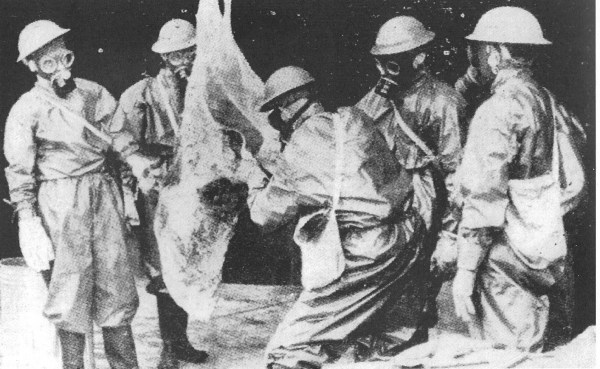
- During war period workers are required to train emergency drills which included wearing gas marks and protective clothing while processing carcases (Pg 76)
Source. TMG Pg 76. Photo MBL collection
At times during the Second World War, abattoir workers were required to carry out emergency drills. This 1943 photo shows a group of slaughtermen trimming a hindquarter of beef whilst wearing gas masks and protective clothing.
- Prices rise at Gepps Cross markets for prime stock (Pg 77)
- Area is currently affected by drought (Pg 77)
- War period seen government consider implementation of meat control prices at retail level (Pg 78)
- Curtin Federal Government ‘War strategy’ meant certain foods would be rationed (Pg 84)
- Civilian consumption of meat was to reduced by 15% (pg 83)
- Many believed rationing of meat would be preferrable (Pg 78)
- rationing would save transport
- preserve meat supplies
- reduce corruption and
- keep inflation in check
- Curtin Federal Government ‘War strategy’ meant certain foods would be rationed (Pg 84)
- February 1. Sale of third quality pig meat is restricted (Pg 80)
- Sale of fresh pork is already prohibited (Pg 80)
- To stabilise the industry the Australian Meat Industry Commission took responsibility for all surplus pig meat (Pg 80)
- Producers could continue to sell pigs at auction but prices were fixed (Pg 80)
- July 28. Commissioner of meat supplies passes a motion that compulsorily acquires one forequarter of each body of beef processed at Gepps Cross that weighs more 400 pounds or more (Pg 81)
- Compulsorily acquired meat is to be used for canning to supply Britain
- After several months bull beef is included in the restrictions
- Veal weighing 251 pounds and over is now classed as beef
- Producers are urged to market stock in a normal way to allow stock to be available for the services and canning
- September 15. Further food restrictions and rationing came into effect (Pg 84)
- Wholesalers and retail butchers were to provide, under statutory declaration amounts of sales for the previous 4 weeks prior to 01/06/1943 (Pg 84)
- % reduction was based on those figures (Pg 84)
- onus placed on the butcher to achieve objective of reduced meat use (Pg 84)
- quotas were based on the Throughput at Gepps Cross and changed weekly (Pg 86)
- 75% of meat by the butchers to be taken as fresh and 25% frozen (Pg 86)
- South Australia seemed to be singled out as similar practices were not enforced in any other state (Pg 86)
- Destroyed confidence in South Australian markets.(Pg 86)
- Sense of normality to SA markets would not return until the 1950’s (Pg 86)
- Destroyed confidence in South Australian markets.(Pg 86)
- Wholesalers and retail butchers were to provide, under statutory declaration amounts of sales for the previous 4 weeks prior to 01/06/1943 (Pg 84)
- Bacon factories were working at full capacity to process canned goods for the fighting forces and Britain had acute food shortages (Pg 84)
- To meet supply of the military civilian beef consumption was cut 40% (Pg84)
- To counter harsh reduction in beef allowed a 12.5% increase in lamb
- October 11. Fixed number of sheep and lambs allowed for sale at Gepps Cross is 23,000 head (pg 83)
- All stock to only arrive by rail
- No private deliveries were allowed or would be unloaded
- Stock above the number would not be accepted for sale
- November. Restrictions are placed on delivery of stock from some areas to limit supply as the facilities couldn’t process the animals due to a severe manpower shortage and lack of skilled slaughtermen (Pg 81)
- many workers had enlisted or joined others to work in munitions factories at Salisbury and Finsbury
- Only 60 men were operating a chain with a capacity of 71 men (Pg 83)
- Less stock was being processed and 20,000 sheep had to be railed to Victoria for slaughter (Pg 81)
1944
- Livestock numbers yarded and sold double the 1913 figures (Pg 5)
- December 13. compulsory acquisition was extended to all South Australian country meatworks (pg 81)
- Experiments are conducted in America to produce artificial meat from molasses, ammonia, water, air and yeast (Pg 81)
- Meat was to be fed to the troops
1945
- February 26. Australia is experiencing a severe drought and rationing of meat is further reduced (Pg 85)
- rationing reduced by 8.75%
- May 7 further rationing cuts of 12% (Pg 85)
- Country Butchers, previously unrestricted by quotas are also regulated (Pg 86)
- Restrictions of meat remained in place following the war with limits not removed until 24/06/1948 (Pg 85)
- May 9. VE (Victory in Europe) Day (Pg 85)
- War still continues against Japan in the Pacific
- Price fixing is put in place by the Government to place a ceiling on extremely high stock values at the time due to war and drought (Pg 85)
- Placement of a ceiling price caused considerable debate
1946
- October 1. Fixed floor pricing comes in to effect (Pg 86)
- Stock at Gepps cross are already commandeered (Pg 86)
- A great deal of uncertainty surrounded the Gepps Cross markets (Pg 86)
1948
- Works offices are relocated from in the city centre to Gepps Cross (Pg 60)
- June 24. Meat restrictions are lifted entirely (Pg 85)
1954
- March 29. South Australian government take court action to prevent a private company slaughtering stock intended for export claiming “such killings are prohibited by the Metropolitan and Export Abattoirs Act” (Pg 87)
- Noarlunga Meat Ltd had slaughtered 150 lambs to export to Britain (Pg 86)
- Noarlunga Meat were charged, argued that the Act was in conflict with Commonwealth law and therefore invalid
- Supreme court gave an opinion on point of law in 1955
- MEAB were more concerned about lose of future export business
1955
- August. MEAB v’s Noarlunga Meat – Supreme court hearing, text case (Pg 87)
- August to September a major industrial dispute last 8 weeks, occurs during the court hearing of the test case (Pg 87)
- During the dispute Noarlunga helped to supply Adelaide with Fresh meat
- Frequent industrial disputes highlighted the vulnerability of the Gepps Cross works to supply fresh meat during a crisis (Pg 86)
- Re-organisation of the Metropolitan and Export Abattoirs Act was called for
- Country meatworks were to be able to freely supply Adelaide with fresh meat
1967
- Gepps Cross facility diversifies and processes tuna (Pg 60)
- Refrigerated tanks, areas for gilling, gutting and washing facilities were installed (Pg 60)
- Fish delivered came from Port Lincoln (Pg 60)
- Processed 2,000 tonnes of fish a year (Pg 60)
- Initially supplied interestate canneries (Pg 60)
- soon after establishment exported to Japan and the US (Pg 60)
- For many years at this point Gepps Cross cold stores were the largest in the country
- Occassionally used to store other products (Pg 60)
- seed potatoes, egg pulp, polyester resin, apples, dried fruit and cheeses (Pg 60)
- One year over ripe apricots fermented and had to be cleaned up using emergency equipment (Pg 60)
- Cold stores were used exclusively for meat from the 1970’s (Pg 60)
- Occassionally used to store other products (Pg 60)
1970
- Last of the workers cottages are demolished (Pg 64)
1973

Source. TMG Pg 166. Photo. D Darlan, Primary Industries and Resources SA
This 1973 view of SAMCOR Aerial magazine shows the Gepps Cross abattoirs and markets complex before the Southern Works was built. Main North Road, looking south, is on the left of the picture and Port Wakefield road is to the right. Gepps Cross intersection is just out of view at the top of the picture. The northern cattle market, yards and sale ring were still in use and can be seen at the bottom right of the photo.
1980’s

Source. TMG. Pg 167. Photo Primary Industries and Resources SA.
This 1980’s aerial view looking south compares with the previous photo. The Southern Works complex can be seen at the top of the picture. An enlarged Southern yards cattle market complex can be seen to the right.

Source. TMG Pg 131. Photo. Frank Rocca.
The Southern Works beef chain in full operation as seen in the early 1980’s
1982
- Elders build a massive feedlot at the The Levels – entrance area to the marketing stockyards to service the live export sheep trade (pg 33)
Template. Site Name. Est #. State
(this will appear on description)
Short paragraph describing facility (Export / domestic), purpose (Livestock slaughtered and location.
Significant issues
Other Names
- Operating business name1
- Common name used
Current Operation
- Is the facility currently in operation
- Aus meat Accreditation number
- Operator website links
- Contact for employment
- Contact for sales.
Location
- Description of physical location in relation to main town and state
- distance to main urban areas or export sites of that state
Insert – Australia map. location of approximate town site.
(Make Australia map default picture for site.)
Insert – Locality map of more localised area of site
Other abattoirs in Australia
Go to this link to view Location of Australian Abattoirs

Owner
- Owners names and approximate time period of operation
Operation
- Aus-meat accreditation dates.
- Website link to owner of facility
- Employment link to operator of facility
- Sale enquiries
- Type of facility and accreditations for livestock types1
History
Year
2017
- Month. Facility/business Chairman at this time(taken from current website)
- Facility CEO at this time
- Leadership team at this time
Sources
- ‘World on a plate. A history of meat processing in Australia’ Stephen Martyn
- Ausmeat Accreditation list – Date
- Facility website
Cobram
Other Names
Current Operation
- Aus Meat Accreditation registration dated 29/12/2015 #397 – JBS Australia Pty Ltd (Cobram).4
- registered as a Sheep, Goat, Offal export facility.4
- Victorian PrimeSafe licensed facility – Accessed 13/04/2017
- Direct employment enquiries to www.jbssa.com.au
Location
- Cobram is located on the Murray River in far northern Victoria.
- Murray River is the border of Victoria and New South Wales.


Location relative to other abattoirs across Australia
 Location of Australian Abattoirs
How this map works.
This is a google engine layered map. At the moment it consists of 7 layers. By clicking on the box on the right hand side of the layers names it will illustrate the location of the abattoirs.
This is a work in progress and is not a complete list of all abattoirs that have operated in Australia or are currently operating.
Locations are approximate and are in relation to the closest town to which they are addressed.
The same abattoir site may appear in two different lists.
Use this link to access the Google map Australian Abattoirs locations.
Location of Australian Abattoirs
Owner
- JBS Australia1
- Abattoirs owned by JBS in Tasmania
- Devonport abattoir (Tas) (2008) – another multi species abattoir.
- Longford (Tas)
- King Island abattoir (Tas) (2008) – closed in 2012.
- Abattoirs owned by JBS Queensland.
- Townsville (QLD)
- Rockhampton (QLD)
- Dinmore abattoir (QLD)
- Riverview (QLD)
- Toowoomba (QLD) – more commonly known as Beef City
- Abattoirs owned by JBS in Victoria
- Brooklyn (Vic)
- Cobram (Vic)
- Abattoirs owned by JBS in New South Wales
- Yanco (NSW)
- Abattoirs owned by JBS in South Australia
Operation
History
2012
- JBS Australia split into two operating entities to make Northern and Southern regions in relation to abattoirs and feedlots within those areas1.
- South – Victoria, South Australia and Tasmania1
- North – NSW and QLD.1
2013
- November. JBS Swift Australia install closed-circuit television camera’s (CCTV) in it’s Australian meatworks.7
- For the purpose of animal welfare and meatworker safety issues.7
- CCTV for internal use by only JBS, with no plans to allow outsiders to view the footage.7
- JBS’s US beef division (which includes Australia) delivered drop in net sales and earnings in it’s third quarter financial results.8
- Australia’s division performance and overall contribution to the overall result is impossible to distinguish due to inclusion with US and Canadian beef processing results.8
- Earnings before tax $134M,.8
- Down by 22.5% on previous quarter.8
- Down by 28.4% on third quarter last year.8
- result reflection of domestic North American markets.8
- Improved performance had occured in Australian.8
- Demand had increased in Chinese markets.8
- Improved performance had occured in Australian.8
2014
- July. JBS Australia across all facilities in operation kills daily1
- 8,500 cattle,1
- 24,000 smalls – which includes lambs1
- Employs more than 8,000 people1
- July. JBS Australia purchase majority shareholding in NSW based Andrew Meat.6
- specialise in high quality, portion cutting and further processing of meats for domestic and international restaurant and foodservice customers.6
- produce ready-cooked meals.6
- company banner Creative Food Solutions.6
- Andrew Meat will allow JBS expansion into high growth retail and value-adding segments.6
- Expansion of the Andrew Meats business will start in November .9
- JBS global strategy to expand into value added meat protein – opportunity to expand margins.9
- JBS have an existing value-added division – Food Partners.9
- supplies food service customers like Pizza Hut and Domino’s with toppings.9
- Andrew Meats focus will be produce ready meals.9
- ‘grab & go’ beef roasts, designed to compete head on with hot cabinet roast chickens sold in supermarkets.9
- Domestic markets were very immature but also with significant growth potential.9
- At this time JBS operate.6
- 10 processing facilities.6
- Daily processing capacity of more than 8,000 cattle and 21,000 small stock.6
- 5 feedlots.6
- 10 processing facilities.6
- December. JBS currently operate 12 meat processing plants across 5 Australian states2
- Wages & local procurement $730M (Excluding livestock purchases)2
- Employs 8,500 people at the facilities2
- Employs 12,000 people in Australia2
- Total revenue of $6.5B2

JBS processing plants in Australia
Source JBS submission #50 Market Consolidation.
- JBS estimates its current share of four eastern states beef kill – 20% (excludes service kill)2
- JBS share of Australian beef production 16%2
- Market share of national small (lamb, mutton & goat) 16%
- JBS spent $2.4M on halal certification costs of approved religious certifiers in 20142
2015
- June. Cost of processing in Australia 1.5-3 times the cost of processing animals in another country2
- cost of processing grain-fed cattle in Australia is twice of the USA2
- lower levels of productivity in Australia in regards to kg per unit of labour2
- 2 major differences between Australia and the USA2
- Government regulation
- $10 a head more in Australia2
- Dept. of Australian Agriculture fully recover costs of meat export inspection and certification2
- Australia wide DAFF costs $80M2
- JBS contribute $14.5M2
- Export plants don’t use DAFF but use approved employees, which plants fully cover costs2
- JBS estimate an additional $30M at Export level2
- USA & Brazil governments provide services at no or minimal costs to processors2
- Energy Costs
- $15 a head more in Australia2
- Government regulation
- Technical barriers to trade (TBT’s)- Total value in Australia estimated at $1.25B as identified costs2
- 261 TBT’s in 40 key markets2
- 136 have significant trade distortion impacts2
- 261 TBT’s in 40 key markets2
- July. The following charts are from a submission by the Australian government Department of Agriculture to the Senate rural and regional affairs and transport references committee inquiry into Market consolidation and the red meat processing sector.
-

Share of throughput by state for beef in 2014. Pg 16

Major Processing companies by market share May 2015. Pg 16

Cattle Movements to abattoirs. Pg 25

Hourly labour costs for food manufacturing industry Pg 30
- December. ATO publishes tax data for agribusiness corporates.3
- Data interpretation – Companies do not pay company tax on revenue (total income) they pay on profits after paying all expenses, including wages, capital replacement, supplier costs and other operating expenses.3
- Income tax information is for 2013/14.3
- JBS Holdco Australia Pty Ltd produced Total Income $4,040,948,610.3
- Taxable Income $419,882,525.3
- Tax Payable $44,809,334.3
- Taxable Income $419,882,525.3
- JBS Holdco Australia Pty Ltd produced Total Income $4,040,948,610.3
2017
- March. JBS will close Cobram facility temporarily10.
- Longford (Tas) is already closed temporarily, closure extended an additional month10.
- Cobram plant last kill scheduled 16/03/201710
- closure to occur for 4 weeks10
- Staff only informed of closure 17/03/201710
- Currently 290 staff at the plant10
- Cobram can process 3,200 grass and grain-fed lambs a day, as well as hoggets and mutton10.
- Closure is due to livestock supply challenges10
- Tight supplies10
- High Livestock prices10
- Erode processing margins across Eastern Australia10
- Animal protein industry was highly competitive in Australia and Internationally10
- Livestock supply has decline severely in the last 12 months making procurement of stock very difficult and expensive10
- Other abattoirs are temporarily closing10
- Cootamundra (QLD). Manildra Meat Co 10
- February 2017. Cootamundra dropped 150 permanent staff and 70 casuals15
- Administration deemed the business unable to work in a viable manner15
- Lamb prices exceeding $6/kg or $250 per head15
- Deniliquin abattoir Australian Meat Group15
- Closed 17/03/2017 due to high lamb prices15
- Closure had been described as temporary but no sign yet of re-opening15.
- Closed 17/03/2017 due to high lamb prices15
- Esperance (WA) Shark Lake Meatworks10
- Placed in administration 24/02/201715
- Goulburn (NSW). Southern Meats 10
- Gunbower (Vic) McGillvray10
- Closed after more than 60 years of operation15
- Wallangarra (NSW) TFI15.
- May have closed or significantly reduced operations15
- Cootamundra (QLD). Manildra Meat Co 10
- Cobram Closure is a stand-down10
- Consistent with the plant’s Enterprise Agreement with staff10.
- Technically is a temporary stand-down rather than a staff stand-down10
- re-opening will be considered in 4 weeks on 24/04/201710
- Usual for short seasonal maintenance shutdowns for this time of year10
- Livestock processed under the Great Southern brand program at Cobram or10 Longford (Tas) will be transferred and processed at Brooklyn (Vic)10
- Competitive market access internationally was being affected by timeframe to finalise an expansion of chilled markets for beef and lamb to China10
- Current model of high livestock prices was not sustainable10
- High prices good for producers10
- operational costs for processors, energy or general regulatory costs were playing a significant part in Australia’s competitiveness against America, Brazil and New Zealand processors10.
- Labour costs10
- red tape associated with cost of compliance10
- Expected reduced lamb processing capacity in Australia later in the year10
- Restocker sheep indicator 145c/kg higher than previous year10
- Light lamb indicator 101c/kg higher than previous year10
- Trade lamb indicators up 69c against year ago levels10
- Heavy lamb indicators up 52c against year ago level10.
- Prices are forecast to go higher in winter due to supply shortfall10
- Up to 350 workers will be affected by the 4 week closure11
- Staff had been informed 17/03/201711
- Notice had been given that staff were not required to attend work from Friday 17/03/201711
- Kill floor staff to return 18/04/201711
- Boning room staff to return 19/04/201711
- Load-out, maintenance, skin shed and rendering staff may be required to work intermittently during the stand-down period11
- Kill floor staff to return 18/04/201711
- Notice had been given that staff were not required to attend work from Friday 17/03/201711
- Staff were to be paid accrued annual leave during the stand-down period11
- Staff had heard of the Longford (Tas) stand-down and had been nervous that the same thing would happen to them at Cobram11
- Staff had been informed 17/03/201711
- State Member for Ovens Tim MCurdy calls on the Victorian Premier Daniel Andrews to visit Cobram in the wake of the abattoir shut-down12.
- Wants a plan in place to support the community incase the shut-down is longer12.
- Had been a difficult year in the region for primary producers12
- Murray Goulburn announced farm gate milk prices drops that affected many local dairy farmers12
- April. Cobram abattoir stand-down is extended another month13.
- Stand-down is now expected to extend for months14.
- Return to work not expected until September or October14.
- Possible stand-down could stretch out for 8 months14
- Affecting 241 employees14
- Workers were not able to apply to Centrelink as they were not made redundant14
- JBS have made some staff positions redundant14
- Longford (Tas) temporary closure is also extended for the full extent of the current season14
- affecting 86 employees
- Stock that would have been processed at Cobram or Longford (Tas) are now being diverted other company facilities at Brooklyn (Vic) and Bordertown (SA)
- 9 Major closures of processing plants at different companies across eastern Australia have occurred recently14
- Plants that remain in operation are working on loss-making skeleton 3 day weekly kills15.
- Questions the over-capacity in the lamb processing industry relative to the supply pool15
- Exacerbated by the advent of the Tier One export certification process15
- Former domestic only plants gained export status to export their products and expanded the facilities to increase sales15.
- Volatility in the processing sector has always been a common factor15
- Drought – stock are in oversupply15
- Allows high profitability to the processor 2-3 years ago15
- Dramatic stock shortage leads to big losses in processing as base cost of the animal increases15.
- Export markets unwilling to pay more adds to buy-sell impact15.
- Drought – stock are in oversupply15
- High levels of foreign investment interest in processing recently15
- Exacerbated by the advent of the Tier One export certification process15
- Stock supply shortages are partly affected by the strength of the current wool market15.
- Stock retained at the moment were Merino wethers that previously would have been placed into lamb production15.
- Domestic retail price wars are blamed for current cost-price squeeze on lamb processors15.
- Current supply challenge and processing plant impact is without precedent15.

Source Australian Export Abattoir Locations 2014
Location sites of export abattoirs accredited as Aus-meat facilities 2014

Source Australian Abattoir Locations – Temporary closures during 2017
Location of export abattoirs and domestic (Gunbower) facilities that have been forced to significantly reduce operations or shut-down for lengthy periods in 2017 due to shortage of stock supply (Sheep)


Sources Cobram Vic. JBS
- ‘The next Swift Shift’ The Weekly Times. 30.07.2014
- sub50_JBS Inquiry into the effect of market consolidation on the red meat processing sector
- ‘ATO publishes tax data for agribusiness corporates’ Beef Central 18.12.2015
- AUS-MEAT Accreditation Listing 29.12.2015
- ‘Big Beef producer cuts deal with Tasman group’ The Age 06.03.2008
- ‘JBS takes stake in Andrews Meat’ www.farmonline.com.au 09.07.2014
- ‘Swift CCTV camera action’ Weekly Times 13.11.2013
- ‘JBS delivers lower third quarter beef sales, revenue’ Beef Central 14.11.2013
- ‘What’s behind JBS taking a big stake in Andrews Meat Value adding Businnes? Beef Central 10.07.2014
- ‘JBS shutters second lamb plant, as livestock supply and price issues intensify’ Sheep Central 17.03.2017
- ‘Stand down at abattoir’ Cobram Courier 23.03.2017
- ‘Premier asked to visit JBS staff: McCurdy’ Cobram Courier 29.03.2017
- ‘Stand-down extended at JBS Cobram’ Cobram Courier 12.04.2017
- ‘JBS cobram stand down extended for months’ Cobram Courier 19.04.2017
- ‘Indefinite closure for JBS lamb plants, as supply challenge reaches critical point’ Beef Central 20.04.2017
Killarney #22Q. QLD
Current Operation
- Closed 08/02/2010.
Location
- Killarney is located in the far southern region of South East Queensland within 5km of the QLD / NSW border.
- Located Brosnan Road, Killarney, 2 hours drive from Brisbane CBD43
- Killarney’s major closest small town is Warwick, population of approximately 15,500 people1.
- Warwick is located 30km Northwest of Killarney
- Killarney’s major larger towns are Toowoomba 100km north and Brisbane 130km to the North East1.


Location relative to other abattoirs across Australia
Location of Australian Abattoirs
How this map works.
This is a google engine layered map. At the moment it consists of 7 layers. By clicking on the box on the right hand side of the layers names it will illustrate the location of the abattoirs.
This is a work in progress and is not a complete list of all abattoirs that have operated in Australia or are currently operating.
Locations are approximate and are in relation to the closest town to which they are addressed.
The same abattoir site may appear in two different lists.
Use this link to access the Google map Australian Abattoirs locations.
Location of Australian Abattoirs
Owner
- Hancock Family. 1976 – 20088
- Roly Hancock8.
- sons of Roly, Rohan, Hector and Tony8
- Roly Hancock8.
Operation

- Aus-meat Accredited Establishment list at July 199764
- as a domestic abattoir. Accreditation number #0022Q
- Operated as Killarney abattoir
- Processing Beef, sheep and pigs
- Aus-meat Accredited Establishment list as at 18/07/200868
- as a domestic abattoir. Accreditation number #0022Q
- Operating trading name – KA Operations Pty Ltd
- Processing beef, sheep and pigs
- Rating – A
- Aus-meat Accredited Establishment list as at 18/03/201065
History
1976
- January 17. Killarney abattoir begins operation under Roly Hancock8
- Staff of 15 men8
2000
- Facility is taking a break only over 3 public day holidays of Christmas period2
2004
- December. Plant rolls back working hours from 38 hours per week to 30 hours per week4
- Seasonal shortage of stock is the main reason4
- drought breaking rains in the region
- lowest level of sheep numbers in Australia this decade
- Australian dollar peaked at record highs
- Production is usually offset by higher returns for by products such as hides, tallow and meat meal4
- High dollar exchange has made exports actually worth less
- a lift in the Australian dollar will hopefully lead to a short reduction in working time4
- Seasonal shortage of stock is the main reason4
2006
- January. Warwick town shire is considering tighter water constrictions if levels in reserve drop too low5
- Killarney abattoir bores have not been considered in any proposals at this time
- Feedlot application for 999 standard cattle unit capacity (SCU) located North branch road at Warwick is refused by council6.
- Objections had been citing concerns of odour, water supply and conflict with rural residential character of the district6.
- New application is made for 499 SCU6.
- Feedlot application for 999 SCU at Loch Lomond (10km west of Killarney) is approved by council7.
- No objections are made against the proposal7.
- August. MLA conduct a research project to look at the collection of carcase weight and information to utilise for computerisation and ability to relay information to the producer, processer and wholesaler67.
- system must be compliant to export standards.

Source. MLA report P.PIP 0079. Inside the boning room. Pg 11
2007
- January. Feedlot application for 1,700 SCU located at Loch Lomond is sought to be built on the property ‘Belvedere’6.
- 1km from the previous proposal approved in late 20067.
- ‘Belvedere’ 440 ha property purchased by Gold Coast based company ‘ Professional Investment Cattle’6.
- subsidiary of ‘Professional Investment Holdings’6.
- Licensed dealer in securities with $12.5B under management6.
- subsidiary of ‘Professional Investment Holdings’6.
- Feedlot would turn off 170 cattle after feeding for 70- day period, to be processed at Killarney abattoir6.
- represent a 15% increase in cattle processing6.
- “Help to ensure economic future” Killarney CEO Hector Hancock6.
- represent a 15% increase in cattle processing6.
- Road works upgrades would be required to accommodate semi-trailer turning movements6.
- Protests are held against the proposal citing smell, devalued properties, noise, building restrictions, dust and Condomine river pollution7.
- Area was a hub for life-stylers and retirees7.
2008
- January 21. Announcement is made of sale of Killarney abattoir to Dudley Leitch8
- Killarney abattoir sold for $5.1M 62
- Dudley Leitch already owns another abattoir facility at Pittsworth8
- 5km South west of Toowoomba
- General manager of operations – Hector Hancock (of previous ownership)8
- Sale of abattoir occurred in conjunction with a separate purchase of Condomine River meats8
- Included property ‘Berrima’ and feedlot of 5,000 head capacity8
- Sale of abattoir was never advertised. Roly Hancock wished to take a backwards step from the operations8.

Source. Hema Maps. Showing Proximity of Pittsworth abattoir south west of Toowoomba to Killarney abattoir near NSW QLD border. approximately 120km apart.
- Dudley Leitch came into business success with gold discoveries in Victoria, listing ‘Perseverance Company on the Australian stock exchange in 19878.
- shares rocketed from 25c to $13 in 4 months8.
- Abattoir will capitalise on 2 of its by -products that have doubled in value recently8
- Tallow, base for soaps and cosmetics, bio-diesel source8
- $300 / tonne to $1,000 / tonne8
- Meat-meal, replacing grain in diets for pigs and chooks8
- doubled price in last 3 years8
- Tallow, base for soaps and cosmetics, bio-diesel source8
- Machinery will be installed to ensure the retention of more tallow8
- Abattoir currently employs 179 people8
- Abattoir capacity has the ability to process daily8
- 400 cattle
- 100 pigs
- 1,100 sheep and lambs
- “Half of the staff I’m related to and the other half I grew up with, We didn’t want to sell to just anyone but we feel Dudley is genuine, caring and recognises the value of our workers and we are confident he will look after our family at the abattoir” Hector Hancock8
- June. 2008 season has been very wet in most parts of QLD causing stand-downs and in most places, the plants starting dates were delayed3
- New owners will continue to work on working agreements and work with union3
- Expectation that a new Enterprise agreement will be negotiated towards the end of 20083
- Australian Bureau of Statistics (as at 30/06/2008) estimate Australia’s sheep flock is down 10% (fallen by 8.78M)51
- Lowest Australian sheep flock since 191651
- QLD record a lowering of 3.96M head51
2009
- June. Warwick saleyards receives a record high price of $84.50 for butchers merino’s51
- sold to Killarney abattoir51
- competition for some sheep came from Fletchers International (Dubbo)51
- Currently very positive for sheep producers due to 51
- sheep prices increasing51
- low stock numbers 51
- concern for future over supply by wool growers51
- meat processors anticipated shortfall in sheep availability during winter months51
- July. During the last 12 months 70%, 140 employees have undertaken some form of on-the-job training9.
- All levels of the workers from managers to newly -recruited school leavers9.
- Aim was improve training opportunities and have skills formerly recognised9.
- Technology advances and OHS has placed increased pressure on people to undertake formal training9.
- Leitch Pastoral Group owned meatworks employ 190 locals9.
- including 50 casual staff9.
- It is claimed 42 employees lost their jobs at the Killarney and Pittsworth plants22
- Dudley Leitch is ranked in QLD top 100 rich list53.
- #80 $109M53.
- September. Dudley Leitch believes he has discovered potential to revolutionise the meat processing industry10.
- Transforming animal by-products into organic fertiliser10.
- Intends to develop the organic fertiliser and test it extensively on their own properties10.
- Using methods on the properties to stop degradation of farming land10.
- Organic product will put carbon back into the soil with high phosphorous10.
- Utilises natural products that make the soil super-absorbent with combined with nitrogen and phosphorous10.
- Commercialisation of the product will incorporate intention to float a public company in 201010.
- Leitch group currently own 52,600 ha in the region10.
- intensively grazing10.
- 100,000 meat ewes
- 3,000 nanny goats
- intensively grazing10.
- Temporary job losses occur for a month as facility is shifted from mutton to young cattle and prime lambs10.
- 10-12 people will be laid off10.
- Offered positions on other properties of the company10.
- 10-12 people will be laid off10.
- Killarney markets are mainly into Sydney where there is heavy competition with exporters10.
- Local markets will now be the focus10.
- bone more lamb and young beef10.
- output will be a higher quality product10.
- bone more lamb and young beef10.
- Pittsworth facility has undergone recent $6M renovations10.
- New rendering plant that cost $4M10.
- New rendering plant is being considered for Killarney10.
- Current process takes 12 hours10.
- new facility would take 45 minutes10.
- Tallow quality is better10.
- new facility would take 45 minutes10.
- Current process takes 12 hours10.
- Editorial article in Warwick Daily applauds the long-term business investment in the region of operators such as Dudley Leitch11.
- Other regions of QLD are reliant on the mining boom11
- Areas of agriculture require long-term investment11
- October. Shortage of suitable cattle for slaughter is causing loss of production at the facility12
- John Dee (Oakey QLD) is similarly affected, missed 1 production day12
- Contributing factors causing supply problems12
- Seasonal conditions12
- Stock are not finished as well12
- Rising Australian dollar12
- Places pressure on price causing some plants to offload product into the domestic markets12
- Seasonal conditions12
- Leitch Pastoral Operations manager – Rob Doro12
- Cattle markets had tightened recently making it difficult to source livestock12
- Killarney is committed to operating full kill 5 days per week, throughout the year12
- Wallangarra (NSW) is temporarily closed due to a shortage of sheep13
- Facility was planning to modify its plant to equip as a beef chain but this would take 9 months to complete13
- December. Rumours are quashed by Dudley Leitch that the Killarney abattoir is in financial trouble14
- Recent restructuring at the abattoir had cost 18 people their jobs14
- Forward contracts had been introduced14
- Negotiations are ongoing with the unions14
- Enterprise agreement for Pittsworth abattoir and Condamine river meats.14
- New enterprise agreement for Killarney would occur in early 201014
- Renovation of the waste-water ponds was occuring14
- Development talks were occurring in regards to the compost material14.
- Clearing sale of some machinery items were to be sold on December 19 owned by Dudley Leitch14
- 20 properties had been purchased in the last 3-4 years and a large volume of old machinery had accumulated14
- Rumours had been concerned with how well the Killarney abattoir was running
- Annual Christmas party had failed to occur14
- Rumours had surfaced that Killarney production was slowing to concentrate on Pittsworth plant14
- Loss of Killarney as an employer would be devastating for the town14
- Hancock family have officially severed all ties with the Killarney plant14
- Split had been amicable14.
2010
- February 8. 240 workers are stood down from Killarney and Pittsworth abattoirs15
- Both meatworks would have suspended operations15
- including wholesale and feedlot arm Condamine River meats15
- Management say abattoir is not closed and they have not sacked anyone15
- Stand down was a result of current economic climate15
- competitive marketplace a factor16
- “The meat industry is a difficult environment at the best of times and this has been a particularly tough period” Rob Doro. Leitch Pastoral Group operations manager.15
- Announcement of stand down comes only 2 months of assurances the abattoir wasn’t in financial trouble.15
- Further announcement is expected to occur 12/02/201016
- Management were confident of the plant re-opening, staff were not16.
- Pittsworth residents said closure of the Pittsworth abattoir would be a massive blow to the community17.
- Pittsworth currently employed 110 people17.
- Killarney currently employ 130 workers18.
- Condamine River meats, uncertain of number of employees stood down18.
- Meatworks would continue to operate with skeleton staff18.
- Leitch Pastoral group would ensure employees were paid entitlements18.
- Outstanding debts to Leitch pastoral were being actively pursued to meet creditor obligations18.
- Killarney had been the regions largest employer for 30 years18.
- Yangan abattoir was receiving enquiry from wholesale and retail butchers desperate to secure kill space in wake of the Killarney closure18.
- Yangan didn’t have the infrastructure to process more stock18.
- currently at 70% kill capacity18.
- To increase capacity use would require significant increase in the workforce18.
- currently at 70% kill capacity18.
- Yangan didn’t have the infrastructure to process more stock18.
- February 12. confidence increases for the meatworks re-opening due to the fact 800 sheep are in the abattoir yards19
- Management say the stock have been in the yards since the initial shutdown19
- Stock have been on feed and water for the duration19
- Management say the stock have been in the yards since the initial shutdown19
- Announcement is made that the closure of the Killarney and Pittsworth abattoirs will continue in-definitely20
- Dudley Leitch is confident the plant will re-open20
- Grant Thornton, Brisbane based management consultants are hired to begin a debt collection program20
- Expected to accelerate recouping of debt owed
- Government provide assistance packages and support to employees of the facilities21
- Jobs Assist program to assist employees to look for other positions21
- Working with the unions to provide accelerated Centrelink entitlements
- An independent government review identifies solutions that will keep the business afloat21
- Company may or may decide to accept the proposals21.
- Annual turnover of the 2 plants is in excess of $80M22
- Businesses have a substantial amount owing from debtors22
- Workers are angry and in disbelief at the recent announcements22
- Claim the owners misled them22
- Some producers are owed money by the abattoirs for livestock sold as well as for wages owed22
- Government had been providing assistance for some time to the abattoirs through the ‘Job assist program’22
- February 16. AMIEU call for urgent meeting with management to provide definite dates and certainty to workers regarding work and entitlements23
- Staff are not yet legally redundant, therefore are effectively still employed by the facility23
- Workers are unable to claim concessions if they are not made redundant
- Centrelink unemployment entitlement may allow $400 / fortnight payment23
- Wages were nearer $1200 a week23.
- February 19. 4 Workers accuse Leitch Pastoral Group have failed to make superannuation payments to employees accounts since June 200924
- Payroll anomalies are being investigated by Grant Thornton management consultants24
- Some employees are also owed holiday pay24
- Employees have contacted superannuation funds, who then referred to Australian taxation office to begin an investigation into the workers entitlements24.

Source gtal 2010 ka operations report released 01/04/2010
Showing final figures of monies owed for employee entitlements by KA operations.
- Wallangarra (NSW) plant is sold to South Australian company25
- workers at Wallangarra are assure their jobs are secure25
- Wallangarra has been accessing some stock that normally would have been processed at Killarney and selling product into areas traditionally sold to also by Killarney25
- Current sheep prices are very high25
- due to low flock numbers nationally25
- Gympie meatworks – Nolan Meats business was operating as normal52
- highest throughput of cattle, processing 400 head a day52
- March 3. Leitch Pastoral Group is placed into voluntary administration26
- Dudley Leitch assures those affected by the Killarney abattoir the facility would be re-opened once debts had been collected from suppliers26
- Several parties have shown interest in creating an alliance to keep the facility in operation26
- Leitch Pastoral Group is now under the control of Michael McCann from the Grant Thornton accounting firm27
- Operations at the Killarney and Pittsworth abattoirs would remain suspended
- Likely the facilities will be placed for sale27
- Westpac bank announce a relief package to assist customers who are employees of Leitch pastoral company affected by the closure of the abattoirs28
- Home loans may defer payments for 3 months28
- Existing business loans can request loan restructure without usual bank fees applicable28
- Credit card customers can request emergency credit limit rises28
- Personal loan customers can apply to refinance at a discounted fixed interest rate28
- Westpac will waive interest penalties for early drawing of term deposits28
- Free consultations with financial planners28
- March 5. Alleged theft occurs of $31,000 worth of equipment from Leitch Pastoral Group properties in the last fortnight29
- Killarney abattoir had a mig welder and maintenance equipment29
- Elbow valley Property lost a spray unit29
- Dudley Leitch is confident abattoirs will re-open30
- Not necessarily under Leitch Pastoral Group30
- Both plants are only 2 multi species abattoirs of significant size in the region30
- Reason for failure of the abattoirs30
- Outstanding payments to Condamine river meats30
- Failed bid to unite various wholesale groups under one banner30
- “The main problem we were having out there firstly the wholesale people not selling the meat at the right price and not making money” Dudley Leitch30
- Lack of salesmen pushing the product and lack of ability to collect debts
- Dudley Leitch would step back from meat operations of the Leitch Pastoral Group though he would continue to run the farming entities30
- Dudley Leitch insisting the farming entities were separate to the processing30
- A number of Leitch properties were already on the market for sale
- Core staff and basic maintenance crew remain at the plant enabling it to be re-opened if required30.
- Leitch Pastoral Group owe in excess $7M to over 200 claimants31
- Warwick Livestock agents31
- Stock and Station agents across Darling Downs are owed more than $900,00031
- cattle producers31
- Coomith Cattle Company $170,00034
- Un-named producers supplied stock worth $22,000 for slaughter of 31 head in November35
- Had suspected problems with Killarney and had begun to grow heavier cattle and sell to another abattoir at Oakey prior to the end of 200935
- Increased freight cost of $16-$20 per head35
- Producers weren’t suppling stock to Killarney because the facility wasn’t making timely payments for them35
- Producers had to chase abattoir for payment35
- Had suspected problems with Killarney and had begun to grow heavier cattle and sell to another abattoir at Oakey prior to the end of 200935
- Superannuation funds $307,500, with over $265,000 to one fund alone31
- Employees have received additional information from Grant Thornton but may have to wait 8-10 months before payment31
- $3,000 garnered from employees wages for child support agencies was not forwarded to the agencies31
- Employees are receiving formal notice of their termination of employment31
- Government bodies31
- WorkCover QLD $584,00031
- Governments Levies Revenue Service $78,00031
- Warwick Livestock agents31
- Dudley Leitch himself is listed as a creditor – owed $2.25M31
- Dudley Leitch supplied stock from his own properties to the Killarney abattoir when the facility was struggling to source stock35
- $946,000 is owed internally between the 3 entities of the Lietch Pastoral Group31
- Dudley Leitch had personally rung people to assure they would receive their money31
- Full liabilities is still unknown as they don’t include former employees or financiers31
- Suppliers feel Dudley Leitch should not be listed as a creditor31
- “Now like all failed businessmen he is finding blame with everyone but himself” – suppliers31
- Creditor documents cast doubt on whether those owed money would see much32
- Creditors view that voluntary administration absolves the groups owner of any responsibility to pay his debts32
- Dudley gets to keep his assets because the voluntary administration only relates to the 3 other entities32
- Employees rank as a priority ahead of claims by ordinary unsecured creditors and ahead of secured creditor31
- 2nd – Rural Bank31
- Accounting firm Grant Thornton to receive $225,000 for resolving the crisis31
- $485 hourly rate31
- Suppliers were cynical of administrators being able to guarantee their payment but not payment to other creditors31
- Dudley Leitch quits as Director of Kings Minerals due to personal reasons32
- Walks away with share portfolio of $5.7M32
- Not uncommon for company directors to resign from other positions if certain their interests could be subject to intervention32
- March 10. A proposal by the Leitch Pastoral Group to resurrect the Killarney abattoir as a co-operative with financiers Rural Bank is put forward33
- Rob Doro resigned as Leitch Pastoral Group operations manager but allowed him to put proposal forward33
- May allow creditors to recover money 33
- Killarney to retain a major employer33
- Would require Dudley Leitch and Rural Bank to forgo the assets of both Killarney and Pittsworth plants and roll them into a new entity33
- Abattoirs would have an accountable board with independent and professional directors33
- Require government support in the form of start up capital
- Interest reduced loans33
- Rob Doro resigned as Leitch Pastoral Group operations manager but allowed him to put proposal forward33
- Co-operative idea is labelled as “unrealistic, Cinderella solution” to the “only hope” for those owed monies34
- Those owed money could translate their debt into shares34
- Financial data was viewed that the abattoirs could be viable under a tightly controlled management regime34
- Creditors and suppliers were wary of proposal but considered it may be a real option34
- preference to see State Government take action to ensure corporations were not allowed to protect assets behind trading companies34
- Views34
- Co-operative concept had merit if close attention was paid to developing a sensible business model to ensure sustainable volume and pricing34
- Bank wouldn’t for-go assets in the interest of a few trade creditors34
- Lietch had always structured the business to protect assets
- If the meatworks are actually viable why had Grant Thornton not recommended trading out of the situation34
- March 12. Creditors meeting is held at Grant Thornton offices in Brisbane35
- Grant Thornton indicate that unsecured creditors would not receive any money35
- Further meetings are held with government organisations to consider the co-operative proposal35
- Employees will receive monies owed in 90 days36
- $1.6M in entitlements36
- $1.3M is expected from debtors36
- Federal Government General Employee Entitlements and Redundancy Scheme will top up any outstanding amounts36
- $1.6M in entitlements36
- Southern Downs Regional council developed a 70 ML off-stream storage facility last year with the understanding it was critical to the Killarney abattoir37
- Ratepayers may be forced to pick up the $1.1M cost of the facility37
- Killarney abattoir had been expected to use 50% and be the main contributor to the cost recovery37.
- April 1. Report to creditors is released by Grant Thornton.
gtal_2010_ka_operations_pty_ltd_second-report_to_creditors

Source gtal 2010 ka operations. Recommendations of action Pg 2
- Reasons for failure of the business as cited on page 6 of gtal report.

Source gtal 2010 ka operations. Reasons for failure. Pg 6

Source gtal 2010 ka operations. Insolvent trading Pg 7

Source gtal 2010 ka operations. Return to creditors Pg 8

Source gtal 2010 ka operations. Profit and Loss Pg 16.
All accounts are un-audited and showing a trading loss of $1.27M at 28/02/2010

Source gtal 2010 ka operations. Statement of Position Pg 22
Statement of Position showing debt to Rural bank of $32M
- April 14. Lietch Pastoral Group meat entities are placed in formal liquidation38
- Both meatworks. Killarney and Pittsworth are listed for sale by tender38
- Dudley Leitch also lists a farming property owned in the Killarney area is listed for sale38
- Employees are resentful of the fact Dudley Leitch owns property in the area but isn’t forced to sell the land or personal home while employees had to wait until legal notice of formal liquidation to receive their access to funds and still wait 90 days for payment39

Source Mercury ‘Last of Leitch properties…’ 31/10/2014
Listing of properties held within the Leitch Pastoral Group portfolio
- 3 of the 27 Trainees employed at Killarney have found work at other sites39
- Yangan abattoir employed 2 fitter and turners to enable them to finish training39
- Most would be forced to forget training and take work elsewhere where ever they could39
- Big W distribution centre employed 20 former meatworks staff39
- Oakey abattoir (John Dees) employed 10 former Killarney workers39
- Some Killarney workers were able to relocate to find work at other centres39
- May 21st. Formal tenders for the 2 abattoirs close at 5pm40.
- Facilities were being offered as 2 separate entities40
- Dudley Leitch rural enterprises are struggling operating on skeleton staff40.
- Management team now consist of Dudley, his daughter and a lawyer40.
- Business review had been conducted for Government by Grant Thornton for Jobs Assistance Intensive program41
- Independent business review of Killarney abattoir
- Authors Note – Date is not mentioned of when the review was actually conducted.
- Report undertaking cost $88,771.9641
- Report didn’t indicate Leitch Pastoral Group was insolvent.41
- Independent business review of Killarney abattoir
- June. Pittsworth abattoir is under contract to overseas interests
- Settlement to occur June 2842
- Killing expected to begin within weeks of settlement42
- Settlement to occur June 2842
- Killarney operations has received interest from overseas and interstate buyers42
- Dudley Leitch believes facilities could operate as service kill but not as wholesale operations42
- Killarney may have the potential to export42
- Made error in not bringing arms of Pittsworth and Killarney meat wholesale arms together – effectively they were in competition with each other42
- Leitch groups still has a considerable debt42
- Clean up work was being carried out at the Killarney site42.
- August. Pittsworth abattoir re-opens under new ownership48
- Pittsworth closes permanently April 8 201148
- Dudley Leitch is included in QLD Top 100 List53.
- Estimated worth of $81M ranked 9453.
- 2009 ranking had been #80 at $109M53.
- Dudley Leitch claims ‘net personal financial wealth’ is impossible to assess53.
- His family are heavily burdened by debt53.
- Estimated worth of $81M ranked 9453.
- Creditors who are owed money by the Leitch groups are taking on extra overdraft to pay bills53.
- December. Colliers International real estate sale agents list Killarney abattoir for sale43.
- Property consisting of 32ha grazing land43
- Dudley and Karen Leitch hold an online auction of 7,000 Dorper and Damara sheep from traprock country west of Warwick44
- Karen Leitch is also selling a high-class artworks store as a closing down sale44
- Artes de Mexico specialises in unique forms of handmade ceramics44
- Dudley Leitch continues to run 60,000 head breeding sheep flock on his traprock country areas44.
- Sale is not confirmed to meet requirements of creditors but for 16 workers on the properties44
- Karen Leitch is also selling a high-class artworks store as a closing down sale44
- Dudley Leitch vows to re-open his beef cattle feedlots at Millermerran and Cullendore within the next few months44
- Court action is on-going against the Killarney and Pittsworth abattoirs 44
- Killarney co-op lodged March 201044
- Undisclosed amount was agreed on and would be paid44
- Coomith Cattle Company of Meandarra, Perrett Cattle company of Injune (owed $61,000) and the Amber Downs Feedlot at Wandoan lodged May 3144
- Killarney co-op lodged March 201044
- Overseas investor inspects the Killarney abattoir44
- Local (NSW and QLD) has shown some interest in the facility45
- Colliers International selling agents are confident Killarney abattoir will be sold46
- 7 groups of people have inspected the facility46
- A shortlist of the offers will now be done46
- Some are looking to re-open the facility others to lease the property46
- 7 groups of people have inspected the facility46
2011
- February. 2 potential buyers are in talks with the sales agent47
- Hopeful a result may have occurred mid January but local flooding had caused delays47
- April. Pittsworth abattoir permanently closes48
- Freestone Feedlot, 2,000 head capacity located north of Warwick remains under external administration54.
- Feedlot stock numbers were down due to high cattle prices54.
- Feedlot had service killed at Killarney54.
- Carcases were processed at their own meat processing facility at Molendinar (QLD Gold Coast)54.
- May. Equipment is removed from the site48
- Rumours the facility will not re-open48
- Scrap metal merchant was removing materials and gear48
- Equipment from Killarney is used to refurbish Forbes #656 NSW 69.
- Previous offers and negotiations had fallen through48.
- Rumours $1.3M had been rejected in the hope of achieving a $2M sale48.
- Dudley Leitch and his wife are subject to supreme court action by the ATO49.
- $600,000 in unpaid taxes49
- Tax debt under the Leitch family trust49
- Family home in Brisbane was auctioned in the last week selling for $696,00049
- Leitch’s plan to move to one of their livestock properties49
- Leitch’s sell 102ha Beaudesert property $1.33M49
- $600,000 in unpaid taxes49
- November. Dudley & Karen Leitch are formerly declared bankrupt50
- Tenants on former Leitch properties are ordered to vacate the properties by the end of January 201250
- Cattle suppliers who took Leitch to court have not received any payment of monies and expect legal costs to have doubled their losses.50
- ATO launch a second legal case for further unpaid taxes and Superannuation Guarantee charges $998,589.07 plus interest and court costs50
- December. Killarney abattoir remains in the hands of the creditors50
- site is gradually being dismantled with numerous sheds and workshops already gone50
2012
- June. Belvedere (Owned by Leitch Pastoral Group) is passed in at auction $1.7M55.
- August. Killarney abattoir site (now stripped of some sheds and most equipment) is sold to Chris Shaw $167,00062
- October. Rumours Killarney abattoir will be converted to a pig processing facility56
- Swickers at Kingaroy is currently processing 2,000 pigs a day56
2013
- February. Memorandum of understanding is announced to re-open Killarney abattoir57
- Northern Co-Operative Meat Company (Casino NSW) and Killarney based business identity Chris Shaw of Canning Downs58
- Co-op currently run pig plant at Booyong (Lismore)58
- Abattoir (formerly beef and sheep) would need to be completely rebuilt and refurbished58
- Initial phase will be a feasibility study58
- Chris Shaw had been interested in buying the Killarney site and building a pig abattoir himself.58
- A new pig facility would directly compete with Casino, Northern Co-op wanted to have some control of negotiations58
- better enable Casino protection for its business and staff58
- Killarney would have saved many producers transport costs58
- Northern Co-Operative Meat Company (Casino NSW) and Killarney based business identity Chris Shaw of Canning Downs58
- Livestock producers who received payment of livestock prior to the Leitch groups being placed under administration will be forced to repay money as they should not have received preferential treatment to unsecured creditors59
- First call on assets is owed to ATO59
- 2nd secured creditors – Rural bank59
- 3rd company employees59
- owed approximately $1.5M60
- 3rd company employees59
- 2nd secured creditors – Rural bank59
- Return of payment of money will place undue stress on suppliers who provided stock under contract and in good faith of payment59
- Some were considering a joined legal action to keep the money59
- First call on assets is owed to ATO59
- Law: Corporations Act60
- By Law, to recover an unfair preference, the liquidator must show that the transaction occurred at a time when the company was insolvent, that the transaction gave the creditor an advantage over other creditors(preferential treatment) and that the creditor suspected or should have suspected that the company was insolvent.60
- October. Dudley Leitch is working as a part time consultant for a Chinese company mining copper61.
- Dudley Leitch and his wife are still listed as owners of several properties at Gore, Stonehenge, Springdale and Terrica61
- At this time creditors owed from the collapse of Killarney, Pittsworth and Condomine River meats have not been paid61
- Neither has the ATO61
- Some suppliers who were asked to return payments have to avoid court costs61
2014
- March. Grant Thornton as liquidators role will end61.
- Expectation winding up process of the collapsed Leitch groups to be formally finalised62
- unlikely that local firms and suppliers will receive any monies owed62
- Re-development of the Killarney site as a pig processing facility could take up to 2 years62
- Chris Shaw has withdrawn from the project62
- Owns the Killarney site62.
- Northern Co-op was proceeding with due-diligence62
- Chris Shaw has withdrawn from the project62
- October. Leitch properties Enisclare and Stonehenge sell prior to auction63
- Last of the Leitch Pastoral group holdings will be auctioned63.
- Bodumba will be sold 31/10/201463
- Final of more than 17 properties63
- Including 2 abattoirs63
- Started buying in 2005 and 2006 continuing through the property price highs of 200863
- Accumulated a rural portfolio of $30M63
- Final of more than 17 properties63
- Bodumba will be sold 31/10/201463
- Collapse of Leitch groups affected local property markets63
- Prices back 30-40% from 200863
Sources
- https://en.wikipedia.org/wiki/Warwick,_Queensland Accessed 06/04/2017
- http://www.cattlefacts.com.au Work Recess Dates 2000-2001
- AMIEU – Ian McLauchlan. 2008. – note link not working
- ‘Killarney abattoir staff face reduced work hours’ Warwick Daily News 10.12.2004
- ‘Outlook murky for Killarney’s water supply’ Warwick Daily News 12.01.2006
- ‘Loch Lomond feedlot plan is in’ Warwick Daily News 11.02.2007
- ‘Feedlot plan on the nose’ Warwick Daily News 22.02.2007
- ‘Meatly deal snaps up abattoir and feedlot’ Warwick Daily News 24.01.2008
- ‘Upskilling benefits both staff and bosses’ Warwick Daily News 10.07.2009
- ‘Abattoir plan a first: Leitch’ Warwick Daily News 22.09.2009
- ‘Long-term investment needed in the region’ Warwick Daily News. Editor. 22.09.2009
- ‘Cattle supply impacts on meatworks’ Warwick Daily News 13.10.2009
- ‘Abattoir closure kills 200 jobs’ Warwick Daily News 27.10.2009
- ‘Leitch disputes rumours’ Warwick Daily News 05.12.2009
- ‘Abattoir workers stood down’ Warwick Daily News 08.02.2010
- ‘230 abattoir workers stood down’ Warwick Daily News 09.02.2010
- ‘Leitch Pastoral Group closes’ Warwick Daily 09.02.2010
- ‘Abattoir suspends workers’ Warwick Daily News 09.02.2010
- ‘Abattoir future to be known today’ Warwick Daily News 12.02.2010
- ‘Leitch vows to re-open abattoir’ Warwick Daily News 12.02.2010
- QLD Government Media release. Mr Andrew Fraser. 12.02.2010
- ‘Leitch extends plant shutdown’ Warwick Daily News 13.02.2010
- ‘Abattoir workers’ future uncertain’ Warwick Daily News 16.02.2010
- ‘Employees missing super’ Warwick Daily News 19.02.2010
- ‘Meatworkers told their job’s safe’ Warwick Daily News 02.03.2010
- ‘Abattoir owners confirm closure’ The Chronicle 03.03.2010
- ‘Abattoir entities in receivership’ Warwick Daily News 03.03.2010
- Westpac Bank Media release. 03.03.2010
- ‘Thieves make a hit on abattoir plant’ Warwick Daily News 05.03.2010
- ‘Abattoirs will reopen: Leitch’ Warwick Daily News 05.03.2010
- ‘Show us the money, Dudley’ Warwick Daily News 05.03.2010
- ‘Leitch resigns from top job’ Warwick Daily News 06.03.2010
- ‘Bold bid to keep abattoir running’ Warwick Daily News 10.03.2010
- ‘Plan to reinvent abattoirs’ Warwick Daily News 11.03.2010
- ‘Leitch faces creditors’ Warwick Daily News 12.03.2010
- ‘Better news for abattoir workers’ Warwick Daily News 12.03.2010
- ‘Abattoir leaves $1M water bill’ Warwick Daily News 31.03.2010
- ‘Leitch now in liquidation’ Warwick Daily News 14.04.2010
- ‘Workers doing it tough’ Warwick Daily News 15.04.2010
- ‘Killarney abattoir’s future unsure’ Warwick Daily News 20.05.2010
- Parliamentary questions on notice. #697 13.04.2010. Mr Springborg.
- ‘Killarney is still a goer: Leitch’ Warwick Daily News 02.06.2010
- ‘Colliers lists Killarney’s idle abattoir’ Stock Journal 09.12.2010
- ‘No movement on Killarney abattoir’ Warwick Daily News 10.06.2010
- ‘Locals register abattoir interest’ Warwick Daily News 14.12.2010
- ‘Abattoir set to sell’ Warwick Daily News 23.12.2010
- ‘Two groups interested in abattoir’ Warwick Daily News 24.02.2011
- ‘Killarney abattoir’s future vague’ Warwick Daily News
- ‘Tax office chasing down Leitch’s’ Warwick Daily News 26.05.2011
- ‘Millions to mud: Leitch bankrupt’ Daily Mercury. 17.12.2011
- ‘Sheep Producers smiling as meat price on the increase’ Warwick Daily News 02.06.2009.. Via http://www.questia.com
- ‘Local meat jobs safe, Industry is uncertain’ Warwick Daily News 24.02.2010
- ‘Living off the fat of the Lamb? Former abattoir owner Leitch rejects papers rich list tag’ Warwick Daily News 17.08.2010. via http://www.questia.com
- ‘Freestone Group still in Limbo..’ Warwick Daily News 05.04.2011. via http://www.questia.com
- ‘Belvedere QLD passed in for $1.7M’ www.farmonline.com.au 29.06.2012
- ‘Is pig abattoir sale tale a lot of pork pies?’ Warwick Daily News 10.10.2012. via http://www.questia.com
- ‘Abattoir plan is exciting’ Warwick Daily News. Editor comments 23.02.2013. via http://www.questia.com
- ‘Talks ramped up on new abattoir hopes riding on new venture…..’ Warwick Daily News 23.02.2013. via http://www.questia.com
- ‘Producers’ nightmare as big funs demand cash’ Warwick Daily News 28.02.2013
- ‘Liquidator looks into money owed’ Warwick Daily News 28.02.2013. via http://www.questia.com
- ‘Dudley Leitch back in mining biz’ Warwick Daily News 29.10.2013
- ‘Two-year plan with set-up of pig plant’ Warwick Daily News 01.04.2014
- ‘Last of Leitch properties to be offered up for auction’ Daily Mercury 31.10.2014
- Aus-Meat Accredited Establishment List July 1997
- Aus-Meat Acc Listing 18.03.10
- gtal_2010_ka_operations_pty_ltd_second-report_to_creditors
- PPIP0079-Final-Report
- Aus-Meat Accredited Establishment List 18/07/2008
- ‘Three meat processing plants hit the market….’ Beef Central 14.09.2016
Noarlunga (SA)
Noarlunga was a historic meatworks in operation during the 1950’s, It was instrumental in taking court action against the monopoly of the Gepps Cross works at the time and having the laws changed in SA to allow other meat works to process stock for export
Other Names
Current Operation
- No longer in operation
Location
- Noarlunga is located approximately 20km south of Adelaide in South Australia


Source Hema maps. Location of Old Noarlunga, and Port of Noarlunga
Operational History
1950
- Noalunga abattoir opens(Pg 88)1
- Designed by the General Manager of the MEAB of Gepps Cross (Pg 88)1
- At the time of opening it was not compulsory for meat killed outside the metropolitan area to be inspected.(Pg 88).1
- Noarlunga did have all carcasses examined by a qualified meat inspector
1954
- March 29. South Australian government take court action to prevent a private company slaughtering stock intended for export claiming “such killings are prohibited by the Metropolitan and Export Abattoirs Act” (Pg 87).1
- Noarlunga Meat Ltd had slaughtered 150 lambs to export to Britain (Pg 86).1
- Noarlunga Meat were charged, argued that the Act was in conflict with Commonwealth law and therefore invalid
- Supreme court gave an opinion on point of law in 1955
- MEAB were more concerned about lose of future export business
1955
- August. MEAB v’s Noarlunga Meat – Supreme court hearing, text case (Pg 87).1
- August to September a major industrial dispute last 8 weeks, occurs during the court hearing of the test case (Pg 87).1
- During the dispute Noarlunga helped to supply Adelaide with Fresh meat
- Frequent industrial disputes highlighted the vulnerability of the Gepps Cross works to supply fresh meat during a crisis (Pg 86).1
- Re-organisation of the Metropolitan and Export Abattoirs Act (MEAA)was called for
- Country meatworks were to be able to freely supply Adelaide with fresh meat
- Premier, Mr Playford was prepared to support as long at the abattoirs were no closer than 80 miles to each other for economic reasons (Pg 87)
- December 17. High court rule that a section of the MEAA is inoperative and invalid because it is inconsistent with the Commonwealth Commerce Act (Meat Export) (Pg 88).1
- Means South Australian Act no longer has sole authority for slaughtering for export
- 02/03/1956 High court in Melbourne ruled that South Australia could not challenge the validiy of the commonwealth regulations
- 04/07/1956 Privy court in London ruled South Australia’s claim was invalid
1956
- March 2.High court in Melbourne ruled that South Australia could not challenge the validity of the commonwealth regulations in regards to being sole authority of meat export in that state (Pg 88).1
- July 4. Privy court in London ruled South Australia’s claim was invalid to be sole authority of slaughter of stock for meat export in that state (Pg 88).1
- Noarlunga immediately sought and began to build substantial export market to the United sates of vacuum- frozen lamb cuts (Pg 88).1
- began expansion of it’s works to cope with increased throughput (Pg 88).1
1959
- Managing director of Noarlunga Meat Ltd, Reg Hinton, formed the Derwent Meat Company Pty Ltd, a wholesale meat company in Tasmania (Pg 88).1
- Reg Hinton had moved away from South Australia because of the the control of the SA government exerted on the meat trade by means of the Abattoir Act.
- Noarlunga Meat’s victory in the courts effectively spelt the end of the monopoly held by Gepps Cross works and saw a number of other abattoirs begin operation with a view to export meat (Pg 89).1
Sources
- ‘The Meat Game – A history of the Gepps Cross Abattoirs and Livestock markets’ Richard Maurovic, 2007
Mackay
Mackay abattoir, owned by NH Foods trading as Thomas Borthwick and sons is a modern and currently operating facility. Organically accredited specialising in high quality grass fed beef.
Other Names
- Thomas Borthwick
- Borthwick’s meatworks
- Nippon Mackay
Current Operation
- Is currently in operation as at 2016.
Location
- Mackay is located on the east coast of Queensland, Approximately 970km north of Brisbane, 334 km north of Rockhampton and 394km south of Townsville.
- The Nippon Mackay abattoir is located at Bakers Creek approximately 10km south of Mackay.


Owner
- Nippon Meats (Japanese) purchased 1989.4
- Nippon Meat Packers6
- Subsidiary of a Japanese Multinational
- Nippon meat packers incorporated 19786
-
 Source Nippon Meat Packers Australia interactive beef products
This is a great diagram that is able to be clicked on in the Nippon website and illustrates where the various cuts of beef and offal are located in the animals bodies
- Nippon currently own 3 operating abattoirs in Australia ( as at 2016)

Operation
- Mackay is certified for organic beef production.2
- Specialising in high quality, chilled grass fed beef
- Cattle are sourced from mainly Central QLD
- Export markets include Japan, USA, Republic of Korea, South Africa, Russia, Europe, Taiwan, Mexico, Ukrain and Indonesia.13
- Nippon currently own 3 abattoirs in Australia,
Other Abattoirs in the region
To access this map go to Australian Abattoirs – Google map interactive
History of Mackay meat processing facility
1890’s
- Recognition that the export trade of meat needs to be developed for the economic benefit of Australian producers (Pg 1041).1
- Existing low values are due to fact that half to one third of surplus meat is exported.1
- Should be exporting 250,000 to 300,000 carcases of beef.1
- £1M pounds is required to construct meatworks.1
- If not constructed £10M pounds could be added to existing capital of the banks and still their securities would be unprofitable(Pg 1042).1
- Parliament develope “The Meat and Dairy Produce Encouragement Act”(Pg 1042).1
- Levy imposed on both cattle and sheep.1
- 2 funds .1
- Dairying herds
- Beef herds
- Fund allows for establishment of meatworks at.1
- Pinkenba
- Bowen
- Redbank
- Cardwell
- Broadsound
- Gladstone
- Brisbane
- Charleville
- Mackay
- Biboohra (Mareeba)
- Burketown and
- Sellheim
1905
- Mackay abattoir inception.56
- Authors note – there is a significant discrepancy as to when this site was established.
1954
- Beef Cattle in the district of Mackay totalled 268,809 head.15
- Meeting is held to discuss possibility of establishment of an abattoir in Mackay.15
- If constructed must allow for extension to cope with increase in cattle export.15
- Mackay Local Abattoir board applied for £5,000 debenture loan to build the facility.15
- Refused by 5 Insurance companies
- Refused by 2 banks and
- Public curator
1965
- July. Mackay, Baker’s Creek works opens – Borthwicks.16
1980’s
- The Australian beef trading/processing environment is worsening(Pg 119).5
- QLD Cattle herd in 1975 was 14M head.5
- QLD Cattle herd in 1987 is 9M.5
- There is low utilisation rates through meatworks and the need to reduce the number the meatworks is seen to improve efficency and reduce operational costs (Pg 120).5
- QLD Cattle herd in 1975 was 14M head.5
1983
- Federal Industries Assistance Commission produce a report that reveals the Australian meat processing industry has 38% excess capacity (Pg 126).7
1986
- April. Joint Venture Proposal is begun to amalgamate.7
- FJ Walkers (Owned by Elders IXL)
- Already own 10 abattoirs, including 4 key export works and meat packing plants in Australia (Pg 119).5
- Metro Meat Industries
- Smorgon Consolidated Industries
- Tancred Bros
- Thomas Borthwick & Sons
- Borthwicks to add their plants of Mackay and Bowen (QLD).7
- FJ Walkers (Owned by Elders IXL)
- Wide spread concern of potential domination of the QLD beef market by the merger entity (Pg 127).7
- May. Trade Practices Commission (TPC) holds a investigation.7
- June. TPC announce will not place legal impediment to the merger.7
- July. Borthwicks withdraw from talks(pg 120).5
- Borthwicks had operation problems of it’s own and wanted to sell all Australian assets including hides and skin processing not just jewels of Bowen and Mackay.5
- Portland (Vic) would be particularly difficult to sell due to union unrest.5
1987
- Is listed in Aus-Meat Accreditation List as Establisment #67.8
- Borthwick. T & Sons Ltd.
1988
- January. Teys Brothers are in discussion with Borthwick to purchase Borthwick Australian assets and a Japanese branch of the company (Pg 121).5
- Teys had been in a joint venture with Canada Packers (Pg 121).5
- Canada Packers withdrew from the joint venture which influenced Teys to seek financial backing from Kerry Packer in bidding for the Borthwick assets
- Purchase price $25M Australian
- AMH saw the ‘new entrant’, Teys as a threat to AMH’s ability to remain profitable and achieve further rationalisation in the northern region (Pg 122).5
- AMH commented that Borthwick operations were the main price competition in QLD (Pg 122).5
- If Borthwicks not in the market AMH would earn $10 a head more per animal.5
- AMH offered Borthwicks $29M for Australian Assets (Pg 122)
- TPC advised AMH not to proceed without their consultation as they would likely contravene Sec 50 Trade Practices Act and likely dominate the QLD cattle market (Pg 123).5
- TPC placed an injunction for AMH to withdraw offer (Pg 123).5
- AMH resisted arguing the the order would likely allow Teys to purchase without actual determination of contravention of section 50.5
- AMH offered undertaking that Borthwicks business’s would be maintained and conducted independently and in competition with the business of AMH.5
- TPC accepted but possible divestiture order was of significant commercial risk to AMH.5
- TPC announced an inquiry was to be held.5
- Borthwicks sale to AMH was accepted 26/01/1988
- Borthwick Hides and skins business were immediately sold.5
- All remaining parts of Borthwicks were combined with AMH
- February. TPC begins inquiry.5
- TPC accepts that northern QLD is a seperate market to central and southern QLD.5
- AMH control 5 of the 10 abattoirs in the region.5
- Bowen abattoir could lift total regional slaughter capacity to over 76.76%.5
- TPC ruled AMH had contravened section 50.5
- Ruling was AMH must divest itself of Bowen & Mackay
- Could retain control of Portland (pg 128).7
- 3 months to do so
- appeals and cross appeals conducted.
- Ruling was AMH must divest itself of Bowen & Mackay
- Trade Practices Commission forced sale due to AMH having dominant market share.2
- March. TPC final judgement ruling on AMH case (Pg 123).5
- Case is held as precedent on what constitutes the geographical limits of a product market
- While the court case was in process AMH had been operating the plants(Pg 123).5
- Profits from them had been above market expectations.5
- Bowen was of marginal importance
- Mackay was significant because of the access to lucrative Japanes market (Pg 128).7
- AMH offered QLD plants to Anglo Irish $32M (Pg 124).5
- initially Anglo Irish accepted but revalued plants at considerably less and withdrew from the deal
- TPC increased pressure on AMH to sell plants (pg 124).5
- If AMH didn’t sell them TPC would put plants up for public auction at market price
- Nippon Meat Packers, in consortium with Mackay Sugar to purchase the Bowen and Mackay plants (Pg 123,86).5
- reported $32M
1997
- July. Is listed at this point in time in Aus-Meat Accreditation Listing.9
- Beef Export Abattoir #67 Thomas Borthwick & Sons P/L
- November. Nippon announce closure of the plant.17
- Loss of employment of 450 workers
- government encourage company and unions to continue negotiations of a new EBA.17
- With government prepared to offer assistance package to facilitate new investment in the plant to bring up to world class standards if agreement is reached
1990
- ABARES report – Foreign Investment and Australian Agriculture

Proportion of cattle slaughtered by ownership of abattoirs 1990
Source ABARES foreign ownership 2011 Pg 31
1991
- 77 Beef export Abattoirs are in operation in Australia at this time.51
- 27 have some level of foreign ownership.51
- Ownership dominated by Japan, UK and the US.51
1994
- Nippon purchase (Pg 86).5 Wingham (NSW)
- Wingham is a major beef exports facility.5
- Tomen sells it’s interest to Nippon.5
- Major shareholder in Anvic Meat Exports Pty Ltd.5
1995
- Simon Stahl is appointed manager of the Mackay Plant57
- previously worked at Oakey (QLD)57
1997
- Nippon has invested $200M in abattoirs and feedlots over the previous decade(Pg 86).5
- 3rd Largest meat processor in Australia.5
- Exporting to 34 countries.5

NH Foods holdings. Source www.nh-foods.com.au – General Information accessed 21/12/2015
2000
- Seasonal closure date of works 20/12/2000.19
2001
- Seasonal re-opening date of works 22/01/2001.19
2002
- Mackay facility is currently operating.20
- 5 days per week.20
- Day and Afternoon
- Voluntary Saturdays
- Processing 1,020 head per day.20
- 5 days per week.20
2003
- February. Borthwicks fined $15,000 after 3 employees overcome by carbon monoxide gas in a chiller room.37
2004
- March. Borthwicks fined $40,000 for spilling 4 tonnes of tallow into Bakers Creek after a pumping tank overflowed.37
- May. Borthwicks fined $40,000 due to death of a trainee export buyer when a stack of frozen meat fell on him.37
- Paid $334,000 compensation to an employee who suffered permanent disability due to cabon monoxide incident.37
- July. Facility was shut down 12 hours and 350 employees evacuated due to ammonia spill.37
2008
- Is listed at this point in time in Aus-Meat Accreditation Listing.10
- Export Abattoir ( Beef Offal) A+
- #67 Thomas Borthwick & Sons
- Export Abattoir ( Beef Offal) A+
2005
- Rockhampton – Lakes Creek (QLD) receives $660,000 federal grant to re-open it’s meatworks under Regional partnerships program.21
- Rockhampton Lakes Creek had closed in 2002, 1,200 staff lost jobs.21
- Jointly owned by Teys Investments Pty Ltd and Consolidated Pastoral Company Pty Ltd (Kerry Packer).21
- Neither Rockhampton (AMH) or Mackay (Nippon) received any finanical support.21
- Both sites are in direct competition with Rockhampton Lakes Creek.21
- October. Mackay embarks on extensive recruitment drive locally but to practically no avail.22
- workers have left to seek employment in the mining industry.22
- Mackay employs 20 Brazillian boners to replace local workers.22
- 2 year working Visa, after which they can apply for Australian citizenship.22
- Workers will receive $950 a week.22
- In Brazil they earned $200 a month, same work.22
- Borthwicks plan to import more Brazilian workers next year.22
- December. 2005 has seen a 50% turnover in the 500 plus staff at the plant.23
- Borthwicks will employ up to 50 Brazilians in 2006.23
- Mackay plant contributed to the Mackay economy in 2005.23
- $17M in wages.23
- Purchased 150,000 head of stock at cost of $135M.23
- Numbers down due to restricted supply of cattle due to drought and graziers holding cattle to rebuild herds

Queensland drought situation 2003 – 2005 www.longpaddock.qld.gov.au
- Plant seasonal closure 18/12/2005.23
2006
- Planned seasonal opening Mid January first shift.23
- second shift in February
- January. Plan to process 190,000 this year.24
- Processed 160,000 last year.24
- 50 Brazilian staff employed
- some South African tradesmen due to start soon
- New staff will allow production throughput to lift from 600 to more than 900 head a day.24
- Staff numbers in total to almost 520
- August. Up to 30 workers lost jobs due to short supplies of cattle.25
- second boning shift has been suspended
- Employees say had less than 25 minutes notice of their termination.25
- Staff cuts based on ‘last on, first off’ basis.25
- Australian workers saying they lost their jobs while imported workers kept theirs.25
- Production to drop from targets of 900 head to 650 head daily.25
- Shortage of cattle and workers has taken it’s toll.25
- To operate effectively the facility needs to hire an additional 140 people.25
- 2 workers who had been on probation period loose their employment after consideration of their performance by the company.26
- Was done in accordance with EBA
- Both offered work for the day and one to the end of the week
2007
- August. 40 Brazilian workers on 457 Visa’s travelled to Rockhampton to meet with AMH for employment at the plant in Rockhampton.27
- AMH recently been taken over by JBS Friboi
- September. Federal Member from QLD, National Party, De-Anne Kelly says AMH Holdings is threatening the viability of smaller abattoirs by poaching their overseas workers.28
- Claims 18 Brazilian workers left a local abattoir to work at Dinmore (QLD).
- Another 30 workers set to leave Mackay – Nippon Meat Packers
- October. Meatworks will cut pockets off employee overalls and conduct random searches to prevent stealing of gallstones.29
2008
- January. Seasonal start up expected to begin 24/01/2008.30
- Anticpating a great year at the meatworks.30
- Have had 4 years of struggling against drought and labour problems.30
- turnover of 35 staff every month.30
- Borthwicks imported workers on ‘457 visas’ from Brazil, South Africa and the Cook Islands.30
- housed and looked after by the company.30
- Another 40 Brazilians, as well as Ireland and South Africans with 50 locals would begin.30
- Mining has shown a significant slowdown in job offers.30
- At the peak 600 mining jobs were advertised regularly now only 200.30
- Existing 350 workforce will soon be joined by 100 more.30
- Expect to process 150,000 head of cattle.30
- Increase of 10% on previous year.30
- Have had 4 years of struggling against drought and labour problems.30
- “It’s been depressing for 4 years, If it weren’t for the fact we were foreign owned we would have had to close” Simon Stahl. Manager at Borthwicks.30
- Seasonal conditions had improved significantly in the area.30
- southern regions were still drought stricken.30
2008
- June. Borthwicks meatworker is awarded $84,587 in damages for workplace injury.31
- Total damages award was $102,028.31
- Work Cover received $17,441.31
- Total damages award was $102,028.31
- July. Abattoir will be forced to close for 2 days due to a Truck strike that will affect cattle deliveries.32
- Truck strike was due to concerns of increased registration costs, harsher penalties for working extra hours.32
- lack of rest stops forced truck drivers to drive longer than they wanted.32
2009
- January. Seasonal opening 27/01/2009.33
- A Halal slaughterman is employed allowing the facility to sell beef to Islamic countries.33
- lucrative market.33
- more difficult to access than previous years due to protocols.33
- Many Muslims around the world interested in Australian beef.33
- Expected to process 150,000 cattle through the year.33
- December. Borthwicks loose a Supreme Court appeal against a fine for a workplace accident.34
- 2 accidents combined total of $114,000.34

Queensland drought situation 2007 – 2009 www.longpaddock.qld.gov.au
2010
- October. Joint research is conducted using the abattoir waste solids in the pyrolysis process.35
- Waste to Energy. MLA project A.ENV.0101 March 2011
- solid waste streams from red meat processing are generally disposed of at cost by the abattoir.35
- study was to look at ways the waste can be treated through anaerobic/aerobic biological treatment and improving management practices, reducing disposal costs and minimising fossile fuel consumption.35
- Ways for the abattoir to produce their own renewable energy.35

Major Companies in the Australian Red meat processing industry
Source IBIS world June 2010
2011
- January. Devastating floods across Central and southern QLD and large parts of NSW and Victoria.52
- affected slaughter numbers to abattoirs.52
- June. Injured foreign meatworker lodges compensation claim Borthwicks $740,000.36
- Began work at facility February 2006 earning $807 a week.36
- Worked until Mid August 2009, then placed on light duties until early 2010.36
- Employment was terminated due to injuries.36
- Claims that not enough staff or rest breaks are provided.36
- Typical work day.36
- Start 6am
- Take a 7 minute break at 7.20am
- 20 minute break at 8.30am
- 7 minute break 10.15am
- 30 minutes for lunch at 11.15am
- 7 minute break at 12.45pm
- 10 minutes at 1.50pm
- Finish at 2.45pm.
- July. Borthwicks found guiltyof failing to discharge workplace health and safety obligations for incident that had occured 8/10/2007 when a meatworker had been trapped between a metal beam and shelving.37
- September. Borthwicks finsed $70,000 for trapped foot incident.38
- Borthwicks had provided training to the worker and had safety measures in place that had not been disregarded by Borthwicks.38
- Finding was based on Borthwicks failing risk management.38
2012
- Currently processing 750 head a day.2
- January. Mackay meatworks seasonal opening about 24/01/2012.39
- Manager. Simon Stahl leaves and is appointed CEO of NCMC at Casino57
- November. Australia’s negotiations with Korean beef export market need to be finalised.40
- Korean Beef trade is worth $770M.40
- Delays have stalled with Gillard insistance that an Investor state dispute settlement (ISDS) mechanism in the agreement be excluded.40
- Korea is Australia’s 3rd largest beef export market.40
- 2011 146,347 tonnes
- 15% of Australia’s global beef exports
- Currently 49% of Korean beef imports
- Delays in FTA are causing high costs to processors.40
- Australia’s market position would decline dramatically in 2013 to Korea if the EFT is not finalised soon.40
- US beef has significant advantages over Australia.40
- January 2015 will seee US gain a 5.3% tariff advantage
- Australian been incures 40% tariff to Korea
- Tariff widens 2.66% each January
- US entering Korea Tariff free 2026
- January 2015 will seee US gain a 5.3% tariff advantage
- If the FTA is not finalised with similar tariff to US markets.40
- Australia will incur cumulative loss A$1.4B over 15 years
- Australia’s share of Korean market falling from current 49% to 26% in 2026.
- US beef has significant advantages over Australia.40
 Nippon Meat Packers Revenue Source IBIS world 2010,2013

Nippon Meat Packers Profit Earnings Source IBIS world 2010,2013
2013
- Mackay abattoir throughput of meat.41
- 90% exported
- 10% for domestic sales
- Distribution of beef enterprises in the Mackay Whitsunday region is 80% coastal and 20% hinterland.41
- Many producers combine sugarcane and pasture improvment with cattle production or fattening
2014
- Nippon Meat Packers Pty Ltd changes name to NH Foods.55

NH Foods Australia Logo Source www.nh-foods.com.au
- April Frozen beef shipments to Russia are temporarily suspended from 07/04/2014.44
- A similar suspension occurred 31/03/2014 for chilled beef.44
- Temporary suspension of beef offal imports occurred 27/01/2014.44
- Wingham exports meat to Russia affected, along with another 29 Australian establishments.44
- Australia placed additional requirements on its testing requirements.44
- Russia detected Trenbolone 21/03/2014.44
- Australian authorities held an immediate meeting with Russian counterparts.44
- providing details of testing and invited Russia to inspect Australian meat establishments.44
- Trenbolone is not produced from cattle treated with HGP’s.44
- Russia has a zero tolerance, most countries have a maximum residue limit.44
- Russia placed new requirements of detection of Trenbolone.44
- Russia may consider Asia, Chinese port and Indian buffalo meat imports to replace decrease is supplies from the US, European union and Australia.44
- Australia has been a traditional beef exporter to Russia since the 1970’s.44
- To July 2012 – June 2013 exported 24,000 tonnes
- To July 2013 – February 2014 20,000t
- Trade is worth more than $170M a year
- Russia is a declining market for Australian beef exports
- Calendar year to date Russia taken only 1,221t beef
- Full year exports 2010 and 2011 topped 60,000 tonnes
- Tropical cyclone Ita hits far north QLD coast.

Tropcial Cyclone Ita impacts QLD April 2014 www.longpaddock.qld.gov.au
- May. Mackay region producers are fairing better with climate conditions than Western QLD.42
- Drought a significant factor in many areas of QLD
- Other factors affecting producers are.42
- high Australian dollar
- rising debts
- surplus of cattle due to halting of live export with Indonesia in 2011
- July. Australia is on the verge of finalising a FTA with Japan.43
- 97% of exporters set to get preferential treatment or be duty free
- Japan’s standard 38.5% tariff on frozen beef will be cut to 19.5%
- Fresh beef exports tariff will drop to 23.5% over the next 15 years
- Beef Offal, worth $167M will also have reduced tariff and increased quota
- December. Korea-Australia Free trade agreement enters into force 12/12/2014.50
- Initially an immediate cut to some tariffs with a further cut 01/01/2015.50
2015
- January. MLA forecast.53
- Australian cattle herd has gone from 35 year high (2013) to 20 year low (2015).53
- Australian cattle herd slip to 26.8M head by June 2015
- by 2016 expected decline to 26.5M head
- by 2020 27.9M head
- Adult cattle slaughter expected to slump 15% year on year.53
- 2015 to 7.8M head
- 2020 expected 7.9M slaughter
- Long term Female average in 2014 52%
- Normally female kill percentage 47%
- Only in years 1977, 1998 & 2003 has female kill been above 50%
- Normally female kill percentage 47%
- Beef exports record levels in 2014 1.39M tonnes shipped weight.53
- Expected to drop 20% to 1.3M tonnes in 2015
- Australian cattle herd has gone from 35 year high (2013) to 20 year low (2015).53

QLD Drought Situation 2013 – 2015 www.longpaddock.qld.gov.au
- March. Foreign ownership in Australian red meat processing.

Share of Australian red meat processing
Source The Stock Standard. VFF March 2015
- April. FK Gardiner & Sons plan to build an abattoir, Darling Downs, Toowoomba.46
- July. The following charts are from a submission by the Australian government Department of Agriculture to the Senate rural and regional affairs and transport references committee inquiry into Market consolidation and the red meat processing sector.

Capacity of major beef abattoirs in QLD. Pg 15
Share of throughput by state for beef in 2014. Pg 16
Major Processing companies by market share May 2015. Pg 16
Cattle Movements to abattoirs. Pg 25
Hourly labour costs for food manufacturing industry Pg 30
- December. Currently listed in Aus-Meat Accreditation Listing
- #67 Thomas Borthwick & Sons Pty Ltd Export Abattoir (Beef Offal) A+.11
- Mackay abattoir has a current listing as EUCAS accredited abattoir.12
- Export markets of Borthwick’s include Japan, USA, Republic of Korea, South Africa, Russia, Europe, Taiwan, Canada, Mexico, Ukraine, Indonesia.13
- Plant is Halal certified.13
- Current processing in excess of 750 cattle per day.13
- Plant closed 10 days earlier than usual for seasonal break.48
- December. Mackay plant expects it will have to compete hard for cattle in 2016.48
- Industry has been slaughtering cattle at record rates for the past 3 years.48
- inevitable a shortage would arrive
- Current El Nino cycle is creating fear that the rainfall will be reduced in the upcoming wet season.48
- some graziers are destocking
- Industry has been slaughtering cattle at record rates for the past 3 years.48
- American Trim market dropped significantly the last few months.48
- some processors going into the red
- Predicts Asian markets opportunities will emerge.48
- more value add on products
- Meatworks will look to expand to enable ability to use more of the carcase
- will see every harvestable portion of organs to be packed
- December. ATO publishes tax data for agribusiness corporates.54
- Data interpretation – Companies do not pay company tax on revenue (total income) they pay on profits after paying all expenses, including wages, capital replacement, supplier costs and other operating expenses.54
- Income tax information is for 2013/14.54
- NH Foods produced Total Income $845,824.273.54
- Nil taxable income and nil tax payable.54
2016
- January. KAFTA third round of tariff cuts occur 01/01/2016.49
- Fresh, chilled and frozen beef has a current tariff 34.6%.49
- Will reduce to 32%
- Original level was 40%
- Meat export is worth $A1.07B in 2014/15
- Korea has always been one of biggest meat export markets
- Shipments for lamb have increased 35%
- Fresh, chilled and frozen beef has a current tariff 34.6%.49
Sources of Mackay Abattoir
- QLD beef industry 1962. pdf
- ‘Northern Australian Beef Industry – Assessment of opportunities and risks’ ABARE 2012
- House of Representatives Petition. Abattoirs. 09.03.1998.
- ‘World on a plate – A history of meat processing in Australia’ Stephen Martyn
- ‘Meat Processing in Australia’ IBIS World. June 2010
- ‘Employers & Industrial Relations in the Australian Meat Processing Industry’ J OLeary 2008
- Aus-Meat Accreditation Listing Nov 1987
- Aus-Meat Accreditation Listing July 1997
- Aus-Meat Accreditation Listing 18.07.2008
- Aus-Meat Accreditation Listing. Accessed 31.12.2015
- EUCAS accreditation Dept. Ag. 25.02.2015
- www.nh-foods.com.au/thomas-borthwick-sons/
- NH Foods brands
- ‘Mackay district’ www.trove.nla.gov.au 01.12.1954
- www.mackayhistory.org
- ‘Mackay Meatworks’ QLD Government media release 11.11.1997
- ‘Competition & Exit in Meat Processing’ J Rolfe, R Reynolds 1999
- www.cattlefacts.com.au. Work Recess Dates 2000-2001
- www.archive.amieu.net 02.07.2002
- ‘Packer firm given grant for abattoir’ Sydney Morning Herald 19.02.2005
- ‘Meatworks imports workers? The boys from Brazil’ Daily Mercury 21.10.2005
- ‘Meatworks to recruit 50 new workers from Brazil’ Daily Mercury 17.12.2005
- ‘Abattoir lifts staff numbers’ Daily Mercury 30.01.2006
- ‘Struggling abattoir axes 30 workers’ Daily Mercury 21.08.2006
- ‘Meatworkers angry at more job losses’ Daily Mercury 23.08.2006
- ‘Meatworks hopes to keep workers in Mackay’ ABC News 02.08.2007
- ‘More workers to leave Borthwicks abattoir’ ABC Rural 07.09.2007
- ‘Abattoir beefs up security after gallstone thefts’ www.mg.co.za 05.10.2007
- ‘Our Cash Cows’ Daily Mercury 17.01.2008
- ‘Injured worker wins $84,000 payout’ Daily Mercury 10.06.2008
- ‘Truck Strike will cause Borthwicks shut-down’ Daily Mercury 26.07.2008
- ‘Halal slaughterman to boost Mackay beef exports’ ABC News 27.01.2009
- ‘Borthwicks loses court appeal’ Daily Mercury 17.12.2009
- Waste to Energy. MLA project A.ENV.0101 March 2011
- ‘Injured meatworker sues works’ Daily Mercury 24.06.2011
- ‘Meatworker trapped for 20 minutes’ www.questia.com (partial article) 19.07.2011
- ‘Company must pay $70,000’ Daily Mercury 12.09.2011
- ‘Stock carriers hope for a better year’ Daily Mercury 09.01.2012
- ‘Korean beef trade under threat’ The Land 14.11.2012
- State of Agriculture region report 2013.
- ‘Mackay graziers cash in on strong seasons’ Daily Mercury 08.05.2013
- ‘Australia’s free trade agreement with Japan could see prices fall for consumers’ www.news.com 08.07.2014
- ‘Update on Russia’s suspension on Australian beef’ Beef Central 03.04.2014
- The Stock Standard. VFF March 2015
- ‘FKG plans processing move’ QLD Country Life 30.04.2015
- Dept Ag. Submission to Market consolidation and the red meat processing sector July 2015
- ‘Mackay meatworks gets ready to compete….’ ABC Rural 17.12.2015
- ‘Korea cuts import tariffs further’ www.farmonline.com.au 01/01/2016
- Trade Minister Media release 03.12.2014
- ABARES foreign ownership 2011
- ‘Slow season opening for processors’ Beef Central 11.01.2012
- ‘MLA forecasts beef market adjustment’ The Land 27.01.2015
- ‘ATO publishes tax data for agribusiness corporates’ Beef Central 18.12.2015
- www.nh-foods.com.au
- Mackay Planning. Connecting Mackay
- ‘New CEO for Casino plant’ Beef Central 15.02.2012
Yuendumu
Yuendumu is located approximately 280km north west of Alice Springs. This post includes a brief overview of aboriginal and european occupation, conflicts and difficulties faced by the people who lived in the area. Yuendumu settlement operated a pastoral activity and attempted to establish a meat processing facility to support the local community.
Current Operation
- Closed
Location
- Yuendumu is approximately 300km north west of Alice Springs in the Northern Territory
- Abattoir facility itself was located about 20km out of the township


Owner
- NPC1
Operation
- Slaughterhouse was established 1990 to supply meat to local community and income to the cattle operation of NPC.
Acronyms
- ADC Aboriginal Development Commission
- ATSIC Aboriginal and Torres Strait Islander Commission
- BTEC Brucelloisis Tuberculosis Eradication Campaign
- CAAPA Central Australian Aboriginal Pastoralist Association
- DAA Department of Aboriginal Affairs
- DEET Department of Employment, Education and Training
- DEIR Department of Employment and Industrial relations
- IAD Institute for Aboriginal Development
- NPC Ngarliyikirlangu Pastoral Company
History
Pre 1800’s
- Yuendumu is situated on Ngalia Warlpiri country (Pg 246)
- Evidence supports that continuous occupation has occured for 10,000 years (Pg 246)
- Main land owning group is Walpiri (Pg 248)
- People moved extensively for hunting and gathering, withdrew to core areas of importance at watering points in dry periods and extended over very large areas in better seasons.(Pg 249)
- Walpiri maintained close relationships with other clans to north, east – Kurinji and Anmatyerre, Pitjantjatjara and Pintubi (Pg 249)
- Walpiri discriminated against Arrernte tribes.(Pg 249)
1873
- Warburton expedition crossed the Tanami and came into contact with Warlpiri people (Pg 250)
1890’s
- Commencement of pastoral settlement increased contact with aboriginal people (pg 250)
1900’s
- Granite goldfields commenced, a series of wells were established between Granites and Hooker Creek (Pg 250)
- relationships not always cordial with aborigines.(pg 250)
1914
- Gold reserves had petered out (Pg 250)
1920
- Pastoral lease uptake increased to the north and far west (Pg 251)
- Conflict with aborigines increased (Pg 251)
1928
- Coniston massacre occurs (Pg 251)
- 28 Warlpiri die as a result of an avenge attack by police and pastoralists in retaliation of the death of a non-aboriginal dingo hunter.(Pg 251)
1932
- More gold is discovered at the Granites. (Pg 251)
- Several pastoralists open up mining ventures for wolfram and gemstones.(Pg 251)
1940’s
- Reports of Aboriginal peoples state of living in the Tanami region build pressure to establish an Aboriginal reserve in the area.(Pg 251)
- Reverend of Baptist union wanted resumption of whole of Mt Doreen station lease.
- lengthy negotiations, interrupted by WWII
1946
- Yuendumu reserve 2,200 km square was established (though not declared until 1956) (Pg 256)
- Area was selected because a bore had established permanent water (Pg 256)
- land was in immediate vicinity to a bore on unoccupied crown land (Pg 256)
- Country not particulary suited to cattle (Pg 256)
- Later 137 sq miles was transferred from reserve to Mt Allan pastoral lease (Pg 252)
- Yuendumu welfare settlement was established.
- to settle nomadic Aboriginal groups under the Aboriginal affairs policy of assimilation (Pg 252)
- to provide social welfare of Aboriginal people, train them in non-aboriginal skills so they may be assimilated into non-Aboriginal society (pg 252)
- Policy objectives was training and employment for work within and outside the settlement (Pg 252)
- Also to provide administration, health, education and general development functions
- Cattle project was included with (pg 252)
- garden (vegetable growing)
- piggery
- poultry
- Aim to increase self sufficency
- Cattle enterprise started with 200 head (Pg 254)
- Initial population 400 people (pg 252)
1960’s
- Population now over 1,000 people (pg 253)
1967
- Rations and cash allowance replaced by Training allowance Scheme (pg 255)
- Scheme – in lowest form, was less than dole
- Scheme – in highest level paid less than award wages
- Settlement residents received free basic health service, education and subsidised meals from communal kitchens
- Some residents received free rudimentary housing
1970
- NT Social Welfare Branch annual report state there is (Pg253)
- well established garden
- bakery
- store
- mining company
- housing association and a school council
1972
- Settlement was under administrative control of NT Social Welfare Branch (Pg 253)
- Superintendent on advice from village council
- Village council were representative body of all skin groups living in Yuendumu
- Labour government election announce Aboriginal affairs policy of self-determination (Pg 253)
- beginning of major structural changes in administration and development
- Moves made to incorporate the cattle project as a pastoral company (pg 253)
- Cattle herd now 3,500 head
- Particularly good grass seasons 1967-1972 (Pg 255)
- Further growth was limited by lack of reliable water sources
- at this time only had 2 reliable bores and 1 dam for the entire herd
- Management had varying degrees of pastoral industry expertise
- Income from cattle sales was not paid to community but into Consolidated revenue(Pg 254)
- lack of incentrve to sell cattle, meant very low turnoff of animals (Pg 255)
- Expenses were paid from cash and rations under Settlements administration therefore not reliant on cattle project (Pg 254)
- Capital development for all projects was reliant on annual budget priorities.
- Funding priorities depended on Canberra / Darwin
- Cattle project goal was to maximise employment, train men in pastoral skills and provide fresh meat to the community (Pg 255)
- Department of Aboriginal Affairs (DAA) was primary employer of all people (Pg 267)
1974
- Crash of beef prices. No cattle turned off during the period 1972-75.(Pg 257)
- Only killers for kitchen, averaged 2 per week (Pg 258)
- Seasons had been very good 72/73 – meant herd numbers built rapidly (Pg 258)
1977
- Privatisation occured of some activities that previously had been under control of the Social Welfare divisions (Pg 130)
- Bakery, garden, poultry farm and kitchen had ceased operation by this time.(Pg130)
- Muster was conducted of Yuendumu and neighbouring property, Haasts Bluff. 850 prime bullocks sold when trucked to Adelaide. Gross return of $720,000, None of the funds went to the cattle enterprise (Pg 260)
- Yuendumu is declared Aboriginal land under the Aboriginal land rights Act 1977 (Pg 262)
- NPC couldn’t access mainstream rural finance (Pg 262)
- Authors note – When Aboriginal land is alienated freehold it is not able to be sold. It can’t held as security for loans, therefore can’t be used as security for debt repayment.
- NPC couldn’t access mainstream rural finance (Pg 262)
1978
- Annual cost of training allowance for cattle enterprise $80,000 (Pg 255)
- Trucking and drafting yards were gradully built from scrap steel from government dumps (Pg 266)
- NPC employed 12 stockmen (Pg 265)
- high levels of employment numbers were maintained through cattle sales, labour programs and funding.
1979
- Ngarliyikirlangu Pastoral Company (NPC) is formed (Pg 259)
- 6 directors with 60 shareholders
- All government assets were sold except the cattle (Pg 260)
- NPC commenced operations with a tractor, trailer and approximately 3500 head of cattle.(Pg 261)
- Enterprise grant was applied for – $55,000 79/80 (Pg 261)
- Stock mortgage was raised $20,000 (Pg261)
- Stockmans wages were to be paid from cattle sales.(Pg 261)
- BTEC begins (pg 261)
- Significant tension arose as company directors of NPC used vehicles for personal use (Pg 263)
- highlighted critical tension – rights of the land owner over an enterprise taking place upon his and other descent group lands (Pg 263)
- Cattle sale money was thought it should be split between directors and shareholders
- misunderstood the link between income and costs – owners thought “funny business going on” (Pg 263)
- community people were taking killers without payment to the company (Pg 264)
1980
- NPC employed 20 stockmen (Pg 265)
1981
- Cattle enterprise was (Pg 266)
- bantail mustering
- culling old stock
- testing and ear tagging young stock (BTEC)
- developing internal paddocks
- improving monitoring of waters
- regularly testing for disease free status
- NPC was one of the few aboriginal properties to not be issued with compulsory destocking order (pg 266)
1981/82
- IAD began to advise on property development (Pg 266)
1983
- Feasibility study concluded that the property had insufficent waters to develop herd to 5,000 – 6,000 head.(Pg 266)
- Alternative development options were suggested.
- Develop herd to 5,600 head.
- establish more bores, paddocks and yards, estimated to cost $283,000
- build a community abattoir and a butcher shop, estimated to cost $21,500
- restocking and operational costs estimated to cost $355,000
- NPC felt it was in a positition to be commercially viable and achieve its development aims (Pg 269)
- DAA was subumed to private and public organisations. (Pg 267)
- now eleven organisations employing 73 Aboriginal people
- created confusion, political rivalry and conflict in Yuendumu
- Number of outstations were being established at Yuendumu (Pg 268)
- Negotiations commenced over royalities relating to goldfields in Tanami (Pg 268)
- Directors began to take less interest in cattle operations (Pg 273)
- Advisory service of IAD was withdrawn and as funding was based on IAD feasibiltys study funding was withheld.(Pg 270)
- Significant conflict in the community 1983 – 1996 major disputes as to the role of the council and local governement (Pg 276)
1985
- Central Australian Advisory Pastoralist Association (CAAPA) was formed (Pg 270)
- acted as lobbyist for Central Australian Pastoralists
- Limited property development advice
- no accounting or training services provided
- accepted IAD study
- NPC applied for development funds $706,000, over 5 years.
- Application was unsuccessful based on land capacity (Pg 271)
1985/86
- NPC received a capital grant of $37608. (Pg 271)
- DEIR continue support through community employment program (Pg 271)
- enables 19 full time and 24 casual employees to be maintained.
1986
- Concerns raised by Central Land Council as to Yuenduma land resource ability to support a herd of 5,600 head (Pg 269)
- CLC calculated a safe stocking rate of 1,000 – 1,500 head (Pg 269)
- NPC access to funding was now been seriously affected (Pg 269)
1988 / 89
- CAAPA management was being questioned (Pg 274)
- questionable individual grants to cattle stations
- Alledged funds allocated to NPC were used by a CAAPA employee to purchase personal paintings (Pg 274)
- Audit could not account for $70,000
- CAAPA was investigated, wound up and no further action was taken by ATSIC
1990’s
- Hawke-Keating Governments introduced form of local government called community government
- This had been opposed by land councils – come leadership became more focused on structure of community organisations and less on delivery of service issues.(Pg 170)
- Result was that community operated cattle stations depended on who from their families was represented in community councils (Pg170)
- Allies of the cattle company – Ngarliyikirlangu were on council – in kind support of bulldozers and graders was available for dam building (Pg170)
- when council had people not interested in cattle operation there was no support for it.(Pg170)
- Proliferation of Commonwealth and NT agencies serving communities (Pg171)
- singnificant lack of co-ordination between them (Pg171)
- An aboriginal community pursuing pastoral activities to attempt to conduct a whole of property development program needed to consult and negotiate with 4-5 Commonwealth and NT agencies. (Pg 171)
 Source – Black Pastoralism S Phillpot 2000 (Pg 172)
Agencies consulting with Aboriginal communities
- All employment funding is withdrawn (Pg 271)
- reason of withdrawal – funding is meant to be directed at economically viable projects (Pg 271)
- Ministers letter to NPC advise that $1.2M has been invested over last 10 years (Pg 271)
- NPC dispute and say it was only $670,000 (Pg 271)
1990
- Employment is reduced to only 1 employee plus manager (pg 275)
- Abattoir is developed (Pg 272)
- Licensed slaughterhouse built from a grant from ATSIC and training subsidies from DEET (Pg 276)
- Over first 14 months of operations employs 4 different trainers (pg 272)
- no aboriginal trainees were able to complete training programs in meat processing (pg 272)
- 1993-1996 no training is conducted (pg 272)
- Abattoir operation(Pg 276)
- became a major cash flow for NPC
- was difficulty in employing qualified butchers to train Warlpiri butchers
- slaughterhouse was not well maintained
1993
- Manager was unemployed by NPC, continued to run the operation while on unemployment benefits (pg 275)
- Herd numbers to now below 3,000 head (Pg 275)
1994 / 95
- Beef prices collapse.(Pg 273)
- NPC can’t turn off enough cattle to cover interest on debts
1996
- Department Primary industries advised that facility didn’t meet the new Australian Quarantine Inspection service standards (Pg 276)
- NPC is currently unviable, Owes Yuenduma Mining Company $150,000, secured by 1,500 head of cattle. (Pg 281)
- Throughout its operation 1972 – 1996 NPC never made a profit or achieved economic viability (Pg 282)
1997
- 1st January – slaughterhouse lost its licence (Pg 276)
- Possible if the slaughterhouse had been successfully operated it would have enabled NPC to achieve a profit (Pg 282)
- NPC business effectively was only sustained by the benevolence of its major creditor – Yuendumu Mining Company (Pg 276)
Sources
All references –
Black Pastoralism – Contemporary Aboriginal Land Use – The experience of Aboriginal owned pastoral enterprises in the Northern Territory – 1972 – 1996 Stuart Phillpot. 2000.
Palumpa. NT
Palumpa is an aboriginal community SW of Darwin, operating a pastoral property the abattoir is of vital economic importance to the property as it supplies meat to the local community.
Other Names
- Wadeye abattoir
- Port Keats abattoir
Current Operation
- Currently in operation
Location
- Palumpa is an aboriginal owned pastoral station 230 km south west of of Darwin, located near a town called Wadeye in the Joseph Bonaparte Gulf. Community living area originally known as Palumpa is now called Nganmarriyanga.


Owner
Operation
- Processes 20 head of cattle a week1
History
1980’s
- Palumpa Pastoral Property was originally established as an offshoot of Port Keats Mission (pg 316)3
- Property Established as a private company (Pg 333)3
- directors largely represent the traditional owners of the area4
- For long periods the station was the only provider to the services of the developing community4
- Property is situated on some of the best Pastoral land in the Port Keats / Daly River area. (Pg 316)3
- Covers a wide variety of country.(Pg 399)3
- Average grazing capacity 1 beast to 50 hectares.(Pg 399)3
- Takes 5-7 years to produce a 500kg animals (Pg 399)3
- Run relatively small herd compared to the district commercial grazing average (Pg 399)3
- Land is low grazing capacity and wet season limits production (pg 399)3
- Major reason for success was the estalishment of domestic abattoir to provide meat to surrounding communities.(Pg 316)3
- Palumpa Properties main support was the community of Port Keats.(Pg 316)3
- Initial capital investment of abattoir operations was provided by the NT government(Pg 343)3
1990
- Until 1990 Palumpa had been able to access loan and grant funding from Aboriginal Development Corporation (ADC) and Aboriginal Torees Strait Islander Commission (ATSIC) (pg 316)3
1993
- Palumpa property title at this time is Aboriginal freehold.3
- Land area Size 1,150 sq km.(Pg 329)3
- receiving ATSIC or other enterprise support at this time (pg 329)3
- Operated under CDEP program (Pg 329)3
- 3 community services were available (Pg 329)3
- Had a non-local manager (Pg 329)3
- Employed 4 people (Pg 329)3
- Herd Size of Palumpa property 3,700 head (Pg 329)3
- Carrying Capacity 10,000 head (Pg 329)3
2000
- Palumpa Pastoral property is of sufficent size to support the abattoir processes (Pg 316)3
- Employ 5 people on the property and 7 in the butcher shop (Pg 316)3
2007
- Facility is cited in a report to be in operation at this time (Pg 14)2
- Demand for MSA (Meat standards Australia) is not an issue for indigenous communities, therefore these small abattoirs don’t compete with product from southern Australia.(Pg 14)2
2008
- July. At this point in time there are two other abattoirs operated on communities that are Aboriginal owned5
- September. Indigenous Land Corporation have acquired 221 properties across Australia since 19956
- Manage 70,000 head of cattle on various Aboriginal held stations6
Sources
- Managing Indigenous Pastoral Land. Module 9. 14/025
- ‘A pre-feasibility study of supply and demand issues for multi-species abattoir in Northern Australia’ G Niethe. 2009.
- ‘Black pastoralism – Contemporary Aboriginal land use’ S Phillpot 2000
- NT Place Names register. Accessed 26.01.2015
- ‘Rare bush abattoir’ ABC Rural 07.07.2008
- ‘Cattlemen muster pride’ The Australian 22.09.2008