Category Archives: Australian Abattoirs

Biboohra

Other names

  • Baron Meatworks

Current Operation

  • Closed                           

Location              

      Australia. Biboohra jpg    

  Map. Biboohra

Owner

  • Cairns District graziers
  • Alligator creek meatworks company
  • MJ Munro

Operation          

  • operated on/off 25 yrs

History

  • Butcher shop is still standing that was meatworks and wood stove in Mareeba museum

1896 – 1897

  • Established as Baron Meatworks,

1900 

  • Liquidated and sold to Alligator creek meatworks, operations extended.

1903 

  • Liquidated sold to MJ Munro Cairns

1907 

  • Closed

1913

  • Reopened

1927  

  • Closed, operated as a cannery in last days


Sources

Giru

Current Operation

  • Operating (2012)1

Location             

  • 50 km S of Townsville

Australia. Giru

Map. Giru jpgSource – Hema Maps. Australia Truckies Atlas

Owner                 


Operation          

  • small local processor1


History                


Sources

  1. ‘Northern Australian beef Industry – Assessment of risks and opportunities’ ABARE. 2012.

El-Arish

Current Operation

  • Operating as at 20121
  • Aus-meat accrediation #103143Q2

Location             

  • 30 km S of Innisfail, 240km N of Townsville

Australia. El-Arish

Map. El-Arish jpgSource – Hema maps – Australia truckies atlas

Owner                 

  •  Blenners wholesales meats2

Operation          

  • Small Local processor1

History                


Sources

  1. ‘Northern Australian beef Industry – Assessment of risks and opportunities’ ABARE. 2012.
  2. Aus-meat accrditation list 14.01.2013

Biloela

Current Operation

  • Currently Operating – currently accredited # 399 AUS-MEAT 14.01.131   
  • Employment contacts www.teysaust.com.au/employment                

Location             

  Australia. Biloela jpg   

map BiloelaSource – Hema maps. Australia Truckies atlas       

Owner                 

Teys Logo_edited-1

Source Logo http://www.teysaust.com.au

Operation          

  • Export, Beef and Offal
  • Teys also own North Rockhampton – 2009 calendar year Teys produced 15% less volume than in 2005 and 2006, with “a lot of days off” (Brad Teys)2

History                

1956

  • Facility was built13

1999 

  • Owned at 1999 by Teys3
  • Has a reported capacity 137,000 head per 50 weeks operation cycle3

2005

  • Biloela moves to hire refugees
    • Booming mining sector meant unemployment rates in the region 1.9%
    • Plant was unable to fulfil production demands due to unfilled job positions
      • Plant was only operating at 80% capacity
      • Foreign labour meant it could operate at 100%

2006

  • Teys utilise migrant workers at Biloela and Rockhampton – Lakes Creek abattoir (QLD).4
    • Workers are employed on 457 visas (Pg 17)4
    • Hired through a labour hire company AWX Pty Ltd4
      • Teys don’t directly employ the workers4
      • Workers were hired as casuals and paid a flat rate that was $2 /hr less than permanent Teys Bros employees4
    • Created a two-tiered workforce4
      • discriminatory against foreign workers4
      • reduced the labour costs.4
      • moved to a new agreement in 20134

2009

  • October. Teys announce a reduction of days working at Biloela5
    • blaming global financial crisis5 and
    • State government’s policy favouring of live export5
  • December. 40 foreign workers are cut5
    • Afternoon boning shift component of workforce5
    • Some are Korean, holders of working holiday visas5
    • Existing 350 workers – Australian and long stay visa holders will remain5
      • Most long stay visa holders were Vietnamese5
  • Teys consider job cuts at the Rockhampton – Lakes Creek (QLD)
  • Plant closes for seasonal break 11/12/20095
    • will resume in the New Year5
    • operating a 5 day single shift5
      • Processing 554 head5
      • single boning shift5
  • Gloomy outlook is reason for shift being closed5
    • Forecasts of dramatic reduction in available cattle in 20105
      • similar to the last quarter of 20095
      • Conditions expected to persist to 20115
    • Poor seasons5
    • Floods5
    • Large number of stock being live exported from QLD5
      • tilted playing field favours live export5
    • High Australian dollar5
    • Weak demand in export markets5

2010  

  • Kill to drop from 750hd day to 550hd

2011

  • July. Australian Competition & Consumer Commission (ACCC) don’t oppose Teys Bros & Cargill Beef Australia Merger7
    • View that the proposed merger would be unlikely to substantially lesson competition in any of the markets examined7
      • ‘fat’ cattle ready for slaughter7
      • acquisition of ‘feeder’ cattle destined for feedlots7
      • supply of processed beef to retailers and wholesalers7
  • Foreign labour in Australian beef processing8
    • Most people employed in meatworks and related industries are Australian citizens8
      • Depending on categories factored there are 35,000 – 50,000 employees in meat processing and handling businesses.8
      • Is a change of cultures, many have strong ethnic origins8
      • 457 Visa holders 5-10% of all food processing and manufacturing employees in Australia8
    • In 2010/11  there were 4,730 QLD 457 Visa’s granted8
      • 130 were skilled meatworkers (1.5%)8
      • Nationwide total 457 Visas issued to the entire Agriculture, forestry & fishing category is only 2.5%8
    • There is a labour shortage at all levels8
      • Competition from the mining sector8
      • labour force tends to be transient8
        • meat industry may source more foreign labour than other industries8
    • Other heavy users of 457 Visa’s8
      • Health Industry
      • Many hospitals unable to function without nursing support of imported labour8
  • Cattle supply is very tight23
    • Producer’s aren’t selling cattle due to poor prices23
    • Company (Teys) forced to reduce kill days23
      • for week beginning 18/07/2011 don’t even have one days kill organised as at 14/07/201123
    • CEO Teys Brad Teys, says been 30 years since he’s seen the supply of cattle so tight23

2012

  • Pacific Island Workers Scheme is working well9
    • Seasonal worker program is a scheme for the Agriculture and accomodation industries to employ people from overseas for short periods. Seasonal Worker program
  • “..the Biloela meatworks have always said that there would be no foreign workers in the meatworks while there was an Australian without work” MP Ken O’Dowd9

2013

  • Migrant workers that had previously worked under Work Choices now moved to a Meat Industry Award Agreement 2010. (Pg 17)4
    • Now received penalty rates for overtime, public holidays & shift allowances4
  • July. Beenleigh abattoir (QLD) wage dispute will not effect job security at other sites operated by Teys10
    • Beenleigh plant had much higer operation costs than Biloela or Rockhampton abattoir (QLD)10
      • Beenleigh only delivering 1% profit in the past four years10
  • If the meat processing industry is to avoid the path of the car manufacturing industry it needed to change10
    • “What we did in the 1970’s we can’t do now” Tom Maguire Teys’s general manager of corporate affairs10

2014

  • Free Trade agreement with China is being negotiated.11
    • Possibility of 1M head of cattle a year to be exported to China11
    • AMIEU QLD Industrial officer Lee Norris says the deal would lead to thousands of lost jobs.11
    • Central QLD university professor or regional economic development John Rolfe – hugh economic boost to cattle producers and would lead to a more robust industry11
    • QLD Premier Campbell Newman supports China deal – it was critically important for agricultural industries11
    • “They’ve been doing it tough in the west and northwest for quite some time now with the drought, and at least this gives people hope that when conditions return to normal that they actually have some real opportunities in the future” – Campbell Newman11

2015

  • February. Tropical cylcone Marcia swept over the QLD coast on 20/02/201512
    • Category 5, 300km/hr winds came across the Capricorn coast13
  • Significant structural damage has occured to12
    • JBS Rockhampton (Beef city)12
    • Teys Australia Rockhampton (Lakes Creek) abattoir (QLD)12
    • Biloela plant has not suffered damage but will lose time due to power supply problems12
    •  3 plants together account for 2,500 head a day slaughter capacity12
  • Biloela plant
    • Localised flooding12
      • Plant itself was not flooded13
    • Currently employs 400 people13
    • Currently processing 700 cattle a day13
    • did conduct half a days kill on day of the cyclone12
      • cyclone caused loss of only a single slaughter shift13
    • No Kill conducted following Monday 23/02/201512
      • boning shift is being conducted on 23/02/201512
    • Cattle at Lakes creek abattoir are either transported back to properties or origin (at Teys expense) or being sent to Biloela and Beenleigh abattoir (QLD) for processing12
  • Teys suffered cyclone damage to its Innisfail abattoir (QLD) in 2011. It was mothballed at the time but never reopened.12
  • Category C Emergency relief needs to be announced by Federal Government as soon as possible13
    • enables grants of $25,000 to eligible businesses and farms13
  • March. Cyclone damage to the two larger meat processors in Rockhampton will see JBS Rockhampton closed for at least a month and Teys Australia Rockhampton (Lakes Creek) QLD closed for atleast another week14
  • Seasonal stock work was complicating the matter with normal turnoff14
    • Producers having to send stock to other plants will incure greater freight costs14
    • Earliest stock were able to be slaughtered at Biloela was in April.14
  • Damage to the meat processing facilities renews debate of introduction of live export in the region14
    • Authors note – I think this in reference to using Port Alma (Rockhampton) to export live animals14
    • “We need diversity in any business and live export is part of that” Cattle Council of Australia president Howard Smith14
  • Teys Australia submission in regards to Australian workplace relations system15
  • September. Biloela plant is recognised at National level at Australian Migration and Settlement Awards – winning Business Inclusion award16
    • Foreign labour represents 70% of the plants 470 strong workforce16
    • Enabled operating capacity 100% since 200516
    • Biloela plant rates in the top 10% of the national industry16
      • due to newly skilled workforce16
      • Had to attract people to the town with a strategy as there weren’t many unemployed16
    • “The fact they could get a job and they were self-sufficent and they were contributing was the big reward” Duncan Downie – General manager of operations at Biloela16
  • November.Plant shuts down for two days in week due to lack of cattle17
    • Did not operate 02/11/2015 & 09/11/201517
    • Gone through an extended dry period17
      • Producers are holding onto cattle17
      • Cattle herd deminishing for 4-5 years due to drought17
      • When it does rain, shortage of cattle supply17
        • Don’t have the numbers to process at the facility17
    • Aim to operate 2 shifts 5 days a week, killing 710 head a day17
      • cut back operations due to shortage of cattle17
      • When graziers rebuild (if it rains) processing numbers will at normal targets17
      • Live export competition was having an impact but was not the major contributing factor17
      • “I don’t know what impact the live export trade will have. It is a long way to bring the ships down to Port Alma and the cattle they get in this areaare different to the cattle they get up north” D Downie.17
    • Plant normally sources cattle within 350km of the facility17
      • recently has had to purchase from Victoria, Longreach, Charters Towers and further north.17
  • Investment to occur at Biloela plant $10M over the next 6 months17
    • Work will begin in annual shutdown period17
      • Annual preventative maintenance program17
      • $2.7M upgrade boning room17
      • Installation of new vacuum pack machine and conveyor system17
      • In January plans to install new coal-fired boiler17
    • Seasonal closure is planned to begin 10/12/201517
  • Plant will conduct last kill 26/11/201518
    • final boning shift will happen 27/11/201518
    • Staff told 11/11/201518
    • Extended 7 week summer-season for the plant18
      • Normal schedule is 4 weeks18
        • Staff usually take 4 weeks of annual leave19
        • extra 3 weeks will be leave without pay19
      • Original target was to close 10/12/2015, reopen 08/01/201618
    • Cattle supply circumstances have dramatically changed18
      • shortage of cattle18
        • sustained records of slaughter across Eastern Australia18
          • Destocking from Western Areas19
          • high prices for cattle19
        • record live exports of cattle18
        • National herd level was on a 35 year high, to a 20 year low over the last 2 years.18
    • “This is a once-in-a-generation decline, but unfortunately  we can expect herd numbers to stay significantly low for at least the next two years as cattle producers rebuild their stock” Tom Maguire22
    • Biloela is a specialist grassfed plant, processing 700 head a day on single shift, employing 440 staff18
    • Intend to re-open 18/01/201618
    • Previous year (2014) had killed close to christmas18

ABC rural 12.11.2015._edited-1

Biloela meat processing complex. Source ABC Rural 12.11.2015

  • Early and extended shut down of the abattoirs due to lack of supply of cattle is affecting local butchers21
    • 2014 300g steak $7-$8 retail21
    • Now $9.6021
      • pricing is affecting the consumers ability and desire to pay for the product21
  • Early closure of Biloela would affect every little butcher across QLD21
    • Main problem is the drought21
    • Problem will continue when processors come back on line due to wholesalers buying aswel21
  • Agforce president Leo Neill Ballantine21
    • cattle shortage was a problem that wasn’t going to go away21
    • regardless of rain, will always be problesm with existing conditions21
      • vacuums are created in the market if producers can’t get assurances from processors21
      • producers need to be brought more into the supply chain21
        • enables cattle to be ready ahead of time21

Sources – #399 Biloela – Teys Australia (QLD)

  1. AUS-MEAT accreditation list 14.01.13
  2. ‘Abattoirs under stress’ Beef Central 22.02.13
  3. Competition and Exit in Meat Processing Agribusiness Review Vol 7 1999
  4. ‘Union Avoidance Strategies in the meat processing/packing industry in Australia and the USA compared’ A Jerrard & P O’Leary
  5. ‘Aussie workers safe in Teys cuts’ Central Telegraph 11.12.09
  6. ‘Meatworks jobs may get the chop’ The Morning Bulletin 11.12.2009
  7. ACCC will not oppose Teys Bros & Cargill Beef Australia proposed merger’ 06.07.2011
  8. ‘Processors raise hackles over ‘foreign labour’ claim’ Beef Central 21.07.2011
  9. Statement by member Ken O’Dowd. Parliament
  10. ‘Workers safe at Rockhampton and Biloela’s abattoirs’ The Morning Bulletin 14.07.2013
  11. ‘Cattle export deal with China raises fears for abattoir workers’ jobs’ Couriermail 07.11.2014
  12. ‘Power outages, structural damage from cyclone….’Beef Central 23.02.2015
  13. ‘CQ meatworks back in action’ QLD country Life 26.02.2015
  14. ‘Shutdown highlights market concerns’ www.farmweekly.com.au 02.03.2015
  15. Teys submission to Australian Productivity commission into workplace relations system. March 2015
  16. ‘Refugees save Meatworks’ Central Telegraph 04.09.2015
  17. ‘Teys Bros invest $10M in to Biloela plant’ Central Telegraph 09.11.2015
  18. ‘Teys Biloela joins list of ‘extended shutdown’ beef plants, as herd contraction bites hard’ Beef Central 11.11.2015
  19. ‘Teys abattoir shuts early due to lack of supply’ ABC Rural 12.11.2015
  20. ‘Cattle shortage forces extended closure at Teys Biloela’ The Morning Bulletin 12.11.2015
  21. ‘QLD’s rib eye price is sky high says butcher’ Observer 17.11.2015
  22. ‘Cattle shortage hits Teys’ www.farmonline.com.au 18.11.2015
  23. ‘Cattle supply chokes’ ABC Rural 14.07.2011

Ayr

Current Operation

  • Operating (as at 2013)1

Location             

  • Ayr is 90 km south of Townsville

Australia. Ayr jpg

Map Ayr

Owner   

  •               

Operation          

  • Small1

History                


Sources

  1. ‘Northern Australian beef Industry – Assessment of risks and opportunities’ ABARE. 2012.

Milestones in the Australian Meat Industry

1860’s 

  • Outbreak of pleuropneumonia – decimated herds in NSW4

1861 

  • 1st Freezer works invented – Darling Harbour8

1870   

  • Tick introduced on imported stock from Dutch Bativia4

1896  

  • Tick Plague bought red water fever – killed many cattle, some pastoralists abandoned properties4

1910   

  • 3 Zebu bulls introduced to QLD4

1948   

  • 15 year contract with Australia – UK purchased all exportable beef surpluses8

1950’s   

  • Large numbers of imports of Zebu to QLD4
  • Refrigeration for long haul transports improved in efficiency and financially8
  • Sheep prices soared £1 head – during Korean war10

1954-60 

  • Britain won contracts in previous Australian export markets. USA developed ‘grinder beef’ allowed new markets for North Australia4
  • Global demand for beef, boom lead to record cattle numbers in Australia8

1959

  • USA Lean beef market development8

1960     

  • Australian Sheep herd 155M10
  • Petrodollars Money – Middle East had significant discoveries of oil and lifted living standards in those countries, created a building boom, workers mainly from 3rd world muslim countries10             pg 28
  • 1st shipment to Middle East. 2500 Australian sheep £6, 14 shillings and 4 pence a head including fodder for voyage10Pg 28

1967    

  • UK – had outbreak of FMD8

1970’s 

  • BTEC began – stopped 1989. Cost $800M
  • Large cattle numbers and slaughter rates in 1970’s prompted significant expansion in processing capacity in QLD, with an increase in capacity of 32% between 1975 – 1982 (Rolfe 1988). The plants then faced work practices characterised by single shifts and a tight tally’s system. Most of the expansion met through construction of new plant, which was also needed to meet export standards in many of the overseas markets3
  • Sheep live exports significant – Middle east, Cattle SE Asia8
  • Economic downturn in the 70’s led to drops in global beef demand8
  • 4 out of 5 meatworks in North Australia had their export licences withdrawn –
  • “inability to fullfill obligations under the meat board diversification scheme in Australia”8
  • Australian sheep herd 180M10Pg 37

1973 

  • Australian sheep herd 142.3M10Pg 37

1974     

  • Beef Crash – caused by major loss of markets USA & Japan, severe drought started. Cattle prices plunged to lowest level in 30 years.4
  • Herd shrank by more than 60%5
  • Oil prices crisis triggered global collapse4

1975     

  • LE to SE Asia re-emerge on a small scale after years of inactivity5
  • LE mainly to Malaysia, Philippines and then in early 90’s to Indonesia8
  • National Beef herd 32.8M10Pg 42
  • National Sheep herd 127.5M10 Pg 42

1978  

  • AMIEU – picket line 4 weeks, prevented sheep being loaded onto ship, Feedlot Adelaide Virginia 90,000hd sheep. Were losing sheep due to rain and cold weather, Waterside workers unions also striked in support.Unions lead by Bob Hawke. Public rally supported by Farmers 10,000 against the union 4th April 1978. Operation Sheeplift – loaded at Wallaroo.10Pg 43
  • Meat Processing in trouble – didn’t have enough outlets for all the meat it was processing, yet LE was thriving at significantly higher prices, LE was shipping aged merinos, not suitable to slaughter in Aust, AMIEU still picketed10Pg 49

 1980’s  

  • Cyclical downturn in slaughter numbers occurred in the early 1980’s, rationalisation was required. Industry commission inquiry in 1983 recommended market forces rather than government intervention be allowed to drive the changes.3
  • Plant closures of the late 1980’s was in response to rationalisation pressures. Most plants that were closed were the older, inefficient plants that reached the end of their operating life(Reynolds and Sangster 1998b).3

1984

  • Australian Meat Holdings (AMH) formed – was pivotal in rationalising the meat processing sector in QLD– consortium of 4 meat processing companies, Including Elders (who bought other partners out in 1988) who then sold to USA processor (ConAgra)1993-1996.

1984 – 1986 

  • AMH closed 5 plants of the initial 11 owned by the consortium – utilisation rates had fallen to 32%

1989   

  • BTEC finalised4.

1990’s 

  • By the 1990’s, plant closures tended to be forced by financial losses rather than operating inefficiencies3
  • USA market health regulations forced many abattoirs across Australia to shut down8

(Not sure when actually occurred – ????????)

1993   

  • Live cattle exports to Asia and Middle East 147,000hd1

1994  

  • Live cattle exports to Asia and Middle east 290,000hd1

1993 

  • Beginning of Enterprise Bargaining Agreements (EBA)

1994    

  • disputes and lock out at Rockhampton AMH abattoir

1996  

  • EBA’s introduced – Previously tally system has set rates of pay and also rate of productivity. Any new investment in efficiency meant workers just reached minimum tally in a shorter time. Tally system removed, increased production levels3.
  • EBA allowed multiple shifts,reduced penalties and shift loads, longer working days and increased pay rates. 30-40% increase in effective capacity. Lead to 40% reduction in unit costs3.
  • AMH if gained a 4% efficiency achieved a net gain of $62M over 10 years, industry wide net gain would yield $404 net gain3

2006

  • Innisfail Meatworks closed leaving Townsville as only Northern abattoir in QLD5.

2010 

“Last weeks QLD cattle kill of 43,700 hd was 40% below the same week last year, The extreme low rates of kill are also reflected in industry statistics showing that for the 3 months ended January 30, Australian beef exports to the US reached just 38,000t a far cry from the same period in 08/09 of 70,000t2

2011

  • Live Export ban to Indonesia.

2012  

  • Carbon tax introduction – $23/t for over 25,000t of greenhouse emissions.Europe payint $9.80/t6
  • Australian Export Meat Inspection System (AEMIS) introduced7
  • “AEMIS  utilises the presence of full-time government  veterinarian assessing the incoming stock and oversighting the production and inspection process, and a full time government food safety meat assessor inspecting”7
  • “The system is subject to external audits from senior Australian government veterinarians and by foreign officials representing many of our major trading partners”7
  • One processor says will add $100,000 in costs over next 12 months7
  • May. JBS arrived in Australia 2007, “despite $500m investment on improvements and upgrades, the cost of production of beef relative to major international competitors has actually worsened” JBS CEO Andre Nofueira12

2013  

  • February. QLD cattlemarket indicator (QCMI) 1985 $70.80 buy the same amount of goods in todays $ would cost $180.70 – prices are 30% lower in real terms than what they were in 859
  • March. Near record weekly kill tally – 81601, close to all time record July 200111
  • Young cattle indicator slipped 12c/kg, some grids back by 20c/kg
  •  

Sources

  1. ‘The past is before us’, The Australian Society for the Study of Labour History. Undated

www.historycooperative.org/proceedings/asslh/index.html

  1. ‘Abattoirs under stress’Beef Central 22.02.10
  2. Competition and Exit in Meat Processing:A QLD Case Study. Agribusiness review 1999

References with their articles (Rolfe 1988),(Reynolds and Sangster 1998b)

  1. ‘North’s Beef Powerhouse’ Nth QLD Register 22.11.12
  2. ‘100 years of Northern Beef Production’ Nth QLD Register 22.11.12
  3. ‘Processors beef with carbon tax’ Nth QLD Register 06.09.12
  4. ‘Exporters query E.coli blow-up’ QLD Country Life 31.05.12
  5. ‘Sailing ahead’ Annabelle Coppin 2009
  6. ‘Beef Prices at historic lows necessitates focus on cost of production’ Beef Central 18.02.13
  7. ‘The Australian Livestock Export trade’ Nigel Austin 2011
  8. ‘Record QLD kill reflects ‘avalanche’ or dry weather cattle’ Beef Central 19.03.13
  9. ‘JBS heads calls for industry-wide focus on competitiveness’ Beef Central 17.05.12

Dinmore

Current Operation

  • Aus Meat Accreditation registration dated 29/12/2015 #235 – JBS Australia Pty Ltd (Dinmore).13
    • registered as a Beef, Offal export facility.13
  • Direct employment enquiries to www.jbssa.com.au  

Location              

  • South east QLD
  • 40 km west of Brisbane. 9km east of Ipswich

 Owner

  • AMH (1999)4
    JBS Australia

Operation          

  • Export – Beef, Offal1
  • (1999) Nominal capacity 625,000hd per 50 weeks4
  • Slaughtering, boning, packaging, by-products rendering and hide processing
  • Spent 10’s Millions $ over past 10 years on environmental/sustainability projects, in areas like water treatment, establishing excellent performance creditials in the environmental area2
  • “Site operates with arguably the most stringent environmental license conditions on waste water management, motor and other noise abatement of any meat plant in Australia”2.

Dinmore photo. _edited-1Source 2007 Feedback MLA

Other historical and current meat processing facilities located in Australia can be viewed at;

Australian abattoirs inactive map

abattoirs_edited-1

History of Dinmore #235

1990

8. ABARES Nov 2011_edited-1

Proportion of cattle slaughtered by ownership of abattoirs 1990
Source ABARES foreign ownership 2011 Pg 31

1991

  • 77 Beef export Abattoirs are in operation in Australia at this time.19
    • 27 have some level of foreign ownership.19
    • Ownership dominated by Japan, UK and the US.19

1996

  • AMH intend to spend $50M upgrading Dinmore as part of $90M capital investment program across six Australian operations6
    • AMH controlled by big US rural commodities trader – ConAgra, a major exporter from North America6
    • AMH accounts for 16.5% of Australia’s beef kill.6
      • currently owns another 8 facilities but will be consolidating to 5 and closing Beaudesert (QLD), Guyra and Portland (Vic)7
        • others owned Dinmore, Townsville, Rockhampton and Aberdeen6
            • Author note – not sure of 8th.
        • Intended that 300 jobs would be replaced at Dinmore when expansion completed there6

1999 

  • AMH owned at this point4
  • Is the largest plant in QLD at this point.

2005

  • Significant regions of drought across QLD.

QLD Drought 2003_2005_edited-1

Queensland drought situation 2003 – 2005 www.longpaddock.qld.gov.au

2007_2009_edited-1

Queensland drought situation 2007 – 2009 www.longpaddock.qld.gov.au

2010  

  • Will drop from 11 to 9 shifts over a 5 day week this year in light of the livestock supply and demand challenges3
  • Between Townsville and Dinmore plant 430 people laid off.8
  • Dinmore current operating capacity 3,300 head a day.10
    • Mainly to Export 75% – Japan, US, Korea, Taiwan and Indonesia.10
  • Dinmore employs approximately 2,000 workers.10
    • About 1,700 work in production roles across 2 shifts Monday to Friday.10
    • The remainder are cleaning, maintenance and head office functions.10
    • Most Employees are male 70% employed and full-time casuals.10
    • Around 20% are from overseas – 457 Visa’s China and Brazil.10
    • 5 year EBA is currently in place, no piecework incentives provided.10
    • most workers said to be be union members.10
      • walking delegate employed on site.10
    • Company has strong internal promotion culture aimed at increasing retention.10

IBIS Jun 2010_edited-1

Major Companies in the Australian Red meat processing industry

Source IBIS world June 2010

2011

  • January. Devastating floods across Central and southern QLD and large parts of NSW and Victoria.21
    • affected slaughter numbers to abattoirs.21
  • July.National slaughter rates decline 5%.22
    • Australian currency pressures.22
      • A$ is now above US108c.22
      • economic news out of US could send currency even higher.22
      • higher A$ would cripple Australia’s already limited price competitiveness for beef in international markets.22
    • QLD which does approximately half of Australia’s processing capacity.22
      • Down 8% from the previous week.22
      • lowest kill recorded in QLD in July for past decade.22
      • Down 21% on same period last year.22
      • Significant number of QLD plants only killing 3-4 days.22
    • listless export beef demand.22
    • Meat processing and export is low-margin business due to.22
      • Import duties.22
        • Indonesia 9%.22
        • Korea 40%.22
        • Japan 38%.22
      • New AQIS charges on meat inspection would add millions to processor costs.22
    • Is currently a big build up of meat in cold stores due to difficulty in selling into sluggish markets, Japan and the US.22

7. ABARES Nov 2011_edited-1

Red Meat throughput Australian abattoirs, Foreign and Australian owned 2011 Source ABARES foreign ownership 2011 Pg 29

2012  

  • Govt. grant $4.4M with JBS own $4.4M upgrade its waste water treatment system, installing new pre-treatment equipment and covered anaerobic lagoon technology2.
  • Company’s carbon tax liability was expected to cost $3.5M yr,($23/t) project will save $1M in energy costs and cut liability each year by $790,000.
  • Still doesn’t place Dinmore plant below 25,000t threshold, to get below that would cost a further $16M.

2013

  • “JBS is in the process of supporting the transition of it’s 457 workforce to permanent residency”5
  • 457’s residency requires certain level of english speaking, International English language testing system level 5. – often above the level meat workers most parts of world can reach5
  • Recently completed a $50M upgrade employing most modern techonology available to ensure maximum efficency and consistency of the quality of the product9
  • Employees 235 people9
  • Daily processing 3,350 beef or 1,675 head per shift9
  • November. JBS Swift Australia install closed-circuit television camera’s (CCTV) in it’s Australian meatworks.16
    • For the purpose of animal welfare and meatworker safety issues.16
    • CCTV for internal use by only JBS, with no plans to allow outsiders to view the footage.16
  • JBS’s US beef division (which includes Australia) delivered drop in net sales and earnings in it’s third quarter financial results.17
    • Australia’s division performance and overall contribution to the overall result is impossible to distinguish due to inclusion with US and Canadian beef processing results.17
    • Earnings before tax $134M,.17
      • Down by 22.5% on previous quarter.17
      • Down by 28.4% on third quarter last year.17
    • result reflection of domestic North American markets.17
      • Improved performance had occured in Australian.17
        • Demand had increased in Chinese markets.17

2014


  • July. JBS Australia purchase majority shareholding in NSW based Andrew Meat.15
    • specialise in high quality, portion cutting and further processing of meats for domestic and international restaurant and foodservice customers.15
    • produce ready-cooked meals.15
    • company banner Creative Food Solutions.15
    • Andrew Meat will allow JBS expansion into high growth retail and value-adding segments.15
  • Expansion of the Andrew Meats business will start in November .18
    • JBS global strategy to expand into value added meat protein – opportunity to expand margins.18
    • JBS have an existing value-added division – Food Partners.18
      • supplies food service customers like Pizza Hut and Domino’s with toppings.18
    • Andrew Meats focus will be produce ready meals.18
      • ‘grab & go’ beef roasts, designed to compete head on with hot cabinet roast chickens sold in supermarkets.18
      • Domestic markets were very immature but also with significant growth potential.18
  • At this time JBS operate.15
    • 10 processing facilities.15
      • Daily processing capacity of more than 8,000 cattle and 21,000 small stock.15
    • 5 feedlots.15
  • December. JBS currently operate 12 meat processing plants across 5 Australian states11
    • Wages & local procurement $730M (Excluding livestock purchases)11
    • Employs 8,500 people at the facilities11
      • Employs 12,000 people in Australia11
    • Total revenue of $6.5B11
  • JBS plants 2014_edited-1

    JBS processing plants in Australia

    Source JBS submission #50 Market Consolidation.

    • JBS estimates its current share of four eastern states beef kill – 20% (excludes service kill)11
      • JBS share of Australian beef production 16%11
      • Market share of national small (lamb, mutton & goat) 16%
    • JBS spent $2.4M on halal certification costs of approved religious certifiers in 20142

    2015

    • January. MLA forecast.20
      • Australian cattle herd has gone from 35 year high (2013) to 20 year low (2015).20
      • Australian cattle herd slip to 26.8M head by June 2015.20
        • by 2016 expected decline to 26.5M head.20
        • by 2020 27.9M head.20
      • Adult cattle slaughter expected to slump 15% year on year.20
        • 2015 to 7.8M head.20
        • 2020 expected 7.9M slaughter.20
      • Long term Female average in 2014 52%.20
        • Normally female kill percentage 47%.20
        • Only in years 1977, 1998 & 2003 has female kill been above 50%.20
      • Beef exports record levels in 2014 1.39M tonnes shipped weight.20
        • Expected to drop 20% to 1.3M tonnes in 2015.20
    • March. Foreign ownership of Australian red meat processing facilities
    • Nippon share_edited-1

      Share of Australian red meat processing

      Source The Stock Standard. VFF March 2015


  • March. Cyclone Marcia cross the Capricornia Coast some plants were damaged.70
    • Supply is exceeding capacity in QLD at this point.70

Cyclone Marcia Feb 2015_edited-1

Impact of Cyclone Marcia February 2015. www.longpaddock.qld.gov.au

  • June. Cost of processing in Australia 1.5-3 times the cost of processing animals in another country11
  • cost of processing grain-fed cattle in Australia is twice of the USA11
    • lower levels of productivity in Australia in regards to kg per unit of labour11
    • 2 major differences between Australia and the USA11
      1. Government regulation
        • $10 a head more in Australia11
        • Dept. of Australian Agriculture fully recover costs of meat export inspection and certification11
          • Australia wide DAFF costs $80M11
          • JBS contribute $14.5M11
        • Export plants don’t use DAFF but use approved employees, which plants fully cover costs11
          • JBS estimate an additional $30M at Export level11
        • USA & Brazil governments provide services at no or minimal costs to processors11
      2. Energy Costs
        • $15 a head more in Australia11
    • Technical barriers to trade (TBT’s)- Total value in Australia estimated at $1.25B as identified costs11
      • 261 TBT’s in 40 key markets11
        • 136 have significant trade distortion impacts11
  • July. The following charts are from a submission by the Australian government Department of Agriculture to the Senate rural and regional affairs and transport references committee inquiry into Market consolidation and the red meat processing sector.
  • abattoir capacities dept ag sub consolidation_edited-1
    • Capacity of major beef abattoirs in QLD. Pg 15

      T2 Throughput state beef_edited-1

      Share of throughput by state for beef in 2014. Pg 16

      T4 processing companies market share_edited-1

      Major Processing companies by market share May 2015. Pg 16

      M4 direct cattle movements NLIS QLD_edited-1

      Cattle Movements to abattoirs. Pg 25

      F12 hourly labour costs food manufacturing_edited-1

      Hourly labour costs for food manufacturing industry Pg 30

October. 10 mayors from Southern QLD form a mayoral group to act as a united lobby group for their region.24

  • represent 25% land area of QLD, quarter of QLD cattle and 75% of grain and crop production area24
    • support the Oakey abattoir push for rail transport improvements.24
    • $2M in State and Federal funding is required to fund new rails sidings.24
      • Federal government feel that private investors should fund the improvements themselves.24
      • will add to processor competition in the area.24
  • Only 2 abattoirs are currently contracted to be supplied cattle on the Western line.24 JBS Dinmore (QLD) and Teys Beenleigh (QLD)
    • Oakey is to be added, starting January 2016.24
      • Contractually Oakey can recieve cattle but as they have no rail siding this is not physically possible.24


  • AACo have animals processed at Eastern abattoirs as service kill.23
    • See year 2013.23
    • Gross processing costs had increased in the 6 months to September 2015.23
      • $1.13 risen to $1.21/kg, 7% increase year on year HCW.23


  • December. ATO publishes tax data for agribusiness corporates.12
    • Data interpretation – Companies do not pay company tax on revenue (total income) they pay on profits after paying all expenses, including wages, capital replacement, supplier costs and other operating expenses.12
    • Income tax information is for 2013/14.12
    • JBS Holdco Australia Pty Ltd produced Total Income $4,040,948,610.12
      • Taxable Income $419,882,525.12
        • Tax Payable $44,809,334.12

2013_2015_edited-1

QLD Drought Situation 2013 – 2015 www.longpaddock.qld.gov.au


Sources for Dinmore QLD. JBS

  1. AUS-MEAT Accreditation list 14.01.13
  2. ‘JBS offered $4.4M grant for Dinmore carbon abatement project’ Beef Central 04.02.13
  3. ‘Abattoirs under stress’ Beef Central 22.02.10
  4. Competition and exit in Meat Processing Agribusiness review Vol 7 1999
  5. ‘JBS to help 457 workers to Aussie residency’ Ipswich QLD 02.03.13
  6. ‘US beef exporters force three abattoirs to close’ SMH 15.05.1996
  7. ‘Guyra abattoir closure’ Mr Raymond Chappell 15.05.96 http://www.parliment.nsw.gov
  8. ‘Australia: Union shuts down picket of locked out meatworkers’ http://www.wsws.org. 28.12.2010
  9. http://www.jbsswift.com.au. Accessed 13.11.2013
  10. Work-skills-and-training-2301-1
  11. sub50_JBS Inquiry into the effect of market consolidation on the red meat processing sector
  12. ‘ATO publishes tax data for agribusiness corporates’ Beef Central 18.12.2015
  13. AUS-MEAT Accreditation Listing 29.12.2015
  14. ‘Big Beef producer cuts deal with Tasman group’ The Age 06.03.2008
  15. ‘JBS takes stake in Andrews Meat’ www.farmonline.com.au 09.07.2014
  16. ‘Swift CCTV camera action’ Weekly Times 13.11.2013
  17. ‘JBS delivers lower third quarter beef sales, revenue’ Beef Central 14.11.2013
  18. ‘What’s behind JBS taking a big stake in Andrews Meat Value adding Businnes? Beef Central 10.07.2014
  19. ABARES foreign ownership 2011
  20. ‘MLA forecasts beef market adjustment’ The Land 27.01.2015
  21. ‘Slow season opening for processors’ Beef Central 11.01.2012
  22. ‘Caualties emerging as export kill pressure continues’ Beef Central 25.07.2011
  23. ‘AACo’s Darwin abattoir projected to be strong finanical performer’ Beef Central 18.03.2013
  24. ‘$2M only barrier to better rail access for cattle’ Beef Central 20.10.2015

Beenleigh

Large processing facility operated by Teys with Cargill. Recently had a number of wage disputes. Has recently invesed heavily in new technology, currently operating 2 shifts processing 1,300 cattle per day

Current Operation

  • Currently in operation as at 2015.

Location             

                   Australia. Beenleigh

Map Beenleigh 001

Owner                 

Historical and current meatworks, canneries and abattoirs located in Australia can be viewed at;

Australian abattoirs inactive map

abattoirs_edited-1

Operation          

  • Export
  • Nominal capacity 200,000hd as per 50 weeks(as at 1999)1
  • 800 staff2

History of the Beenleigh meat processing facility              

2010

  • Partnership between Teys and Meat Livestock Australia (MLA) develop the semi automated ‘Beef Pullers’ – Collaborative Innovation Strategies (CIS) program20
    • five units now installed by Teys and other processors20
    • technology is designed to overcome some physical and OH & S challenges of the boning line20
      • MLA don’t fund but provide support to assist to access commonwealth research grants 50:50 basis20
  • Beef Pullers – assist in removal of bones and knuckle – recognised as two most physically demanding tasks20
    • Cost/benefit shown increased profit margin $3.50 – $4.65 per carcase20
    • Pay back period 5 months or less.20
  • Beenleigh currently employs 800 workers.37
    • Up to 50% of skilled staff mostly from Brazil and Vietnam.37
    • Most workers are union members.37
    • With a union representative in every department.37
    • Joint consultative committee.37
    • An EBA is currently in place.37
      • skilled staff receive payments above the award.37
      • slicers and boners recieve tally (piecework) payments.37

2011

  • July. CEO – Brad Teys “..it’s been about 30 years since he had seen the supply of cattle so tight”9
  • producers not selling cattle due to poor prices and company forced to reduce kill days at Beenleigh to 3 days a week, Biloela 1 day, Rocky 3 days and Naracoorte was shut down temporarily9

2012

  • March. Petition started to close abattoir due to dust and health risks from cattle yards11
  • June. Rockhampton – Lakes Creek abattoir Labour hire employees (mainly humanitarian entrants) are renumerated under a WorkChoices agreement that pays a flat rate of pay26
    • without penalties for overtime or shift allowance26
    • Previously the workers had been paid at enterprise agreement rates26
    • AMIEU campaigned enterprise agreement be reinstated26
      • AMIEU claim Teys no longer allowed access to facilities due to this incident26
  • August. Carbon tax said to impact in costs of $2M- unless takes drastic action to reduce its emissions – a plan that would involve a temporary shut down2
  • Key competitors don’t face carbon tax3

2013

  • February. Clean technology allocations – $2.83M, project $6M. Install 34ML covered anaerobic lagoon and basin to capture biogas for use on site. Reduce emissions by 85% saving $1.3M energy costs and $380,000 carbon price per year4
  • March. AMIEU lodge an application for rights of entry order to the plant26
    • Teys provided a room to which employees could see their representative if they wished26
      • AMIEU claim room was too small, only able to hold 50 people, with sometimes 130 union members in attendance26
      • EBA used the room when AMIEU made a protected action ballot to be conducted26
      • AMIEU claim then due to the number of people Teys were unable to supply a room suitable26
        • Oztrail outdoor gazebo with a table and 2 chairs. “It was located immediately adjacent to a truck marshalling area, with the attendant flies, stock manure and noise”26
        • AMIEU made another application26
          • allowed to use the lunchroom26
  • May. Workers Dispute.

Teys Australia CEO Brad Teys

A number of companies that specialise in higher quality grain fed beef have been forced to close, merge or restructure over the past decade due to uncompetitive workplace arrangements”2

We are dealing with a union stuck in the 70’s, that still believes in unfettered union power2

  • 24th May – 4 hour stoppage. AMIEU strike.5
  • 24 hour strike by AMIEU for 31st May – 2nd in a week5
  • Teys saying what AMIEU want
    • 50% leave loading5
    • penalty rates within ordinary hours5
    • forced payment for idle time5
    • increased Workers compensation benefits above that prescribed by legislation5
  • Teys say – Many of staff are not union members, Only 28% of workforce voted in favour of strike5
  • AMIEU say – 80% are members, 75% supported action of stopwork6
  • What union say is happening at plant
    • Beenleigh operations made $38M in after tax profits, 9 years to 10/11, during same period paid $33M in dividends6
    • Teys want to cut wages by 20%, increase workload by 30%. Large part of workforce have lifted productivity by 18% since 1998, yet real wages declined by 11%6
  • Tey’s are in process of negotiating new workplace agreement2
  • Wages $40M each year2
  • June. Processing in Australia costs $300 a beast, USA $150 Brazil $1117
  • Boner in Australia earns $30/hr, in USA $12/hr10
  • 2012/2013 study – International Labour Organisation rates countries per highest hourly wage in manufacturing10.
    1. Denmark
    2. Switzerland
    3. Australia
    • 11th USA
    • 17th New Zealand
    • 28th Brazil.
  • Wage structures require more flexibility for seasonal harvesting, peak times in Agriculture which change employment demands and short term staff requirements10
  • AMIEU spokesperson Matt Journeaux. said members oppose to cuts up to 18.3% of current earnings for 30.5% more work. For a slicer meant a loss of $8448/yr12
  • Staff tell Teys CEO “they have had a gutful” of continued industrial action – Brad Teys – Teys CEO17
  • Negotiations continue17

The only way we will reach agreement is for the AMIEU to negotiate with an enterprise and productivity focus. They still don’t understand the need for change” – Brad Teys – Teys CEO17

  • Teys Australia currently operate 6 plants in 3 states with 5,000 employees10
  • July. AMIEU and employee representatives refused to allow a new wages and bonus offer be put to secret ballot to members13
    • Staff wanted performance bonuses removed, Teys did and replaced with 3% wage increase13
    • Cash bonus make up lost time during dispute13
  • Negotiations on Enterprise bargaining agreement ended13
  • Beenleigh plant operated on a 1% return on asset base for past 4 years13
  • Teys considered closing the plant after eight months of negotiations28
    • following 4 years of low returns28
  • 300 signatures of staff calling for a ballot, less than 50% voted for industrial action AMIEU rejected secret ballot forcing company (Teys) to terminate negotiations and explore options which included closure of plant14
  • Teys put forward 5 proposals, all rejected by AMIEU and committee14
  • Plant employs 800 staff, responsible for 4000 flow on local jobs and $250M into local economy14
  • Oct. Fair Work Commission approve the Enterprise bargaining agreement passed in employee secret ballot, to commence October 4.Follow 10 month industrial dispute with AMIEU
    • Victory of common sense and a final rejection of obstructionist union tactics” Tom Maguire (Teys’)15
    • Its a real stunner that Australia’s 2nd largest meat processing company with net equity of over $200M and $2.19B in revenue wants to pay people below award rates and conditions” AMIEU15
  • Teys’ offer unprecedented, a profit- sharing incentive for staff in EBA, is unique in meat processing and manufacture industry, 5-7% on top of normal earnings if reaches set profit targets.16
    • “company and its workforce has to work together to lift productivity in what is a highly competitive global meat processing environment”, “Manufacturing must reform to remain competitive”16 Tom Maquire (Teys’)
    • “From the outset, only a minority of workers wanted to take industrial action. Then a majority voted to approve the new EBA. Yet the union persisted to drag this out only to achieve was was agreed in the first place” Tom Maguire (Teys)18
    • AMIEU, QLD Industrial Officer Lee Norris – serious doubts Teys would deliver on its commitments16
  • During Federal election in 2013 period – Beenleigh EBA came under national spotlight when opposition leader – Tony Abbott questioned by the Fair work commission would not endorse a workplace agreeement supported by most of the staff31

2014

  • March.Currently processing 1,300 prime cattle per day19
    • Operating two shifts, one in afternoon and one in day.19
  • Fair Work Commission (FWC) throw out the EBA following an appeal by AMIEU30
    • EBA will now need to go back to FWC for approval30
    • 500 employees will immediately have weekly pays cut $25-3030
    • majority of employees on site will actually owe Teys up to $900 each30
  • Teys Australia – a Cargill Joint Venture have plants in QLD, NSW & SA19
  • Fair work commission throw out Enterprise Bargaining Agreement (EBA) following appeal by AMIEU21
    • Conditions employed under since October 201321
    • Employees voted in favor of EBA April 201321
    • If EBA dismantled some 500 employees could have weekly pay packet reduced by $25-$3021
      • Majority of employees would find they owe company as much as $900 each21
    • AMIEU claim voting was “ballott rigged” Brian Crawford, AMIEU branch secretary22
      • allowing trainee supervisors to vote.22
    • Teys deny rigging23
      • vote administered by Australian electoral commission not by Teys23
      • Trainee supervisors been included in last 6 EBA’s since 201223
      • some trainee supervisors are union members23
      • AMIEU have long been aware of inclusion of trainee supervisors23
    • Types of reforms acheived in 2013 EBA vital for the survival of the meat processing company23

    “We must continue to manage rising manufacturing costs or processing will go the way of the car industry and other manufacturers” Tom Macquire. Teys corporate affairs manager.23

  • Workplace relations inquiry submission by Teys, John Salter – General manager of workplace relations26
    • Teys Australia is Australia’s second largest beef processor & exporter26
      • annual turnover $3B26
      • Operating in QLD, Vic, NSW & SA26
        • 9 locations26
    • Employs close to 4,500 people26
      • often the largest employer in various regional centres26
      • Annual payroll in excess of $350M26
      • People costs represent 62% of operating expenses26
    • Teys is party to 21 FWC approved Enterprise agreements26
    • Beenleigh site agreement was reached with employees in 201326
      • approval has been mired by litigious complexity which the Fair Work Act of 2009 has exacerbated, rather than neutralised26
      • Agreement subject to interlocutory stay of FWC full bench order26
      • First EBA approval September 201326
        • FWC Deputy President at the time. Ingrid Asbury.31
      • First FWC full bench appeal – December 201326
      • Second EBA approval – April 201426
        • FWC Deputy President at the time. Ingrid Asbury31
      • Second FWC full bench appeal – September 201426
      • First Federal court hearing June 201526
      • Second Federal court hearing scheduled for May 201526
    • Beenleigh current operations two shift basis Monday – Friday26
      • some employees on site 24/726
      • Employee figures fluctuate but some 24 periods 850 employees to meet production schedules26
    • 2010 EBA had significant inflexibilities threatening the viability of the plant26
      • operational and cost base challenges,26
        • which other competitors (within Teys incl) don’t face26
          • cost of environmental compliance due where plant is located in a heavily populated area26
    • 2013 EBA allowed increased productivity26
    • If forced to go back to 2010 EBA some job losses may occur as production costs are reassessed26
    • Changes considered are:26
      • lowering throughput of cattle to 1,200 head a day26
      • Changing boning & load out departments to 5 day 8 hour roster26 (40 hours)
        • currently working on a 4 day by 9.5 hour roster26 (38 hours)
        • 5×8 roster could result in 20% redundancies26
          • 40 permanent staff in load out and boning rooms26
          • 3-4 in the cleaning26
          • others in salary staff, management and supervisory areas26
      • 2010 EBA doesn’t accomodate taking of annual leave but is featured in the 2013 EBA26
        • if annual close down resumes under 2010 EBA reduction in 5% staff to cover for annual leave if had been taken in 2013 EBA26
        • these staff would now be surplus to requirements under 2010 EBA26
      • Teys invested $20M in the 2014/2015 year26.
        • this increased job creation26
      • Payroll system CHRIS in a retro perspective to accomodate reversion to payment of skilled workers would cost $500,000 to implement26
  • July. Teys currently employ 4,500 people in QLD, NSW and SA.24
  • Workers at the Beenleigh plant had voted to approve a work place agreement in 2013 but AMIEU had obstructed the deal and mounted continuous appeals.24

“..the business environment in Australia, especially industrial relations, was not conducive to manufacturing, and the sector could not compete internationally” Tom Maquire24

  • Teys say reform of the labour arrangements, greater market access and a reduction in costs and charges on companies were key ares that needed to be pursued by the government.24

“We must remove the ability by third parties – namely unions – to interfere with the relationships companies have with employees, allowing them to hold up and counter legitimate agreements” Tom Maquire24

  • Federal Government must tackle industrial relations reform or risk the closure of more manufacturing industries33
  • New EBA – Teys Australia will include productivity-based profit sharing34
    • as well as annual wage increases34
    • Is an industry first inititive
    • Bonus cheque $2000 – $600034
    • AMIEU oppose the the bonus34
  • September. Profit sharing bonus’s were paid this week25
    • represents pay-out of about $1.2M25
    • Paid the bonus’s inspite of union opposition and will not be asking workers for a refund25

2015

  • February. Federal Court ruled that controversial enterprise agreement approved by workers in 2013 was invalid27
  • 35 jobs created under the new EBA35
    • jobs are now directly threatened35
  • An independent economic report estimated the Beenleigh plant flow effects;35
    • contributes more than $360M in GDP to Brisbane region35
    • underpins more than 1800 full time equivalent jobs35
  • Teys Australia Beenleigh Ltd v’s AMIEU 2015
    • News article cites 600 workers to affected27
    • AMIEU claim 300 workers will have ‘fatter’ pay packets27
      • argued a ballot to pass the EBA included people who were ineligible to vote27
    • Federal court rule that company must return to 2010 agreement27
      • Higher skilled workers are paid more27
        • boners, slicers & slaughtermen27
          • payment is based on weight of cattle processed27
        • lower skilled workers would be worse off27
          • lower skilled will have a lighter workload27
      • 2013 agreement was to pay on hourly rate irrespective of how many animals processed27
      • AMIEU claimed Teys told workers they wanted a 20% increase in productivity without increasing pay27
        • Teys deny claim27
          • Tom Maquire – said the company can’t compete with overseas rivals unless it cuts labour costs and increases productivity27
  • Unions would now meet with Teys to negotiate new agreements.27
  • Decision in regards to the future of the Beenleigh plant was approaching31
    • Cattle herds were falling31
    • Tougher international competition from US and Brazil expected31
      • Australian Cost of Production (COP) $300 a head31
      • US & Brazil COP $16531
  • August. EBA dispute has been ongoing since 201332
    • Federal Court ruled that Fair work commission had made a wrong decision to back the union, it was entitled to make wrong decisions32
    • Means the 2014 EBA is now void32
      • 500 workers wouldn’t receive bonus of $4,500.32
      • Similar bonus’s in 2015 would also be lost32
      • Scheduled wage increases for the next 2 years are gone32
    • Now operation will be under the 2010 EBA where32;
      • current hourly rate will decrease32
      • every worker will be worse off by 12%32
    • Teys were working on a new plan to secure rises and bonus’s32

Sources

  1. Competition & Exit in Meat Processing. Agribusiness review Vol 7 1999
  2. ‘Gillard great carbon tax backdown – Off the Hook’ QLD Country Life 02.08.12
  3. ‘Processors ‘beef’ with carbon tax’ Nth QLD Register 06.9.12
  4. ‘Teys, T & R latest round of carbon abatement grants’ Beef Central 18.02.13
  5. ‘Teys wants union to ‘get real’ and negotiate to protect 800 jobs’ Beef Central 31.05.13
  6. ‘On the brink: Teys warns “reform, or more jobs will be lost’ Beef Central 31.05.13
  7. ‘Teys hold talks with AMIEU, as workers call for close to dispute’ Beef Central 12.06.13
  8. ‘Manufacturing on the brink’ Teys Media Release 29.05.13.
  9. ‘Cattle supply chokes’ NT Country hour. 14.07.11
  10. ‘Food processing labours under high wages’ ABC rural 07.06.13
  11. ‘Shut down Teys Beenleigh’ Petition. http://www.activism.com
  12. ‘Strike action taken by workers at Teys Bros abattoir in Beenleigh over wages’ Courier mail. 04.06.13
  13. ‘Teys: 800 jobs at risk as union rejects wages offer’ Beef Central 12.07.13
  14. ‘Teys’ Beenleigh workers petition directly for secret Ballot’ Beef Central. 22.07.13
  15. ‘Warning to Government and unions to enter “New age of Industrial relations” 09.10.13
  16. ‘Beenleigh profit sharing incentives blazes trail for meat industry EBA’s’ Beef Central 09.10.13
  17. ‘Teys: Workers want end to ongoing industrial dispute’ QLD Country life 13.06.2013
  18. ‘End to Teys dispute in sight’ Nth QLD Register 03.10.2013
  19. Job advertisement for 2 workers. Teys. 03.03.2014
  20. ‘Research partnership delivers new commercial technologies’ Feedback. March 2010
  21. 800 Beenleigh workers face pay cuts under AMIEU action. Beef Central. 07.03.2014
  22. ‘Union tells Teys to put-up or shut-up’. Beef Central 11.03.2014
  23. ‘Teys rejects union claim of EBA vote-rigging’. Beef Central 12.03.2014
  24. ‘Teys:Govt must take action’ Nth QLD Register 10.07.2014
  25. ‘Industrial relations: Beenleigh staff paid ‘ground breaking’ profit share cash bonuses’ Beef Central 04.09.2014
  26. AMIEU ‘The National Meatworker’ August 2013
  27. ‘Ruling finds controversial enterprise agreement approved by workers in 2013 was invalid’ The Courier-mail 12.02.2015
  28. ‘Teys Clashes with union over enterprise dispute’ The Bulletin 06.08.2015
  29. sub0095-workplace-relations
  30. ‘Fight over Teys EBA continues’ www.Farmonline.com.au. 07.03.2014
  31. ‘Teys looks at closing abattoirs’ www.farmonline.com.au 17.02.2015
  32. ‘IR system fails 800 Beenleigh meatworkers, says Teys’ Beefcentral 03.08.2015
  33. ‘Teys calls for greater IR reform’ www.farmonline.com.au 08.07.2014
  34. ‘Teys says AMIEU opposes its employee bonus plan’ Beef Central 25.07.2014
  35. ‘IR system “needs urgent overhaul” as court……” Beef Central 13.02.2015
  36. ‘Workers safe at Rockhampton and Biloela’s abattoirs’ The Morning Bulletin 14.07.2013
  37. Work-skills-and-training-2301-1

Mt Isa

Current Operation

  • Closed 19862                                       

Location             

  Australia. Mt Isa jpg          

Owner                 

  • AMH

Operation

  • QLD Meat Industry board operated and was responsible for co ordination of wartime meat production
  • Export2
  • Nominal Capacity 56,000hd per 50 weeks2

History                

1942  

  • Mt Isa Meatworks and cold storage facilities  built

1980

  • Over capacity of the meat processing sector had always been a chronic problem, but where previously it was due to seasonal factors now the problem was a direct result of management decisions during the late 1970’s (Pg 85, thesis)3

    • Chronic over capacity, undersupply of cattle and oversupply of labour requirements (Pg 117, thesis)3
    • Processing sector shed 15,000 jobs between 1980-1984 (Pg 117, thesis)3
      Entire export sector was regulated by the speed and skill of the production process (The chain and CanPak killing systems), bureaucratic control systems regulated the substantive and procedural rules (The tally and awards)(Pg 120, thesis)3
    • the only way forward for employers was rationalisation of the production capacity (Pg 120, thesis)3

1986

  • Australian Meat Holdings (AMH) – Four largest meat processors in Australia had decided to combine their resources(Pg 126, thesis)3
    • FJ Walkers (Wholly owned by Elders)3
    • Metro Meat Industries3
    • Smorgon Consolidated Industries3
    • Tancred Brothers3
      • combined assets $90M (Pg 127, thesis)3
      • Plan was to combine resources of QLD meat processing facilities, take over Mackay (then owned by Borthwicks) and Bowen plants. Establish the most suitable operating capacity for the new entity and then rationalise the remaining excess capacity (Pg 126 thesis)3
      • Borthwicks latter withdrew from talks but was latter taken over by AMH in 1987 (Pg 128, thesis)3
  • AMH principal objective was to rationalise capacity of its 9 abattoirs, so the remaining plants would operate near full capacity (Pg 128, thesis)3
    • two older plants immediately decomissioned (Pg 128, thesis)3
      • Authors note – think Cairns Abattoir ( QLD)  and Cape River were two of these plants.
      • By 1996 AMH had closed 5 of the 9 plants.(Pg 128, thesis)3

2011

  • July. NorthBeef Group formed to start feasibility study to investigate the availability of establishment of new processing works in western QLD4
    • Enormous swathe of Australian cattle country isn’t served by local meat processing facilities4
    • abattoir built locally could reduce trucking cattle long distances and provide alternative markets4
  • Past operations suffered due to inability to secure year-round supplies to maintain viable business4
  • High Australian dollar currently reducing price competitiveness of Australian boxed beef in key export markets4
  • Abattoirs closed in last 25-30 years – Pentland, Mt Isa and Cloncurry4
  • Wait time to have cattle processed in Townsville currently 4-6 weeks4
  • New operation
    • Need to process 500 head a day4
    • Possibly ship from Townsville4
    • Look at using 457 visas, fly in/fly out employees.4

Sources

  1. Competition & Exit in Meat Processing. Agribusiness review Vol 7 1999
  2. Employers & Industrial Relations in the Australian Meat processing Industry. P. O’Leary 2008
  3. ‘Producers examine northern meatworks concept’ Bee Central. 07.03.2014

Pentland

More commonly known as Cape River meatworks this facility was originally built by the army and developed into the 2nd largest meatworks in QLD in its prime. This plant at various times processed beef, sheep and horses. Finally owned by AMH, closed in 1989.

Other names

  • Cape River Meatworks3

Current Operation

  • Closed 19893

Location             

                   Australia. Pentland


Map -Pentland

Owner                 

  • Built by the USA Army  to supply canned beef1
  • Tancards (1945)1
  • AMH (1986)5         

Operation          

  • Was the 2nd largest meatworks in QLD1
  • Nominal Capacity 112,000 head per 50 weeks4

Pentland kill seasons 76-89_edited-1Adapted from chart – Kills and seasons from 1976.
Source Cape River Meatworks – Robyn Muller
Shaded area showing the period of operation of Pentland for each year.

chart, kills._edited-1Adapted from chart – Kills and seasons from 1976.
Source Cape River Meatworks – Robyn Muller
Slaughter rates while in operation of Pentland.


Other Abattoirs in operation in the region

Townsville -Stuart (QLD)


History of Pentland Abattoir               

1942

  • Captain Paul Gregory of the Australian Army was appointed officer in charge of the 2nd/1st Field Butchery. His role was to organise beef to be sent to the troops overseas.(Pg 3)5
    • Was instructed to find a suitable location for an abattoir in North Queensland.(Pg 3)5
    • Previously domestic slaughter was conducted at Charters Towers but the facilities there were unable to cope with the extra requirements of the army (Pg 5)5
  • Pentlands site on the Cape River was chosen due to abundance of high quality and volume of water.(Pg 2)5
    • Required rail and road access (Pg 5)5
    • Safe distance from the coast (Pg 5)5
    • Another site near Hughenden on the Flinders River had been considered (Pg 5)5
  • Army had a convalescent hospital in Pentland, allowed them to use the capable patients for light duties.(Pg7)5
  • Cattle supplying properties were able to keep the transport costs at a minimum as most animals were walked to the site for delivery (Pg 7)5
  • Building of the works site area began late in 1942 (Pg 5)5
  • Site was resumed from the “Thyra” property with no advance notice or compensation to the then owners of the area Alma and Harry Bode (Pg 5)5
  • 50,000 pounds was spent on the plant to date.(Pg 5)5

1943

  • February. Building of the actual works facilities begins (Pg 7)5
    • Facility was operational after only 4 months of construction (Pg 15)5
    • Was built with 2 ramps to accomodate sheep and cattle (Pg 14)5

Pentland 006_edited-1Source – Cape River Meatworks – Robyn Muller
Construction of the slaughter floor.

  • Freezer rooms first buildings to be erected with the bricks made on site.(Pg 7)5
  • Water – supplied by a piston pump in a concrete box under the sand in the Cape River (Pg 10)5
    • Storage of water was in 10 elevated iron 2,000 gallon tanks (Pg 10)5
  • Steam Power – Boiler room, built in 1910 came from a sawmill in Warwick (pg 10)5
    • Had 48 watertubes for heating (Pg 10)5
    • Fired by 6′ lengths of wood – called ‘cordwood’ (Pg 10)5
    • Used 7 tonnes of wood a day (Pg 10)5
  • Ice works – Water filled canisters that were immersed into tubs of brine and frozen overnight5
    • Able to produce several tonnes of ice daily5
    • Cannisters were 3′ X 2′ – weighed 100 pounds when frozen5
    • Ice was packed into the sides and ends of insulated rail cars5

Pentland 001

Source – Cape River Meatworks – Robyn Muller
Engineers store, workshop and ice works. Rail wagon and loop on the right

  • Digester was a single system (pg 57)5
  • Rail loop was built from the main line so wagons could be shunted off for loading.
    • Loading platform extended from the freezing rooms, 60 yards along the line.(Pg 11)5
  • Defence foodstuffs – Dept of Supply and Shipping. Issued a memeorandum to have the Cape River meatworks in operation by July 1943 (Pg 4)5
  • Townsville and district are finding the Armies drawing on food reserves extremely difficult.(Pg 4)5
    • Army required food supply, ice, water, electricity and firewood(Pg 4)5
    • Luxuries like lollies, softdrink, baby powder were virtually unobtainable (pg 4)5
    • Issue of meat was strictly controlled by coupons. (Pg4)5
  • Chronic shortage of domestic meat by 1943 had reached crisis point (Pg 5)5
  • Military call ups of young meat-workers caused a serious shortage of skilled labour (Pg 5)5
    • Exemptions and releases were allowed from the armed forces to increase production (Pg 5)5
  • May. Works facilities are completed (Pg 7)5
  • Initial engine installed, Crossley, was unable to supply sufficent needs (Pg 9)5
  • Ruston Engine was installed, Hornsby Diesel, Class5 VERE 275 KVA (Pg 9)5
  • Sept. 27th. The meatworks is officially commissioned by the Army (Pg 6)5
    • Operating unit is the 2/1 Australian Fd Butchering Coy. (Pg 6)5
  • From 20/08/1943 – 30/06/1944. Plant averaged 70 head per day.(Pg 9)5
    • 3 fifths were frozen for long distance (Pg 9)5
    • About 1,600 head, 262,590 pounds of meat in one month (Pg 9)5
    • Facility produced 339,685 KWH of power, used 33,127 gallons of fuel, 3,639 of oil and 440 tonnes of cord wood.(Pg 9)5

1944

  • May. Going rate for ‘fats’ 38 shillings per hundred – approximately 10-12 pounds per head (Pg 15)5
  • Cattle delivered on the hoof or by train (Pg 15)5
  • Processing procedure (Pg 15)5
    • Animal was stunned with a hammer in the knocking box5
    • Hind legs shackled and the throat cut, body hung to bleed.5
    • Body put back on the floor5
    • Body was marked down the neck, brisket, front legs, back legs and then the side5
    • Hide removed with a knife5
    • Body hung again to be fronted out (guts dropped)5
    • Hand saws were used to cut down the backbone of each body.5
      • Electric saws were not installed at this time5
    • Beef moved to chillers or freezer5
      • At this time all beef was sent  as bone in quarters5
      • If it was to be transported within a 700 miles radius the beef was chilled5
      • If it was to travel outside 1000 miles and onto ships it was frozen5
    • By products were all used (pg 16)5
      • Blood, bone and wastes were cooked and dried then supplied to Army vegetable farms5
      • Tripe was sent to hospitals in New Guinea where wood for cooking was scarce5
      • Hides were sent to Brisbane to be made into leather goods for the army5
    • Plant was used as a training centre to qualify slaughtermen to then be sent to other operational areas. (Pg 16)5
  • 20,000 pounds a year was spent on research of Buffalo fly.(Pg 16)5
    • Buffalo fly caused considerable damage to hides and affected the animals health (Pg 16)5
  • Pentland was only handling a minimal amount of beef. (Pg 16)5

1945 

  • August. Armistice was announced (Pg16)5
  • Shed was at very low production (Pg 16)5
  • Army had no further use for the facility and left it to the care of a caretaker.(Pg 16)5

1947

  • John Kelly  purchased the facility for 10,000 pounds. (Pg 18)5
    • Kelly was a sheep and cattle dealer.5
    • Established himself as a wholesale butcher who moved into meat export5
    • Largest exporter of beef after Vestey’s and Swift’s at the time5
  • Kelly also purchased the cold stores at Aitkenvale in Townsville. (Pg 18)5
  • There was a shortage of 44 gallon drums. Kelly purchased all the empty drums of petrol and avgas, numbering in the thousands from the wartime airstrips and used these to ship the tallow (Pg 18)5
  • Average kill was 80 head a day.5
  • Production was overseen by a Commonwealth meat inspector paid by the government (pg 19)5
  • Butchers, skinners and saw men were on contract (Pg 19)5
  • All other labourers were paid on tally (Pg 19)5
    • I was paid a wage of 6.96 pence per head. On a good week I could earn up to 10 pounds take home pay after tax” Jack Everett. (Pg 19)5
  • A Riverstone saw for cutting bodies was installed. (Pg19)5
  • All beef was processed to boneless quarters, placed in net stockings and then heshion bags. (Pg 19)5
    • The bags were sewn with twine to fit around the quarter5
    • Each quarter was marked as fore or hind and stencilled with the owners name5
    • Meat was stored in the Pentland freezers in stacks, then loaded to rail wagons and transported to Kelly’s coldstores in Townsville5
    • From Townsville to the port for export.5
    • Double handling was expensive and the season ended as an unprofitable operation.5

1948

  • New yards and crush for horse processing were built (Pg 19)5
  • Horses were slaughtered for pet food, fertiliser, hair, oil and hides. (Pg 19)5
  • Attempt to obtain an licence to export horse meat for human consumption. Was rejected. (Pg 19)5
  • Horses were being replaced by machinery. Heavy horses, donkey and brumby’s were processed.(Pg 19)5
  • Horse meat dressed was priced at 1 pound seventeen and 6 pence.(Pg 19)5
  • Processing and slaughter was carried out at ground level. (Pg 20)5
    • Carcasses were chopped into chunks, all meat, offal, bone and waste was dumped into a skip and taken to the digester (cookers)5
    • Dead horses from the yard and foals were also put into the digester5
  • Smell of the digester was terrible  and was even smelt in Pentland township 10 kms away.(pg 20)5
  • Cookers cooked overnight and the next morning water pumped into the bottom so the contents would rise (Pg 20)5
    • Horse oil (Neatsfoot oil) was pumped into 44 gallon drums.5
    • Remains in the digester were taken out, crushed and dried and bagged.5
      • some used as poultry supplement, most was fertilizer5
  • Hides were salted and stacked (Pg 20)5
  • Horse tail hair was tied in bolts and packaged.(Pg 20)5
  • Processing of the horses was not continuous and breaks frequently occured due to supply and weather. (Pg 20)5

1949

  • Liberal Government won office.(Pg 20)5
  • Kelly reapplied for an export licence for horse meat, was successful.(Pg 20)5
  • Meat works required a comeplete overhaul to restore it to export condition5
    • Refrigeration system was completely replaced.(Pg 21)5
  • Horses were shot in the crush before hoisting (Pg 23)5
  • New method of hide removal was used. (Pg 23)5
    • Bodies were anchored to the floor and the hide pulled upwards.5
  • Slaughtered approximately 80 per day (Pg 23)5
  • Bodies were cut into quarters and bagged (Pg 23)5
  • Horse meat went to London, Tokyo, The Hague and Europe.(Pg 20)5
    • Most meat went to Smithton in London and then resold to other countries.5
  • All orders and correspondence was placed and received via telegram (Pg 23)5
  • Friday was pay day, bankroll paid in cash. Approximate wage was 22 pounds per week (Pg 23)5
    • Board and keep were removed from wages5
  • AMIEU represented all workers.(Pg 24)5
    • Union ticket was 4 pounds per year5
  • Union ruling that one beast had to be killed after afternoon smoko to keep the ‘Tally’ artificially low and generate overtime payments (Pg 24)5
    • Ruling was not enforced Fridays. When worked always finished 1pm.5

1959

  • Rail bridge washed away in wet season (Pg 24)5
  • Pentland processes horses until this period (Pg 24)5

1960

  • New rail way bridge was built (Pg 24)5
  • Facility is not used for one year to avoid tetanus contamination from the horses (Pg 24)5

1961

  • Several graziers are convinced to submit large contributions to form a co-op to buy the facility by developers – This was revealed as a scam and it is unknown if the scammers were charged (Pg 24)5
  • Commences to kill cattle again (pg 24)5
  • Cattle prices were high and coupled with increased killing costs made the production uneconomical and killing ceased (Pg 24)5
  • Facility is offered for sale (Pg 24)5

1960

  • Tancreds inspect the Pentland facility5
  • Site was in a neglected state.5
  • Regarded as a superior site to another meatworks Tancred’s owned in Winton (Mainly a sheep processing facility (Pg 27)5

1962

  • Kelly sells Pentland (Pg 18)5
  • Tancreds purchase for 25,000 pounds. (Pg 27)5
  • Much of the Winton facility is demolished and transported to Pentland for refurbishment (pg 27)5

1963

  • May First kill occured.(pg 30)5
  • 29 head processed (pg 30)5
  • Slaughter area was same as when the army  and horses were processed.(Pg 30)5
    • Shoulder high cement enclosure with no gauze5
    • Stunning was still with a hammer5

Pentland 001Source – Cape River Meatworks – Robyn Muller

Slaughter floor in 1963.

Pentland 007_edited-1Source – Cape River Meatworks – Robyn Muller

Boning Room in 1963

  • Slaughter process (Pgs 30 & 32)5
    • Beast was stunned in knocking box5
    • Shackled and bled5
    • Bodies dressed by knives5
      • Gut was slashed and rinsed5
      • Offal packed and frozen5
    • Brains retrieved, used in the canteen5
    • Beef was hung in halves and sent to the 1st chiller overnight5
      • Seperation of Bull, Ox and Cow rails.5
    • Day after killed, sides quartered at the 3rd rib5
    • Quarter beef was table boned.5
      • Cuts went to slicers5
      • bones and scraps went into barrows to go to by-products5
      • slicers trimmed and shaped the meat into specialised cuts5
    • Women packers were behind the slicers.5
      • cleaned and stamped the meat with the shed stamp TANCRED 2235
      • Specialised cuts were boxed5
      • loose meat, shin beef was packed in specific boxes of 60 pounds.5
    • wiring machine wired the boxes with metal wire.5
    • Meat was graded. boxes labeled.
      • Blue – Oz – 1st grade5
      • Red – Cow – 2nd grade5
      • Black – Bull of mixed – 3rd grade5
    • Workers had to wash the boards and benches themselves and wash their own clothes.5
    • boning rooms were not air conditioned5
  • Boners were paid a tally on 52 quarters (Pg 34)5
  • All other labourers were paid wages (Pg 34)5
  • Managers residence was completed (Pg 35)5
  • Tancreds had a company truck they used to transport the cartons to the wharf from Pentland, in preference to using the rail wagons (pg 48)5
    • Tarpaulin was laid on the truck and cartons stacked, then covered with another tarp (pg 48)5
  • DPI office was a brick and concrete building (Pg 51)5
    • One state DPI was in attenance at all times.5
    • Duties was to oversee local affairs and stock inspections (Pg 51)5
  • Vets Office was located next to the DPI’s (Pg 52)5
    • American vet inspections visited annually and had very strict quarantine requirements (pg 52)5
  • Commonwealth meat inspectors attended to export affairs (pg 51)5
    • Inspectors travelled from Brisbane, 6 or 7 at a time to do 3 or 6 month stints (Pg 51)5
  • First aid officer was a worker in the offal room5

1964

  • Road Bridge over the Pentland river is constructed (Pg 15)5
  • Power lines were connected to Pentland in time for the beef season (Pg 34)5
  • Meatworks constructed a Hostel, Kitchen / Dining room facilities on site (Pg 36)5
    • Barracks could accomodate 50 men5
      • 2 man bedrooms5
      • Serviced daily5
    • Food and board was removed from wages5
      • average cost was 7 quid5
  • Boning & Brisket room could now be cooled to 50 degrees F with power connected (Pg 42)5
  • Quarters tables had 9 boners and 11 slicers (Pg 42)5
  • Women were employed more in packing sections (Pg 42)5
  • Refrigeration cooling system was direct expansion (Pg 45)5
    • Direct expansion cooling is a method using refrigerant gases, compressors and coils by pressurizing the contents reactions of hot and cold transfers can be utilised.5


1965

  • Eric Musk becomes part time manager of meatworks for Tancreds (pg 37)5
  • Slaughter floor almost completely rebuilt (Pg 39)5
  • Method of dressing the beef was changed.(Pg 39)5
    • still a straight rail system5
    • Bodies were hung for bleeding and stayed on the rail5
    • Stands were erected at different levels using air knives5
  • Still less than 100 head a day being processed (Pg 42)5
  • Boiler was converted to run on furnace oil.(Pg 45)5
    • Firebox was fitted with jets and blowers with electric connections.5
  • Vet employed full time at the meatworks (Pg 52)5

1966

  • Different wage system introduced – Everyone was paid tally and waiting time (pg 34)5
  • 20 commission homes were erected for familie of workers in Pentland.(pg 35)5
  • Full board at the Barracks cost $20 for one week (Pg 36)5
  • Sheep floor was built, Mainly equipment from Bourke (Pg 41)5
    • Tancred’s were accessing an Arab market (Pg 41)5
  • 2nd Boiler was installed, 72 watertube boiler that had been built in 1909 (Pg 46)5
  • Road transport was the preferred method of transport, Rail loop was pulled up (Pg 48)5
  • Laundry was built, prior to it being built and serviced the workers washed their own clothes (Pg 50)5

1967

  • Meatworks establish a recreation room that contained a darts and hooky board (Pg 36)5
    • In the 1970’s this room had to be converted to barracks to house extra employees (Pg 36)5
  • Eric Musk becomes full time manager for Tancreds (Pg 37)5
  • First sheep kill occured (Pg 41)5
  • Sheep slaughter process (Pg 41)5
    • Sheep slaughtered 10 at a time and hung on a ring frame on a rollar to be chilled overnight.5
    • For boning the sheep were taken off the ring, placed in pairs on another5
    • Sheep processed on a moving chain5
    • Boned out and bulk packed, then frozen5
    • Up to 2,000 sheep a day were slaughtered5
    • Pelts dried but had problems with contamination by flies5
  • Beef was still being processed. Sheep and Beef kill would occur on alternate days. (Pg 41)5
  • Beef processed still using the tables (Pg 41)5
  • Brisket room was converted to a load out area.(Pg 45)5
  • No. 3 Chiller was built (Pg 45)5
  • Slaughter floor efficency increased but the boning room couldn’t process all the beef (Pg 47)5
    • Tancreds purchased one third of the load out area at the Suter Pier and built a boning room (Pg 47)5
    • All bones and waste products were transported back to Pentland for processing through the By products (pg 47)5

1968

  • Sheep only processed for 2 seasons (Pg 41)5
  • Processing sheep wasn’t successful due to location and problems with excessive nodules in meat due to speargrass (Pg 41)5
  • No. 5 Freezer was extended and converted into 3 freezers (Pg 45)5
  • Water supply from bores had reached crisis point5
    • 2 new bores were drilled and 2 new concrete 10,000 litre tanks constructed (pg 49)5
  • First Aid room was built (Pg 50)5

Late 60’s

  • Cultivation paddocks were established beside and behind the meatworks for experimental strains of grasses (pg 47)5
    • Paddocks were flooded with waste water but the fat content was too high for the plants to survive5
  • Settling ponds were built to allow the fat to float to the top and the water to be pumped from underneath was purer for irrigation.(Pg 47)5
    • Dams on fire – fat was burned from the top of the dam5

1970

  • Mutton floor converted to ‘top boning room’.(Pg 42)5
  • Moving mutton chain converted to a side bonign chain which extended from the original lower boning room up a slope (Pg 42)5
  • Boning team was now 14 men, with 15 slicers, 15 labourers (Including 4 learners), 16 packers and 7 juniors who attending stamping and cartons (pg 42)5
  • Boning rooms now required by DPI standards to be a constant 10 degrees Celsius (pg 45)5
  • Ruston engine was still used as back up on occassion as the connected power was unreliable and blackouts could last for more than 24 hours. (Pg 45)5
  • By this time Tancreds had built no less than 25 butcher shops in and around QLD. (Pg 47)5
  • At this time 12 Commonwealth Meat Inspectors manned the shed (pg 51)5
    • Maintaining staff was difficult and locals were trained and passed Inspector exams (Pg 51)5

1972

  • 5 more homes were built in Pentland (Pg 35)
  • 2 Policemen stationed at Pentland to cater for influx of people (Pg 35)5
  • Cryovac machine was installed in the lower boning room for choice cuts (Pg 43)5

1973

  • A new boiler was installed, 5,000 KW (Pg 46)5

1974

  • First aid room is relocated  to a room under the boning room near the gut box (pg 52)5
    • room also served as the labaratory  for the fat content testing (pg 52)5
  • Slaughter floor extensively renovated – Moving chain was installed(Pg 39)5
    • Beaudesert had a similar installation5
  • Modernisation enabled women to be employed in boning room, trimming and ‘C’ grade positions (Pg 40)5

1975

  • Eric Tusk transfers to Townsville to manage the cold stores (Pg 37)5
    • Longest serving manager for Tancreds (Pg 37)5
  • Abbey Day becomes manager (Pg 38)
  • Freezer now handle 2,000 bodies a day with a 48 hour freezing duration to minus 10 degrees (Pg 45)5
  • Shortage of skilled boning room staff (Pg 55)5
  • Constructed a ‘learner boning room’ ready for the 1976 season (Pg 55)5
  • Hopper or fat and bone bin was installed5
  • Australia was in a severe economic crisis.6
    • Most severe since the Great Depression.6
    • Profits slumped and mass sackings followed with general manufacturing factory closure occurring.6
      • Unemployment in Australia reached 5%.6
    • Whitlam Labour government at the time, economic policy swung from expansion to reining in the ballooning deficit.6
      • government felt key to recovery was ‘healthy profits’.6
        • attacked dole bludgers, wage rises and militant unions.6
      • large scale protests occurred across Australia.6
      • Townsville 3 meatworks stopped work for the day October 24.6

1976

  • Boning room received newer and more modern machines as technology upgrades occured (Pg 43)5

1977

  • During peak operating season a severe water shortage occured due to a very dry year (Pg 49)5
    • September, rain and the river run, replenishing the bores.5
  • Pentland township also expericenced water shortages. (Pg 49)5
  • Council sunk a new bore south of the Cape River, this supplied the meatworks and the township (Pg 49)5
  • Two large Southern Cross tanks were built within the meatworks compounds.(Pg 49)5
  • Council paid $1M to install the bore, tanks and pipelines.(Pg 49)5
  • New storeroom and laundry were built (Pg 51)5
  • Old canteen, women’s amenities and first aid room became the DPI offices5

1978

  • Slaughter floor now operating a 22 man team, most of the time was 18 men operation (Pg 40)5
  • Record kill for one shift was broken within 24 hours 2 times (Pg 44)5
    • Rockland Downs  Cracker Cows 700 head slaughtered in one shift (Pg 44)5
    • Next day by lunchtime 444 head had been knocked and by end of shift 701 slaughtered, Cracker cows again from Rockland Downs. (Pg 44)Pentland 004Source – Cape River Meatworks – Robyn Muller

The ‘Knocking box’, Using a hammer to stun the beast. The man who did the knocking was so proficent he was called ‘One shot Huxley’ (Pg 30)5

  •  Government built a house for the state DPI
  • Commonwealth meat inspectors were housed in 2 homes allocated for their use (Pg 35)5
  • Another Boiler installed, 6,000 KW (pg 46)5
  • December. Abbey Day leaves position of manager (Pg 38)5
  • John Crawford takes over as manager (Pg 38)5
    • Had originally been a tally clerk and trained as a boning room foreman at the facility (pg 38)5
  • First aid room is moved (Pg 52)5
  • During the peak seasons loaded 3 containers and 3 trucks a day (Pg 52)5
    • 3,500 cartons.5
    • Capacity of each load up to 17,000kg5

1979

  • During the 70’s the township propered as a result of the meatworks (Pg 35)5
    • 30 new privately owned houses had been built in Pentland township5
    • Another 10 in Homestead township
    • Caravan park had 30 powered sites and 4 units, all were full.5
    • Caravan park was built near the facility and it was full to capacity5
    • State school enrolements was 74 children5
    • Local Swimming school was built5
    • Towns only hotel was renovated and thriving.5
    • 2 service stations operated5
    • Golf club and sports associations were established5
    • 4 race meetings were held each year5
    • Sutherland Park Rodeo was built and held an annual event5
    • in the early 70’s 2 grocery stores operated5
  • During the slack season of 79/80, 1,000 horses slaughtered (Pg 54)5
    • Bulk pack order going to Belgium for human consumption5
    • Order was completed in 6 weeks5
    • New sterilising and wash down equipment allowed the order to be processed without tetanus complications5
    • 2 scientists attended to take blood samples to study research into cancer5

Source – Cape River Meatworks – Robyn Muller

1980

  • Over capacity of the meat processing sector had always been a chronic problem, but where previously it was due to seasonal factors now the problem was a direct result of management decisions during the late 1970’s (Pg 85, thesis)2
  • Chronic over capacity, undersupply of cattle and oversupply of labour requirements (Pg 117, thesis)2
  • Processing sector shed 15,000 jobs between 1980-1984 (Pg 117, thesis)2
    Entire export sector was regulated by the speed and skill of the production process (The chain and CanPak killing systems), bureaucratic control systems regulated the substantive and procedural rules (The tally and awards)(Pg 120, thesis)2
  • the only way forward for employers was rationalisation of the production capacity (Pg 120, thesis)2
  • Charlie Ulett becomes manager of the meatworks (Pg 38)5
    • Had originally worked in the maintenance and freezers, moving on to become a quality control officer (Pg 38)5
  • 6 Rabbi’s came to Australia to oversee an order for a Jewish Kosher order (Pg 53)5
    • One lived in a home in Pentland to conduct the order5
    • They attended every beast themselves with a clean cut to the throat with a special knife from a packed case.5
    • Knife was cleaned and sharpened after every operation5
    • No shadow could fall on the beast which had to be slaughtered before midday5
    • Only bullocks or female forequarters were used.5
  • Suspected Tuberculosis and Brucellosis cattle were processed from the NT in 1981 & 1982 (Pg 54)5
    • Had been industrial stife in Katherine and the cattle were unable to be processed there.5
    • Those cattle tested positive to TB went down the hogger (Hammer and Mill that crushed bones)5
    • approximately 5% of the cattle were put through the hogger.5

Pentland 002Source – Cape River Meatworks – Robyn Muller

Pentland Meatworks (1980)
Far left, undercover stock yards, Main processing taller mid section leading to the freezers and loading docks. Far right is the laundry and storeroom

1982

  • Fewer than 15 men were using the hostel facilities at the meatworks (Pg 36)5
  • Many of the buildings were removed and relocated for private dwellings (Pg 36)5
  • Paul Herrod becomes manager of the meatworks (pg 38)5
    • Previously been a labourer then a foreman of the slaughter floor5
    • Herrod set a precedent in that he was not only the manager but also purchased the stock.5
      • set a patturn for future of how some of the Tancred meatworks operated in the future. (Pg 38)5
  • Format of the packing was changed (Pg 43)5
    • All rooms designed with all meat after leaving the slicer were placed on a moving belt5
    • Speicalised cuts retrieved and placed in cryovac bags5
    • Remainder of meat stayed on the belt to go to downstairs packers.5
  • DPI had very strict stipulations regarding the touching of meat and cartons.(Pg 43)5

1984

  • State school enrolments had risen to 84 children (Pg 35)5

1986

  • sold to AMH Kill cut back to 300 day AMH owned Stuart meatworks Townsville and Dinmore, cut back at Cape river to save freight to others.2
  • Paul Herrod remains as manager until end of the season (Pg 38)5
  • Australian Meat Holdings (AMH) – Four largest meat processors in Australia had decided to combine their resources(Pg 126, thesis)2
    • FJ Walkers (Wholly owned by Elders)2
    • Metro Meat Industries2
    • Smorgon Consolidated Industries2
    • Tancred Brothers2
      • combined assets $90M (Pg 127, thesis)2
      • Plan was to combine resources of QLD meat processing facilities, take over Mackay (then owned by Borthwicks) and Bowen plants. Establish the most suitable operating capacity for the new entity and then rationalise the remaining excess capacity (Pg 126 thesis)2
      • Borthwicks latter withdrew from talks but was latter taken over by AMH in 1987 (Pg 128, thesis)2
  • AMH principal objective was to rationalise capacity of its 9 abattoirs, so the remaining plants would operate near full capacity (Pg 128, thesis)2
    • two older plants immediately decomissioned (Pg 128, thesis)2
      • By 1996 AMH had closed 5 of the 9 plants.(Pg 128, thesis)2
  • Geof Tancred was elected as inaugural Chairman but by the end of 1986 withdrew and had no further involvement with the new company (Pg 63)5
  • AMIEU argued against the amalgamation, saying it gave the company unfair monopoly (Pg 61)5
  • AMH argued the downturn in markets made it a practical consortium (Pg 61)5
  • Downturn in overseas markets, American dollar, coupled with rise of interest rates many meat companies struggled to keep afloat (Pg 63)5

1987

  • Ken Johnson takes over managers position (Pg 38)5
    • Previously been a slicer, tally clerk, quality control officer and office manager.5
  • Slaughter floor mainly 12-14 men working on a daily kill of 250 head (Pg 40)5

1988

Pentland 001Source – Cape River Meatworks – Robyn Muller

Lower moving Belt, dated 1988

1989 

  • Last kill (Pg 38)5
    • 4 month season, only 22,694 head processed.5
    • Mainly American beef5
  • At time of closure all refrigeration relied on electricity and all heating was generated by furnace oil (Pg 46)5
  • Union membership ticket now costs $140 per year (pg 44)5
  • Ken Johnson transfers to AMH Stuart meatworks (Pg 38)5
  • September. Closed 22nd. (Pg 61)5
    • Lowest annual kill and shortest season in 20 years5
  • Long running battle between AMIEU and AMH begun (Pg 61)5
  • November. All maintenance staff had been paid off and only a caretaker remained.5

1990

  • Uncertainty if Pentland was going to reopen.(Pg 61)5
  • Public meetings engaged in heated debate regarding the shed future (Pg 61)5
    • AMH’s general manager, John Gunthorpe stated that at the time no decision had been made to close the works (Pg 61)5
    • People were told to prepare for the inevitable that it would close5
    • Petition was drawn up and placed at various businesses calling for government pressure to ensure the facility reopened (Pg 61)5
  • AMH and AMIEU urged state government and DPI to process Northern Territory cattle from BTEC to be processed at Pentland (Pg 62)5
    • letter published in the newspapers from AMH to NT Minister stating5
      • Offering Pentland facility to the NT to process NT cattle.5
      • 300 head to be processed a day5
      • resources from markets to go to the NT5
      • currently a heavy drought and acute cattle number shortages were occuring5
      • Without the NT cattle the Pentland abattoir would close.5
      • Would directly impact 400 people and 1,000 indirectly5
  • Survey of the area showed that 5,000 head were within 100km and readily available for slaughter (pg 62)5
  • April. Public meeting an announcement was made that Pentland would not reopen for the 1990 season. (Pg 62)5
    • reason given that there was not enough cattle available to process5
  • 20,000 head of cattle were entering QLD to be processed.5
    • DPI could not give preferential treament to Pentland to receive the cattle as other sheds had bid for the animals (Pg 62)5
    • AMH said that it’s Townsville shed had to be operating at maximum daily kill (650 hd) before they could consider re-opening Pentland (Pg 62)5

1996

  • Auctioneers were commissioned to inspect and catalogue the plant (Pg 64)5
  • March. 2 day auction, unreserved prices (Pg 64)5
    • Rumoured to have netted only $360,000 (Pg 64)5
  • Demolition company was commissioned to demolish the remaining buildings and plant.(Pg 64)5

 2014

17.10.2014 164_edited-1Photo – Jo Bloomfield October 2014
Pentland meatworks. The ramps leading to where the slaughter area would have been.

17.10.2014 165_edited-1Photo Jo Bloomfield October 2014
Pentland. The initial slaughter area floor with stock ramps to the left and frezer and processing rooms to the right

17.10.2014 172_edited-1Photo – Jo Bloomfield October 2014
Pentland. Inside the rooms that were directly placed after the slaughter area

17.10.2014 167_edited-1Photo Jo Bloomfield October 2014
The Freezer rooms and truck loading platforms.
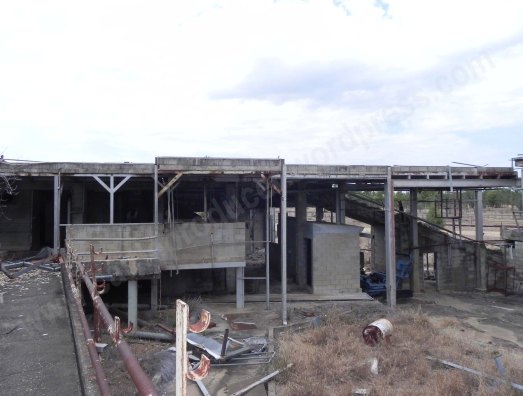
17.10.2014 173_edited-1Photo Jo Bloomfield October 2014
Pentland. Looking from the Hides area to the main processing areas of the meatworks from the opposite sides of the building to previous photographs.
The Main ramp leads to the top level, of now removed structures. The ramp I am standing on leads to rooms for initial processing of carcase. Main boning and processing to the left out of picture

17.10.2014 168_edited-2Photo Jo Bloomfield October 2014
furtherest from the picture is the top level of where the cattle would have been slaughtered and undergone initial processing. The level I am standing on to take the photo is the where the boning and cutting facilities would have been. Freezers and chillers are located directly to the left.

17.10.2014 169_edited-1Photo Jo Bloomfield October 2014
Pentland. Inside one of the Freezer / chiller rooms. Large open doors at each end. Processed carcases came from the right. Loading docks to trucks were outside on the left.

Sources

  1. ‘North’s beef powerhouse’ Nth QLD Register. 22.11.12
  2. Employers & Industrial Relations in the Australian Meat processing Industry. P. O’Leary 2008
  3. ‘Cape River Meatworks, From Go to Woe 1942 -1989’ Robyn Muller
  4. Competition and Exit in Meat Processing. Agribusiness review Vol 7 1999
  5. ‘Cape River Meatworks – From Go to Woe 1942 -1989, and 10 years on’ Roby Muller.1999
  6. anu.edu.au-Whitlam sacking 1975