Tag Archives: abattoir closures

Glenroy

Current Operation

  • Closed(1964)1

Location              

  • Located on Glenroy Station, 190 miles(304km) S of Wyndham 160 miles(256km) E of Derby1

Australia. Glenroy

map Glenroy

Owner

  • Kidman – period of 1920’s – 30’s2


Operation

  • Processed 60 head cattle a day1

History

1920’s – 1930’s

  • Cattle supplied from Victoria River Downs which at that stage was owned by Emmual, Forrest and Yuill with Kidman. Pg 1152

Sources

  1. ‘Northern Australian beef Industry – Assessment of risks and opportunities’ ABARE 2012
  2. ‘The Australian livestock export trade’ Nigel Austin. 2011

Cairns

Cairns (more commonly known as Queerah meatworks) was located in far north QLD received cattle from mainly north Australia, often by Barge from the NT and Normanton that had travelled from the gulf of Carpentaria. Began to export in 1950’s closing in 1989

Number of photographs kindly supplied by the Cairns Historical Society, a museum and library operated by volunteers.

Other names

  •  Queerah

Current Operation

  • Closed 19861
  • Others say 19894

P08210 (2)Source – Cairns Historical Society, 1952. Photo PO8210
The Cairns Meatworks

Location             

  • Skelton Creek, Cairns

Australia. Cairns. jpg

Map. Cairns 001Source – Hema Maps. Australia Truckies Atlas.

Owner                 

  • Amagraze. Director Fred Beaver (1962)3
  • AMH

Operation          

  • Export1
  • Nominal Capacity 110,000hd per 50 weeks1

History                

 1950

Queerah 1950.Source Cairns Regional Council. Dated 1950

Queerah Meatworks

  • Begun to export early 1950’s4

 1960’s 

  • 1st loading 6th June 1960.Ships – Irene Clauser ,  Inger Clausen – coasters – length of 50m, shallow draft, carry 200-250hd1
  • Clara Clauser – specifically built for Gulf trade, larger but shallower draft of only 1.8m, carry 800-1000hd1
  • Involved in shipping cattle Gulf of Carpentaria around Cape to Cairns, otherwise cattle had to be walked 3500km to east coast, ships took 5 days1
  • Burketown, Karumba & Normanton – shipping from these regions to Bowen and Cairns. Govt paid a 3 pound freight subsidy3
  • Earlier service operated by barge Wewak, owned by Marine contracting and towing company1pg 72

p04059 (2)Source – Cairns Historical society. 1963. PO4059
Winners of the Queerah meatwoeks carcass competition Cairns Show

1962 

  • Isla Clauser – replaced Inger Clauser  and Irene Clauser, to be replaced by Ida Clauser3
  • At this time Cairns (Queerah) was most modern meatworks in the southern hemisphere5
    • Had first continuous chain – carcase kept moving along the line, once it started5
  • July. Meatworkers strike5
    • 13 boners including union president had been sacked for go-slow5
    • Industrial commission and Conciliation commission directed men’s re-employment as boners – they were but with union predisent as a trimmer, reducing wage by half5
    • Company refused to give preference to union workers of  AMIEU5
    • Union called stop work. – 41 employees including union president dismissed5
  • 100 graziers moved in to keep works operating – came from Cape York, Gulf, Hughenden, Alpha and Warwick5
    • mainly used to bone due to backlog of meat5
  • Boners earning 60-65 pounds a week, strike wanted 5 more5
  • Strike went for about 10 days5

1970’s

  • Cairns Harbour board Installed large Freezers at the Number 1 wharf to store meat in cartons for direct loading to the ship4

p04048 (2)Source – Cairns Historical Society. c1970

Loading export meat from the Queerah meatworks at Cairns wharf

1975

  • Ida Clauser supported Gulf trade to about this year3
  • Clara Clauser – larger, shallow draft built specifically to navigate shallow north Australian rivers3.

1980

  • Over capacity of the meat processing sector had always been a chronic problem, but where previously it was due to seasonal factors now the problem was a direct result of management decisions during the late 1970’s (Pg 85, thesis)5

    • Chronic over capacity, undersupply of cattle and oversupply of labour requirements (Pg 117, thesis)5
    • Processing sector shed 15,000 jobs between 1980-1984 (Pg 117, thesis)5
      Entire export sector was regulated by the speed and skill of the production process (The chain and CanPak killing systems), bureaucratic control systems regulated the substantive and procedural rules (The tally and awards)(Pg 120, thesis)5
    • the only way forward for employers was rationalisation of the production capacity (Pg 120, thesis)5

1986

  • Australian Meat Holdings (AMH) – Four largest meat processors in Australia had decided to combine their resources(Pg 126, thesis)5
    • FJ Walkers (Wholly owned by Elders)5
    • Metro Meat Industries5
    • Smorgon Consolidated Industries5
    • Tancred Brothers5
      • combined assets $90M (Pg 127, thesis)5
      • Plan was to combine resources of QLD meat processing facilities, take over Mackay (then owned by Borthwicks) and Bowen plants. Establish the most suitable operating capacity for the new entity and then rationalise the remaining excess capacity (Pg 126 thesis)5
      • Borthwicks latter withdrew from talks but was latter taken over by AMH in 1987 (Pg 128, thesis)5
  • AMH principal objective was to rationalise capacity of its 9 abattoirs, so the remaining plants would operate near full capacity (Pg 128, thesis)5
    • two older plants immediately decomissioned (Pg 128, thesis)5
      • Authors note – think Cairns  and Cape River abattoir (QLD) were two of these plants.
      • By 1996 AMH had closed 5 of the 9 plants.(Pg 128, thesis)5

1989

  • Closed4

Sources

  1. Competition & Exit in Meat Processing. Agribusiness review Vol 7 1999
  2. ‘100 years of Northern Beef Production’ Nth QLD register 22.11.12
  3. ‘The Australian Live Export Trade’ Nigel Austin.
  4. Cairns Historical Society.
  5. Employers & Industrial Relations in the Australian Meat processing Industry. P. O’Leary 2008
  6. ‘Queerah Meatworks strike’ North QLD register 17.10.2013

Ross River

Built in 1882, QLD meat export agency formed supplied contracts for supply of product to England. Plagued by industrial action its whole operating life most notably in 19919 when a violent clash between the unions and police occurred. Been through ownership receiver, beef price crash, strikes, droughts and market changes. Smorgons meat processors, last owner collapsed in 1994, facility closed in 1995. Site now developed as a residential site with only the chimney still remaining as a historic site.

Other names

  • Ross River meatworks

Current Operation

  • Closed 19951

 Location             

   Australia. Ross River         


Owner                 

  • Built by QLD meat export and Agency (QME) – Principal Sir Thomas Mcllwraith, QLD Premier2
    • QME was a government operated organisation
  • Vesteys purchased 19556
  • Smorgons6

Operation

  • Export
  • Nominal Capacity 120,000hd per 50 weeks1

Other abattoirs in the region

Pentland (QLD)

Townsville – Stuart (QLD


History of Ross River abattoir               

  • Initially was a major exporter for Townsville region
  • Meatworks chimney still stands today, restored

1866

  • Boiling works began operation 1 kilometre downstream from latter site of Ross River meatworks5
    • Boiled down tallow was selling in Sydney 46 shillings cwt, hides 16 shillings5
    • Gold discoveries forced works to close due to lack of stock supply5
    • closed 18705
  • Initial workforce of 7006

1882

  • Built and cost to build £75,0004
  • June. Started operation.5
  • Processing 80 head cattle day
  • used gravitational system, animal killed on one floor and then meat processed in others4
  • Wharf couldn’t handle the ships to transport frozen meat and a coastal steamer had to be modified to convey meat from wharf to ship.5
  • Operating company of meatworks imposed strict conditions on delivery of cattle, requiring animals to be delivered on particular days or suffer5

1890

  • QLD meat export and Agency co formed(Pg 47)8
    • Sir Thomas Milwraith & John Cooke, floated company with 1M pound8
    • Agents in London – Messrs. W Weddel and Co8
    • 5 year freight contract with Houlder Bros & co, for conveyance of 1200t meat per month8
    • Company formed to give graziers markets in the Old World (England) for their suplus cattle8
  • Plans submitted to build meatworks in Brisbane & Townsville.5

1891

  • Construction began – 6 acres freehold5
  • Was considered one of the best factories of the time with freezers and used electricity for lighting (Townsvilled didn’t have household electricity until 1923)5
  • When designed used a system of dry air compression, this was replaced with ammonia compression and air circulating batteries a few years latter (Pg 49)8
  • First industrial dispute before even began work5
    • Contractor (McCallum Park) v’s carpenters  – McCallums only wanted to pay 10 shillings a day, 2 shillings below going rate5
  • Industrial disputes would mark next 100 years of operation5

1897

  • Was receiving complaints about the effluent being pumped into the river after relocation of manure shed, rudimentary digestors installed that produced fertiliser and sold to locals5

1900’s

  • Mr Charles Harford – In charge at the time over a period of 13 years – Ross River abattoir was the most up to date abattoir he had seen4.
  • In reference to Ross River “In order to combat the exorbitant demands of labour it was necessary to use as much labour-saving machinery as possible”4
  • Costs – Total cost for yarding, killing and other handling as well as dealing with offal and by products was £1/3p per head for cattle and £18 per 100 sheep. Quoted in 1914 “..but the work could not be done at that price now”4
  • “One man knocked down 520 cattle in a day of eight hours”4
  • Difficulties arose in meat marketing – with competition form

site _edited-1Source – ‘A history of the frozen meat trade’. Critchell & Raymond. 1912.
Photo is undated Titled. QLD meat export and Agency company Limited. Ross River works Townsville.

1903

  • Cyclone Leonta hit Townsville on 9th March 1903. Causing widespread devastation. Many buildings at the Ross River meatworks were unroofed or demilished15

1910

  • Half of Freezing capacity was fitted with direct expansion piping, so effective the remaining freezing block was outfitted the following season as large expenditure (Pg 49)8

Prior to 1912 report

  • Manager Robert Stewart (Pg 48)8
  • A controlling holding in the company was purchased by G.S Yuill & co (London based)8
  • Ross River (then known as Ross Creek works) had recent upgrades and refitting.(Pg 48)8
    • Made the works the most up-to-date freezing works in the existance in either hemisphere (pg 48)8
    • Original freezing machinery plant ( air circulating batteries) and other equipment discarded.(Pg 48)8
    • New freezing and electric plant being erected with new steam engines, both for electric and freezing services – supply 220 lbs pressure through triple expansion, supplied by mechanically fired boilers and coal supply .(Pg 48)8
  • Ross River works, coal was expensive, water supply limited and drainage difficult – improvements now made the render at the works second to none for economy and convenience in working (pg 49)8

1917

  • Companies who operated meatworks asked Arbitration court to regulate wages and conditions in the industry to replace direct bargaining with the unions7

1919

  • company had won an court order in previous year to delete ‘union preference clause’ from the award wages system6
    • Clause had been in effect since 19117
  • February – More than 700 meatworkders resolved to declare works black6
    • AMIEU membership was 2442,largest branch at Ross River of 756 members7
    • 500 cattle released from stockyard and water posioned6
      • Cattle deliberatly released by protestors, ring leaders arrested. Supporters after speeches and drinking broke into a gunshop before marching on the watch house9
      • Violent clash between police and unionists. Trouble stemmed from long standing industrial unrest  between meat companies and AMIEU19.
        • Area was besiged by unemployment and economic depression19
        • Unrest degenerated into a riot with shots fired – 9 people injured, seven as a result of police bullets19
        • Townsville remained in a state of siege for weeks19
  • June – strike declared “Only meatworkers responded; all other unions voted to stay on the job. When the strike began about 80 ‘scabs’ were employed. By mid-August more than 300 were working, including AMIEU members who had dribbled back to work”7

1921

  • Export beef trade collapsed6

1953

  • Kenneth Woodhead Moore became manager of the Ross River meatworks14
    • Moore was manager until 1956.14

1955

  • QME – disclosed an overdraft of $2,392,954, at the time estimated cost of replacement of the works was $800,0006
  • November – offer from Vestey’s (British) accepted $1,575,000
    • Subsidiary company W.Weddel & Co – purchased Angliss meat interests in 1934.6
    • 1961 QME had entered into partnership with 11 other companies – Angliss Group6

old photo_edited-1Source – Wikipedia. Photo public property. Undated

holding yards_edited-1Source – This is Australia Oswald L Ziegler, Dated 1956.
Looking over holding yards of Ross River meatworks outside city of Townsville

1960’s

  • Extensive upgrades including a kill chain6
  • Women allowed to work on the killing floor6
  • Chilled beef shipments had resumed from Townsville for the first time since WWI6
  • QLD government resumed land for realignment of major raods Townsville to Ayr6

1975

  • QME submitted application to sub divide holding paddocks for residential blocks6
  • Australia was in a severe economic crisis.17
    • Most severe since the Great Depression.17
    • Profits slumped and mass sackings followed with general manufacturing factory closure occurring.17
      • Unemployment in Australia reached 5%.17
    • Whitlam Labour government at the time, economic policy swung from expansion to reining in the ballooning deficit.17
      • government felt key to recovery was ‘healthy profits’.17
        • attacked dole bludgers, wage rises and militant unions.17
      • large scale protests occurred across Australia.17
      • Townsville 3 meatworks stopped work for the day October 24.17

1992

  • Smorgon Consolidated industries purchased6

1993

  • Type 1 road trains – truck with dog trailer allowed access directly to meatworks3.

1994

  • Smorgon meat processing company suffer huge company collapse in early 1994

1995 

  • American markets opened for poorer quality meats and resulted in death knell of canning operations.6
  • February. closed5
    • closure announced by Smorgons on 27th Feb, 199510
  • A seasonlly operated plant that worked 9 months of the year, employed about 380 people, many long term employed at the facility10
  • previous year facility had processed 86,000 head of cattle10
    • projections that Live export would reach 390,000 in 1995 concerned union10
    • Australia’s total live cattle export for 1994/95 402,120 head and 1995/96 649,715 head11
  • Union and animal welfare group met and formed a group CALE (Committee Against Live Export)10
    • Tony Clunies-Ross as secretary10
    • CALE spearheads struggle to protect jobs and ease the suffering of animals10
    • Initive spread with CALE groups in Victoria and Western Australia10
  • 400 people lost jobs5

1997

  • Land purchased by a developer of Fairfield Waters12
  • Developer had originally planned to keep the chimney and three gable buildings near it to turn into a public monument and a brewery12
    • Never allowed as reports showed all structures structurally damaged and should be demolished12
    • Buildings were demolished12

1999

  • Buildings demolished leaving only brick chimney12

Chimney_edited-1Source – http://www.panoramio.com/photo/12516926, Tim Dickson, Not dated.
Remaining chimney of the Ross River meatworks

2007

  • Developer Lancicn planned to demolish chimney to build a resort.12
    • Engineering report commissioned by Lancini found chimney was too unstable and old to preserve12
    • Residents complained and ordered a professional report into stacks structural integrity12
      • report said chimney could stay12
  • Government then fought over who should pay for repairs12
  • Chimney was heritage listed12
    • repairs cost $200,000
  • Chimney is now surrounded by Lancini’s Springbank urban village.12
    • Claims of ghostly figures appearing by the chimney as dark outlines, thought to be the ghost of a man named Crawford who died at the works in 1901 after he fell into a vat of boiling fat.13

Sources

  1. Competition & Exit in Meat Processing. Agribusiness review Vol 7 1999
  2. ‘100 years of northern beef production’Nth QLD Register 22.11.12
  3. ‘Trucking Industry moves ahead’ Nth QLD Register 11.04.13
  4. ‘The abattoirs – Evidence before the commission’ The Adelaide Advertiser. 30.01.1914.
  5. ‘Ross River Meatworks, Part I’ Nth QLD Register 18.07.13
  6. ‘Ross River meatworks, Part 2’ Nth QLD Register 25.07.13
  7. ‘100 years of struggle and change’ AMIEU History. Claude Jones
  8. ‘A history of the frozen meat trade’ Troubridge & Raymond. 1912
  9. http://www.jculibrarynews.blogspot.com.au
  10. ‘Meatworkers and animal libbers form alliance’ Green Left Weekly. 30.08.95
  11. ‘The Australian livestock export trade’ Nigel Austin. 2011
  12. http://www.wikipedia.org/wiki/Ross_River_Meatworks_Chimney
  13. http://www.paranormal.com.au
  14. Australian Dictionary of Biography. Moore (1917-1990) Vol 18, 2012
  15. http://www.northqueenslandhistory.blogspot.com.au
  16. ‘Barricades & Batons: An historical perspective of the policing of major industrial disorder in Australia’ D. Baker. 1999
  17. anu.edu.au-Whitlam sacking 1975

Wyndham

Current Operation

  • Closed

Location              

  • East Kimberley, 120km from NT border

Map Wyndham

map.Wyndham 001Source – Hema Australia Handy map 9th edition.

Locations of other Australian abattoirs.

Owner

  • Project Development Corporation (PDC) prior to 19765
  • Wyndham Meats (1960’s)
  • Hookers & PDC created a joint venture (1976)5
  • Hookers owned outright (1978) operated as Norwest Beef Industries Limited5

Operation

  • Seasonal operation killed May to September1
  • Average turnover was 30,000 hd cattle1
  • 45 yrs of public operation ran at a loss, sold 19661
  • Was export accredited – received cattle from NT prior to 1959 (when Darwin and Katherine) built1

 History

1897

  • JJ Holmes – Member for East Fremantle, member of parliament, at time Commissioner of railways – talked of long range solution to tick problem was formation of freezing works and chilling works at Wyndham. Pg 1777

1906

  • Talk of forming syndicates for chilling and beef-extract works in Wyndham. Pg 2057
  • Richard Tilden – British promotor who had been involved with failed mining schemes in Kalgoorlie, tries to raise capital to establish a floating abattoir.Pg 2337

1907

  • Properties from Kimberley were loading cattle at Wyndham for delivery to Robbs Jetty abattoir (WA), SS Mildura had run aground at North-West Cape and caused drowning of all 700 cattle aboard. Pg 2377
  • Kimberley pasturelands was producing more cattle than WA state could consume and were walking cattle overland to Queensland abattoirs.Pg 2367
  • James Mitchell, Minister for Agriculture promises provide two thirds of cost of construction of works at Wyndham. 40-50,000 pounds. Interest free for first 5 years and thereafter on gaurantee of 5%.Pg 2377
    • People weren’t happy with the meatworks receiving assistance.7

“Why should rich firms like these get large sums of government money free of interest whilst a struggling farmer can get no more than 500 punds and pay 6% for it” West Australian Newspaper.Pg 2377

1908

  • Techinical advisor of a large freezing works in Syndey investigates Wyndham proposal and advises cost to be minimum 100,000 pounds, 25,000 above original estimate.7
    • expert estimate included Jetty and supply of fresh water sourced 20 miles away from site7
    • Government withdraw support of funding. Pg 2597
    • Michael Durack visits William Angliss, who owns meatworks in Footscray, Melbourne, Angliss advises Durack that excluding land the facility cost 50,000 pounds, including freezing, chilling, boiling down and preserving works. pg 2677
  • Bovril Australian Estates show interest in partnering building of Wyndham abattoir. Pg 2937
    • Bovril would latter build Bullocky point abattoir (NT) in 1917, which only operated for 3 years
    • Bovril had just taken up leases in 1908 Victoria River Downs in NT and Carlton near Wyndham.Pg 3157
    • Bovril also said to be considering purchase of a steamer to convert to a floating abattoir7
      • approached Australian government for assistance and wanted to use Asian labour, business would be conducted in Cambridge gulf and not infringe on White Australia policy of the time. Pg 3157
  • Government attempted to assist with cattle movement – as alternative to sea transport subsidised the development of the Canning Stockroute. Pg 3167

1910

  • Kimberley cattle being sold for 3 pounds in Fremantle after shipping from Wyndham and Derby. Pg 3247
  • Live export was opening up to Philippines which would take light weight cattle. Pg 3247

1911

  • Advisor to Bovril that suitable site for an abattoir was on property Auvergne. Pg 3427
  • Government surveyor Sanderson, advises on feasibility of abattoir at Wyndham, with water being sourced from various sources.
    • Project wasn’t an alternative to Manilla live export trade but would be advantage to ship frozen meat to avoid quarantine  problems with stock to be held prior to shipping.Pg 3437
  • If meatworks not established in 1912. Richard Tilden would undertake project at estimated cost of 25,000 pounds, not including water which government was expected to provide. Pg 3497

1912

  • WA change of Government from Liberal to Labor – leader John Scadden. Withdraw support of Wyndham abattoir. Pg 3807
    • The government enter the Wholesale butchery business to reduce price of meat to public. Pg 3807
    • Government also take over shipping along coast. Pg 4377

1913

  • NT government talk of establishing meat works in Darwin, this is not supported by WA producers though a meatworks in Katherine was. Pg 3917
  • Government had already commited to establishment of abattoir in Darwin.7

1914

  • Vesteys sign a contract with government to establish meatworks in Darwin. Pg 4147Bullocky Point abattoir (NT)
  • Declaration of WW1 occured – WA government reconsider establishment of meatworks at Wyndham. Pg 4147

1915

  • March. WA state government sign a contract with building group Nevanas for materials and to construct abattoir for 159,510 pounds. Pg 4217
  • Bullocky point abattoir (NT) construction is well underway. Pg 4287
  • July. Agreement between government and Nevanas ended and Wyndham abattoir construction again under review.Pg 428.7
    • Shipping space to Nevanas had been made unprocurable. Pg 4307
    • 3% of estimate had been paid. Pg 4307
    • government renegotiated with Public works to build abattoir, some materials already delivered to Wyndham. Pg 4307
      • No public tender called and reaction of public was unfavourable.Pg 4307
  • Government supply two more ships for coast transport of people and cattle7
    • N.2. prinz Sigismund – Kaisers private yacht – renamed the Bambra. Pg 4377
    • Kangaroo – new vessel, first diesel engined motor vessel. Pg 4377

1916

  • Wyndham works making progress – mile from town, Water pool is located 20 miles out with 2 25,000 gallon tanks and pumping site.Pg 4417

1917

  • Trade union strikes impeded progress of meatworks construction. Pg 4547

1918

  • Meatworks costs now 723,000 pounds from original estimate of 155,150. Pg 4627
    • Debate on how the works was to be run, by the state or a joint enterprise. Pg 4627
    • Nevanas claimed they had the right to solely operate the facility. Pg 4627
  • Construction finished late in 1918, facility had an electric lift. Pg 4697

1919   

  • Constructed as a public meat works1
  • Meatworks to be operated under Government control7
    • Government offered producers 5-7 pounds less than other markets.Pg 4727
    • Post war markets and freighting costs were still indefinite.Pg 4727
    • Outbreak of pneumonic influenza forced quarantine – disrupted travel, delay in loading and unloading cargo.Pg 4737
  • Government resumed land held near abattoir, 60,000 acres, land was resumed forcefully including all improvements, living quarters, yards, fences and wells, from Duracks with no compensation. Pg 4817

1920

  • VRD cattle (Owner – Bovril Australian Estates) were Wyndham’s largest supplier5
  • Angliss discuss with Durack possibility of leasing Wyndham works.7
    • Angliss has processed in Australia 1,250,000 sheep and 30,000 cattle. Employed 1,000 men at 4 pounds to 4pounds 10 shillings a week. Pg 4907
  • June. Works having difficulties – inexperienced workers and strikes for higher pay. Pg 494.7

1930  

  • VRD supplied one third of 10 568 head slaughtered this year5
  • Abattoir paid £3 1s 5d, compared to realised value on VRD for 4000 head purchased by Sidney Kidman, paying £4 2s 6d5Pg 118.
  • ‘condemns’ chuted to be processed as meatmeal – ‘political reasons’5Pg 144.

Note by Jo Bloomfield – Not sure what this statement was in reference too – think there was strife between the management and workers and more than usual number of condemned cattle occurring, Could also refer to the government overseers.

1942

  • Japanese attacked Darwin, Government at the time were concerned if Japan invaded from the north that they would have a ready supply of meat and food therefore temporaily closed the meatworks down from this time to approximately 1949.6
  • Government also had landholders remove many cattle from northern properties and move south incase of invasion, so as to deny ready food source6
  • Cattle which had normally supplied this abattoir were now walked down the Murranji stockroute, eventually to QLD, 47,000 cattle in 1942, 30,000 from Vestey’s Wavehill alone. Demand for meat had increased on east due to Troops6

1949

  • ‘Airbeef’ Cattle slaughtered on Glenroy station, meat flown to Wyndham and Derby for exports and freezing1

1950’s

  • Abattoirs in the north were still operated ‘frontier mentality'(Pg 64)9
    • short processing seasons of 20-25 weeks9
    • largley itinerant labour9
    • Living and working conditions were dangerous9
    • Animal welfare standards were low9
    • Sanitation compiled to UK market standardsfor quarter beef, were well below standards for emerging US markets of boxed beef (Pg 64)9
  • US grinding beef market of the late 1950’s suited the cattle that were present in the north (Pg 64)9
  • Plants were encouraged to upgrade to meet USDA standards (Pg 64)9

1959

  • Improved to meet stringent USDA (USA Dept of agriculture) hygiene regulations1

1960’s

  • Wyndham Meats – Collective bargaining with Emanuel Exports, including Derby and Broome
  • UK agreement – quarter bone in carcases – meat was of inferior quality. Many condemned and processed into meatmeal5

1966  

  • Abattoir sold to private buyer1.

1968

  • Entire plant is condemned for its wooden structure by USDA reviewer(Pg 64)9
    • Decision was extended to cover all Wyndham beef on the water and in the US9
  • Affected importers and exporters, Wasn’t covered by insurance (Pg 64)9
    • finanical fallout took many years to resolve.9
  • Connections in Eastern Europe and Austria came in to play (Pg 65)9
    • 1,000t of affected product still in Australia was picked up at Wyndham and sold to Romania, with health certificates9
    • Export statistics don’t show shipments to Romania for that year, apparently customs and DPI were not present at loading9

 1970

  • Couldn’t meet USDA standards – lost export licence, so did Broome, Derby, Darwin and Katherine1
  • Beef Crisis was taking effect, many northern abattoirs were losing money.9

1970’s 

  • Ray Fryer – Uranpunga, Roper Gulf (NT) – trucked his own cattle from property to works. 3 day round trip, 1100 miles, 22 bullocks or 20 cows, received $150/hd ($3000 total), cost $500 fuel. “It was the only way to get a bit of money coming in”4

       1974

  • Ian Mc Bean was sending load of cattle from Bradshaw, return of sale barely covered costs of sending the animals (Pg 122)8

1976

  • PDC & Hookers created joint venture in attempt to rationalise the Katherine and Wyndham meatworks, outside shareholdings also purchased5

1978   

  • Hooker Corporation owned outright5

1985  

  • Export beef plant closed June 19851
  • Stayed open longer than other plants as was subsidised by the government3
  • Effluent from the works ran into a drain and straight into the sea, great burly for sharks (Pg 67)9

Sources

  1. ‘Sailing ahead’ Annabelle Coppin. 2009
  2. ‘The Australian livestock Export trade’ Nigel Austin 2011
  3. ‘Northern Australian Beef industry – Assessment of risks and opportunities’ ABARE 2012
  4.  ‘Red Dust Rising- The story of Ray Fryer of Urapunga’ Marion Houldsworth 2004.
  5. ‘The Big Run- The story of VRD station’ Jock Makin. 1970
  6. ‘The Murranji track – Ghost road of the drovers’ Darrell Lewis 2007.
  7. ‘Sons in the Saddle’ Mary Durack.
  8. ‘The privileged few’ Jeff Hill. 2008
  9. ‘World on a plate – A history of meat processing in Australia’ Stephen Martyn 2013

Point Stuart

A small abattoir that was in operation prior to  BTEC was being conducted, Processed buffalo and cattle.

Other Names

  • Jimmy Creeks meat works

Current Operation

  • Closed

Location   

  • 150km E of Darwin

Point Stuart abattoir ruinsSource – Northern Territory Library. Not dated.

Point Stuart abattoir ruins.

Owner                                 

  • Epitoma Pty Ltd1

Operation


History

1970’s

  • Alan Woods worked as an accountant for the abattoir.6

1973

  • Bulls and other cattle being delivered to site by Tom Fawcett from Old Mt Bundey station(Pg 162)4

1975

  • Paddy Heatley carted buffalo from Walgait reserve to Pt Stuart (then called Jimmy’s creek)5

1980

  • abattoirs closed for a period (Pg 244)4

1983

  • AMEU served logs of claims to set up tally system2
  • Workers contracted, unskilled workers earned $50-$60 a day2
  • Skilled slaughterman earn $350 day2

1984

  • AMIEU set up picket line3

1987  

  • Closed prior to 871

Source

  1. Savanna Responses to Feral Buffalo in Kakadu National Park (2007)
  2. Mudginberri revisted: a case study of a secondary boycott. Green Left. 16.01.13
  3. Mudginberri dispute. Wikipedia 16.01.13
  4. ‘The Privileged Few’ Jeff Hill. 2008
  5. http://www.roadtransporthall.com
  6. ‘NT live exporters mourn loss of founding identity Alan Woods.’ Beef central. 18.02.14

Munmarlary

Current Operation

  • Closed

Location

  • West Alligator River, 190km E of Darwin, 60km W of Canon Hill & Mudginberri

Map. Munmarlary. jpg

Owner


Operation

  • Species Cattle / Buffalo1

History

 1984

  • Closed prior to 871

Sources

  1. Savanna Responses to Feral Buffalo in Kakadu National Park (2007)

Mudginberri

Current Operation

  • Closed. Built 1970’s

Location 

  • Inside Kakadu National park. 250km E of Darwin

Map. Mudginberri. jpg

Owner   

  • Jay Pendarvis8
    • John David Pendarvis (09/09/1932 – 02/01/2004).9

Operation

  • Workers mainly itinerant and worked in dry season only.
  • Workers were not contracted directly to Jay Pendarvis but through 3 contractors
  • Intended to process large number of feral buffalo, particularly when BTEC in operation.

History

1974

  • Government offered contracts to catch Buffalo out of the South Alligator area (Kakadu National park) (Pg 163)8
    • All animals caught around South Alligator, East Alligator, Swamps of Canon Hill and Magilla creek went to Mudginberri. (Pg 164).8
    • Mangilla swamp – 1000 buffalo caught – within an area of 10 kilometres from abattoir. (Pg 164)8
    • All buffalo caught were carted to Mudginberri meatworks – Jay Pandarvis manager at the time (Pg 163)8
  • From 1974 to 1977 Mudginberri and Jimmey’s Creek abattoirs were the only 2 export abattoirs licenced to export to West Germany (EU).9
    • A west German, Australian Veterinarian and a DPI meat inspector were on site.9
  • Jay Pandaris is reported to have developed the first portable cattle panel that was used in mustering.9

Insert photo of current red panels that are based on similar type of Jay Pandaris’s.

Photo – G. Beere. Mudginberri abattoir, unloading buffalo. Unknown date.

1976

  • Geoffrey Beere is manager of the facility at this time.9
    • “We were excited to be part of a system that was paid on kilograms into a carton and when we finished loading the 20 tonne reefers and the DPI seals were placed on the doors, the cheque was in the bank account” G. Beere (Manger).9

Photo. G. Beere. Mudginberri. Extract of a personal letter sent to G Beeres from Jay Pendarvis. 24/04/1975

    • “I was very proud, years later when I learnt that a Brisbane Export Boning room adopted what they called the Mudginberri system” G Beere. (Manager).9
    • 6c was paid per pound x 5 workers (In cartooned 64 lb export boxes.9
  • All workers at the time were financial members of the AIEMU.9

Photo. G Beere. Mudginberri. Unknown date.

Photo. G. Beere. Mudginberri. Wayne Finn. Unknown date.

1977

  • Geoffrey Beere is manager of the facility at this time.9

1983 

  • 1983-85 AMIEU dispute symbolised the fundamental crisis facing Australia in 1985 as there was sharply declining prosperity within Meatworks due to poor productivity and trade-union intransigence4. Pg 49
  • AMIEU served log of claims to set up tally system at Mudginberri (M) as it was operating under its own agreements with workers.


Note on Tally system.

Tally system was work place arrangement prior to 1995 – Plant operated on single shift, Kill / Slaughter quota, when quota for day reached slaughter of animals was stopped6.

Normal operation was start 6am end 2pm

Enterprise Bargaining Agreements (EBA’s) introduced – Previously tally system has set rates of pay and also rate of productivity. Any new investment in efficiency meant workers just reached minimum tally in a shorter time. Tally system removed, increased production levels3.

EBA allowed multiple shifts, reduced penalties and shift loads, longer working days and increased pay rates. 30-40% increase in effective capacity. Lead to 40% reduction in unit costs3.

1984

  •  Australian Meat Industry Employees Union (AMIEU) set up picket line outside Mudginberri.10
    • AMIEU claim that all employees should be paid under a wages system known as the tally system.10
  • Mudginberri at the time didn’t employ labour directly. They engaged contractors who in turn hired men to carry out the work. These workers were on individual contracts.10
    • This is 2 decades before the era of Work Choices and Australian Workplace agreements.10
  • July. Mudginberri management won court orders and the picket line was disbanded.10
  • The Conciliation and Arbitration Commission made an award that didn’t adopt the tally system but included a provision enabling the use, on certain conditions, of a system of payment by results.10
    • Workers accepted this award but AMIEU rejected it.10
      • AMIEU reneged on an earlier undertaking to abide by the commissions decision and re-established a picket line.10

1985  

  • May. Union workers from Katherine abattoir and others picketed Mudginberri starting 9th May, lasting 4 months. Actual workers at Mudginberri didn’t participate.
  • ACTU at this time endorsed AMIEU
  • Government meat inspectors refused to cross the picket line, for fear of being fired.
    • Production at Mudginberri stopped and didn’t resume until 24 June.
    • Only NT government inspectors were authorised to enter the facility which meant the meat was only allowed for domestic consumption, which was  ½ price earnings of export.
  • AMIEU refused to lift picket and were fined, AMIEU assets were frozen – All Australian meatworkers went on strike, reportedly 20,000 people. Then included maritime and transport workers strikes in support
  • Mudginberri was member of NTCA who are members of National Farmers Federation (NFF)
  • NFF sponsored Pendarvis legal actions.
    • NFF built a $10M fighting fund.10
    • Pushed for changed in the Industrial relations system.10
      • Mudginberri sought to establish a right for employer and employee to negotiate terms and conditions which best met the particular nature of an abattoir’s operation.11
  • NT gov guaranteed $2M loan to abattoir on condition would sue AMIEU
  • Mudginberri was the first time the Trade Practices Act was used successfully against a trade union.10
  • Full arbitration commission allowed the contract system but also stated decision was only applicable in the NT
  • 27 court cases, 2 years litigation.
    • Jay Pendarvis awarded $1 759 444 damages
    • Huge personal toll to Jay Pendarvis, 21 days of intense cross examination during the damages action.10
  • Robert Bright who owns Batchalor abattoir (NT) buys Mudginberri (pg 248)8
    • ran on terms of kill one day, bone the next (Pg 249)8
    • Only needed one crew,8
    • workers applied for jobs and half selected8
    • working crew went on strike in sympathy for others not selected.8
    • Bright gave choice to had been originally cut out if they wanted to replace the first picks, they did and stayed until closure (Pg 249)8
  • Foreman at Mudginberri at the time – Tom Turnbull (pg 249)8
  • John David Pendarvis (Jay Pendarvis)  is named 1985 Australian Newspaper – Australian of the Year.9

1986 

  • The Mudginberri case (1986) set a major precedent for law – Secondary or indirect boycotts – Anti competitive conduct – ss 45D-45E

The Mudginberri Case (1986) AMIEU v’s Mudginberri station Pty Ltd (1986) 161 CLR 98.

Finding by court – A union carried out a secondary boycott by stopping another union from providing services to a ‘target’ corporation.

AMIEU blockaded Mudginberri station after it refused to pay workers the AMIEU pay rates. Meat inspectors who belonged to another union refused to cross the picket line which meant the Mudginberri meat couldn’t be approved for export.

Federal court held – That AMIEU was engaged in an illegal secondary boycott. Court granted injunction to stop the blockade

The union ultimately paid nearly $2M in damages and fines of $2000 per day for each day the picket remained after the injunction was granted.5

1987

  • Mudginberri closed down, it was the  last of the Alligator River abattoirs to be closed


2004

  • Jay Pendarvis passes away. Special permission is gained from Aboriginal elders for Jay Pendarvis’s ashes to be spread over Mudginberri Billabong.9
  • A memorial for Jay Pendarvis is installed at a cemetary site on Mudginberri.9

Photo. G. Beere. Mudginberri. Memorial of Jay Pendarvis.


image. 03.06.13.Source – Splashingpaint.blog.com.

Mudginberri abattoir – Abandoned

M. Outside.Source – Splashingpaint.blog.com

Mudginberri -InsideSource – Splashingpaint.blog.com

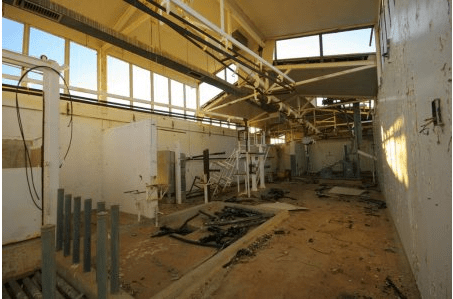
Inside the disused Mudginberri abattoir. The animal entered the kill box on the left, when slaughtered hang chain progressed to rear of shed.

Special Mention – The site Splashingpaint.blog.com has some of the most beautiful scenic and wildlife shots of the Northern Territory I have ever seen. it is well worth a view.

 Source

  1. Mudginberri revisted: a case study of a secondary boycott. Green Left. 16.01.13
  2. Mudginberri dispute. Wikipedia 16.01.13
  3. Savannah Responses to Feral Buffalo in Kakadu National park
  4. ‘Australian Livestock Export Trade’ Nigel Austin 2011
  5. ‘Australian Business Law’ 7th Edition. Vickery/Flood 2012.
  6. Competition and Exit in Meat Processing:A QLD Case Study. Agribusiness review 1999
  7. References with their articles (Rolfe 1988),(Reynolds and Sangster 1998b)
  8. ‘The privileged few’ Jeff Hill 2008
  9. Geoffrey Beere. Personal Communication. 23.10.2017.
  10. Price for all when union power met its equal. 12.06.2014.
  11. australianpolitics.com-Andrew Robb Lib-Goldstein Maiden Speech. 29.11.2004.

Marrakai

Other names

  • Wild Bore

Current Operation


Location 

  • 100km SE of Darwin

Owner   

  • Wild Boar Abattoir

Operation            

  • Pet meat abattoir, couple hundred metres from licensed premises.

History   

1979 

  • Pet meat (horse)was being packed as Buffalo for human consumption1
  • Pet Meat 30c/kg – Buff $1.40/kg1
  • Other litigation pending at Wild Boar at this time


Sources

1.       Royal Commission into Australian Meat Industry A. Woodward 1982

Litchfield

This abattoir was also known as Berrimah abattoir – confusion arises as when the proper Berrimah abattoir was closed it left Carl Mortensen with no where to process his pigs and therefore he built another abattoir to cater to his needs. Litchfield.

Other Names

  • Berrimah
  • Darwin

Current Operation

  • Closed 20071

Location             

  • Berrimah         

Owner  

  •  Carl Mortensen & Jim Scott.4

Operation          

  • Processing pigs goats and buffalo1
  • Was purpose built for attached piggery outlet, processing 6000 pigs a year11
  • Had ability to process cattle, buffalo, sheep, goats and deer1

History                

1991

  • Berrimah abattoir (NT) closes, Carl Mortensen had a piggery which used to use Berrimah to slaughter. When it closed he was forced to send pigs south to be slaughtered.4

1992

  • Built – facility was unique in that it was low cost and flexible using modulars and quick to construct.4
    • Cost $500,000 – multi species plant that could slaughter and bone4
    • Building took 10 weeks4
    • Modular design allowed it to be moved if necessary4
    • Panel clad module 8m long X 4m wide  and 5m high erected in 8 major sections on stilts4
    • Plant consisted of knocking box & cradle dressing, added chillers and freezer modules.4
    • stockyards were being built4
    • Stilts allowed truck access in all weather and effluent control.4
    • Employed 4 people – working 4 days a week at full capacity4
    • Could process 35 cattle or 135 pigs a day4
    • also processes buffalo, horses4

Photo_edited-1Source – ‘New abattoir for $500,000’ Top Paddock Newsletter #1 Sept 1993.

Litchfield abattoir showing its modular construction

  1993

  • Opened1
  • Was built after the Berrimah abattoir (NT) (Angliss) abattoir closed and owner wasn’t able to find a slaughter point for the piggery that he operated, so he built his own adjoining the piggery.2
  • Also operated as a service kill abattoir for 40 cattle on cattle days2

              2007   

  • Closed1
  • Owner wished to retire and was unable to find a buyer for the piggery.2
  • Used to run a herd of 300 sows producing roughly 6,000 pigs a year,3
    • Had done this since 19723
    • Demand had fallen – mainly in big chain stores not wanting carcase pork.3
    • Difficult to get butchers to work due to pay and hours required3


Sources

  1. ‘Northern Australian Beef Industry – Assessment of risks and opportunities’. ABARE 2012
  2. Personal communication of person who knew the owner. 04.11.13.
  3. ‘Darwin abattoir closes’ ABC Rural. 20.04.2007
  4. ‘New abattoir for $500,000’ Top Paddock newsletter #1 Sept 1993

Bullocky Point.

Other Name                                                                                                  

  • Vestey’s Freezer works

Current Operation

  • Closed – Historic.

 Location 

  • Darwin (NT) Wharf, Bullocky Point, Fannie Bay area.
    Darwin High School7
  • A large cement tank still exists that is used as a pavilion for expos that are held at the site4
    • authors note – in more recent photographs it looks like these large square tanks are used for water storage.
  • Bullocky Point is north of Mindil beach adjoining it and  the Darwin ski club.

Australia. Bullocky Point

Map - Bullocky Point

  • Holding paddock of old abattoir was Burrells Creek (Pg 141)11

 Owner/s   

  • Vestey’s, Owned Wave Hill (then 6000 sq miles)7

 Operation             

  • Closed 19201

 History   

1824

  • Captain James Bremer of HMS Tamar takes possession of Melville and Bathurst Island, in response to concerns over the security of northern Australia (Pg 1)14

1825

  • Buffalo, cattle, goats, sheep and pigs are imported to the Islands for food supply (Pg 1)14

1827

  • Settlement was established, Port Wellington at Raffles bay on the mainland14 (Pg 1)
    • Animals brought across from the islands14

1829

  • Port Wellington was abandoned (Pg 1)14
    • Some animals were shipped to WA, those that remained were abandoned14

1838

  • 3rd attempt to establish permanent presence in the North of Australia (Pg 1)14
    • Settlement of Victoria at Port Essington on Coburg Peninsula14
    • Some livestock were came with the settlers and others augmented from shipments from Java and neighbouring islands (Pg 1)14

1849

  • Settlement of Victoria – abandoned and the majority of stock left to run free (Pg 2)14

1860’s

  • British authorities influenced by earlier problems of colonising the north, they viewed pastoral settlement as dubious (Pg 2)14
    • disease was prevalent14
    • mortality commonplace14
    • little knowledge of the topography or vegetation, particularly poisoness plants14
    • controlling stock was extremely difficult14
      • would require horses, expertise and intensive capital investment in fencing, water supplies and yards.14
    • Distances and risks of shipping goods was extremely expensive14
  • No attempt was made to establish pastoral industry until this time. (Pg 2)14

1863

  • What is now known as the Northern Territory is temporarily annexed to South Australia and is known as the Northern Territory of South Australia (Pg 7)14
    • Created the Northern Territory Act – Limited pastoral leases to between 25 and 300 square miles, with only a 14 year tenure (Pg 8)14
    • stocking had to be done before the lease was processed (Pg 8)14

1872

  • NT Act – stocking arrangements were eased (Pg 8)14
    • Encouraged more uptake of land14
  • SA came under increasing pressure to construct a railway system (Pg 23)14
    • Most favoured a south-north line14
      • Studies indicated that even with the country fully stocked with cattle there would be insufficent stock for the venture14
    • Legislation  was introduced to induce British entrepeneurs to construct a land-grant line, in return for freehold title of up to 50,000 acres per track mile14
      • Proposal had significant public support but was rejected as it would have meant transfer of one-quarter of the territory to overseas interests (pg 23)14

1880

  • Forerunner roadway of the Stuart Highway extends 135 miles southward of Darwin14
  • Cattle located in NT – 17,720 head (pg 12)14

1885

  • Cattle located in the NT – 146,562 head (Pg 12)14
  • Cattle overlanded from the Territory to various markets 4,970 head (Pg 25)14

1886

  • Editor of the Times newspaper had considered the question of frozen beef was potentionally a more lucrative export market than live cattle (Pg 28)14

1889

  • Construction began on the railway from each end (pg 23)14
    • Darwin to Pine Creek14
    • Adelaide to Oodnadatta14
  • At this time cattle were mainly walked overland (Pg 24)14
    • long waterless sections of stock routes – no wells or man made facilities14
    • Localised droughts could cause deprivation of markets for up to 2 years14
    • Rendering works located at this time in Normanton and Burketown14
    • Other markets were goldfields in mainly WA14

1892


  • SA authorities aware that Territory meat markets were deeply depressed and mindful of a much needed export trade (Pg 26)14
    • realised to establish export trade would need significant government assistance14
  • Tender was called to supply, provision and operate a vessel to carry 200 fat bullocks to export (Pg 26)14
    • 10 trips per year
    • subsidy of £5,000, plus a charge to stock forwarders for each animal payable to the carrier.14
    • Had to ship from Port of Darwin, Victoria, Adelaide, McArthur, Roper and Limmen Bight rivers and Glyde Inlet14
  • Only one tenderer – Stevens, acted on behalf of stock agency Goldsbrough Mort (pg 26)14
    • failed to attract further interest or establish to a co-operative14
    • contract was for 5 years, starting 1st April, steamer Darwin.14

1893

  • Stevens had gained entry to Javanese market (Pg 27)14
    • secured a contract to supply 750,000 pounds of beef annually for 3 years14
    • Prices £8 a beast, this was regarded as satisfactory14
  • Criticism as to quotas not filled but full subsidy received, profit in backloading and no Macarthur and Tableland cattle were being exported, market was mainly for Goldsbrough and Mort properties (Pg 28)14


1894

  • Shipping trade developed between Whydham and Fremantle (Pg 25)14
    • Cattle loaded at Whydham receiving £16 to £17 per head14
    • Territory producers were recieving £2 10s on property14
    • 4,000 head shipped from Whydham, numbers were expected to increase in following years.14
  • 13,896 head had been overlanded from the territory to various markets (pg 25)14

1895

  • Cattle located in the NT – 280,957 head (Pg 12)14
  • Territory authorities extended Goldsbrough Mort contract for 2 more years (Pg 27)14
    • conditional on the construction of a £30,000 meatworks in Darwin14
  • Freezing works were not viable alternative in the Territory at the time – due to wide dispersion of stock facilities would need to be built at Victoria River, Port of Darwin and the Gulf (Pg 29)14
    • Producers not prepared to invest capital14
  • Returns to producers for live cattle on property £2 10s, animals delivered to Rockhampton £2 15s14
  • Frozen meat wasn’t an option for wider Asian market (Pg 29)14
    • lacked refrigeration capacity14
    • poor distribution facitilities and retail outlets14
    • specific religious rites had to be performed14
    • government health inspectors requirements14
    • Asians did not like the texture of frozen meat.14
  • Canning was another possibility, there were proposals for more rendering works (Pg 29)14
    • could have absorbed poor quality stock14
    • High costs prevented an proposals being established in the Territory14

1894

  • Goldsbrough and Mort is restructured and properties are sold (Pg 43)14
    • Victoria Downs, costs are slashed by 25%14
    • Newcastle waters is wound up for there is “not market for cattle within payable distance” , Stock are sold for less than £1 per head14
    • Wave Hill station is auctioned on a per head basis with all improvements14
      • Cattle fetch 15s each14

1895

  • January 15 – Government of SA appoint a 7 member Royal commission (Pg 43)14
    • To determine the causes of the Territory’s ills and hopefully right them14
    • Over 6 months and 2 days the commissioners visit Melbourne, Brisbane and 4 other major QLD centres.14
    • Speak to cane-growers and visit meatworks14
    • Hold 35 meetings, take evidence from 69 witnesses14
    • Genuineness of the commission comes into question when they failed to visit the Territory, relying on questionaires sent to a number of settlers and prominent businessmen14
  • Commissioners report lists a number of factors that they believe are responsible for the Territory parlous state.(Pg 43)14
    • Emphasis the necessity for amendments to the Pastoral Act14
    • a thorough investigation into redwater disease14
    • government subsidise water-boring in dry country14
    • provision of adequately watered stock routes14
    • Subsidies for freezer and canning works14
    • Completion of trans-continental railway – on a land grant system14
    • re-opening of WA border to Territory cattle.14
  • Report was not well received, proposed nothing that had not already been canvassed (Pg 43)14
  • Authorities had not intended to accept findings unless ready money was available or well backed by private enterprise (Pg 43)14
  • SA Government offered £5,000 loan on a pound for pound basis to be repaid from profits to investors willing to construct and operate meat preserving and canning works (Pg 50)14

1898

  • Live exports – Hong Kong market alone capable of absorbing 12,000 head is sent a trial shipment to Batavia from Marrakai and Daly River (Pg 25)14

1899

  • Nieuman and Niemann establish a series of meat extract and canning works (pg 50)14
    • First is located on Daly River14
      • Was operational within 3 months14
      • Tins were made at the works14
      • Product was satisfactory14
      • Venture failed14
      • Producers were selling to Wydham for better livestock prices14

1900

  • Successive – residents (administrators of the Territory) called for freezing work options – a number of schemes advanced.(Pg 51)14
    • Victoria River Meat Freezing and Preserving Co was promised under specific conditions to construct works (Pg 51)14
      • £10,000 to assist in construction14
      • Capacity of 1,000 head per week14
      • Work force of 3-400 people14
      • proposed to be built at Rugged Ridge on the south bank of the Victoria River14
    • Concerns there weren’t enough cattle to support (Pg 51)14
      • 50 to 60 thousand cattle or previously unsaleable animals could be processed.14
    • Victoria river  was too shallow to accomodate ocean going vessels (Pg 51)14
    • Factory was never built. (Pg 51)14
  • Establishment of profitable meat-processing enterprises in the NT wasn’t easy (Pg 51)14
    • suffer from diseconomies of small scale14
    • distance factor meant no single abattoir could attract all Territory cattle.14

1906

  • Bovril Australian Estate announce its intention to open a preserving, packing and extract plant capable of processing 300 head a day over 6 month season in Wyndham (Pg 50)14
    • Bovril had acquired Victoria River downs and 2 other properties14
    • Bovril had expected turnoff of 20,000 head annually14
    • Darwin wasn’t preferred as the immediate land surrounding was less suitable for agisted stock14
    • Territory public and authorities reacted vigourously to assist via incentives to have facility build in Darwin14
    • Bovril response – proposal to build a floating abattoir and freezing works, located in the VRD district (Pg 51)14
    • SA authorities insisted that plant be constructed in Darwin14
      • Bovril choose not to build anywhere in north Australia14

1910 

  • Labour government planned to build a state sponsored packing plant at Darwin to process the cattle raised on properties3                                          

1911

  • Commonwealth Government now assumed resposibility for the NT, effective 1st January 1911 (pg 56)14
    • SA Premier had tried to sell NT to the infant commonwealth for £2,585,57314
      • didn’t succeed in sale14
        • region had a very poor economic record14
        • Large Asian population lived in the NT14
  • Vestey family capital had grown to £1M in the NT.(Pg 51)14
    • Part of its buisiness was production, processing and distribution meat empire14
    • had acquired cold storage plants in China, Argentina, Russia and France14
    • Vestey’s looking to acquire NT land and run 250,000 head of cattle14

 1912

  • Parliament readings – Katherine railway line estimated to cost of survey £5,000 and construction £500,000, announce proposed freezer works to cater for all the needs of all northern Australia7Pg 24.

1914 

  • Agreement signed contract between Vestey’s and Commonwealth for company to construct and operate a meatworks in Darwin and Government would extend existing rail line from Pine creek to Emungalan (Katherine)6

                                                “The agreement was with regard to the lease of the land and to conform to this, the company had to kill, store and ship for private owners under the terms and conditions which required the approval of the Administrator6

  • December. Construction began

…steel and reinforced concrete, with galvanised iron roofing. The total ground area under roof is about 5 acres, the total floor space being 10 acres. The refrigeration space comprises of 1,000,000 cubic feet. The staff quarters can accomodate 35 men, and the men’s quarters 320. For senior members of the staff 14 dwelling-houses are erected or in course of erection. The works accommodation provides for killing and chilling 500 cattle, while 400 carcases can be frozen and 200 canned per day (Pg 51)

  • Construction began – delays due to war, supply of goods and materials and costs esculated8.
  • Planned to commence operations in April 1916 (Pg 51)14
    • delayed due to labour disputes and wartime shortages of material14
  • Vestey’s had significant contracts with British military establishments to ensure progress on the facility continued (Pg 51)14
  • Construction employed 500 or more men at a time with unprecendented rates of pay (Pg 51)14

1915

  • Michael Durack visits Bullocky point in the process of being built.10

” The works here well advanced – about 149 men on the job and quarters for 300 men under construction. Four bores pumping into a 40,000 gallon tank, 700 gallons every 24 hours. The water supply does not seem to me to be too assured but a general feeling of optimism prevails and all are looking forward to the works being ready for action mid 1916. It is believed that 250 head will be treated per day” MP Durack. 16.07.1915.pg 42810

1915 construction - Copy_edited-1Source NT Library – NT Library – Construction of Vestey’s meatworks 1915
Dated 1915 – During construction. The Slaughter area is the sawtooth building at the rear, Freezer area is lower buildings to the right foreground. The buidings to the far left I think was the preserving/canning

area.

1916

  • Michael Durack visits Bullocky point.10

“One of the buildings- a two storey place has a floor space of 350′ x 65′. The entire works has a floor space of ten acres. The water supply still seems to present a problem though at present they are drawing 15,000 gallons a day from 3 or 4 wells. For washing down, cooling etc.. they will draw water from the sea.. They expect soon to be killing 500 head a day” MP Durack 01.01.1916. Pg 44010

Aerial _edited-1Source NT Library, Aerial view Vestey’s meatworks 1944

Facility was actually abandoned at this point, Far left is Vesteys beach.

DArwin _edited-1Source NT Library. Darwin meat works (no date)

Double story building, unknown use. There is a railway line located on the left, think this buiding may have where animals housed waiting for slaughter.

mens quarters_edited-1Source NT Library. Mens Quarters UnDated

Men’s quarters able to house up to 300

  • NT administrator – Dr Gilruth speaks with Durack.10

” He sees the labour problems looming with the encouragement of irresponsible unionists. Sly grog selling is rife and the polic can’t cope with it. He thinks as before that WA made a great mistake in starting the works at Wyndham – says we should have waited and profited by the mistakes that Darwin is soon to make” MP Durack 01.01.1916. Pg 44110


1917  

  • Constructed1
  • Eventual cost £1M9
    • Cost of construction escalated from £300,000 to estimated £700,00015
      • Equivalent of $200M today (2018)15
  • Vesteys built 3
  • Construction costs substantially higher than expected6
  • Was intended that killing was done on land and a specially fitted out ship was moored alongside the Darwin wharf, war prevented the wharfs use7
  • Was a large employer when Darwin only had population of 20004. pg 67
  • Meatworks had a capacity to process 55 head a day, freezer capacity of 6000t, the largest in Australia at the time5
  • Facility intended to target a kill of 50,000 bullocks every dry season15
  • Government completed 88km rail extension to Pine Creek6
  • April. Killing commenced – 14 week season.(Pg 52)14
  • Season of 1917 processed nearly 19,000 cattle, majority from Vestey’s properties5
    • Processed 18,911 head in 191714
  • Used all parts of the animal (Pg 52)14

“The blood and bone go to make manure, the horns and hoofs are carefully saved, the fat melted down into tallow, the very membranes of the stomach go to make sausage skins” (Pg 52)14

  • Vesteys Manager – CWD Conacher – Plant was having problems due to wartime shipping restrictions, high costs and labour disputes. Pg 45210
    • Believed problems would be easily resolved once war finished. Pg 45210

    picture_edited-2Source http://www.samemory.sa.gov.au ID 41113/1
    The writing on the photograph –
    far left Concrete feed water tank – 2 straight walled square concrete tanks
    Centre – ?? Steam room – the two tall pipes are chimneys and this is where the boilers were located

  • Variable costs of operation that included wages, materials and administration(Pg 65)14
    • greatly in excess of those current elsewhere14
    • £8 16s 8d per head14

          cold Storage building – assume where meat was chilled. Actually refers to building that wall can   be seen of. The saw tooth building in the rear right back is the slaughter area.

2 - Copy_edited-1Source – http://www.trove.nla.gov.au. Looking west towards Darwin.
Railway tracks entering the facility.
employee preserving section_edited-1Source NT library. Meat preserving crew Dated 191?

1920.'s #2 - Copy_edited-1Source NT Library – Buildings Dated 1920’s
Looking at other photos the saw tooth building is the slaughter floor at the top level and and assume animal housing at the lower.

  • about 460 men were employed and 1,680 cattle were being processed each week (Pg 52)14
  • Effect on the local community was substantial14

“During the killing season the monthly average payment for railway freight on cattle was over £1,000. The highest fortnightly pay to employees was in July, when butchers and construction men received £10,754, and the highest amount drawn by any one worker for a fortnights labour was £40 1s 1d” (Pg 52)

Source ABC Rural 08.06.2018

Source ABC Rural 08.06.2018

1918 

  • Season of 1918 processed 29,000 cattle, majority from Vestey’s properties5
    • Processed 29,011 head in 191815
  • 500 beasts could be killed and chilled, 500 carcases frozen and 200 canned a day7

1920's - Copy_edited-1Source NT Library Buildings 1920’s Looking to Darwin, Mindil beach in background

Looking into the cement water storage tanks with residences and assume offices in the mid ground, mens quarters to the far right. Darwin city in the far back ground.

  • Community unrest was extremely high. 1,000 demonstrators marched on Darwin parliament house(Pg 40)13
    • Conspiracy had been uncovered between the government and Vesteys regarding illegal take over of large pastoral properties involving bribes.(Pg 40)13
  • Vestey’s seeking further Government assistance, including a reduction in rail and wharf charges (Pg 66)14
    • and a £2 head killing subsidy14
    • Authorities were already losing £70,000 a year in concessional rail freight14
  • Wartime contracts were what kept the facility in operation (Pg 66)14

1919  

  • Short operating seasons and union disputes caused problems8
  • Stop work meeting at works in protest at an increase in the price of bottled beer. Pg 47510
  • Vestey’s requested government assistance due to higher costs of construction, exceptionally high labour costs and therefore higher treatment costs. They also requested long-term rail freight agreements, adjusted wharfage rates and bores on their properties. Government refused8
  • Scandal – pastoralists stopped sending cattle to £1M abattoir. A letter had been published outlining among other things a plot to derive another large pastoral company of its stations.2pg.21
  • John Carey, Director of Agriculture and Acting Administrator of NT when Dr J.A Gilruth not present. Carey also took on job as chief clerk in Vestey packing plant. Carey wrote to Vestey’s “..that the lease of a large pastoral holding with hundreds of thousands of head of cattle on it would expire shortly. The administrator could refuse renewal and grant it to Vestey’s, but it would be necessary to pay him £20,000 to use as graft for officials and parliament for this purpose.”3
  • Due to Carey incident, Unions striked, other pastoralists refused to supply, the officials were smuggled out of Darwin as threats and abuse had been directed at them3
  • Only operated 3 seasons4
  • In 3 years of operation processed meat value was £1,029,271(Pg 52)14
    • meatworker employees had received approximately £400,000 in wages14
  • Variable costs of operation that included wages, materials and administration(Pg 65)14
    • greatly in excess of those current elsewhere14
    • £11 13s 2d per head14
  • Processed 21,866 head in 191915

1920

  • February. Gilruth advises Serious trouble with Darwin works and doubts Vestey’s can carry on. Pg 48910
  • Closed – was never profitable1
  • Closed March 17, 1920 (Pg 61)14
  • Reason for closure – Vestey’s blamed ‘Labour indiscipline and poor quality of local cattle.3
    • Strikes occurred over accommodation – Severe housing shortage in Darwin and therefore administrator waived health regulations and allowed workers to live in camps and tents (Pg 62)14
    • Vestey’s had to meet all demands of the unions (Pg 63)14
      • Company tried to control situation by paying inflated wages, living allowances and travel costs to and from southern states for seasonal workers.14
        • Made bonus payments to other employees in other industries in return for agreements not to strike14
        • Unions justified actions – AWU Darwin Branch Secretary – Harold Nelson14

“In the past capitalists have stolen from the workers and now the workers propose taking back the spoils. Anything wrong with that?” (Pg 64)14

  • Due to war, workers took advantage of labour shortages and went on strike for higher wages, Quote by Sir Edmund Vestey “..it was more profitable to let the cattle die on the stations than to put them through the Port Darwin works5
  • NT cattle herd now at 659,840 head. (Pg 60)14
  • Most immediate cause of closure was the shortage of shipping arsing from losses sustained in the WWI (Pg 62)14
    • Telegram from the Minister for Territories14

“Conacher, meat company states only reason for not operating this season is the government can not give a guarantee regarding shipping to bring coal and supplies and necessary labour. As 95% of settle population is dependent on the meat industry, therefore strongly appeal to the Government for consideration as regards our quota of shipping” (Pg 62)14

  • Government wasn’t in a position to promise ships or guarantee 8-10,000 tonnes of coal required to operate the works (Pg 62)14

Other reasons cited

  • Vestey’s owned a South African operation which was a powerful competitor to Australian product in England. The South African business being more profitable than the Australian. Vestey’s hadn’t wanted to turn down the offer by government to build the Darwin abattoir, someone else would have and thus created competition. Vestey’s invested £1M to build packing plant, they effectively made sure no-one else could compete with them in Australia3
  • Vestey’s had a divested a large proportion of their assets with American interests in WWI for taxation purposes, American Meat Trust (Pg 61)14
  • Gilruth, NT administrator was part of the conspiracy to allow the Meat trust run of the NT (Pg 61)14
  • Australian government failed to build railway between Alice to Darwin to bring in Cattle. Meant plant couldn’t operate profitably and forced Vestey’s to send their cattle to QLD abattoirs3
  • Basic error in abattoir location was due to lack of infrastructure and transport capabilities of source of animals from cattle producing areas, Vesteys owned Wave Hill and would have been better suited to locate a works at Wyndham (WA)8
  • Supply of stock was unsufficent. Turnoff was restricted to animals 4 years and older, Vestey’s herd was only capable of supplying 60% of the Darwin plants operation(Pg 61)14
  • Quality of the stock was unsatisfactory and the immediate area around the hinterland poverish in grass for stocking animals. (Pg 62)14
  • Reported losses of £250,000 after just 3 years2
  • Vestey’s forfeited capital investment of £900,000 and over £260,000 in operating losses (Pg 61)14
    • represented a budget over run of 300% (Pg 65)14
    • Original agreement with NT administrator (Pg 65)14
      • rate of return included depreciation 7.5%pa14
      • profit margin of 6.5%14
        • Company was entitled to annual return of 14% or about £128,00014
      • Yearly throughput never exceeded 30,000 head per annum14
        • represents a fixed cost range £4 5s and £5 16s14
      • Severe impost of wages, materials, admin, repairs and fares14
        • these were greatly in excess of those current elsewhere14
        • Variable cost range from £8 16s 8d in 1917 to £11 13s 2d in 191914
      • Added expenses were station costs, droving fees, rail freight14
      • Vestey’s received £16 per head for a slaughtered beast.14
  • Critics saw building of the facility as a token gesture to simply secure northern land, Vestey’s argued that the government never kept its promise to build the rail lines.(Pg 40)13
  • Effect on Darwin and its narrow ecomic base was calamitous (Pg 61)

“Five or six hundred unemployed were walking the streets, and in spite of every effort made by the Federal Government, no vessels could be procured for nearly two months to take them away to some place where work might be obtained.
As it was impossible to find work locally for the large number of unemployed, many of whom were without any means, the Government was forced to the alternative of either granting to these free rations or free steerage fares to some other part of Australia. The latter was the lesser of the two evils, both from the point of view of the men and the Government. In all 216 free passages were granted, principally to Greek, Patagonian and Spanish immigrants who had been attracted to Darwin in previous years…” (Pg 61)14

1921 

  • Abattoir didn’t reopen in 1920 or 1921. Government became concerned and extended the rail freight agreement to 19248
  • Export beef market plummeted in 19218 (Red water fever)

1925

  • Reopened briefly to operate as a boiling down works4
  • 9600 head turned into tallow but Vestey’s claimed a loss on operations8

Boiler room_edited-1

Source NT Library. Man in boiler room 1940.

1937

  • Payne Fletcher report – Board of inquiry in regards to a range of issues concerning the NT at the time (Pg 128)14
    • Considered the possibility or re-opening the meatworks, but considered it unviable as by now it was suffering badly from rusting and deterioration of the concrete (Pg 129)14

1940

  • Threat of war, army base was made at the site of Vestey’s meatworks12

1941 army trucks - Copy_edited-1Source – NT Library. Army base at meatworks. 1941/1942

Army vehicles of the 23rd Reserve motor transport unit.

ablution block_edited-1Source NT Library Ablution block 1940

1940's barracks - Copy_edited-1Source NT Library. Army barracks at meatworks 1940’s

 1950

1950's chimney's - Copy_edited-1Source NT Library. Meatworks in derelict state 1950
Facility by this time had been guttered of usable equipment, some used at other facilities to start meatworks.

1956

  • Fire extensively damaged what remained of the facility, mens quarters was burnt to the ground and several other buildings.
  • Site demolished except for large cement tank6

1962

  • Construction of the Darwin High school began

1962 high school construction_edited-1Source NT Library.. Construction begun on Darwin High School 1962.

1982

Darwin high school_edited-1Source – NT Library. Darwin High School. 1982

The old Vestey’s meatworks buildings removed and replaced by school facilities. The only historic infrastructure remaining being the 2 square water tanks built in 1915.


Sources

  1. ‘100 years of Northern Beef production’ Nth QLD Register 22.11.12
  2.  ‘The Australian Livestock export trade’ Nigel  Austin 2011
  3.  ‘The Rise and fall of the house of Vestey’ Phillip Knight 1993.
  4. ‘Wild Cattle, Wild Country’ Ann Marie Ingham. 2007
  5. ‘Vestey’s before the food commission’. www.samememory.sa.gov.au. 1925
  6. ‘Establishment of Vestey’s meatworks’ Commonwealth Government records about the NT.
  7. ‘Katherines No lady’ Winsome Maff
  8. ‘Pastoral Australia:Fortunes, Failures & hard Yakka’ M. Pearson, J. Lennon.2010
  9. ‘Meatworks project for N. Territory’ The Canberra Times 21.11.52.
  10. ‘Sons in the saddle’ Mary Durack.
  11. ‘The privileged few’ Jeff Hill 2008
  12. NT Library. Photographic history of Vestey’s meatworks
  13. ‘World on a plate  – A history of meat processing in Australia’ Stephen Martyn 2013
  14. ‘Distance, Drought and Dispossession – A history of the Northern Territory Pastoral Industry’ G McLaren, W Cooper. 2001
  15. ‘Vestey’s and AACo abattoir both mothballed after 3 years, So why can’t Darwin sustain an abattoir? ABC Rural 08.06.2018