More commonly known as Cape River meatworks this facility was originally built by the army and developed into the 2nd largest meatworks in QLD in its prime. This plant at various times processed beef, sheep and horses. Finally owned by AMH, closed in 1989.
Other names
Current Operation
Location


Owner
- Built by the USA Army to supply canned beef1
- Tancards (1945)1
- AMH (1986)5
Operation
- Was the 2nd largest meatworks in QLD1
- Nominal Capacity 112,000 head per 50 weeks4
 Adapted from chart – Kills and seasons from 1976.
Source Cape River Meatworks – Robyn Muller
Shaded area showing the period of operation of Pentland for each year.
 Adapted from chart – Kills and seasons from 1976.
Source Cape River Meatworks – Robyn Muller
Slaughter rates while in operation of Pentland.
Other Abattoirs in operation in the region
Townsville -Stuart (QLD)
History of Pentland Abattoir
1942
- Captain Paul Gregory of the Australian Army was appointed officer in charge of the 2nd/1st Field Butchery. His role was to organise beef to be sent to the troops overseas.(Pg 3)5
- Was instructed to find a suitable location for an abattoir in North Queensland.(Pg 3)5
- Previously domestic slaughter was conducted at Charters Towers but the facilities there were unable to cope with the extra requirements of the army (Pg 5)5
- Pentlands site on the Cape River was chosen due to abundance of high quality and volume of water.(Pg 2)5
- Required rail and road access (Pg 5)5
- Safe distance from the coast (Pg 5)5
- Another site near Hughenden on the Flinders River had been considered (Pg 5)5
- Army had a convalescent hospital in Pentland, allowed them to use the capable patients for light duties.(Pg7)5
- Cattle supplying properties were able to keep the transport costs at a minimum as most animals were walked to the site for delivery (Pg 7)5
- Building of the works site area began late in 1942 (Pg 5)5
- Site was resumed from the “Thyra” property with no advance notice or compensation to the then owners of the area Alma and Harry Bode (Pg 5)5
- 50,000 pounds was spent on the plant to date.(Pg 5)5
1943
- February. Building of the actual works facilities begins (Pg 7)5
- Facility was operational after only 4 months of construction (Pg 15)5
- Was built with 2 ramps to accomodate sheep and cattle (Pg 14)5
 Source – Cape River Meatworks – Robyn Muller
Construction of the slaughter floor.
- Freezer rooms first buildings to be erected with the bricks made on site.(Pg 7)5
- Water – supplied by a piston pump in a concrete box under the sand in the Cape River (Pg 10)5
- Storage of water was in 10 elevated iron 2,000 gallon tanks (Pg 10)5
- Steam Power – Boiler room, built in 1910 came from a sawmill in Warwick (pg 10)5
- Had 48 watertubes for heating (Pg 10)5
- Fired by 6′ lengths of wood – called ‘cordwood’ (Pg 10)5
- Used 7 tonnes of wood a day (Pg 10)5
- Ice works – Water filled canisters that were immersed into tubs of brine and frozen overnight5
- Able to produce several tonnes of ice daily5
- Cannisters were 3′ X 2′ – weighed 100 pounds when frozen5
- Ice was packed into the sides and ends of insulated rail cars5

Source – Cape River Meatworks – Robyn Muller
Engineers store, workshop and ice works. Rail wagon and loop on the right
- Digester was a single system (pg 57)5
- Rail loop was built from the main line so wagons could be shunted off for loading.
- Loading platform extended from the freezing rooms, 60 yards along the line.(Pg 11)5
- Defence foodstuffs – Dept of Supply and Shipping. Issued a memeorandum to have the Cape River meatworks in operation by July 1943 (Pg 4)5
- Townsville and district are finding the Armies drawing on food reserves extremely difficult.(Pg 4)5
- Army required food supply, ice, water, electricity and firewood(Pg 4)5
- Luxuries like lollies, softdrink, baby powder were virtually unobtainable (pg 4)5
- Issue of meat was strictly controlled by coupons. (Pg4)5
- Chronic shortage of domestic meat by 1943 had reached crisis point (Pg 5)5
- Military call ups of young meat-workers caused a serious shortage of skilled labour (Pg 5)5
- Exemptions and releases were allowed from the armed forces to increase production (Pg 5)5
- May. Works facilities are completed (Pg 7)5
- Initial engine installed, Crossley, was unable to supply sufficent needs (Pg 9)5
- Ruston Engine was installed, Hornsby Diesel, Class5 VERE 275 KVA (Pg 9)5
- Sept. 27th. The meatworks is officially commissioned by the Army (Pg 6)5
- Operating unit is the 2/1 Australian Fd Butchering Coy. (Pg 6)5
- From 20/08/1943 – 30/06/1944. Plant averaged 70 head per day.(Pg 9)5
- 3 fifths were frozen for long distance (Pg 9)5
- About 1,600 head, 262,590 pounds of meat in one month (Pg 9)5
- Facility produced 339,685 KWH of power, used 33,127 gallons of fuel, 3,639 of oil and 440 tonnes of cord wood.(Pg 9)5
1944
- May. Going rate for ‘fats’ 38 shillings per hundred – approximately 10-12 pounds per head (Pg 15)5
- Cattle delivered on the hoof or by train (Pg 15)5
- Processing procedure (Pg 15)5
- Animal was stunned with a hammer in the knocking box5
- Hind legs shackled and the throat cut, body hung to bleed.5
- Body put back on the floor5
- Body was marked down the neck, brisket, front legs, back legs and then the side5
- Hide removed with a knife5
- Body hung again to be fronted out (guts dropped)5
- Hand saws were used to cut down the backbone of each body.5
- Electric saws were not installed at this time5
- Beef moved to chillers or freezer5
- At this time all beef was sent as bone in quarters5
- If it was to be transported within a 700 miles radius the beef was chilled5
- If it was to travel outside 1000 miles and onto ships it was frozen5
- By products were all used (pg 16)5
- Blood, bone and wastes were cooked and dried then supplied to Army vegetable farms5
- Tripe was sent to hospitals in New Guinea where wood for cooking was scarce5
- Hides were sent to Brisbane to be made into leather goods for the army5
- Plant was used as a training centre to qualify slaughtermen to then be sent to other operational areas. (Pg 16)5
- 20,000 pounds a year was spent on research of Buffalo fly.(Pg 16)5
- Buffalo fly caused considerable damage to hides and affected the animals health (Pg 16)5
- Pentland was only handling a minimal amount of beef. (Pg 16)5
1945
- August. Armistice was announced (Pg16)5
- Shed was at very low production (Pg 16)5
- Army had no further use for the facility and left it to the care of a caretaker.(Pg 16)5
1947
- John Kelly purchased the facility for 10,000 pounds. (Pg 18)5
- Kelly was a sheep and cattle dealer.5
- Established himself as a wholesale butcher who moved into meat export5
- Largest exporter of beef after Vestey’s and Swift’s at the time5
- Kelly also purchased the cold stores at Aitkenvale in Townsville. (Pg 18)5
- There was a shortage of 44 gallon drums. Kelly purchased all the empty drums of petrol and avgas, numbering in the thousands from the wartime airstrips and used these to ship the tallow (Pg 18)5
- Average kill was 80 head a day.5
- Production was overseen by a Commonwealth meat inspector paid by the government (pg 19)5
- Butchers, skinners and saw men were on contract (Pg 19)5
- All other labourers were paid on tally (Pg 19)5
- “I was paid a wage of 6.96 pence per head. On a good week I could earn up to 10 pounds take home pay after tax” Jack Everett. (Pg 19)5
- A Riverstone saw for cutting bodies was installed. (Pg19)5
- All beef was processed to boneless quarters, placed in net stockings and then heshion bags. (Pg 19)5
- The bags were sewn with twine to fit around the quarter5
- Each quarter was marked as fore or hind and stencilled with the owners name5
- Meat was stored in the Pentland freezers in stacks, then loaded to rail wagons and transported to Kelly’s coldstores in Townsville5
- From Townsville to the port for export.5
- Double handling was expensive and the season ended as an unprofitable operation.5
1948
- New yards and crush for horse processing were built (Pg 19)5
- Horses were slaughtered for pet food, fertiliser, hair, oil and hides. (Pg 19)5
- Attempt to obtain an licence to export horse meat for human consumption. Was rejected. (Pg 19)5
- Horses were being replaced by machinery. Heavy horses, donkey and brumby’s were processed.(Pg 19)5
- Horse meat dressed was priced at 1 pound seventeen and 6 pence.(Pg 19)5
- Processing and slaughter was carried out at ground level. (Pg 20)5
- Carcasses were chopped into chunks, all meat, offal, bone and waste was dumped into a skip and taken to the digester (cookers)5
- Dead horses from the yard and foals were also put into the digester5
- Smell of the digester was terrible and was even smelt in Pentland township 10 kms away.(pg 20)5
- Cookers cooked overnight and the next morning water pumped into the bottom so the contents would rise (Pg 20)5
- Horse oil (Neatsfoot oil) was pumped into 44 gallon drums.5
- Remains in the digester were taken out, crushed and dried and bagged.5
- some used as poultry supplement, most was fertilizer5
- Hides were salted and stacked (Pg 20)5
- Horse tail hair was tied in bolts and packaged.(Pg 20)5
- Processing of the horses was not continuous and breaks frequently occured due to supply and weather. (Pg 20)5
1949
- Liberal Government won office.(Pg 20)5
- Kelly reapplied for an export licence for horse meat, was successful.(Pg 20)5
- Meat works required a comeplete overhaul to restore it to export condition5
- Refrigeration system was completely replaced.(Pg 21)5
- Horses were shot in the crush before hoisting (Pg 23)5
- New method of hide removal was used. (Pg 23)5
- Bodies were anchored to the floor and the hide pulled upwards.5
- Slaughtered approximately 80 per day (Pg 23)5
- Bodies were cut into quarters and bagged (Pg 23)5
- Horse meat went to London, Tokyo, The Hague and Europe.(Pg 20)5
- Most meat went to Smithton in London and then resold to other countries.5
- All orders and correspondence was placed and received via telegram (Pg 23)5
- Friday was pay day, bankroll paid in cash. Approximate wage was 22 pounds per week (Pg 23)5
- Board and keep were removed from wages5
- AMIEU represented all workers.(Pg 24)5
- Union ticket was 4 pounds per year5
- Union ruling that one beast had to be killed after afternoon smoko to keep the ‘Tally’ artificially low and generate overtime payments (Pg 24)5
- Ruling was not enforced Fridays. When worked always finished 1pm.5
1959
- Rail bridge washed away in wet season (Pg 24)5
- Pentland processes horses until this period (Pg 24)5
1960
- New rail way bridge was built (Pg 24)5
- Facility is not used for one year to avoid tetanus contamination from the horses (Pg 24)5
1961
- Several graziers are convinced to submit large contributions to form a co-op to buy the facility by developers – This was revealed as a scam and it is unknown if the scammers were charged (Pg 24)5
- Commences to kill cattle again (pg 24)5
- Cattle prices were high and coupled with increased killing costs made the production uneconomical and killing ceased (Pg 24)5
- Facility is offered for sale (Pg 24)5
1960
- Tancreds inspect the Pentland facility5
- Site was in a neglected state.5
- Regarded as a superior site to another meatworks Tancred’s owned in Winton (Mainly a sheep processing facility (Pg 27)5
1962
- Kelly sells Pentland (Pg 18)5
- Tancreds purchase for 25,000 pounds. (Pg 27)5
- Much of the Winton facility is demolished and transported to Pentland for refurbishment (pg 27)5
1963
- May First kill occured.(pg 30)5
- 29 head processed (pg 30)5
- Slaughter area was same as when the army and horses were processed.(Pg 30)5
- Shoulder high cement enclosure with no gauze5
- Stunning was still with a hammer5
 Source – Cape River Meatworks – Robyn Muller
Slaughter floor in 1963.
 Source – Cape River Meatworks – Robyn Muller
Boning Room in 1963
- Slaughter process (Pgs 30 & 32)5
- Beast was stunned in knocking box5
- Shackled and bled5
- Bodies dressed by knives5
- Gut was slashed and rinsed5
- Offal packed and frozen5
- Brains retrieved, used in the canteen5
- Beef was hung in halves and sent to the 1st chiller overnight5
- Seperation of Bull, Ox and Cow rails.5
- Day after killed, sides quartered at the 3rd rib5
- Quarter beef was table boned.5
- Cuts went to slicers5
- bones and scraps went into barrows to go to by-products5
- slicers trimmed and shaped the meat into specialised cuts5
- Women packers were behind the slicers.5
- cleaned and stamped the meat with the shed stamp TANCRED 2235
- Specialised cuts were boxed5
- loose meat, shin beef was packed in specific boxes of 60 pounds.5
- wiring machine wired the boxes with metal wire.5
- Meat was graded. boxes labeled.
- Blue – Oz – 1st grade5
- Red – Cow – 2nd grade5
- Black – Bull of mixed – 3rd grade5
- Workers had to wash the boards and benches themselves and wash their own clothes.5
- boning rooms were not air conditioned5
- Boners were paid a tally on 52 quarters (Pg 34)5
- All other labourers were paid wages (Pg 34)5
- Managers residence was completed (Pg 35)5
- Tancreds had a company truck they used to transport the cartons to the wharf from Pentland, in preference to using the rail wagons (pg 48)5
- Tarpaulin was laid on the truck and cartons stacked, then covered with another tarp (pg 48)5
- DPI office was a brick and concrete building (Pg 51)5
- One state DPI was in attenance at all times.5
- Duties was to oversee local affairs and stock inspections (Pg 51)5
- Vets Office was located next to the DPI’s (Pg 52)5
- American vet inspections visited annually and had very strict quarantine requirements (pg 52)5
- Commonwealth meat inspectors attended to export affairs (pg 51)5
- Inspectors travelled from Brisbane, 6 or 7 at a time to do 3 or 6 month stints (Pg 51)5
- First aid officer was a worker in the offal room5
1964
- Road Bridge over the Pentland river is constructed (Pg 15)5
- Power lines were connected to Pentland in time for the beef season (Pg 34)5
- Meatworks constructed a Hostel, Kitchen / Dining room facilities on site (Pg 36)5
- Barracks could accomodate 50 men5
- 2 man bedrooms5
- Serviced daily5
- Food and board was removed from wages5
- Boning & Brisket room could now be cooled to 50 degrees F with power connected (Pg 42)5
- Quarters tables had 9 boners and 11 slicers (Pg 42)5
- Women were employed more in packing sections (Pg 42)5
- Refrigeration cooling system was direct expansion (Pg 45)5
- Direct expansion cooling is a method using refrigerant gases, compressors and coils by pressurizing the contents reactions of hot and cold transfers can be utilised.5
1965
- Eric Musk becomes part time manager of meatworks for Tancreds (pg 37)5
- Slaughter floor almost completely rebuilt (Pg 39)5
- Method of dressing the beef was changed.(Pg 39)5
- still a straight rail system5
- Bodies were hung for bleeding and stayed on the rail5
- Stands were erected at different levels using air knives5
- Still less than 100 head a day being processed (Pg 42)5
- Boiler was converted to run on furnace oil.(Pg 45)5
- Firebox was fitted with jets and blowers with electric connections.5
- Vet employed full time at the meatworks (Pg 52)5
1966
- Different wage system introduced – Everyone was paid tally and waiting time (pg 34)5
- 20 commission homes were erected for familie of workers in Pentland.(pg 35)5
- Full board at the Barracks cost $20 for one week (Pg 36)5
- Sheep floor was built, Mainly equipment from Bourke (Pg 41)5
- Tancred’s were accessing an Arab market (Pg 41)5
- 2nd Boiler was installed, 72 watertube boiler that had been built in 1909 (Pg 46)5
- Road transport was the preferred method of transport, Rail loop was pulled up (Pg 48)5
- Laundry was built, prior to it being built and serviced the workers washed their own clothes (Pg 50)5
1967
- Meatworks establish a recreation room that contained a darts and hooky board (Pg 36)5
- In the 1970’s this room had to be converted to barracks to house extra employees (Pg 36)5
- Eric Musk becomes full time manager for Tancreds (Pg 37)5
- First sheep kill occured (Pg 41)5
- Sheep slaughter process (Pg 41)5
- Sheep slaughtered 10 at a time and hung on a ring frame on a rollar to be chilled overnight.5
- For boning the sheep were taken off the ring, placed in pairs on another5
- Sheep processed on a moving chain5
- Boned out and bulk packed, then frozen5
- Up to 2,000 sheep a day were slaughtered5
- Pelts dried but had problems with contamination by flies5
- Beef was still being processed. Sheep and Beef kill would occur on alternate days. (Pg 41)5
- Beef processed still using the tables (Pg 41)5
- Brisket room was converted to a load out area.(Pg 45)5
- No. 3 Chiller was built (Pg 45)5
- Slaughter floor efficency increased but the boning room couldn’t process all the beef (Pg 47)5
- Tancreds purchased one third of the load out area at the Suter Pier and built a boning room (Pg 47)5
- All bones and waste products were transported back to Pentland for processing through the By products (pg 47)5
1968
- Sheep only processed for 2 seasons (Pg 41)5
- Processing sheep wasn’t successful due to location and problems with excessive nodules in meat due to speargrass (Pg 41)5
- No. 5 Freezer was extended and converted into 3 freezers (Pg 45)5
- Water supply from bores had reached crisis point5
- 2 new bores were drilled and 2 new concrete 10,000 litre tanks constructed (pg 49)5
- First Aid room was built (Pg 50)5
Late 60’s
- Cultivation paddocks were established beside and behind the meatworks for experimental strains of grasses (pg 47)5
- Paddocks were flooded with waste water but the fat content was too high for the plants to survive5
- Settling ponds were built to allow the fat to float to the top and the water to be pumped from underneath was purer for irrigation.(Pg 47)5
- Dams on fire – fat was burned from the top of the dam5
1970
- Mutton floor converted to ‘top boning room’.(Pg 42)5
- Moving mutton chain converted to a side bonign chain which extended from the original lower boning room up a slope (Pg 42)5
- Boning team was now 14 men, with 15 slicers, 15 labourers (Including 4 learners), 16 packers and 7 juniors who attending stamping and cartons (pg 42)5
- Boning rooms now required by DPI standards to be a constant 10 degrees Celsius (pg 45)5
- Ruston engine was still used as back up on occassion as the connected power was unreliable and blackouts could last for more than 24 hours. (Pg 45)5
- By this time Tancreds had built no less than 25 butcher shops in and around QLD. (Pg 47)5
- At this time 12 Commonwealth Meat Inspectors manned the shed (pg 51)5
- Maintaining staff was difficult and locals were trained and passed Inspector exams (Pg 51)5
1972
- 5 more homes were built in Pentland (Pg 35)
- 2 Policemen stationed at Pentland to cater for influx of people (Pg 35)5
- Cryovac machine was installed in the lower boning room for choice cuts (Pg 43)5
1973
- A new boiler was installed, 5,000 KW (Pg 46)5
1974
- First aid room is relocated to a room under the boning room near the gut box (pg 52)5
- room also served as the labaratory for the fat content testing (pg 52)5
- Slaughter floor extensively renovated – Moving chain was installed(Pg 39)5
- Beaudesert had a similar installation5
- Modernisation enabled women to be employed in boning room, trimming and ‘C’ grade positions (Pg 40)5
1975
- Eric Tusk transfers to Townsville to manage the cold stores (Pg 37)5
- Longest serving manager for Tancreds (Pg 37)5
- Abbey Day becomes manager (Pg 38)
- Freezer now handle 2,000 bodies a day with a 48 hour freezing duration to minus 10 degrees (Pg 45)5
- Shortage of skilled boning room staff (Pg 55)5
- Constructed a ‘learner boning room’ ready for the 1976 season (Pg 55)5
- Hopper or fat and bone bin was installed5
- Australia was in a severe economic crisis.6
- Most severe since the Great Depression.6
- Profits slumped and mass sackings followed with general manufacturing factory closure occurring.6
- Unemployment in Australia reached 5%.6
- Whitlam Labour government at the time, economic policy swung from expansion to reining in the ballooning deficit.6
- government felt key to recovery was ‘healthy profits’.6
- attacked dole bludgers, wage rises and militant unions.6
- large scale protests occurred across Australia.6
- Townsville 3 meatworks stopped work for the day October 24.6
1976
- Boning room received newer and more modern machines as technology upgrades occured (Pg 43)5
1977
- During peak operating season a severe water shortage occured due to a very dry year (Pg 49)5
- September, rain and the river run, replenishing the bores.5
- Pentland township also expericenced water shortages. (Pg 49)5
- Council sunk a new bore south of the Cape River, this supplied the meatworks and the township (Pg 49)5
- Two large Southern Cross tanks were built within the meatworks compounds.(Pg 49)5
- Council paid $1M to install the bore, tanks and pipelines.(Pg 49)5
- New storeroom and laundry were built (Pg 51)5
- Old canteen, women’s amenities and first aid room became the DPI offices5
1978
- Slaughter floor now operating a 22 man team, most of the time was 18 men operation (Pg 40)5
- Record kill for one shift was broken within 24 hours 2 times (Pg 44)5
- Rockland Downs Cracker Cows 700 head slaughtered in one shift (Pg 44)5
- Next day by lunchtime 444 head had been knocked and by end of shift 701 slaughtered, Cracker cows again from Rockland Downs. (Pg 44)
 Source – Cape River Meatworks – Robyn Muller
The ‘Knocking box’, Using a hammer to stun the beast. The man who did the knocking was so proficent he was called ‘One shot Huxley’ (Pg 30)5
- Government built a house for the state DPI
- Commonwealth meat inspectors were housed in 2 homes allocated for their use (Pg 35)5
- Another Boiler installed, 6,000 KW (pg 46)5
- December. Abbey Day leaves position of manager (Pg 38)5
- John Crawford takes over as manager (Pg 38)5
- Had originally been a tally clerk and trained as a boning room foreman at the facility (pg 38)5
- First aid room is moved (Pg 52)5
- During the peak seasons loaded 3 containers and 3 trucks a day (Pg 52)5
- 3,500 cartons.5
- Capacity of each load up to 17,000kg5
1979
- During the 70’s the township propered as a result of the meatworks (Pg 35)5
- 30 new privately owned houses had been built in Pentland township5
- Another 10 in Homestead township
- Caravan park had 30 powered sites and 4 units, all were full.5
- Caravan park was built near the facility and it was full to capacity5
- State school enrolements was 74 children5
- Local Swimming school was built5
- Towns only hotel was renovated and thriving.5
- 2 service stations operated5
- Golf club and sports associations were established5
- 4 race meetings were held each year5
- Sutherland Park Rodeo was built and held an annual event5
- in the early 70’s 2 grocery stores operated5
- During the slack season of 79/80, 1,000 horses slaughtered (Pg 54)5
- Bulk pack order going to Belgium for human consumption5
- Order was completed in 6 weeks5
- New sterilising and wash down equipment allowed the order to be processed without tetanus complications5
- 2 scientists attended to take blood samples to study research into cancer5
Source – Cape River Meatworks – Robyn Muller
1980
- Over capacity of the meat processing sector had always been a chronic problem, but where previously it was due to seasonal factors now the problem was a direct result of management decisions during the late 1970’s (Pg 85, thesis)2
- Chronic over capacity, undersupply of cattle and oversupply of labour requirements (Pg 117, thesis)2
- Processing sector shed 15,000 jobs between 1980-1984 (Pg 117, thesis)2
Entire export sector was regulated by the speed and skill of the production process (The chain and CanPak killing systems), bureaucratic control systems regulated the substantive and procedural rules (The tally and awards)(Pg 120, thesis)2
- the only way forward for employers was rationalisation of the production capacity (Pg 120, thesis)2
- Charlie Ulett becomes manager of the meatworks (Pg 38)5
- Had originally worked in the maintenance and freezers, moving on to become a quality control officer (Pg 38)5
- 6 Rabbi’s came to Australia to oversee an order for a Jewish Kosher order (Pg 53)5
- One lived in a home in Pentland to conduct the order5
- They attended every beast themselves with a clean cut to the throat with a special knife from a packed case.5
- Knife was cleaned and sharpened after every operation5
- No shadow could fall on the beast which had to be slaughtered before midday5
- Only bullocks or female forequarters were used.5
- Suspected Tuberculosis and Brucellosis cattle were processed from the NT in 1981 & 1982 (Pg 54)5
- Had been industrial stife in Katherine and the cattle were unable to be processed there.5
- Those cattle tested positive to TB went down the hogger (Hammer and Mill that crushed bones)5
- approximately 5% of the cattle were put through the hogger.5
 Source – Cape River Meatworks – Robyn Muller
Pentland Meatworks (1980)
Far left, undercover stock yards, Main processing taller mid section leading to the freezers and loading docks. Far right is the laundry and storeroom
1982
- Fewer than 15 men were using the hostel facilities at the meatworks (Pg 36)5
- Many of the buildings were removed and relocated for private dwellings (Pg 36)5
- Paul Herrod becomes manager of the meatworks (pg 38)5
- Previously been a labourer then a foreman of the slaughter floor5
- Herrod set a precedent in that he was not only the manager but also purchased the stock.5
- set a patturn for future of how some of the Tancred meatworks operated in the future. (Pg 38)5
- Format of the packing was changed (Pg 43)5
- All rooms designed with all meat after leaving the slicer were placed on a moving belt5
- Speicalised cuts retrieved and placed in cryovac bags5
- Remainder of meat stayed on the belt to go to downstairs packers.5
- DPI had very strict stipulations regarding the touching of meat and cartons.(Pg 43)5
1984
- State school enrolments had risen to 84 children (Pg 35)5
1986
- sold to AMH Kill cut back to 300 day AMH owned Stuart meatworks Townsville and Dinmore, cut back at Cape river to save freight to others.2
- Paul Herrod remains as manager until end of the season (Pg 38)5
- Australian Meat Holdings (AMH) – Four largest meat processors in Australia had decided to combine their resources(Pg 126, thesis)2
- FJ Walkers (Wholly owned by Elders)2
- Metro Meat Industries2
- Smorgon Consolidated Industries2
- Tancred Brothers2
- combined assets $90M (Pg 127, thesis)2
- Plan was to combine resources of QLD meat processing facilities, take over Mackay (then owned by Borthwicks) and Bowen plants. Establish the most suitable operating capacity for the new entity and then rationalise the remaining excess capacity (Pg 126 thesis)2
- Borthwicks latter withdrew from talks but was latter taken over by AMH in 1987 (Pg 128, thesis)2
- AMH principal objective was to rationalise capacity of its 9 abattoirs, so the remaining plants would operate near full capacity (Pg 128, thesis)2
- two older plants immediately decomissioned (Pg 128, thesis)2
- By 1996 AMH had closed 5 of the 9 plants.(Pg 128, thesis)2
- Geof Tancred was elected as inaugural Chairman but by the end of 1986 withdrew and had no further involvement with the new company (Pg 63)5
- AMIEU argued against the amalgamation, saying it gave the company unfair monopoly (Pg 61)5
- AMH argued the downturn in markets made it a practical consortium (Pg 61)5
- Downturn in overseas markets, American dollar, coupled with rise of interest rates many meat companies struggled to keep afloat (Pg 63)5
1987
- Ken Johnson takes over managers position (Pg 38)5
- Previously been a slicer, tally clerk, quality control officer and office manager.5
- Slaughter floor mainly 12-14 men working on a daily kill of 250 head (Pg 40)5
1988
 Source – Cape River Meatworks – Robyn Muller
Lower moving Belt, dated 1988
1989
- Last kill (Pg 38)5
- 4 month season, only 22,694 head processed.5
- Mainly American beef5
- At time of closure all refrigeration relied on electricity and all heating was generated by furnace oil (Pg 46)5
- Union membership ticket now costs $140 per year (pg 44)5
- Ken Johnson transfers to AMH Stuart meatworks (Pg 38)5
- September. Closed 22nd. (Pg 61)5
- Lowest annual kill and shortest season in 20 years5
- Long running battle between AMIEU and AMH begun (Pg 61)5
- November. All maintenance staff had been paid off and only a caretaker remained.5
1990
- Uncertainty if Pentland was going to reopen.(Pg 61)5
- Public meetings engaged in heated debate regarding the shed future (Pg 61)5
- AMH’s general manager, John Gunthorpe stated that at the time no decision had been made to close the works (Pg 61)5
- People were told to prepare for the inevitable that it would close5
- Petition was drawn up and placed at various businesses calling for government pressure to ensure the facility reopened (Pg 61)5
- AMH and AMIEU urged state government and DPI to process Northern Territory cattle from BTEC to be processed at Pentland (Pg 62)5
- letter published in the newspapers from AMH to NT Minister stating5
- Offering Pentland facility to the NT to process NT cattle.5
- 300 head to be processed a day5
- resources from markets to go to the NT5
- currently a heavy drought and acute cattle number shortages were occuring5
- Without the NT cattle the Pentland abattoir would close.5
- Would directly impact 400 people and 1,000 indirectly5
- Survey of the area showed that 5,000 head were within 100km and readily available for slaughter (pg 62)5
- April. Public meeting an announcement was made that Pentland would not reopen for the 1990 season. (Pg 62)5
- reason given that there was not enough cattle available to process5
- 20,000 head of cattle were entering QLD to be processed.5
- DPI could not give preferential treament to Pentland to receive the cattle as other sheds had bid for the animals (Pg 62)5
- AMH said that it’s Townsville shed had to be operating at maximum daily kill (650 hd) before they could consider re-opening Pentland (Pg 62)5
1996
- Auctioneers were commissioned to inspect and catalogue the plant (Pg 64)5
- March. 2 day auction, unreserved prices (Pg 64)5
- Rumoured to have netted only $360,000 (Pg 64)5
- Demolition company was commissioned to demolish the remaining buildings and plant.(Pg 64)5
2014
 Photo – Jo Bloomfield October 2014
Pentland meatworks. The ramps leading to where the slaughter area would have been.
 Photo Jo Bloomfield October 2014
Pentland. The initial slaughter area floor with stock ramps to the left and frezer and processing rooms to the right
 Photo – Jo Bloomfield October 2014
Pentland. Inside the rooms that were directly placed after the slaughter area
 Photo Jo Bloomfield October 2014
The Freezer rooms and truck loading platforms.
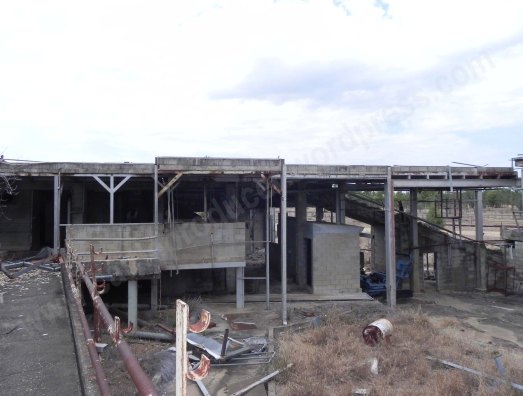 Photo Jo Bloomfield October 2014
Pentland. Looking from the Hides area to the main processing areas of the meatworks from the opposite sides of the building to previous photographs.
The Main ramp leads to the top level, of now removed structures. The ramp I am standing on leads to rooms for initial processing of carcase. Main boning and processing to the left out of picture
 Photo Jo Bloomfield October 2014
furtherest from the picture is the top level of where the cattle would have been slaughtered and undergone initial processing. The level I am standing on to take the photo is the where the boning and cutting facilities would have been. Freezers and chillers are located directly to the left.
 Photo Jo Bloomfield October 2014
Pentland. Inside one of the Freezer / chiller rooms. Large open doors at each end. Processed carcases came from the right. Loading docks to trucks were outside on the left.
Sources
- ‘North’s beef powerhouse’ Nth QLD Register. 22.11.12
- Employers & Industrial Relations in the Australian Meat processing Industry. P. O’Leary 2008
- ‘Cape River Meatworks, From Go to Woe 1942 -1989’ Robyn Muller
- Competition and Exit in Meat Processing. Agribusiness review Vol 7 1999
- ‘Cape River Meatworks – From Go to Woe 1942 -1989, and 10 years on’ Roby Muller.1999
- anu.edu.au-Whitlam sacking 1975
Like this:
Like Loading...


