Category Archives: Australian Abattoirs

Batchelor. NT. (Est # 3777)

Batchelor is a multi species abattoir located south of Darwin. Licensed to process cattle, buffalo and camels. The facility recently underwent significant improvements. Prior to re-opening in December 2019, It had been out of operation  for 16 years .

The current facility is operated by Central Agri Group Holdings, operating as Rum Jungle Meat Exports.


Other names

  • Tenarra4
  • Meneling abattoir (Pg 202)7
  • Rum Jungle meat exports8

Current Operation

  • Is currently in operation (May 2020)
    • Central Agri Group11.

Location

  • 165 Meneling Road. Batchelor NT 084513.
  • 100km S of Darwin

Map. Batchelor

Other abattoirs in Australia

Go to this link to view Location of Australian Abattoirs

abattoirs_edited-1

Owner/s

Historically

  • Windy Hills Australian Game meat. 5 year lease.
  • Ivan Coulter (Operator)1
  • A. Phillips 5

Current

  • Land title – Freehold Sec. 2894. – Tadmansori (Australia) Pty Ltd (ACN 612 804 583)9.
    • Registration of title 03/11/20179.

Operation

Previous operations – prior to 2019.

  • Domestic and Export3
  • 350 hd day (could be limited by wet season)2
  • Halal approved, was originally designed for onshore processing of halal meat products3.
  • It used to be the largest abattoir in the NT3.
  • Process other free range animals, goats, water buffalo1
  • Stockyards, races and interior have changed to suit dimensions and animal welfare requirements of camels1

After 2019 As per Environmental management plan.

  • Remaining land area of Lot 2894 is used for grazing cattle and growing feed crops.13.
    • A cattle export yard is located 1.2km south of the facility but is not currently used.13.
  • At full capacity the facility should process 160 head / day. (expected March 2020)
  • Operation will be mainly during March to December, facility to be shut during wet season due to supply of stock13.
  • Facility is expected to process up to 30,000 head per year of mainly cattle, but also buffalo and donkey’s.13.
  • Holding yards have capacity 320 head onsite.13.
    • One truck will likely deliver 160 head a day.13.
  • Meat and Offal to be produced for export.13.
    • Hides ( Not brined) also exported
  • Tallow and meat meal products will be produced on site in low temperature rending facilities.13.
  • Likely main export site to be Darwin (NT)13.
  • 3 carcass chilling rooms, 3 blast freezers and 2 blast chillers.13.
  • Main effluent pit – 5,000lt.13.
  • Bunded waste storage area for solid waste bins.13.
  • Low temperature rendering with 10m high dryer stack.13.
  • Wastewater treatment ponds 19ML storage.13.
  • 20,000 lt LPG tank for rendering plant and bore water supply.13.
  • Water requirement estimates 1 ML per week.13.
    • Water to be supplied from an existing bore on site.13.

History

1960’s

  • Sid Parker involved with abattoir (Pg 202)7
  • Original abattoir – Meneling abattoir was built during this time and stood where the current Batchelor abattoir is sited.13.
    • Meneling was the name of the property on which the abattoir was built.

1968

  • Sid Parker principal of Meneling meatworks, approached producers about supply of Brahman cross animals for local trade (Pg 205)7
    • Product was sent to Woolworths Darwin store who offered a premium price (Pg 205)7

1974

  • Beef Crash, came unexpectedly and hit hard.(Pg 205)7
  • Properties supplemented income by slaughtering brumbies and buffalo for pet meat (Pg 205)7

1980’s

  • Robert Bright was mustering Finniss River Station. Sent cattle and buffalo mainly into Batchelor (then called Meneling abattoir)(Pg 244)7
    • Money from sale of cattle was paid to a local store to cover wages and goods – cheques were bouncing and people weren’t able to claim their earnings.(Pg 244)7
  • Batchelor – Manager Bill Coleman didn’t realise no-one was getting paid –
    • $80,000 was owed to Robert Bright. Abattoir wasn’t in a position to pay. (Pg 244)7
    • Another creditor lodged summons to wind Batchalor up.(Pg 244)7
  • Creditors meeting – abattoir didn’t have any money to pay anyone and was going to appoint administrators to take over the abattoir. (Pg 244)7
  • Creditors asked Judge if they could take over running of the abattoir instead of installing an administrator- permission was granted (pg 245)7
  • Robert Bright appointed solely to take control, Merl Sharples set up bookwork (Pg 245)7
    • Asked creditors to supply animals to kick start abattoir.7
      • Townsend family from Stapleton agreed to supply animals as they were 2nd largest creditor.(Pg 245)7
    • Abattoir at the time was supplying 60 bodies a week to Woolworths (Pg 245)7
    • Started to contract kill pigs for Angliss meat works as Berrimah abattoir (NT) had closed7
      • Pigs allowed a 2 day a week kill.(Pg 245)7
      • Litchfield abattoir (NT) later processed pigs but wasn’t built until 1993. It was closer to Darwin when Berrimah officially closed in 1991.
    • Meneling only had local licence to supply meat to domestic use, meaning they could only supply Australian market7
  • Facility established contacts with Steiger’s – Waxy Pearce (Pg 245), who had previously been involved with Katherine abattoir (NT) 7
    • Contracts were paid upon loading of the freezer trucks at the abattoir (Pg 245)7
  • Wally Wegscheider – used to work at Meneling, ran the slaughter floor (Pg 246)7
  • Freddy Robinson – ran the boning room7
    • Both Wally and Freddy agreed on a per head price and they would supply their own labourers7
  • Bill Coleman stayed on for period when Robert Bright took over. (Pg 246)7
  • Creditors eventually paid 70c in the dollar to settle legal directions.(Pg 245)7

abattoir books 012Source – ‘A privileged few’ Jeff Hill. Pg 244
Old Meneling abattoir

abattoir books 013Source ‘A privileged few’ Jeff Hill. Pg 246.
Meneling abattoir yards in 1980

1982

  • November 1. Registered land title owner Meneling Station Pty Ltd9.
    • Transfers 02/02/1989 to Meneling Meat Processors Pty Ltd9.

1985

  • Robert Bright bought out major shareholders and debt of creditors to be sole owner (pg 247)7
  • Meneling was upgraded to an export abattoir – allowed to sell anywhere in the world (Pg 247)7
  • Contracted Herman Lind – German contractor who built export abattoirs for the Tatiara Group7
    • Lind was engaged to design new abattoir (Pg 247)7
  • Incorporated part of the old abattoir into the new (Pg 247)7
    • slaughter 10 – 300 animals a day with minimum labour (Pg 247)7
  • Bright needed a loan of $1M, found a bank to lend $650,000 (pg 247)7
    • Used and located second hand abattoir equipment7
    • Owners did a lot of the installation work themselves7
    • Abattoir was built for $800,000 (Pg 247)7
    • Bank supplied rest of money needed. (Pg 247)7
  • Export abattoir required specialised labour, previously as domestic abattoir all workers had been locals, tried to employ non-union with export set up but ended up with some staff that were union (pg 247)7
  • Only killing for one week before labour problems started.(Pg 248)7
    • Union rep at the time – Trevor Surplice (Pg 248)7
  • All boners had walked off job – had called a stop work (Pg 248)7
  • Boners saying they didn’t like the conditions they worked under (Pg 248)7
  • Workers were given choice to stay or leave under the conditions they had originally agreed before strike, a few left.(Pg 248)7
  • Meneling didn’t lose days to strikes even though it had a picket line (Pg 248)7
  • Robert Bright bought Mudginberri abattoir (NT).7

abattoir books 014Source ‘A privileged few’ Jeff Hill. 2008. Pg 247.
New abattoir at Meneling

Unknown dates

  • Went into partnership with a German company that the abattoir supplied buffalo meat7
    • Terms were that Bright had to stay and operate abattoir.(Pg 249)7
    • after couple of years was sold.(Pg 249)7
  • For a long period Meneling was the major employer in Batchelor and killed close to 40,000 head (Pg 249)7.

1989

  • February 2. Registered  Land title Owner Sec 2894 (Plan/s S78/129) is currently Meneling Station Pty Ltd9.
    • Transfers 25/03/1993 to Meneling Meat Processors Pty Ltd9.

1993

  • March 25. Registered Land title Owner is Tenarra Pty Ltd9.

2003

  • Malaysian company ,kept facility closed in preference that stock be sent Live Export to Malaysia3.
  • Reportably the facility is mothballed at this time.18.

2007

  • Currently closed but would be capable of still operating – 250 head a day capacity8
  • March 27. Lapsing Cavaet is registered against title.
    • Global Livestock Corporation (Aust) Pty Ltd (ACN 117 228 412)9.
    • Cavaet will expire 27/06/20079.
    • Authors note – a Cavaet is a registered interest in the land9.
  • June 6. Registered Land title Owner is currently Global Livestock Corporation (Aust) Pty Ltd (ACN 117 228 412)9.
    • Mortgage Dealing 646674. Listed against the title – Mortgagor was  Export-Import Bank of Malaysia Berhad9

2010

  • Camel culls in North of south Australia instead of shoot to waste could have been processed at Batchelor, Company could have increased production from 250 to 500 animals per week.6.

2011  

  • September – Facility is upgraded, cost $5M, will process cattle, camel, buffalo.4.
  • Owners state\ that the facility isn’t alternative to Live animal export, as they have markets in the US and others.4.
  • Indonesia possible to sell small amount boxed beef
  • Main intention to process wild cattle.

Note – Some countries prefer wild run cattle they see them as healthier. Markets have been lost once these wild herds tamed, ie Buffalo Katherine meatworks contracts with Germany.


2012      

  • July. Recomissioning former plant to process 250 camels a day1
  • $2M already spent with further $6M earmarked to do further work1.
  • Problems with Malaysian owners not being able to sell as they owe debts and title won’t be released on land5
  • Reportably the last operational period of the abattoir before re-opening in late 2019.13.

2014

  • May 5.Lapsing Cavaet is registered against title9.
    • PGA Capital group SDN BHD.9.
    • Cavaet will expire 08/08/20149.
  • August 8. Notice of commencement of proceedings by the Caveator registered on title9.
    • Issues of Caveat are not finalised until July 20169.

2016

  • July 18. Caveat issues on title are finalised9.
    • Transfer of certificate of title to Tadmansori (Australia) Pty Ltd ACN 612 084 583 occurs $4,585,6329.

2017

  • December. Central Agri Group (CAG) is formed.
    • National meat processing company that includes multiple processing plants, large scale farms, feedlots and live export depots11.
    • Meat processing facilities include Victoria Valley plant in Trafalgar (Vic), Esperence (WA)11.
      • Partially built facility on a grazing property – Cataby (WA)
    • Entity of CAG will come into operation 01/01/2018.11.
    • Central Agri Group is part owned by Tadmansori Holdings (Australia) Pty Ltd.13.
      • Batchelor abattoir will be operated by CAG subsidiary – Rum Jungle Meat Exports Pty Ltd.13.

Source – Various ASIC and company search extracts – 05/02/2020

  • CAG at this time also purchase Esperence abattoir.17.
    • Esperence had previously been placed into Administration in May 2017.17.
      • Shark Lake Holdings was in hands of liquidators and still owed debts.17.
    • CAG hope to have it back in operation by February 2018.17.
  • CAG also own a property North of Perth, Joanna Plains. A custom feedlot, backgrounding facility
    • Joanna Plains was also a live export depot.17.
    • Beef abattoir was in the process of being constructed on Joanna Plains, CAG hope to finish the building.17.

2018

  • Central Agri Group begin significant investment and upgrading of the facility with plans to re-open in 2019.13.
  • May. Renovations begin on facility, with intentions to be fully operational April.18.
  • Australian Agriculture Company (AACo) annouce it will suspend operations at Livingstone abattoir, Darwin.38.
  • Yeeda (WA), a new facility completed in 2016 is processing 1,100 – 1,200 head and day.39.
    • Project’s backer saying the facility is profitable.39.
  • 30 abattoirs have opened and shut in the NT in the last 100 years.40.
  • July. AACo Livingstone abattoir, Darwin NT closes.21.
    • AACo conducted a review of its asset performance and found the Livingstone abattoir was a major contributing factor with significant losses of $60-65M over the last 12 months.37.
  • November.

“We are focused on a small and niche plant. We are looking to process between 160 and 200 head a day, made up of buffalo and cattle” Peter Polovinka.18. Shareholder of CAG, Director of Rum Jungle meat exports.

“It will be all boxed chilled and frozen product, depending on the orders; if they want quarters, we can do that”. Peter Polovinka.18.

“We want to target at least 35 countries in Asia.” “We do have the demand, We already supply them with meat from our other abattoirs so there is no problem with market access – we already have it”. peter Polovinka.18.

  • AACo invested more than $100 in building a new facility.18.
    • CAG purchased (Batchelor) an existing plant that hadn’t been run for 15 years.18.
    • Batchelor is currently getting fully renovated.18.
      • Renovations about 80% complete.18.
  • Strong Live export market in the NT. Batchelor wouldn’t compete with Live export,  it would complement it.18.
    • Batchelor facility will focus on cull cows and bulls left over from live export.18.
    • Feedlot at the Batchelor site that can hold 3,500 may be utilised to assist with stock supply.18.
  • Batchelor refurbishment has provided a boost to local economy.18.
    • Workers who had previously become unemployed when AAco Livingstone plant were shut down were employed by CAG.18.
      • Some workers were sent to WA Esperence (WA) to stay in work until the Batchelor facility is ready.18.
  • Likely require 35-40 people initially, with possible 100 people later.18.
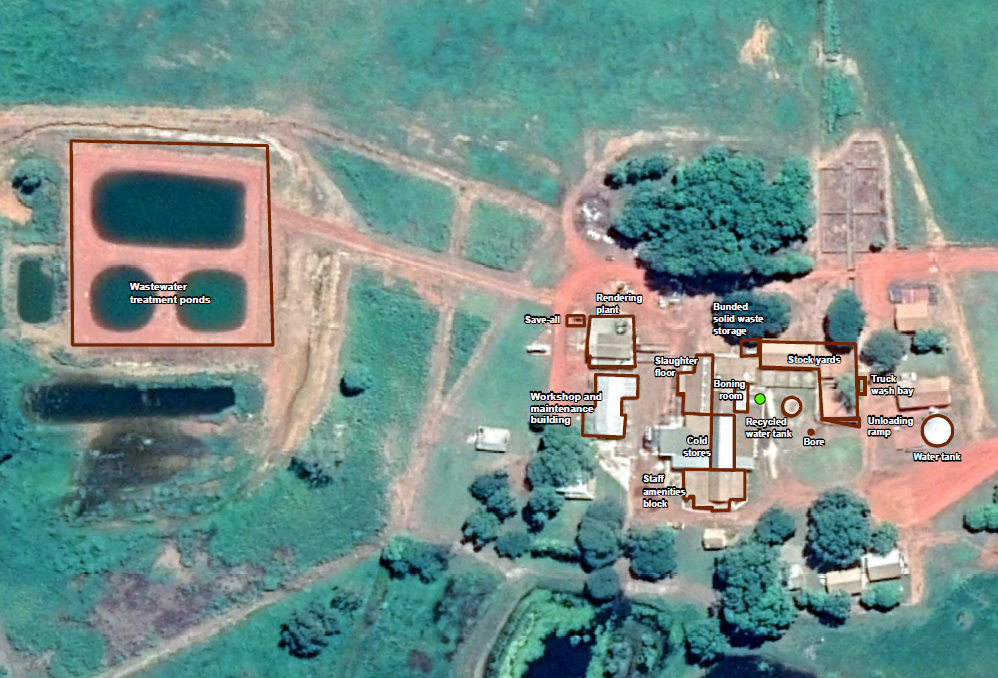


Batchelor abattoir layout – EPA Management Plan. Fig 4. 

  • Previous experience of CAG operating other abattoirs have installed and adopted certain operating procedures to minimise environmental risk and odours.13.
    • installed new raw material chillers.13.
    • Hours of operation of rendering plant will reduce odour units produced.13.
    • Size of anaerobic ponds allows greater average retention of waste.13.
      • 34 days as opposed to minimum 16 days.13.
      • Facility will be shut over wet season.13.

ABC. 01/12/2018.

2019.

  • March. Batchelor is undergoing renovations and will only be months away from being operational.21.
    • When in operation it will be the only large scale works functioning in the NT.13.
    • Livingstone closed in July 201813.
    • Batchelor is believed to be successful where the AACo failed because it won’t compete with Live export.21.

We can’t compete against the live export trade, they are paying far too much” .Peter Polovinka. CAG.21.

“Anyone running a herd of cattle in the NT has felt the impact of AACo abattoir closing”. Markus Rathsmann. Speaking in reference to Livingstone abattoir closing and not able to process out of spec animals suited to Live Export.

  • Batchelor expects to process 200 head a day when in operation.13.
  • Buffalo industry will have benefit with the abattoir re-opens, as animals not suited to live export can be processed for sale.21.

“I think it will be an absolute godsend for the buffalo trade.” NT Buffalo Industry Council Michael Stewart. Speaking in regards to Batchelor re-opening.21.

  • Buffalo meat processed at Batchelor will be exported to Asia, much to Indonesia, where it will compete with frozen Indian buffalo meat.21.
  • May. Batchelor will begin processing of buffalo, cattle and donkey’s from 01/07/2019.19.
    • Facility is expected to recruit workforce of 60 people.19.
    • Seeking Tier 2 accreditation to allow greater market access.19.
  • Shade and water facilities are currently being installed at the holding yards.19.
  • Once processing begins buffalo will be received.19.
  • July. NTCA meet with Chinese owners of Darwin Port to discuss opportunities to export beef from NT to China.23.
    • Landbridge group had already invested in cold-storage facilities at the port and were interested in boxed beef trade between NT and Shandong Province.23.
    • Chinese were circling other mothballed abattoirs in the Territory.23.
    • NTCA had a vision of “network of meatworks” through the central NT corridor to include.23.
      • Batchelor,
        • Currently undergoing refurbishment with likely operation to begin March 2020.
      • Livingstone (NT)
        • Currently mothballed and closed due to operational costs
      • Wamboden (NT)
        • Currently closed and not in operation.
    • Chinese investment company commit to construction of new facility – Hughenden (QLD) processing abattoir to begin operating in 2020.24.
  • August. Batchelor refurbishment has been completed.25.
    • Quality assurance has been done with 2 processing trials completed.25.
    • No firm date for opening has been advised yet.25.
  • Indonesia is shifting to buying meat online, Instagram.32.
    • Online purchases could significantly disrupt Live export trade.32.
    • Australian cattle industry needed to embrace digital platforms, danger of killing the live trade.32.
    • Online purchases are being distributed via scooters due to cheap delivery through a ‘decacorn’ company. Delivery allowed people to avoid crowds.32.
  • Indonesian government had opened up trade to Indian Buffalo and was currently considering trade with Brazil.32.
  • September. Imported Australian lean grinding meat in USA has hit a 4 year high. 90CL. 721c/kg.33.
    • Risks of US recession by mid 2020.33.
    • Possible trade war between China and US may affect markets.33.
  • November. 90CL grinding beef reaches new high. $AUS 840.6 c/kg.34.
  • Australian Eastern states medium cow indicator has risen to highest level since 2016.34.
    • 70% of cows sold through sale yards in 2019 have been purchased by processors.34.
  • Oct – Dec. Batchelor – Dry commissioning is scheduled subject to approvals applied for in 2018.13.
    • Facility will operate for one month 50% capacity.13.
    • Moving to 100% capacity in following months.13.
    • Full operation planned to commence March 202013.

Rum Jungle Branded products. – Central Agri Website Accessed May 2020

Rum Jungle branded products are produced in Victoria.

  • October. Newly renovated Batchelor plant is awaiting NT government approvals to allow commencement of operations.26.
  • Australian abattoirs – Since 2013 there have been 20 publicly announced proposalsto build facilities with only 2 greenfield projects proceeding and operation.26.
    1. New. Livingstone (NT). Opened in 2014. Mothballed 2018, after 4 years of operation.
    2. New. Yeeda (WA). Opened 2016. Has been in continuous operation.
  • December. Batchelor is receiving first animals on site to process.27.
  • Stock will be sourced from Kimberley, Booroloola, Tennant Creek.27.
    • First cattle were due to be processed 03/12/2020 with about 120 expected to be processed each day by the end of the week.27.
  • Facility currently employed 40 people, that would increase in 2020.27.
  • Buffalo will be processed at the site
    • Many international enquiries have been received for buffalo meat.27.
    • NT’s feral buffalo population was on the rise and the abattoir would be important to help control them.27.
      • At the moment only limited types of Buffalo can be sent to live export.27.
      • Currently 161,250 buffalo are roaming wild in Top end (225,000 sq km).35.
        • Buffalo cause significant damage to natural waterholes, destroying wetlands and spreading weeds.35.
        • Majority of Buffalo live in woodland. Large numbers also lived on Aboriginal land.35.
      • In past 5 years 3,000 – 9,000 feral buffalo had been exported to South East Asia.
        • Natural increase of the feral herd was 27,000 per year.35.
          • Natural increase was exceeding numbers harvested by muster’s or culled by rangers.35.

Source ‘More than 160,000 feral buffalo roaming the top end..’ ABC.net.au


  • Batchelor wasn’t accredited to process donkey’s yet but management were looking into it.27.
  • Initial boxed Beef first consignments would be exported to Japan, Vietnam and Singapore.27.

2020

  • March. Planned full operational capacity to be started.13.
  • March 2. Ausqual certifications or organic status and certified USDA are approved.31.
    • Ausqual AQ620160. Valid to 31/03/202131.
    • USDA Audited yearly31.
  • Following pictures are sourced from Tadmansori Holdings website.
    • Show livestock at various stages of pre slaughter to carcass handling after slaughter.31.
      • All photos accessed 10/05/2020


  • Record livestock prices are forcing some abattoirs in NSW to cancel shifts or shut down operations in the short term.36.
    • JBS. Scone (NSW).
    • Southern Meats. Goulburn (NSW) – processed lambs
    • AMIC  – Calls to cut government charges to assist and keep abattoirs in operation.36.
      • Relief in export certification fees – cost the industry $100M per year.36.
        • state level payroll exemptions would save a medium abattoir $1M per year.36.
    • Impacts on abattoirs due to CoVid 19 has led to downturn in chilled export beef market.36.
    • Exported meat to China demand had dropped due to movement restrictions with pre-booking of containers required 3-4 weeks in advance.36.
  • March 23. Pandemic CoVid 19 restriction on border access and workplace activities impact businesses across Australia.29.
    • Border controls are enforced with limitations on access into the NT and within regions via road, rail, sea and air.29.
    • From this point social distancing is required including workplaces.29.
    • People entering the NT and moving within some NT regions require people to quarantine for 14 days.29.

Source – http://www.AMIC.com.au


  • April 3. Rum Jungle products are supplied to BP service stations and convenience stores.31.
  • April. 9. Batchelor start to pack meat into their own branded box for distribution to local and export destinations.31.
  • April 17. Batchelor’s 1st container of meat is sent to Korea.31.
  • Facility is approved for Halal / Islamic certification. HAC3777 / 202. Expires 3/12/2020.31.
  • Batchelor meatworks is running flat out, with orders for cattle to kill booked in until up to June.28.
    • Processing of stock is going well, cattle and buffalo, with likely bookings to be taken further than June.28.
    • Over the wet It is likely only half workforce will work.28.
    • Currently processing 120 animals a day, hopefully this will increase to 200-250.28.
      • for now management don’t want to increase throughput as staff are still being trained and a double shift would be required.28.
      • Buffalo are more difficult to process due to thicker hides.28.
        • Most buffalo meat going to Asia.28.
  • Covid 19 restrictions are causing significant impact on product distribution with containers on some wharfs awaiting pickup due to lock down restrictions in those countries.28.
    • Hong Kong – containers is sitting on the wharf.28.
    • Korea is open.28.
    • New Guinea is open.28.
    • Trafalgar (Vic)  facility is having trouble getting product into Vietnam and through Asia.28.
    • Sales and restrictions on container movement are a world wide issue for all processors and the world market due to lockdown and transport restrictions.28.
  • May 4. Rum Jungle products are offered through Ocean Tree online sales – Hong Kong31.

Rum Jungle Branded Product – From Central Agri Website. May 2020, these products may have been packed in Gippsland facility (Victoria)


  • Northern Territory once again has an operating Major Abattoir, export facility.18.
    • Livingstone currently mothballed.
    • Batchelor is not showing on Aus-Meat Accreditation listing at this time (Accessed 10/05/2020)30.
      • Certificates are displayed on Tadmansouri website. (10/05/2020).31.

Source – Batchelor

  1. ‘NT Camel abattoir set to boost processing’ Stock Journal 19.07.12
  2. ‘Batchalor abattoir two months from opening’ ABC rural 06.06.11
  3. ‘Answer to the live exports stand-off’ www.crikey.com.au
  4. ‘NT abattoir close to reopening’ ABC Rural. 02.09.2011.
  5. Personal Communication – #1. 23.03.13
  6. ‘APY Lands responds to camel cull with food processing plant’ Adelaide Now 20.02.2010
  7. ‘The Privileged Few’ Jeff Hill, 2008
  8. ‘A pre-feasibility study of supply and demand issues for a multi-species abattoir in Northern Australia’ G.Niethe. 2009
    • Extracts from ‘The Meat industry of the Northern Territory’ Lorraine Corowa 2007
  9. Office of Registrar- General. Land Titles historical searches 1982 – 2020
  10. NT Government Water Licence
  11. ‘Northern Australian, Victorian processors join forces’ Stock and Land. 2.12.2017.
  12. ASIC – Current & Historica company extract – Tadmansori ACN 612 804 583. 04.02.2020
  13. Batchelor Abattoir – Environmental Management Plan. Accessed 04.02.2020
  14. Central Agri Group – Website Offices & processing facilities. 14.07.2019
  15. Central Agri group Company relationships
  16. Central Agri Group (ABN 26 606 032 599) Insolvency Notice 15.11.2016
  17. ‘Esperence abattoir set to reopen for exports’ thewest.com. 04.12.2017
  18. ‘Batchelor meatworks set to re-open….’ abc.net.au. 29.11.2018
  19. ‘Batchelor abattoir update’ Buffalo Round Up. News. Aug. 2019
  20. ‘Batchelor meatworks re-opening will help fill Livingstone void’ Beef Central 29.11.2018.
  21. ‘Batchelor meatworks a ‘godsend’ say NT cattle, buffalo industry…’ABC.net.au 27.03.2019.
  22. ‘Ku Nan biggest shareholder of Tadmansori Holdings’ The Borneo post. 03.07.2019.
  23. ‘Landbridge Group and NT Cattlemen….’ ABC.net.au
  24. ‘Chinese investors back major new meatworks for Nth QLD’ 29.07.2019.
  25. ‘Batchelor’ Buffalo Round Up News. Aug 2019.
  26. ‘Australia’s new abattoirs: Where are they up to?’ Sheep Central. 01.10.2019.
  27. ‘Batchelor multi-species abattoir officially opens…..’ ABC.net.au 02.12.2019
  28. ‘Batchelor abattoir’ NT Country Hour. 15.04.2020
  29. CoVid 19. Border control restrictions.
  30. Aust Meat Lists. 2020_05_10.
  31. http://tadmansoriholdings.com/. Pictures accessed 10.05.2020.
  32. ‘Instagram-driven meat sales in Indonesia..’ ABC.net.au 19.08.2019.
  33. ‘US imported grinding meat prices hit 4 year high’ Beef Central 09.09.2019.
  34. ‘As 90CL beef prices boom….’ Beef Central 14.11.2019
  35. ‘More than 160,000 feral buffalo roaming the top end..’ ABC.net.au
  36. ‘Tough times for meat processors…’ABC.net.au. 06.03.2020
  37. ‘AACo abattoir and beef business under review as profits slide’ ABC.net.au 04.04.2018
  38. ‘Australia’s largest cattle company AACo mothballs Darwin abattoir’ ABC net.au. 23.05.2018
  39. ‘Kimberley’s thriving Yeeda beef processing venture….’ Beef Central. 25.05.2018.
  40. ‘China Calling’ Tadmansouri website. Article – Unknown source. TQ.

Bullocky Point.

Other Name                                                                                                  

  • Vestey’s Freezer works

Current Operation

  • Closed – Historic.

 Location 

  • Darwin (NT) Wharf, Bullocky Point, Fannie Bay area.
    Darwin High School7
  • A large cement tank still exists that is used as a pavilion for expos that are held at the site4
    • authors note – in more recent photographs it looks like these large square tanks are used for water storage.
  • Bullocky Point is north of Mindil beach adjoining it and  the Darwin ski club.

Australia. Bullocky Point

Map - Bullocky Point

  • Holding paddock of old abattoir was Burrells Creek (Pg 141)11

 Owner/s   

  • Vestey’s, Owned Wave Hill (then 6000 sq miles)7

 Operation             

  • Closed 19201

 History   

1824

  • Captain James Bremer of HMS Tamar takes possession of Melville and Bathurst Island, in response to concerns over the security of northern Australia (Pg 1)14

1825

  • Buffalo, cattle, goats, sheep and pigs are imported to the Islands for food supply (Pg 1)14

1827

  • Settlement was established, Port Wellington at Raffles bay on the mainland14 (Pg 1)
    • Animals brought across from the islands14

1829

  • Port Wellington was abandoned (Pg 1)14
    • Some animals were shipped to WA, those that remained were abandoned14

1838

  • 3rd attempt to establish permanent presence in the North of Australia (Pg 1)14
    • Settlement of Victoria at Port Essington on Coburg Peninsula14
    • Some livestock were came with the settlers and others augmented from shipments from Java and neighbouring islands (Pg 1)14

1849

  • Settlement of Victoria – abandoned and the majority of stock left to run free (Pg 2)14

1860’s

  • British authorities influenced by earlier problems of colonising the north, they viewed pastoral settlement as dubious (Pg 2)14
    • disease was prevalent14
    • mortality commonplace14
    • little knowledge of the topography or vegetation, particularly poisoness plants14
    • controlling stock was extremely difficult14
      • would require horses, expertise and intensive capital investment in fencing, water supplies and yards.14
    • Distances and risks of shipping goods was extremely expensive14
  • No attempt was made to establish pastoral industry until this time. (Pg 2)14

1863

  • What is now known as the Northern Territory is temporarily annexed to South Australia and is known as the Northern Territory of South Australia (Pg 7)14
    • Created the Northern Territory Act – Limited pastoral leases to between 25 and 300 square miles, with only a 14 year tenure (Pg 8)14
    • stocking had to be done before the lease was processed (Pg 8)14

1872

  • NT Act – stocking arrangements were eased (Pg 8)14
    • Encouraged more uptake of land14
  • SA came under increasing pressure to construct a railway system (Pg 23)14
    • Most favoured a south-north line14
      • Studies indicated that even with the country fully stocked with cattle there would be insufficent stock for the venture14
    • Legislation  was introduced to induce British entrepeneurs to construct a land-grant line, in return for freehold title of up to 50,000 acres per track mile14
      • Proposal had significant public support but was rejected as it would have meant transfer of one-quarter of the territory to overseas interests (pg 23)14

1880

  • Forerunner roadway of the Stuart Highway extends 135 miles southward of Darwin14
  • Cattle located in NT – 17,720 head (pg 12)14

1885

  • Cattle located in the NT – 146,562 head (Pg 12)14
  • Cattle overlanded from the Territory to various markets 4,970 head (Pg 25)14

1886

  • Editor of the Times newspaper had considered the question of frozen beef was potentionally a more lucrative export market than live cattle (Pg 28)14

1889

  • Construction began on the railway from each end (pg 23)14
    • Darwin to Pine Creek14
    • Adelaide to Oodnadatta14
  • At this time cattle were mainly walked overland (Pg 24)14
    • long waterless sections of stock routes – no wells or man made facilities14
    • Localised droughts could cause deprivation of markets for up to 2 years14
    • Rendering works located at this time in Normanton and Burketown14
    • Other markets were goldfields in mainly WA14

1892


  • SA authorities aware that Territory meat markets were deeply depressed and mindful of a much needed export trade (Pg 26)14
    • realised to establish export trade would need significant government assistance14
  • Tender was called to supply, provision and operate a vessel to carry 200 fat bullocks to export (Pg 26)14
    • 10 trips per year
    • subsidy of £5,000, plus a charge to stock forwarders for each animal payable to the carrier.14
    • Had to ship from Port of Darwin, Victoria, Adelaide, McArthur, Roper and Limmen Bight rivers and Glyde Inlet14
  • Only one tenderer – Stevens, acted on behalf of stock agency Goldsbrough Mort (pg 26)14
    • failed to attract further interest or establish to a co-operative14
    • contract was for 5 years, starting 1st April, steamer Darwin.14

1893

  • Stevens had gained entry to Javanese market (Pg 27)14
    • secured a contract to supply 750,000 pounds of beef annually for 3 years14
    • Prices £8 a beast, this was regarded as satisfactory14
  • Criticism as to quotas not filled but full subsidy received, profit in backloading and no Macarthur and Tableland cattle were being exported, market was mainly for Goldsbrough and Mort properties (Pg 28)14


1894

  • Shipping trade developed between Whydham and Fremantle (Pg 25)14
    • Cattle loaded at Whydham receiving £16 to £17 per head14
    • Territory producers were recieving £2 10s on property14
    • 4,000 head shipped from Whydham, numbers were expected to increase in following years.14
  • 13,896 head had been overlanded from the territory to various markets (pg 25)14

1895

  • Cattle located in the NT – 280,957 head (Pg 12)14
  • Territory authorities extended Goldsbrough Mort contract for 2 more years (Pg 27)14
    • conditional on the construction of a £30,000 meatworks in Darwin14
  • Freezing works were not viable alternative in the Territory at the time – due to wide dispersion of stock facilities would need to be built at Victoria River, Port of Darwin and the Gulf (Pg 29)14
    • Producers not prepared to invest capital14
  • Returns to producers for live cattle on property £2 10s, animals delivered to Rockhampton £2 15s14
  • Frozen meat wasn’t an option for wider Asian market (Pg 29)14
    • lacked refrigeration capacity14
    • poor distribution facitilities and retail outlets14
    • specific religious rites had to be performed14
    • government health inspectors requirements14
    • Asians did not like the texture of frozen meat.14
  • Canning was another possibility, there were proposals for more rendering works (Pg 29)14
    • could have absorbed poor quality stock14
    • High costs prevented an proposals being established in the Territory14

1894

  • Goldsbrough and Mort is restructured and properties are sold (Pg 43)14
    • Victoria Downs, costs are slashed by 25%14
    • Newcastle waters is wound up for there is “not market for cattle within payable distance” , Stock are sold for less than £1 per head14
    • Wave Hill station is auctioned on a per head basis with all improvements14
      • Cattle fetch 15s each14

1895

  • January 15 – Government of SA appoint a 7 member Royal commission (Pg 43)14
    • To determine the causes of the Territory’s ills and hopefully right them14
    • Over 6 months and 2 days the commissioners visit Melbourne, Brisbane and 4 other major QLD centres.14
    • Speak to cane-growers and visit meatworks14
    • Hold 35 meetings, take evidence from 69 witnesses14
    • Genuineness of the commission comes into question when they failed to visit the Territory, relying on questionaires sent to a number of settlers and prominent businessmen14
  • Commissioners report lists a number of factors that they believe are responsible for the Territory parlous state.(Pg 43)14
    • Emphasis the necessity for amendments to the Pastoral Act14
    • a thorough investigation into redwater disease14
    • government subsidise water-boring in dry country14
    • provision of adequately watered stock routes14
    • Subsidies for freezer and canning works14
    • Completion of trans-continental railway – on a land grant system14
    • re-opening of WA border to Territory cattle.14
  • Report was not well received, proposed nothing that had not already been canvassed (Pg 43)14
  • Authorities had not intended to accept findings unless ready money was available or well backed by private enterprise (Pg 43)14
  • SA Government offered £5,000 loan on a pound for pound basis to be repaid from profits to investors willing to construct and operate meat preserving and canning works (Pg 50)14

1898

  • Live exports – Hong Kong market alone capable of absorbing 12,000 head is sent a trial shipment to Batavia from Marrakai and Daly River (Pg 25)14

1899

  • Nieuman and Niemann establish a series of meat extract and canning works (pg 50)14
    • First is located on Daly River14
      • Was operational within 3 months14
      • Tins were made at the works14
      • Product was satisfactory14
      • Venture failed14
      • Producers were selling to Wydham for better livestock prices14

1900

  • Successive – residents (administrators of the Territory) called for freezing work options – a number of schemes advanced.(Pg 51)14
    • Victoria River Meat Freezing and Preserving Co was promised under specific conditions to construct works (Pg 51)14
      • £10,000 to assist in construction14
      • Capacity of 1,000 head per week14
      • Work force of 3-400 people14
      • proposed to be built at Rugged Ridge on the south bank of the Victoria River14
    • Concerns there weren’t enough cattle to support (Pg 51)14
      • 50 to 60 thousand cattle or previously unsaleable animals could be processed.14
    • Victoria river  was too shallow to accomodate ocean going vessels (Pg 51)14
    • Factory was never built. (Pg 51)14
  • Establishment of profitable meat-processing enterprises in the NT wasn’t easy (Pg 51)14
    • suffer from diseconomies of small scale14
    • distance factor meant no single abattoir could attract all Territory cattle.14

1906

  • Bovril Australian Estate announce its intention to open a preserving, packing and extract plant capable of processing 300 head a day over 6 month season in Wyndham (Pg 50)14
    • Bovril had acquired Victoria River downs and 2 other properties14
    • Bovril had expected turnoff of 20,000 head annually14
    • Darwin wasn’t preferred as the immediate land surrounding was less suitable for agisted stock14
    • Territory public and authorities reacted vigourously to assist via incentives to have facility build in Darwin14
    • Bovril response – proposal to build a floating abattoir and freezing works, located in the VRD district (Pg 51)14
    • SA authorities insisted that plant be constructed in Darwin14
      • Bovril choose not to build anywhere in north Australia14

1910 

  • Labour government planned to build a state sponsored packing plant at Darwin to process the cattle raised on properties3                                          

1911

  • Commonwealth Government now assumed resposibility for the NT, effective 1st January 1911 (pg 56)14
    • SA Premier had tried to sell NT to the infant commonwealth for £2,585,57314
      • didn’t succeed in sale14
        • region had a very poor economic record14
        • Large Asian population lived in the NT14
  • Vestey family capital had grown to £1M in the NT.(Pg 51)14
    • Part of its buisiness was production, processing and distribution meat empire14
    • had acquired cold storage plants in China, Argentina, Russia and France14
    • Vestey’s looking to acquire NT land and run 250,000 head of cattle14

 1912

  • Parliament readings – Katherine railway line estimated to cost of survey £5,000 and construction £500,000, announce proposed freezer works to cater for all the needs of all northern Australia7Pg 24.

1914 

  • Agreement signed contract between Vestey’s and Commonwealth for company to construct and operate a meatworks in Darwin and Government would extend existing rail line from Pine creek to Emungalan (Katherine)6

                                                “The agreement was with regard to the lease of the land and to conform to this, the company had to kill, store and ship for private owners under the terms and conditions which required the approval of the Administrator6

  • December. Construction began

…steel and reinforced concrete, with galvanised iron roofing. The total ground area under roof is about 5 acres, the total floor space being 10 acres. The refrigeration space comprises of 1,000,000 cubic feet. The staff quarters can accomodate 35 men, and the men’s quarters 320. For senior members of the staff 14 dwelling-houses are erected or in course of erection. The works accommodation provides for killing and chilling 500 cattle, while 400 carcases can be frozen and 200 canned per day (Pg 51)

  • Construction began – delays due to war, supply of goods and materials and costs esculated8.
  • Planned to commence operations in April 1916 (Pg 51)14
    • delayed due to labour disputes and wartime shortages of material14
  • Vestey’s had significant contracts with British military establishments to ensure progress on the facility continued (Pg 51)14
  • Construction employed 500 or more men at a time with unprecendented rates of pay (Pg 51)14

1915

  • Michael Durack visits Bullocky point in the process of being built.10

” The works here well advanced – about 149 men on the job and quarters for 300 men under construction. Four bores pumping into a 40,000 gallon tank, 700 gallons every 24 hours. The water supply does not seem to me to be too assured but a general feeling of optimism prevails and all are looking forward to the works being ready for action mid 1916. It is believed that 250 head will be treated per day” MP Durack. 16.07.1915.pg 42810

1915 construction - Copy_edited-1Source NT Library – NT Library – Construction of Vestey’s meatworks 1915
Dated 1915 – During construction. The Slaughter area is the sawtooth building at the rear, Freezer area is lower buildings to the right foreground. The buidings to the far left I think was the preserving/canning

area.

1916

  • Michael Durack visits Bullocky point.10

“One of the buildings- a two storey place has a floor space of 350′ x 65′. The entire works has a floor space of ten acres. The water supply still seems to present a problem though at present they are drawing 15,000 gallons a day from 3 or 4 wells. For washing down, cooling etc.. they will draw water from the sea.. They expect soon to be killing 500 head a day” MP Durack 01.01.1916. Pg 44010

Aerial _edited-1Source NT Library, Aerial view Vestey’s meatworks 1944

Facility was actually abandoned at this point, Far left is Vesteys beach.

DArwin _edited-1Source NT Library. Darwin meat works (no date)

Double story building, unknown use. There is a railway line located on the left, think this buiding may have where animals housed waiting for slaughter.

mens quarters_edited-1Source NT Library. Mens Quarters UnDated

Men’s quarters able to house up to 300

  • NT administrator – Dr Gilruth speaks with Durack.10

” He sees the labour problems looming with the encouragement of irresponsible unionists. Sly grog selling is rife and the polic can’t cope with it. He thinks as before that WA made a great mistake in starting the works at Wyndham – says we should have waited and profited by the mistakes that Darwin is soon to make” MP Durack 01.01.1916. Pg 44110


1917  

  • Constructed1
  • Eventual cost £1M9
    • Cost of construction escalated from £300,000 to estimated £700,00015
      • Equivalent of $200M today (2018)15
  • Vesteys built 3
  • Construction costs substantially higher than expected6
  • Was intended that killing was done on land and a specially fitted out ship was moored alongside the Darwin wharf, war prevented the wharfs use7
  • Was a large employer when Darwin only had population of 20004. pg 67
  • Meatworks had a capacity to process 55 head a day, freezer capacity of 6000t, the largest in Australia at the time5
  • Facility intended to target a kill of 50,000 bullocks every dry season15
  • Government completed 88km rail extension to Pine Creek6
  • April. Killing commenced – 14 week season.(Pg 52)14
  • Season of 1917 processed nearly 19,000 cattle, majority from Vestey’s properties5
    • Processed 18,911 head in 191714
  • Used all parts of the animal (Pg 52)14

“The blood and bone go to make manure, the horns and hoofs are carefully saved, the fat melted down into tallow, the very membranes of the stomach go to make sausage skins” (Pg 52)14

  • Vesteys Manager – CWD Conacher – Plant was having problems due to wartime shipping restrictions, high costs and labour disputes. Pg 45210
    • Believed problems would be easily resolved once war finished. Pg 45210

    picture_edited-2Source http://www.samemory.sa.gov.au ID 41113/1
    The writing on the photograph –
    far left Concrete feed water tank – 2 straight walled square concrete tanks
    Centre – ?? Steam room – the two tall pipes are chimneys and this is where the boilers were located

  • Variable costs of operation that included wages, materials and administration(Pg 65)14
    • greatly in excess of those current elsewhere14
    • £8 16s 8d per head14

          cold Storage building – assume where meat was chilled. Actually refers to building that wall can   be seen of. The saw tooth building in the rear right back is the slaughter area.

2 - Copy_edited-1Source – http://www.trove.nla.gov.au. Looking west towards Darwin.
Railway tracks entering the facility.
employee preserving section_edited-1Source NT library. Meat preserving crew Dated 191?

1920.'s #2 - Copy_edited-1Source NT Library – Buildings Dated 1920’s
Looking at other photos the saw tooth building is the slaughter floor at the top level and and assume animal housing at the lower.

  • about 460 men were employed and 1,680 cattle were being processed each week (Pg 52)14
  • Effect on the local community was substantial14

“During the killing season the monthly average payment for railway freight on cattle was over £1,000. The highest fortnightly pay to employees was in July, when butchers and construction men received £10,754, and the highest amount drawn by any one worker for a fortnights labour was £40 1s 1d” (Pg 52)

Source ABC Rural 08.06.2018

Source ABC Rural 08.06.2018

1918 

  • Season of 1918 processed 29,000 cattle, majority from Vestey’s properties5
    • Processed 29,011 head in 191815
  • 500 beasts could be killed and chilled, 500 carcases frozen and 200 canned a day7

1920's - Copy_edited-1Source NT Library Buildings 1920’s Looking to Darwin, Mindil beach in background

Looking into the cement water storage tanks with residences and assume offices in the mid ground, mens quarters to the far right. Darwin city in the far back ground.

  • Community unrest was extremely high. 1,000 demonstrators marched on Darwin parliament house(Pg 40)13
    • Conspiracy had been uncovered between the government and Vesteys regarding illegal take over of large pastoral properties involving bribes.(Pg 40)13
  • Vestey’s seeking further Government assistance, including a reduction in rail and wharf charges (Pg 66)14
    • and a £2 head killing subsidy14
    • Authorities were already losing £70,000 a year in concessional rail freight14
  • Wartime contracts were what kept the facility in operation (Pg 66)14

1919  

  • Short operating seasons and union disputes caused problems8
  • Stop work meeting at works in protest at an increase in the price of bottled beer. Pg 47510
  • Vestey’s requested government assistance due to higher costs of construction, exceptionally high labour costs and therefore higher treatment costs. They also requested long-term rail freight agreements, adjusted wharfage rates and bores on their properties. Government refused8
  • Scandal – pastoralists stopped sending cattle to £1M abattoir. A letter had been published outlining among other things a plot to derive another large pastoral company of its stations.2pg.21
  • John Carey, Director of Agriculture and Acting Administrator of NT when Dr J.A Gilruth not present. Carey also took on job as chief clerk in Vestey packing plant. Carey wrote to Vestey’s “..that the lease of a large pastoral holding with hundreds of thousands of head of cattle on it would expire shortly. The administrator could refuse renewal and grant it to Vestey’s, but it would be necessary to pay him £20,000 to use as graft for officials and parliament for this purpose.”3
  • Due to Carey incident, Unions striked, other pastoralists refused to supply, the officials were smuggled out of Darwin as threats and abuse had been directed at them3
  • Only operated 3 seasons4
  • In 3 years of operation processed meat value was £1,029,271(Pg 52)14
    • meatworker employees had received approximately £400,000 in wages14
  • Variable costs of operation that included wages, materials and administration(Pg 65)14
    • greatly in excess of those current elsewhere14
    • £11 13s 2d per head14
  • Processed 21,866 head in 191915

1920

  • February. Gilruth advises Serious trouble with Darwin works and doubts Vestey’s can carry on. Pg 48910
  • Closed – was never profitable1
  • Closed March 17, 1920 (Pg 61)14
  • Reason for closure – Vestey’s blamed ‘Labour indiscipline and poor quality of local cattle.3
    • Strikes occurred over accommodation – Severe housing shortage in Darwin and therefore administrator waived health regulations and allowed workers to live in camps and tents (Pg 62)14
    • Vestey’s had to meet all demands of the unions (Pg 63)14
      • Company tried to control situation by paying inflated wages, living allowances and travel costs to and from southern states for seasonal workers.14
        • Made bonus payments to other employees in other industries in return for agreements not to strike14
        • Unions justified actions – AWU Darwin Branch Secretary – Harold Nelson14

“In the past capitalists have stolen from the workers and now the workers propose taking back the spoils. Anything wrong with that?” (Pg 64)14

  • Due to war, workers took advantage of labour shortages and went on strike for higher wages, Quote by Sir Edmund Vestey “..it was more profitable to let the cattle die on the stations than to put them through the Port Darwin works5
  • NT cattle herd now at 659,840 head. (Pg 60)14
  • Most immediate cause of closure was the shortage of shipping arsing from losses sustained in the WWI (Pg 62)14
    • Telegram from the Minister for Territories14

“Conacher, meat company states only reason for not operating this season is the government can not give a guarantee regarding shipping to bring coal and supplies and necessary labour. As 95% of settle population is dependent on the meat industry, therefore strongly appeal to the Government for consideration as regards our quota of shipping” (Pg 62)14

  • Government wasn’t in a position to promise ships or guarantee 8-10,000 tonnes of coal required to operate the works (Pg 62)14

Other reasons cited

  • Vestey’s owned a South African operation which was a powerful competitor to Australian product in England. The South African business being more profitable than the Australian. Vestey’s hadn’t wanted to turn down the offer by government to build the Darwin abattoir, someone else would have and thus created competition. Vestey’s invested £1M to build packing plant, they effectively made sure no-one else could compete with them in Australia3
  • Vestey’s had a divested a large proportion of their assets with American interests in WWI for taxation purposes, American Meat Trust (Pg 61)14
  • Gilruth, NT administrator was part of the conspiracy to allow the Meat trust run of the NT (Pg 61)14
  • Australian government failed to build railway between Alice to Darwin to bring in Cattle. Meant plant couldn’t operate profitably and forced Vestey’s to send their cattle to QLD abattoirs3
  • Basic error in abattoir location was due to lack of infrastructure and transport capabilities of source of animals from cattle producing areas, Vesteys owned Wave Hill and would have been better suited to locate a works at Wyndham (WA)8
  • Supply of stock was unsufficent. Turnoff was restricted to animals 4 years and older, Vestey’s herd was only capable of supplying 60% of the Darwin plants operation(Pg 61)14
  • Quality of the stock was unsatisfactory and the immediate area around the hinterland poverish in grass for stocking animals. (Pg 62)14
  • Reported losses of £250,000 after just 3 years2
  • Vestey’s forfeited capital investment of £900,000 and over £260,000 in operating losses (Pg 61)14
    • represented a budget over run of 300% (Pg 65)14
    • Original agreement with NT administrator (Pg 65)14
      • rate of return included depreciation 7.5%pa14
      • profit margin of 6.5%14
        • Company was entitled to annual return of 14% or about £128,00014
      • Yearly throughput never exceeded 30,000 head per annum14
        • represents a fixed cost range £4 5s and £5 16s14
      • Severe impost of wages, materials, admin, repairs and fares14
        • these were greatly in excess of those current elsewhere14
        • Variable cost range from £8 16s 8d in 1917 to £11 13s 2d in 191914
      • Added expenses were station costs, droving fees, rail freight14
      • Vestey’s received £16 per head for a slaughtered beast.14
  • Critics saw building of the facility as a token gesture to simply secure northern land, Vestey’s argued that the government never kept its promise to build the rail lines.(Pg 40)13
  • Effect on Darwin and its narrow ecomic base was calamitous (Pg 61)

“Five or six hundred unemployed were walking the streets, and in spite of every effort made by the Federal Government, no vessels could be procured for nearly two months to take them away to some place where work might be obtained.
As it was impossible to find work locally for the large number of unemployed, many of whom were without any means, the Government was forced to the alternative of either granting to these free rations or free steerage fares to some other part of Australia. The latter was the lesser of the two evils, both from the point of view of the men and the Government. In all 216 free passages were granted, principally to Greek, Patagonian and Spanish immigrants who had been attracted to Darwin in previous years…” (Pg 61)14

1921 

  • Abattoir didn’t reopen in 1920 or 1921. Government became concerned and extended the rail freight agreement to 19248
  • Export beef market plummeted in 19218 (Red water fever)

1925

  • Reopened briefly to operate as a boiling down works4
  • 9600 head turned into tallow but Vestey’s claimed a loss on operations8

Boiler room_edited-1

Source NT Library. Man in boiler room 1940.

1937

  • Payne Fletcher report – Board of inquiry in regards to a range of issues concerning the NT at the time (Pg 128)14
    • Considered the possibility or re-opening the meatworks, but considered it unviable as by now it was suffering badly from rusting and deterioration of the concrete (Pg 129)14

1940

  • Threat of war, army base was made at the site of Vestey’s meatworks12

1941 army trucks - Copy_edited-1Source – NT Library. Army base at meatworks. 1941/1942

Army vehicles of the 23rd Reserve motor transport unit.

ablution block_edited-1Source NT Library Ablution block 1940

1940's barracks - Copy_edited-1Source NT Library. Army barracks at meatworks 1940’s

 1950

1950's chimney's - Copy_edited-1Source NT Library. Meatworks in derelict state 1950
Facility by this time had been guttered of usable equipment, some used at other facilities to start meatworks.

1956

  • Fire extensively damaged what remained of the facility, mens quarters was burnt to the ground and several other buildings.
  • Site demolished except for large cement tank6

1962

  • Construction of the Darwin High school began

1962 high school construction_edited-1Source NT Library.. Construction begun on Darwin High School 1962.

1982

Darwin high school_edited-1Source – NT Library. Darwin High School. 1982

The old Vestey’s meatworks buildings removed and replaced by school facilities. The only historic infrastructure remaining being the 2 square water tanks built in 1915.


Sources

  1. ‘100 years of Northern Beef production’ Nth QLD Register 22.11.12
  2.  ‘The Australian Livestock export trade’ Nigel  Austin 2011
  3.  ‘The Rise and fall of the house of Vestey’ Phillip Knight 1993.
  4. ‘Wild Cattle, Wild Country’ Ann Marie Ingham. 2007
  5. ‘Vestey’s before the food commission’. www.samememory.sa.gov.au. 1925
  6. ‘Establishment of Vestey’s meatworks’ Commonwealth Government records about the NT.
  7. ‘Katherines No lady’ Winsome Maff
  8. ‘Pastoral Australia:Fortunes, Failures & hard Yakka’ M. Pearson, J. Lennon.2010
  9. ‘Meatworks project for N. Territory’ The Canberra Times 21.11.52.
  10. ‘Sons in the saddle’ Mary Durack.
  11. ‘The privileged few’ Jeff Hill 2008
  12. NT Library. Photographic history of Vestey’s meatworks
  13. ‘World on a plate  – A history of meat processing in Australia’ Stephen Martyn 2013
  14. ‘Distance, Drought and Dispossession – A history of the Northern Territory Pastoral Industry’ G McLaren, W Cooper. 2001
  15. ‘Vestey’s and AACo abattoir both mothballed after 3 years, So why can’t Darwin sustain an abattoir? ABC Rural 08.06.2018