


The information in regards to the Gepps Cross processing facilities is taken from predominently one book , ‘The Meat Game – A history of the Gepps Cross Abattoirs and Livestock Markets by Richard Maurovic 2007.Published by Wakefield Press. ISBN 978-1-86254-726-1
Historical aspects are included of the Adelaide and metropolitan areas.
Acronymns
GPD Government Produce Department
MAB Metropolitan Abattoir Board
MEAB Metropolitan and Export Abattoirs Board
TMG The Meat Game – A History of the Gepps Cross Abattoirs and Livestock Markets – Richard Maurovic
Years
1841
- Parliamentary Act is introduced requiring licensing ‘for slaughter cattle intended for sale, barter, shipping or exportation’ (Pg 9)
- A public slaughter yard was located in the Adelaide Parklands, Thebarton (Pg 9)
- Authorised location for the slaughter of cattle for the Adelaide Municipality
- At the time it was against the law to slaughter cattle in any other place within the city or within 3 miles of the parkland.
- Facility was of modest scale and the cities butchers would slaughter their own cattle for a fee
- It was not compulsory for lambs, sheep and pigs to be slaughtered at the public slaughter yard (pg 10)
- Slaughtered animals were carried unchilled from slaughter house to their (butcher) shops (Pg 13)
- During hot weather no stock of meat was kept on hand
- Meat on display at retail was exposed to dogs, flies and dust
- Maggots were common problem with pepper being used to deter them (Pg 13)
- Some butchers had cellars to store meat.
- A more hygienic method was recognised to be needed (pg 10)
- Prior to the slaughter yard being built, Adelaide’s 38 butchers would slaughter stock at their own yards
- butcher sites had no drainage facilities, sheep were stuck and bled over a blood-hole that had to be cleaned and created stench (pg 13)
- Butchers outside the limits could slaughter stock if they held a licence and were inspected (pg 13)
- Associated industries established near the slaughter facility along the River Torrens at the present site of the Thebarton Brewery (Pg 13)
- Eventually they were forced to close due to public protests of health and pollution
- Railway from Adelaide to Gawler was built (Pg 30)
1848
- Sheep market area is set aside by proclamation of Government for the purpose of selling sheep (Pg 42)
- 4 acres in the area of the North Parklands (Pg 42)
- These facilities were used up until 1913 when the Gepps Cross yards were constructed (Pg 42)
- This site became very cramped due to numbers being processed (Pg 42)
1861
- Method of cattle sales by auction is introduced (Pg 6)
- Sales are conducted at the site currently (2006) known at Pyneham, Lower North East and Glynburn Roads (Pg 6)
- Prior to auction cattle were valued according to weight and condition, butchers purchasing at a fixed price (Pg 41)
- Price was set by the salesman (Pg 44)
1870’s
- Great difficulty is found to dispose of old ewes and a boiling works is established (Pg 6)
- Located at Port Adelaide (Off Henley Beach Road) at Mile End, operated by EM ‘Ned’ Bagot (Pg 6)
- This facility closed when Leopald Conrad established works at Northfield, where the Yatal Prison is now (2006) located (Pg 9)
- Yatala Prison area was formerly known as ‘The Stockade'(Pg 9)
- This facility closed when Leopald Conrad established works at Northfield, where the Yatal Prison is now (2006) located (Pg 9)
- Another boiling works was established on the Port River, at the present railway bridge of Ethelton, West Lakes (2006). Operated by Dean & Laughton (Pg 6)
- This facility also started a canning operation but was not sucessful, being a venture ahead of its time (Pg 7)
- Located at Port Adelaide (Off Henley Beach Road) at Mile End, operated by EM ‘Ned’ Bagot (Pg 6)
1878
- Proposal to establish a public abattoir away from the city was canvassed (Pg 15)
- Ratepayers were asked to support a scheme to borrow £10,000 to build an new abattoir and adjacent livestock market
- Proposal was rejected and other polls taken in 1882, 1883 and 1898 also rejected the idea (Pg 15)
1882
- Proposal to build an abattoir out of the city is rejected for the 2nd time (pg 15)
1883
- Proposal to build an abattoir out of the city is rejected for the 3rd time (pg 15)
1880’s
- Prior to this period, any stock oversupply weas used for canning or boiled down for tallow (Pg 4)
- Refrigeration is introduced in some meat houses, resulted in oversupply becoming less of a problem (Pg 4)
- Most animals were sold directly, the auction system was becoming increasingly popular that allowed greater competition (Pg 5)
- New public slaughter house was built behind the Adelaide gaol. Location now is Bonython Park (pg 10)
- A new cattle market site had been established called the Adelaide Corporation Yards (pg 10)
- A sheep market already operated in the area near a hotel that still exists (2006) and is called ‘Newmarket’ (Pg 10)
- Sheep flocks were regularly walked through the streets of what is now Adelaide city to the market destinations (Pg 10)
1884
- Cattle market situated at Thebarton, near the Adelaide gaol was opened (Pg 41)
- First beasts auctioned in 1886 (Pg 41)
1890’s
- Severe droughts affected stock numbers and prices (Pg 4)
- A small export slaughterhouse of 20 solo hooks is established at Dry Creek (Pg 53)
- Is a German Export works operated by Leopold Conrad, a prominent Adelaide butcher (Pg 53)
- Spring lambs were slaughtered at Dry Creek between August – November
- Carcases transported to Freezers at Port Adelaide by speciality railway wagons.
1895
- Government Produce Department establish the Port Adelaide Freezing works to open up and develop overseas markets for SA perishable goods (Pg 53)
- Located at Ocean Steamers’ Wharf (Pg 54)
- Four freezing chambers (Pg 54)
- Port of Adelaide ship its first export of frozen meat to Britain containing mostly lamb, pig and poultry (Pg 53)
1898
- Proposal to build an abattoir out of the city is rejected for the 4th time (pg 15)
1899
- Public committee is taking evidence to consider the establishment of a centrally located meatworks to slaughter cattle, sheep and pigs (Pg 15)
- Various councils were asked for their support
1902
- SA State government introduce a Bill to allow municipal authorities the power to borrow money to establish a public abattoir (Pg 16)
- Initial site proposed was near the existing slaughter house at the Adelaide gaol
- Bill was defeated as a suitable site could not be agreed upon
1904
- Dry Creek slaughter house had no tally system and men were paid for treating 130 lambs a day on a ‘go as you please’ basis (Pg 54)
- Between seasons overfat ewes were killed and boiled down there (Pg 54)
1906
- 11 of the 15 councils consulted favor a proposal for a site north of Adelaide (Pg 16)
- 1902 Parliamentary Bill to enable borrowings to build an abattoir are shelved due to alterations


Source. TMG. Page 54. Photo Reg Atkinson collection
A yard view of a slaughterhouse that operated at Dry Creek before the opening of the Metropolitan Abattoirs.
1907
- Dry Creeks facility is unable to cope with the number of stock due to the increase in exports (Pg 54)
- Facility is closed (Pg 54)
- Government Produce Department (Pg 54)
- Builds a sheep meatworks at the Port Adelaide wharf (Pg 54)
- Consists of a double slaughter board with 100 hooks
- more chambers and a drying room
- Cattle and sheep yards
- Beef slaughterhouse
- Enlarge the freezers at the Port Adelaide wharf.
- Builds a sheep meatworks at the Port Adelaide wharf (Pg 54)
- Bill is passed with an amendment to compensate butchers who owned private slaughterhouses which would be forced to close once the new abattoirs (Gepps Cross) became operational (Pg 16)
- Compensation was £7,000 to each butcher owner (Pg 21)
1908
- Metropolition Abattoirs Act receives Governors assent 2nd December 1908 (pg 16)
- The Metropolition Abattoirs Board (MAB) is also established(pg 16)
- Estimated cost of the completed works is £353,000 (equivalent $50M at 2006)(pg 16)
- Abattoirs site area is now Mawson Lakes, Pooraka (2006) was known as Dry Creek (pg 29)
- Land area purchased for the site was 289 acres at Gepps Cross (Pg 17)
- Additional land was purchased of 118 acres and 78 acres (Pg 17)
- Total area of 480 acres(Pg 17)
- Further land is acquired to extend the total area to 611 acres.
- also accommodates crop growing areas (Pg 20)
- Entire area at completion of abattoir, stock markets and paddocks is 626 acres (Pg 38)
- Stock markets would occupy 18 acres (Pg 38)
- Additional land was purchased of 118 acres and 78 acres (Pg 17)
- Design of the entire facility, buildings, stockyards and surrounding buildings was based on requirments of;(Pg 19)
- Location outside of the city, with no indication it will be soon surrounded by buildings
- Road access
- Connection with a railway
- Capable of underground drainage
- Have sufficent water
- Be of sufficent size to allow assured extensions in at least 30 years time
- Entire public abattoirs scheme was elaborate, ambitious and impressive (Pg 36)
- No expense was to be spared to make every department conform to highest level of hygiene.(Pg 36)
- Livestock would be closely inspected with every precaution to prevent the sale of diseased meat (Pg 36)
- Customers would be assured of guaranteed cleanliness and pure food product (Pg 36)
1909
- Advertisements are placed for designs and workers who may be interested in employment (Pg 19)
- 10 designs were received.
- Charles A D’Ebro of Melbourne won the design contract for the abattoirs
- Had designed a facility in Footscray, Victoria for Angliss and Co (Pg 19)
- Also Brooklyn for Thomas Borthwick & Sons
- Geelong for Portland Freezing works
- Abattoirs for the city of Bendigo
- Shire of Oakleigh, Western Australia.
- Had designed a facility in Footscray, Victoria for Angliss and Co (Pg 19)
- MAB only accepted the abattoir plans and didn’t consider any of stock market designs to be suitable and designed their own.
- Construction was planned to begin early 1910 (Pg 19)
- Capacity to slaughter 500 cattle, 4,500 sheep and 280 pigs per day
- Design enabled stock to be held in covered yards
- 7 chilling halls
- Adjacent saleyards would accomodate 3,000 cattle, 50,000 sheep and 2,000 pigs
- Gepps Cross was to only process stock for consumption in the Adelaide Metroplitan area (Pg 56)
- Meat for export was processed at GPD abattoir and freezing works at Port Adelaide (Pg 56)
1910
- Government construct a butter factory, meat conserving and canning works at the Port Adelaide wharf (Pg 54)
- Also establish a state owned butcher shop at Port Adelaide (Pg 54)
- sells reject lambs not up to export standard (Pg 54)
- this causes conflict with local butchers as the meat is sold at reduced prices (Pg 54)
- sells reject lambs not up to export standard (Pg 54)
- Also establish a state owned butcher shop at Port Adelaide (Pg 54)
- Stock Market construction tender is accepted for Gepps Cross (Pg 20)
- Cattle stock yards would enable 400 cattle to be sold through the sale ring per hour.
- Sale ring capable to hold an audience of 200 people with individual animals paraded and then removed, Actual buyers remain seated
- Building had provision for refreshments and a telephone room
- Cattle stock yards would enable 400 cattle to be sold through the sale ring per hour.
- Principal contract for construction of the abattoir went to Wadey & Co of Melbourne (Pg 20)
- Used 11M bricks in construction (Pg 38)
- Contract to build motor garages, workshops and 47 workers cottages – Colyer & Hill
- Eyes and Crowie supplied motor lorries (Pg 20)
- 7 tonne, 27 horsepower Commers (Pg 23)
- Chain driven
- Solid rubber tyres
- 5 speed preselect gearboxes (Pg 23)
- top speed 12 miles per hour (Pg 23)
- Holden’s built the timber bodies (Pg 23)
- sawdust for insulation (Pg 23)
- Follard Hill on the Main North road at Enfield had too steep a gradient for the trucks so the top was shaved off to enable their use (Pg 23)
- 17 trucks in the original fleet (Pg 35)
- Mechanical work was conducted by Newton, McLaren and Co (Pg 20)
- Electrical work was done by Unbehaun and Johnstone (Pg 20)
- Refrigeration machinery was supplied by Wildridge and Sinclair (Pg 20)
- Provision was made near the abattoir for the Government farm to grow hay and cereal crops (Pg 20)
- Engine room, floored with tiles contained 2 sets of refrigeration machinery (Pg 38)
- independent steam condenser
- water circulating pump
- 2 electrical lighting sets
- Chilling rooms were lined with pumice stones for insulation (Pg 38)
- By Products house was designed on the most modern lines
- had tanks, digesters, tallow vats, hydraulic presses, blood cookers, a drying plant, bagging and screening plants, platform scales and bone-crushing plant (Pg 38)
- Boiling down works was built on an acre site one mile from the abattoirs at the Grand Junction road intersection with churchill road (Pg 38)
- Now occupied by the current Dry creek power station (Pg 38)
- Engineers workshop (Pg 38)
- Blacksmiths (Pg 38)
- Carpenters shop (Pg 38)
- Coopers shop (Pg 38)
- Tool shop (Pg 38)
- Paint shop (Pg 38)
- Tackle rooms (Pg 38)
- Dray shed and stables (Pg 38)
- that also housed the 17 delivery trucks (Pg 38)
- Brick garage contained repair shop, washing down area, and accommodation for drivers (Pg 38)
- Behind the Garage were fuel bowsers and tanks (Pg 38)
- Administrative building that fronted the Main North Road (Pg 38)
- provided necessary offices for various managers and staff (Pg 38)
- Included laboratories, a dining room and first aid room (Pg 38)
- 47 workers cottages (Pg 38)
- maisonettes and built in rows in English workingman’s tradition (Pg 38)
- Initially no electricity (Pg 63)
- Each had 3 bedroom, with a generous sized kitchen (Pg 63)
- High ceilings to aid cooling (Pg 63)
- Water was heated by a wood-fired copper (Pg 63)
- Each house had a shed and outside toilet (Pg 63)
- People would purchase ice for ice-chests from a special ice-making freezer on the abattoir site (Pg 64)
- Cottages were also built for receiver of stock and night watchman (Pg 38)
- Larger residences for superintendent, veterinary surgeon, chief inspector, first assistant inspector, mechanical and electrical engineer (Pg 38)
- Sheep market yards (Pg 38)
- Shed , acted as a covered walkway, 896 feet (271m) long (Pg 38)
- 496,864 Melbourne bluestone pitchers were used to pave the market areas(Pg 38)
- 3,152 gates (Pg 38)
- 8,595 timber and concrete posts (Pg 38)
- Calculated total length of all stock paddocks and yards 21.5 miles. (34.4km) (Pg 38)
1911
- February 21, Foundation stone was laid to commemorate the start of construction of the Gepps Cross abattoir and saleyard facilities (Pg 20)
- Constuction for the abattoirs and sheep marketing area is underway (Pg 27)
1912
- Water supply was a problem requiring 3 new bores (Pg 17)
- quality was suitable for watering stock and washing down but not for boilers and domestic purposes
- A steel main water pipe was laid from the Barossa Valley to supply the site (Pg 17)
- Meeting was held to advise of charges the new Metropolitan Abattoirs at Gepps Cross would charge when operational (Pg 21)
- Master Butchers support change that will mean all meat slaughtered will be delivered to butchers at their shops by MAB supplied lorries (Pg 21)
- Experimentation of the new lorry system was conducted at James Eddy’s butcher shop at Main North Road (Pg 23)
- Meat rails were installed at the shop to hang and slide the carcases directly from the delivery truck to the shop (Pg 23)
- All butchers were urged to install rails, If they didn’t they wouldn’t receive meat(Pg 23)
- To avoid unnecessary handling of the meat a cable wire was installed for some operated by a windlass and drum but some butchers feared the strength of their walls couldn’t handle the stress of where the drum was anchored (Pg 24)
- Hyde Patent bar was invented by Unley butcher Charles Hyde
- steel bar mounted on the wall that could be extended into the truck and folded flat when not needed.(Pg 24)
- Trials held of the Hyde bar in 1913.(Pg 24)
- steel bar mounted on the wall that could be extended into the truck and folded flat when not needed.(Pg 24)
- Experimentation of the new lorry system was conducted at James Eddy’s butcher shop at Main North Road (Pg 23)
- Butchers were concerned that if the meat wasn’t delivered to all, then gradually market domination would occur of only the larger butchers who could afford the transport (Pg 21)
- Many butchers had opposed the abattoir as they felt it was stripping them of their rights to; (Pg 21)
- slaughter animals (Pg 21) and
- delivery of meat from the abattoirs to the shops (Pg 21)
- Previously meat had been delivered by horse and cart (Pg 24)
- Butchers felt that government simply did not have the skills to handle livestock and the saleyard/abattoir processes required (Pg 23)
- Butchers felt the entire layout of the Gepps Cross facility and yards was impractical(Pg 23)
- In their view, absurd laying of the site for various markets
- inadequate provision of by-product
- Government lack practical men with knowledge and skills to handle day to day challenges of abattoir operations
- some of the ideas for Gepps Cross were untried and yet to be proven methods of process.
- Some butchers felt that more than one abattoir should be built, it was not the Gepps Cross proposal they opposed it was the fact that processing would be so concentrated to one location(Pg 23)
- butchers wanted more than one abattoir at differing sites built(Pg 23)
- Master Butchers support change that will mean all meat slaughtered will be delivered to butchers at their shops by MAB supplied lorries (Pg 21)
- Butchers were critical of how fresh green skins would be handled(Pg 27)
- Skin shed 600 yards from the abattoir (Pg 27)
- fear that buyers would not trek to the green skins site to buy the product and the skins would rot (Pg 27)
- Butchers felt that any money lost due to damage of skins was borne by them (Pg 27)
- Metropolitan Abatttoirs area for delivery to butchers was divided into 18 districts
- Each area had a colour (Pg 25)
- Each butcher had an identification number (Pg 25)
- coloured numbered discs were used to identify the carcase that would be delivered to each butcher (Pg 25)
- An order was placed by the butcher prior to animal slaughter at the Adelaide Post Office by 2.15pm the day prior to requirement of the carcase (Pg 25)
- orders were telephoned to Gepps Cross (Pg 26)
- 5 copies of the order made (Pg 26)
- drover
- foreman of the killing halls
- foreman of the chilling rooms
- office
- superintendent
- 5 copies of the order made (Pg 26)
- orders were telephoned to Gepps Cross (Pg 26)
- Trucks loaded in the middle of the night for early departure (Pg 25)
- Prior to refrigeration the wooden interiors were sprayed with water, then a solution of formalin to help keep the meat cold (Pg 25)
- meat would be delivered with disks and gumbrels (Meat hooks) (Pg 25)
- the butchers responsibility to return the hooks and discs with his following delivery (Pg 25)
1913


Source. TMG. Pg 43. Photo. Reg Atkinson collection.
This 1913 overhead view of a nearly completed abattoirs sheep market looks east towards Main North road. The covered walkway that ran the length of the market was 896 feet long. The sheep market had 3152 gates and 8959 timber and concrete posts.
- First year of operation of the Gepps Cross Livestock markets
- sell 826,186 animals
- Major agents were:
- Elder, Smith and Co
- Goldsbrough Mort
- Dalgety
- Bennett & Fisher
- Major agents were:
- Previous selling centres are closed (Pg 42)
- Sheep saleyard North Parklands had been in operation since 1848 (Pg 42)
- last sale held 09/07/1913 (Pg 42)
- Cattle saleyard, Thebarton had been in operation since 1884 (Pg 41)
- Last sale held 07/07/1913 (Pg 42)
- Sheep saleyard North Parklands had been in operation since 1848 (Pg 42)
- sell 826,186 animals
- Charles Hyde patent bar is tested for use – steel bar mounted on the walls of butchers shops and would extend into the trucks delivering meat to allow the carcase hooks to move from the truck to the shop with minimal handling (Pg 24)
- the bar could be folded away when not in use (Pg 24)
- Trial operations were conducted of the abattoir prior to formal opening to rectify any problems (Pg 27)
- livestock were slaughtered (Pg 27)
- Pig marketing area is undercover and near completion (Pg 27)
- Areas east of the immediate meatworks were important hay crop production areas supplying numerous dairy farms and chaff works, Modbury, Ingle Farm and Gilles Plains, even Enfield (pg 33)
- July 12. Offical opening of the Gepps Cross meatworks occurs (pg 35)
- Adelaide has a current population of 200,000 people (Pg 35)
- Adelaide is the only Australian capital city where livestock slaughtering and processing was solely undertaken by a local government authority with offical health inspection gaurantee and scientific analysis (Pg 35)
- As the Gepps Cross abattoir opens all city corporation slaughter houses and stock markets are closed (Pg 35)
- 140 private slaugherhouses were located in the metropolitan area (Pg 35)
- were known to be unhygienic and unsavoury (Pg 35)
- 117 were in the Adelaide city area
- 18 at Port Adelaide
- 5 at Glenelg, Marion and Brighton districs
- were known to be unhygienic and unsavoury (Pg 35)
- No butchers were allowed to kill privately(Pg 35)
- 140 private slaugherhouses were located in the metropolitan area (Pg 35)
- All meat supply now came under control of the Lord Mayor – MAB chairman (Pg 35)
- Officals opening speech by Lord Mayor (later Sir) Walter Lavington “the public would look not only for efficent management, but due economy, so the price of meat would not be unduly raised to consumers”
- July 14 Abattoirs commence killing livestock
- workforce 220 men
- had been conducting training prior to the abattoir opening (Pg 39)
- Union rates 2s 3 1/2 d per head – yarding, dressing and everything else.
- workforce 220 men
- Some visitors praised the works others highly critical, felt the facility was a white elephant due to it’s cost (Pg 39)
- First cattle market sale was held 14/07/1913 (Pg 46)
- First bullock was sold for £50, with money donated to the Children’s Hospital (Pg 45)
- First yarding was 1,289 head(Pg 46)
- Works offices for Gepps Cross located in Eagle Chambers, adjacent to the Adelaide town hall (Pg 60)
- Offices were moved to Gepps Cross in 1948 (Pg 60)
- Auctioneers complained the new selling ring was too large (Pg 46)
- high roof was difficult to project their voices if it was raining (Pg 46)
- Sidney Kidman criticised the cattle yard design saying they were unsatisfactory and cost too much to build (Pg 46)
- Angered Kidman that the MAB had not seek advice from stock agents on design and was critical of the bull ring being altered during its construction (Pg 46)
- Bull ring was 5 times too large (Pg 46)
- nearly all gates swung the wrong way (Pg 46)
- More difficult to work 1,000 head in the present yards compared to the old yards (Pg 46)
- Pig selling pens were too far from the railway offloading (Pg 48)
- fat pigs are very difficult to move around (Pg 48)
- Costs of yard fees were very high (Pg 48)
- Gepps Cross charging 3 times more than Melbourne, Sydney and Brisbane (Pg 48)
- Kidman threatened to have all his cattle stock sent to QLD (Pg 48)
- Killing fees in QLD 5-6s (Pg 48)
- rail costs would be reduced 25% (Pg 48)
- price of cattle increases £2-3 a head to consumer and butcher if selling at Gepps Cross (Pg 48)
- Kidman sent the bulk of his cattle to Adelaide but without improvements to the yards it was easier and cheaper to send them to QLD (Pg 48)
- One leading butcher says willing would have paid £1,000 per year to not be part of the Gepps Cross MAB and slaughter his own stock (Pg 49)
- fear was that the small butchers would be driven out of business due to charges (Pg 49)
- scandal at the time surrounded the topic (Pg 49)
- MAB admitted to consultation with stock agents for the sheep yards and on inspection of the yard plans made alterations (Pg 49)
- original plans had no means to move stock from the ramps to other parts of the market areas (Pg 49)
- lack of medium yards at the drafting races (Pg 49)
- MAB had never sighted plans for pig or cattle markets before construction (Pg 49)
- Royal Commission was announced to inquire into the Metropolitan abattoirs. (Pg 49)
- First hide and skin sale was held 15/07/1913 (Pg 46)
- First sheep sale was held 16/07/1913 (Pg 46)
- 13,805 sheep plus 2,225 lambs (Pg 46)
- No stock were to be accepted if marked with tar, only paint or raddle (chalk) was acceptable (Pg 46)
- Calves and pigs were sold the same day as sheep (Pg 46)
- 230 calves (Pg 46)
- 450 pigs (Pg 46)
- pig sales continued to be sold the same day as sheep the entire lifetime of the Gepps Cross yards (Pg 46)
- November 20. Royal Commission begins to take evidence and report on the management, working and control of the abattoir (Pg 50)
- Considered high prices of livestock and slaughtering costs charged (Pg 50)
- effect of flow on prices to retailers (Pg 50)
- investigated sale of meat outside the systems designated territory (Pg 50)
- bad handling of stock (Pg 50)
- closure of butcher shops after the opening of the abattoir (Pg 50)
- Rise in livestock prices could have been attributed to current drought (Pg 50)
- caused 50% increase in stock values (Pg 50)
- Butchers blamed increase in costs on Gepps Cross facility when in fact was market value of livestock (Pg 50)
- Inevitable some values would increase as butchers no longer slaughtered their own stock and carcases were being processed under more hygienic conditions, including meat was transported to them (Pg 50)
- Considered high prices of livestock and slaughtering costs charged (Pg 50)


Source. TMG. Pg 124. Photo Richard Maurovic collection
When the Metropolitan Abattoirs opened in 1913, cattle were slaughtered by teams of men using the ‘bed and tackle’ system. In this circa 1913 picture, a team pose in front of a partially dressed bullock carcass.


Source. TMG. Pg 130. Photo. Reg Atkinson collection
This 1913 picture of the Gepps Cross abattoirs beef slaughter hall contrasts sharply to the modern, automated systems used in the abattoirs of today (See early 1980’s)
1914
- A school known as Abattoirs school is established for employee’s children to attend of Gepps Cross (Pg 31)
- Later changed its name to Pooraka School in 1940 (Pg 31)
- New Royal Commission looks at the operations of any person, combination or trust tending to create any restraint on trade or monopoly in connection with the export of meat from Australia (Pg 51)
- Introduction of US based meat firms were coming into the Australian market (Pg 50)
- US had removed import duties on meat which resulted in the US purchasing larger volumes of Australian product (Pg 51)
- Foreign companies were (Pg 51)
- Swift Beef Company – registered in QLD
- Morris Beef Company of London (Pg 51)
- Purchased a site at the Brisbane river with a view to establish a meatworks in partnership with Borthwicks and Angliss (Pg 51)
- Chicago meat packers firm – Armour & Co (Pg 51)
- this company had purchased 5,000 head of cattle from Sydney Kidman to be processed at Adelaide and exported by the Government produce department of South Australia (Pg 51)
- Royal Commission ruled it was improbable the the 3 foreign companies had intention of engaging in local trade in Australia, their immediate objective to purchase Australian produce in increase supplies in their own refrigerated holdings within the US & Britain (Pg 51)
- ruled there was no evidence in the shape of any concerted action (Pg 51)
1921
- 47 workers cottages that were installed in 1913 were connected to power (Pg 63)
- Police Constable was stationed at Gepps Cross (Pg 64)
1926
- Gepps Cross manager went on an overseas trip to investigate worldwide technological advances in meat processing and handling
- visited New Zealand, United States and Europe
- In the US he visits Chicago stockyards and the Swift meatworks
- Seen the use of the string gang system (Pg 56)
- While efficent the Gepps Cross abattoir wasn’t suited to process due to the need to keep 200 butchers supplies seperate (Pg 56)
1928
- Butchers from Port Adelaide petition the Adelaide city council to amend the Metropolitan Abattoir Act to allow them to have their stock killed at Port Adelaide slaughterhouse (Pg 57)
- Was not allowed as the Port Adelaide facility only treated stock for export (Pg 57)
- Was deemed unfair to take business away from Gepps Cross and the Port Adelaide facility didn’t have a delivery system (Pg 57)
1930’s


Source. TMG Pg 223. Photo Stock Journal.
In the 1930’s, the use of ‘the motor’ to transport sheep to market quickly became popular with many producers. This aerial view, taken in September 1933 shows a congested Gepps Cross market area. A corner of the pig market can be seen at the top.
1932
- The Great Depression has begun to be felt through the entire community and severely disrupts the fledgling export markets (Pg 76)
- The Depression affects the entire meat industry.(Pg 76)
- Freezing works supported by the government cut the wages rates and men go on strike (Pg 76)
- meatworks became idle (Pg 76)
- Many butchers forced to live between seasons on the government handouts (Pg 77)
- Freezing works supported by the government cut the wages rates and men go on strike (Pg 76)
- Severe Wharf strike at Port Adelaide with police stationed day and night at the wharf gates (Pg 76)
- No export lambs could be loaded onto ships at this time
- Considerable conflict existed between slaughtermem, employees and others (Pg 77)
1933
- State Inquiry into the transportation, slaughter, distribution and shipment of livestock in South Australia (Pg 57)
- Committee recommended that control of all slaughtering and freezing of livestock for export and local consumption be vested to a new board – Metropolitan and Export Abattoirs Board ( MEAB) (Pg 57)
- MEAB was to take over powers of
- Gepps Cross and Port Adelaide (Pg 57)
- Glenelg and Marion Abattoirs (Pg 57)
- who had not been under the MAB previously and had been established due to an alliance formed between some butchers in those areas.(Pg 57)
- Glenelg abattoir was located on what is now the Glenelg golf course (Pg 60)
- Glenelg and Marion facilities demolished 1939 (Pg 60)
- MEAB was to take over powers of
- Committee recommended that control of all slaughtering and freezing of livestock for export and local consumption be vested to a new board – Metropolitan and Export Abattoirs Board ( MEAB) (Pg 57)
- December 7. MEAB was passed and assented in parliament (Pg 57)
- All livestock for both local and export were now to be treated at Gepps Cross (Pg 57)


Source. TMG Pg 59. Photo Primary Industries and Resources SA
Before the chain slaughter system was introduced at the Gepps Cross works in 1937, sheep were slaughtered on a ‘solo’ basis. This 1933 picture shows the Gepps Cross solo slaughtermen at work.
1934
- April 12. MEAB commence operations (Pg 57)
- November. Contract to reconstruct the Gepps Cross slaughtering units, provision of freezers and coldstores was created (Pg 57)
- New chain slaughtering system would be installed (Pg 59)
- previous operations meant slaughtermen treated an entire animal singularly (Pg 59)
- Moving chain was a dissassembly line where men performed specific repetitive tasks (Pg 59)
- Necessary additions were completed by 1937 (Pg 59)
- New chain slaughtering system would be installed (Pg 59)
- At this time the Port Adelaide facilities at its zenith(Pg 57)
- Separate beef and calf slaughter-houses (Pg 57)
- mutton and lamb boards (Pg 57)
- Pig hall located on the bottom floor (Pg 57)
1936
- Port Adelaide meatworks closes (Pg 59)
- Demolished 1939 (Pg 60)
1937
- Gepps Cross abattoir new chain system is installed (Pg 59)
- Men who had been employed at Port Adelaide were transferred to Gepps Cross (Pg 59)
- All workers undertook training at the William Angliss works in Melbourne (Pg 59)
- Once acquainted with the system 200 slaughtermen operated 4 chains (Pg 60)
- Processed 14,000 to 16,000 lambs a day (Pg 60)
- Once acquainted with the system 200 slaughtermen operated 4 chains (Pg 60)
- Railway spur line was built to unload export sheep and lambs within the Gepps Cross abattoir (Pg 59)
- Included unloading ramps and construction of covered yards capable of holding 8,000 head (Pg 59)
1939
- Total livestock now yarded and sold at Gepps Cross is 71% higher than in 1918 (Pg 5)
- Port Adelaide works was demolished (Pg 60)
- Glenelg and Marion abattoirs were also demolished at the same time (Pg 60)
- September 1. World War I is declared (Pg 79)
- As part of the war effort (Pg 79)
- householders were forced to billet troops in their homes (Pg 79)
- included providing them with food at the household expense (Pg 79)
- created a heavy retail demand for meat (Pg 79
- householders were forced to billet troops in their homes (Pg 79)
- Beef prices were high due to transport shortages due to restriction of number of railway livestock vans allocated to transport stock to market (Pg 79)
1940
- Abattoir school changes its name to Pooraka School (Pg 31)
- Early days of WW II are in effect (Pg 77)
- Gepps Cross pig slaughter hall is extended (Pg 76)
- Australian Meat Board request that new freezers be constructed to to hold 6 weeks of killing supplies instead of the usual 3 (Pg 77)
- Proposal is put forward to decentralise Gepps Cross and establish smaller works at Kadina and Wallaroo to cope with the lamb season periods (Pg 77)
- Would have allowed free up rail and road transport to better serve the war effort (Pg 77)
- was a considerable lack of labour at the time (Pg 77)
- idea never eventuated (Pg 77)
1941
- Gepps Cross erect and equip a cannery for treating mutton (Pg 77)
- To be fully operational would require 10,000 to 12,000 sheep a month (Pg 77)
- Price charged for slaughter was 5 pence per pound of canned weight of meat (Pg 77)
- plant employed cheaper junior labour (Pg 77)
- Abattoirs didn’t market the meat, producer had to do that and supply their own labels for the cans (Pg 77)
1942
- Livestock wardens were appointed under the Civil Defence Force.(Pg 77)
- Authorities could take charge of all livestock and move them if required for safety in the event of an air raid or state of emergency (Pg 77)
- if an air raid occured the wardens were to record number of deaths and kill injured stock (Pg 77)
- South Australian Railways take control of of all allocations of railway vans for the movement of lambs to market (Pg 81)
- At the time movement of stock, particularly in peak periods of lambing were disrupted due to military priorities and producers weren’t guaranteed stock trains would arrive in time for markets (Pg 81)
- To assist with effective movement of stock 2 sales per week of lambs per week during the peak season will be held (Pg 82)
- Losses and theft during the war years is a problem (Pg 81)
- Gas producers had been fitted to many vehicles to conserve fuel, but Control boards had banned use of some vehicles to conserve tyre rubber (Pg 81)
- March 25. Meat is gazetted a ‘declared commodity’ in the metropolitan area of Adelaide (Pg 79)
- Retail and wholesale selling prices of meat are fixed as at the week prior – 18/03/1942 (Pg 79)
- retail butcher was not allowed to earn a bigger profit markgn that what he earned 30/08/1939
- It was an offence to sell meat at prices exceeding those charged on that date
- Beef per pound 5 1/2 pence
- Mutton per pound 4 3/4 pence
- Lamb per pound 8 pence
- Veal per pound 7 pence
- Metropolitan fixing of meat prices didn’t affect country buyers or those from Melbourne (Pg 80)
1943
- January 1. Meat rationing commences (Pg 84)
- Meat held in Freezers wasn’t released back into the metropolitian market for fear of market collapse of prices to producers (Pg 84)
- Meat rationed to adult is now 2.5 pounds per week
- Children under 9 were allowed only 1.25 pounds
- Meat rationing was a complicated process with 6 classes of meat
- People were issued coupons to surrender to a butcher
- Sausages, edible offals, canned meats and pigs’ feat were not affected by the restriction and were encouraged to be used (Pg 84)
- Mutton style sleeves on woman’s dress clothing was also banned to preserve fabric (Pg 84)
- During war period workers are required to train emergency drills which included wearing gas marks and protective clothing while processing carcases (Pg 76)
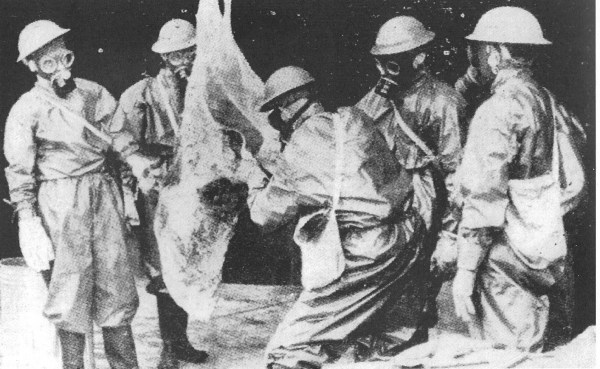

Source. TMG Pg 76. Photo MBL collection
At times during the Second World War, abattoir workers were required to carry out emergency drills. This 1943 photo shows a group of slaughtermen trimming a hindquarter of beef whilst wearing gas masks and protective clothing.
- Prices rise at Gepps Cross markets for prime stock (Pg 77)
- Area is currently affected by drought (Pg 77)
- War period seen government consider implementation of meat control prices at retail level (Pg 78)
- Curtin Federal Government ‘War strategy’ meant certain foods would be rationed (Pg 84)
- Civilian consumption of meat was to reduced by 15% (pg 83)
- Many believed rationing of meat would be preferrable (Pg 78)
- rationing would save transport
- preserve meat supplies
- reduce corruption and
- keep inflation in check
- Curtin Federal Government ‘War strategy’ meant certain foods would be rationed (Pg 84)
- February 1. Sale of third quality pig meat is restricted (Pg 80)
- Sale of fresh pork is already prohibited (Pg 80)
- To stabilise the industry the Australian Meat Industry Commission took responsibility for all surplus pig meat (Pg 80)
- Producers could continue to sell pigs at auction but prices were fixed (Pg 80)
- July 28. Commissioner of meat supplies passes a motion that compulsorily acquires one forequarter of each body of beef processed at Gepps Cross that weighs more 400 pounds or more (Pg 81)
- Compulsorily acquired meat is to be used for canning to supply Britain
- After several months bull beef is included in the restrictions
- Veal weighing 251 pounds and over is now classed as beef
- Producers are urged to market stock in a normal way to allow stock to be available for the services and canning
- September 15. Further food restrictions and rationing came into effect (Pg 84)
- Wholesalers and retail butchers were to provide, under statutory declaration amounts of sales for the previous 4 weeks prior to 01/06/1943 (Pg 84)
- % reduction was based on those figures (Pg 84)
- onus placed on the butcher to achieve objective of reduced meat use (Pg 84)
- quotas were based on the Throughput at Gepps Cross and changed weekly (Pg 86)
- 75% of meat by the butchers to be taken as fresh and 25% frozen (Pg 86)
- South Australia seemed to be singled out as similar practices were not enforced in any other state (Pg 86)
- Destroyed confidence in South Australian markets.(Pg 86)
- Sense of normality to SA markets would not return until the 1950’s (Pg 86)
- Destroyed confidence in South Australian markets.(Pg 86)
- Wholesalers and retail butchers were to provide, under statutory declaration amounts of sales for the previous 4 weeks prior to 01/06/1943 (Pg 84)
- Bacon factories were working at full capacity to process canned goods for the fighting forces and Britain had acute food shortages (Pg 84)
- To meet supply of the military civilian beef consumption was cut 40% (Pg84)
- To counter harsh reduction in beef allowed a 12.5% increase in lamb
- October 11. Fixed number of sheep and lambs allowed for sale at Gepps Cross is 23,000 head (pg 83)
- All stock to only arrive by rail
- No private deliveries were allowed or would be unloaded
- Stock above the number would not be accepted for sale
- November. Restrictions are placed on delivery of stock from some areas to limit supply as the facilities couldn’t process the animals due to a severe manpower shortage and lack of skilled slaughtermen (Pg 81)
- many workers had enlisted or joined others to work in munitions factories at Salisbury and Finsbury
- Only 60 men were operating a chain with a capacity of 71 men (Pg 83)
- Less stock was being processed and 20,000 sheep had to be railed to Victoria for slaughter (Pg 81)
1944
- Livestock numbers yarded and sold double the 1913 figures (Pg 5)
- December 13. compulsory acquisition was extended to all South Australian country meatworks (pg 81)
- Experiments are conducted in America to produce artificial meat from molasses, ammonia, water, air and yeast (Pg 81)
- Meat was to be fed to the troops
1945
- February 26. Australia is experiencing a severe drought and rationing of meat is further reduced (Pg 85)
- rationing reduced by 8.75%
- May 7 further rationing cuts of 12% (Pg 85)
- Country Butchers, previously unrestricted by quotas are also regulated (Pg 86)
- Restrictions of meat remained in place following the war with limits not removed until 24/06/1948 (Pg 85)
- May 9. VE (Victory in Europe) Day (Pg 85)
- War still continues against Japan in the Pacific
- Price fixing is put in place by the Government to place a ceiling on extremely high stock values at the time due to war and drought (Pg 85)
- Placement of a ceiling price caused considerable debate
1946
- October 1. Fixed floor pricing comes in to effect (Pg 86)
- Stock at Gepps cross are already commandeered (Pg 86)
- A great deal of uncertainty surrounded the Gepps Cross markets (Pg 86)
1948
- Works offices are relocated from in the city centre to Gepps Cross (Pg 60)
- June 24. Meat restrictions are lifted entirely (Pg 85)
1954
- March 29. South Australian government take court action to prevent a private company slaughtering stock intended for export claiming “such killings are prohibited by the Metropolitan and Export Abattoirs Act” (Pg 87)
- Noarlunga Meat Ltd had slaughtered 150 lambs to export to Britain (Pg 86)
- Noarlunga Meat were charged, argued that the Act was in conflict with Commonwealth law and therefore invalid
- Supreme court gave an opinion on point of law in 1955
- MEAB were more concerned about lose of future export business
1955
- August. MEAB v’s Noarlunga Meat – Supreme court hearing, text case (Pg 87)
- August to September a major industrial dispute last 8 weeks, occurs during the court hearing of the test case (Pg 87)
- During the dispute Noarlunga helped to supply Adelaide with Fresh meat
- Frequent industrial disputes highlighted the vulnerability of the Gepps Cross works to supply fresh meat during a crisis (Pg 86)
- Re-organisation of the Metropolitan and Export Abattoirs Act was called for
- Country meatworks were to be able to freely supply Adelaide with fresh meat
1967
- Gepps Cross facility diversifies and processes tuna (Pg 60)
- Refrigerated tanks, areas for gilling, gutting and washing facilities were installed (Pg 60)
- Fish delivered came from Port Lincoln (Pg 60)
- Processed 2,000 tonnes of fish a year (Pg 60)
- Initially supplied interestate canneries (Pg 60)
- soon after establishment exported to Japan and the US (Pg 60)
- For many years at this point Gepps Cross cold stores were the largest in the country
- Occassionally used to store other products (Pg 60)
- seed potatoes, egg pulp, polyester resin, apples, dried fruit and cheeses (Pg 60)
- One year over ripe apricots fermented and had to be cleaned up using emergency equipment (Pg 60)
- Cold stores were used exclusively for meat from the 1970’s (Pg 60)
- Occassionally used to store other products (Pg 60)
1970
- Last of the workers cottages are demolished (Pg 64)
1973


Source. TMG Pg 166. Photo. D Darlan, Primary Industries and Resources SA
This 1973 view of SAMCOR Aerial magazine shows the Gepps Cross abattoirs and markets complex before the Southern Works was built. Main North Road, looking south, is on the left of the picture and Port Wakefield road is to the right. Gepps Cross intersection is just out of view at the top of the picture. The northern cattle market, yards and sale ring were still in use and can be seen at the bottom right of the photo.
1980’s

Source. TMG. Pg 167. Photo Primary Industries and Resources SA.
This 1980’s aerial view looking south compares with the previous photo. The Southern Works complex can be seen at the top of the picture. An enlarged Southern yards cattle market complex can be seen to the right.


Source. TMG Pg 131. Photo. Frank Rocca.
The Southern Works beef chain in full operation as seen in the early 1980’s
1982
- Elders build a massive feedlot at the The Levels – entrance area to the marketing stockyards to service the live export sheep trade (pg 33)